
Brežice Castle is a historic Renaissance fortress at Cesta prvih borcev 1 in the centre of Brežice, southeastern Slovenia, close to the confluence of the Sava and Krka rivers. Its origins date to the twelfth century, when the Archbishops of Salzburg established a fortified residence to administer and protect their possessions in the Lower Sava Valley. The castle was first documented in 1249 and subsequently passed to the Habsburgs in the late fifteenth century. During the Slovenian Peasant Revolt of 1515, the medieval fortress was stormed and burned, suffering further destruction in 1528. Reconstruction began in 1531, transforming the site into a Renaissance stronghold with four substantial round corner towers, thick defensive walls and an enclosed courtyard. The castle acquired much of its present appearance during further expansion in the second half of the sixteenth century. Its military importance gradually declined, and after Count Ignaz Maria Attems acquired the property in 1694, it was converted into an aristocratic residence with elaborate Baroque interiors. The most remarkable addition was the Knights’ Hall, a 35-metre-long ceremonial room decorated between 1703 and 1704 by painter Frančišek Karl Remb. Its walls and vaulted ceiling are covered with mythological scenes inspired by Ovid’s Metamorphoses, incorporating allegories of the four classical elements: earth, water, air and fire. A monumental double staircase, decorated chapel, arcaded galleries and vaulted cellars further distinguish the building. The castle suffered considerable damage during the 1917 Brežice earthquake and was subsequently used for administrative purposes, military accommodation and residential housing. Following nationalisation in 1945, restoration work gradually returned much of its historic character. Since 1949, it has housed the Posavje Museum Brežice, with exhibitions devoted to the archaeology, history, art and ethnology of the wider Posavje region. The Knights’ Hall remains one of Slovenia’s largest and most extensively decorated surviving Baroque secular interiors.
Brežice Castle has appeared in Armour of God (1986) and Rosencrantz & Guildenstern Are Dead (1990), with both productions making extensive use of its historic Knights’ Hall. In Armour of God (1986), the room represents a European fashion-show venue where members of a mysterious religious cult kidnap Lorelei, an incident that sets the film’s main adventure in motion. Rosencrantz & Guildenstern Are Dead (1990) uses the same hall and other castle interiors to represent the royal palace of Elsinore in Denmark, providing an elaborate architectural setting for Tom Stoppard’s adaptation of his own celebrated play. Both films were international productions shot in what was then Yugoslavia, taking advantage of the region’s preserved historic architecture and established film industry.
In Armour of God (1986), Brežice Castle’s Knights’ Hall provides the setting for the fashion show attended by Lorelei, played by Rosamund Kwan, who has become a successful fashion designer since leaving the band she once shared with Jackie and Alan. The sequence takes place early in the film and is intercut with footage of Alan, played by Alan Tam, performing at a concert. Members of a mysterious religious cult have discovered that treasure hunter Asian Hawk, played by Jackie Chan, still has feelings for Lorelei and decide to use her to force him into recovering the remaining pieces of the legendary Armour of God. Armed cult members descend upon the fashion event, turning the elegant gathering into a violent attack as gunfire erupts and several people are shot. During the chaos, Lorelei is abducted and taken away by the cult. The real Knights’ Hall was used to represent the fashion-show venue, with its extensive Baroque frescoes, vaulted ceiling and grand proportions providing the background to the sudden outbreak of violence. The kidnapping establishes the film’s central conflict, as Alan subsequently seeks Jackie’s help and learns that Lorelei’s captors are demanding three pieces of the Armour of God as ransom. The Brežice sequence is separate from the monastery scenes filmed at Predjama Castle, another Slovenian location used later in the production.
In Rosencrantz & Guildenstern Are Dead (1990), Brežice Castle represents the interior of Elsinore, the Danish royal palace in which much of Shakespeare’s Hamlet takes place. Written and directed by Tom Stoppard, the film shifts attention away from Hamlet himself and instead follows two comparatively minor characters, Rosencrantz, played by Gary Oldman, and Guildenstern, played by Tim Roth. Summoned to the royal court by King Claudius and Queen Gertrude, the two men are instructed to discover the cause of Hamlet’s increasingly strange behaviour, although neither fully understands the situation into which they have been drawn. Brežice Castle’s Knights’ Hall was selected to represent the main hall of Elsinore, with its richly painted Baroque walls, vaulted ceiling and monumental staircase creating the appearance of an elaborate royal residence. Other parts of the castle, including its historic wine cellar, were also incorporated into the production. Within the palace, Rosencrantz and Guildenstern encounter Hamlet, the royal household and a travelling company of actors led by the Player, played by Richard Dreyfuss. Their conversations and increasingly bewildered attempts to understand their purpose unfold against the grand architectural surroundings, contrasting the apparent order of the royal court with the absurdity of their situation. As events from Hamlet continue around them, the two friends gradually become entangled in a conspiracy they cannot control, eventually being sent to England with a letter ordering Hamlet’s execution. Unbeknownst to them, Hamlet replaces the letter with another demanding their own deaths. The film concludes with Rosencrantz and Guildenstern accepting their seemingly inevitable fate. Principal photography took place in Yugoslavia between January and February 1990, with additional castle scenes filmed at Brezovica Castle near Zagreb. Brežice Castle was specifically selected for Elsinore’s main hall, making its Knights’ Hall one of the production’s most identifiable historic interiors.

Armour of God
Armour of God was filmed primarily in Yugoslavia (now Slovenia and Croatia) and Austria, with notable scenes shot at the Predjama Castle in Postojna, Slovenia.

Predjama Castle
Predjama Castle has appeared in Armour of God and The Witcher, with both taking advantage of its combination of medieval architecture and natural caves.

Villas Rosa dei Venti
Villas Rosa dei Venti appears in The Day of the Jackal (2024–), where it is used as the Jackal and Nuria’s home. The villa is in Rabac, Croatia.
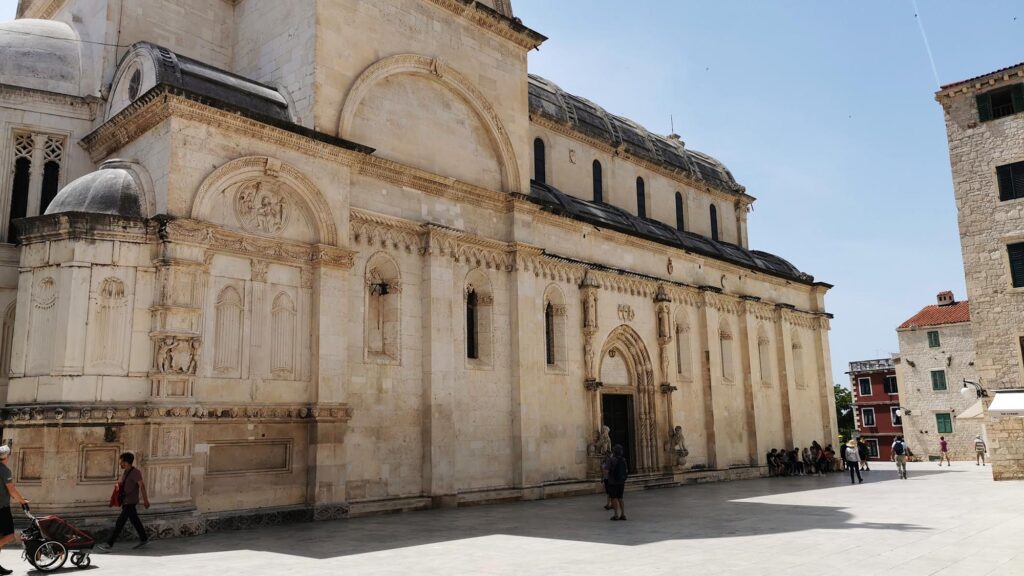
The Cathedral of St. James
The Cathedral of St. James appears in Game of Thrones, where Šibenik is used to represent parts of Braavos in season 5.
Hohenwerfen Castle
Hohenwerfen Castle is in The Sound of Music, Where Eagles Dare, Kinderarzt Dr. Fröhlich, Scarecrow and Mrs. King, Frankenstein’s Aunt, The 10th Kingdom +++.

Hotel DeMatteis
Hotel DeMatteis in Venice appears in "Spider-Man: Far From Home" as the rather disappointing hotel where Peter Parker and his classmates stay.
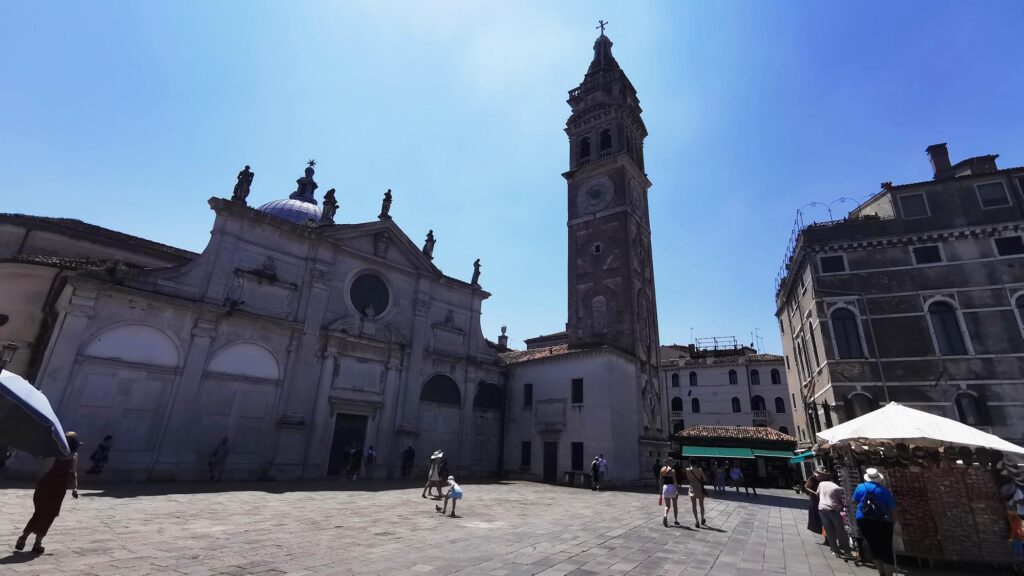
Santa Maria Formosa
Films associated with Santa Maria Formosa are A Little Romance (1979), The Wings of the Dove (1997) and Spider-Man: Far From Home (2019).

Bridge of Sighs
Bridge of Sighs appears in From Russia with Love, The Avenger of Venice, A Little Romance, A Haunting in Venice, and Madonna’s music video for “Like a Virgin”.

St. Mark’s Square
Films associated with St. Mark’s Square are Summertime, Death in Venice, A Little Romance, Moonraker, The Tourist, Inferno and Spider-Man: Far From Home.

St Mark’s Campanile
St Mark’s Campanile often appears in films as part of the wider San Marco skyline, its most direct use as a filming location is in "Nosferatu in Venice" (1988).