
Basilica Cistern, known in Turkish as Yerebatan Sarnıcı or Yerebatan Sarayı (Sunken Palace), is an enormous underground Byzantine water reservoir beneath the historic Sultanahmet district of Istanbul, Turkey, a short distance southwest of Hagia Sophia. Constructed during the reign of Emperor Justinian I in the sixth century, following the Nika riots of 532, it was designed to supply water to the Great Palace of Constantinople and surrounding imperial buildings. The structure takes its name from the large public basilica that once occupied the site above it. Measuring approximately 140 metres long and 65 metres wide, the reservoir has a capacity of around 80,000 cubic metres and is supported by 336 marble and granite columns arranged in twelve rows of twenty-eight. Most of the columns stand approximately nine metres high and were reused from earlier Roman buildings, resulting in an unusual mixture of Classical, Ionic and Corinthian capitals. Its most distinctive architectural features include two enormous carved Medusa heads used as column bases, one positioned upside down and the other on its side, whose original purpose and provenance remain uncertain. Following the Ottoman conquest of Constantinople in 1453, the reservoir continued supplying water to parts of the city, including the gardens of Topkapı Palace, before gradually falling into disuse. The French scholar Petrus Gyllius brought it to wider European attention during the 1540s after investigating reports that local residents were drawing water and catching fish through openings beneath their houses. Extensive restoration between 1985 and 1987 removed decades of accumulated sediment, exposed previously submerged architectural details and introduced raised walkways, allowing the cistern to open as a museum in 1987. A further major restoration, completed in July 2022, strengthened the historic structure against earthquakes, replaced its concrete walkways with lighter platforms and introduced a new lighting system designed to reveal the extraordinary scale of its vaulted underground interior.
Basilica Cistern has appeared in From Russia with Love (1963), The International (2009) and Brotherhood of Tears (2013), while also providing the setting for the extended climax of Inferno (2016). The location has been used for several different fictional purposes, from a secret British intelligence passage beneath Istanbul to a discreet meeting place for international arms dealers. In From Russia with Love (1963), James Bond and Kerim Bey cross the reservoir by rowing boat to reach a concealed observation post beneath the Soviet consulate. The International (2009) uses the underground chamber for a confidential meeting between a powerful banker and a Turkish weapons manufacturer, while Brotherhood of Tears (2013) incorporates it into the mysterious international courier assignments undertaken by its central character. In Inferno (2016), the cistern becomes the hiding place of a biological weapon threatening humanity, although the production recreated the historic reservoir at Korda Studios in Hungary rather than filming its principal action sequences inside the actual monument.
In From Russia with Love (1963), directed by Terence Young, Basilica Cistern appears during an extended espionage sequence involving James Bond, played by Sean Connery, and the head of British intelligence operations in Istanbul, Ali Kerim Bey, played by Pedro Armendáriz. After an assassination attempt involving a limpet mine at Kerim’s office, the two men decide to investigate whether Soviet intelligence is responsible for the attack. Kerim leads Bond through a concealed doorway behind a tapestry in his office and down a flight of steps into an enormous underground reservoir, which he incorrectly attributes to the Roman Emperor Constantine. The pair board a small rowing boat, with Kerim standing at the stern and using a single oar to guide them through the dark water between the long rows of ancient marble columns. At one point, several rats climb onto the oar, prompting Kerim to shake them back into the water. As they continue their journey, he explains that rowing through the cistern has become part of his daily exercise routine. They eventually reach a landing and enter a smaller chamber supposedly situated directly beneath the Soviet consulate. Here, Kerim reveals a concealed periscope supplied by the British Royal Navy, allowing them to observe a meeting taking place in the building above. Through the device, they identify the Bulgarian assassin Krilencu, who has been working against Kerim, and gain information about Soviet intelligence activities surrounding the Lektor cryptographic machine. The cistern returns later in the film when Bond and Tatiana Romanova, played by Daniela Bianchi, steal the Lektor from the Soviet consulate and escape through the underground passages with Kerim’s assistance. Although the film presents Basilica Cistern as directly connected to the consulate, the geography is fictional: the real former Soviet consulate is situated in Beyoğlu, across the Golden Horn from Sultanahmet. The sequence was filmed inside the actual reservoir in 1963, more than two decades before the major restoration that introduced the modern walkways, preserving an unusually extensive record of its earlier appearance.
In The International (2009), directed by Tom Tykwer, Basilica Cistern appears during the film’s final Istanbul sequence, when Interpol investigator Louis Salinger, played by Clive Owen, attempts to expose the illegal international arms-trading operations of the Luxembourg-based International Bank of Business and Credit (IBBC). After the bank’s negotiations with Italian weapons manufacturer Calvini Defense collapse, its chairman Jonas Skarssen, played by Ulrich Thomsen, travels to Istanbul to arrange an alternative deal with Turkish arms dealer Ahmet Sunay, played by Haluk Bilginer. Accompanied by former East German intelligence officer Wilhelm Wexler, played by Armin Mueller-Stahl, Skarssen meets Sunay following a funeral service. The two businessmen withdraw from their companions to conduct their negotiations privately, with Sunay leading Skarssen into the ancient underground cistern, which he presents as a remarkable place known to relatively few outsiders. Surrounded by the enormous marble columns and dimly illuminated water, they discuss the purchase of 4,200 XW-41 missile systems that require upgrading with VOLCON guidance technology. Sunay assures Skarssen that his facilities in Cyprus can complete the necessary modifications within the bank’s deadline, but their conversation becomes increasingly tense when Skarssen reveals that he knows Sunay has already supplied Israel with countermeasures capable of defeating the same weapons. This information is particularly sensitive because the IBBC intends to sell the missiles to buyers in Iran and Syria, and disclosure of their vulnerability would destroy the bank’s lucrative arrangement. Meanwhile, Salinger and Wexler have arranged for the meeting to be secretly recorded, hoping to obtain evidence that can be used to expose the deception and undermine the entire operation. The cistern provides the setting for the crucial negotiations before the story moves into Istanbul’s Grand Bazaar and the surrounding rooftops for its final confrontation, during which Skarssen is killed by an assassin working for the Calvini family. The production filmed inside the real Basilica Cistern, although the geography of the sequence is deliberately altered, presenting Süleymaniye Mosque, the Blue Mosque, the underground reservoir and the Grand Bazaar as an almost continuous series of connected spaces.
In Brotherhood of Tears (2013), originally titled La Confrérie des larmes and directed by Jean-Baptiste Andrea, Basilica Cistern provides the setting for one of the mysterious international deliveries undertaken by Gabriel Chevalier, played by Jérémie Renier. Gabriel is a former police detective struggling financially while raising his daughter Juliette alone following the death of his wife. When an old acquaintance offers him an unusually well-paid position as a courier for an anonymous organisation, he accepts despite the secrecy surrounding the arrangement. His assignments involve collecting locked suitcases and delivering them to clients in different countries, under strict instructions never to open the cases, question their contents or miss a scheduled appointment. One of these journeys brings Gabriel to Istanbul, where he descends into the Basilica Cistern to meet a mysterious contact played by Turkish actor Ali Pinar. The exchange takes place within the vast underground chamber, its repetitive marble columns, dark water and relative isolation providing a distinctive setting for the clandestine transaction. The scene is part of a wider series of deliveries that gradually takes Gabriel from Istanbul to other international destinations, including Bruges and China. Although the work initially transforms his financial circumstances, the increasingly suspicious nature of his assignments and their effect on his relationship with Juliette eventually awaken his former instincts as a police investigator, leading him to question the identity and intentions of the organisation employing him.
In Inferno (2016), directed by Ron Howard and adapted from Dan Brown’s novel, Basilica Cistern provides the setting for the film’s extended climax involving Harvard symbologist Robert Langdon, played by Tom Hanks, and a biological weapon created by billionaire geneticist Bertrand Zobrist, played by Ben Foster. Having followed a series of clues connected to Dante Alighieri through Florence and Venice, Langdon eventually reaches Istanbul, where he discovers that Zobrist’s final message points towards the so-called Sunken Palace beneath the historic city. The weapon, a genetically engineered pathogen intended to address global overpopulation through catastrophic means, has been concealed inside a plastic bag submerged in the waters of Basilica Cistern. Langdon, World Health Organization director Elizabeth Sinskey, played by Sidse Babett Knudsen, and Harry Sims, played by Irrfan Khan, arrive at the underground reservoir while an orchestral concert is taking place inside, with musicians performing on raised platforms surrounded by water. As the audience listens to the performance, WHO personnel begin searching the submerged sections of the enormous chamber, concentrating on the area around the famous Medusa-head column bases. Meanwhile, Sienna Brooks, played by Felicity Jones, who has secretly been working to fulfil Zobrist’s plans, arrives with accomplices intending to rupture the container using an explosive device. Sims confronts the conspirators but is fatally stabbed by Sienna, while Sinskey locates the biological weapon and attempts to secure it inside a specially designed containment vessel. Langdon tries to persuade Sienna to abandon her plan, but she refuses and detonates an explosive underwater, killing herself in the process. Although the blast ruptures the original container, Sinskey has successfully enclosed it within the protective vessel, preventing the pathogen from escaping into the reservoir. A final struggle breaks out when one of Sienna’s surviving accomplices attempts to open the containment unit, but the intervention of security personnel allows the weapon to be secured. While the story takes place inside Basilica Cistern, the elaborate action sequence was not filmed in the historic monument. Instead, production designer Peter Wenham supervised the construction of a large reconstruction at Korda Studios in Etyek, near Budapest, Hungary, where the extensive water sequences, orchestra platforms and explosive effects could be filmed under controlled conditions without endangering the fragile Byzantine structure.
Basilica Cistern (2025)


From Russia with Love
From Russia with Love (1963) was primarily filmed on location in Istanbul, Turkey, with significant scenes shot in Scotland, Venice, and at Pinewood Studios.

Inferno
Inferno (2016) was shot across Florence, Venice, Budapest and Istanbul, with Florence providing the most important real-world setting.

Hagia Sophia
Hagia Sophia has appeared in several international films, including "From Russia with Love" (1963), "Argo" (2012) and "Inferno" (2016).

Grand Bazaar
Grand Bazaar has appeared in From Russia with Love (1963), The International (2009), Argo (2012), Taken 2 (2012), Skyfall (2012), Inferno and Charlie’s Angels.
Capela Ghica
Capela Ghica, also known as the Ion Ghica Family Chapel, is a nineteenth-century funerary chapel within the historic Ghica estate in Ghergani,…

Peleș Castle
Peleș Castle appears in The Brothers Bloom, A Princess for Christmas, the A Christmas Prince movies, and Royal Matchmaker.

Acropolis of Athens
The Acropolis of Athens has served as a dramatic, often backdrop for several films, most notably Boy on a Dolphin (1957) and The Two Faces of January (2014).
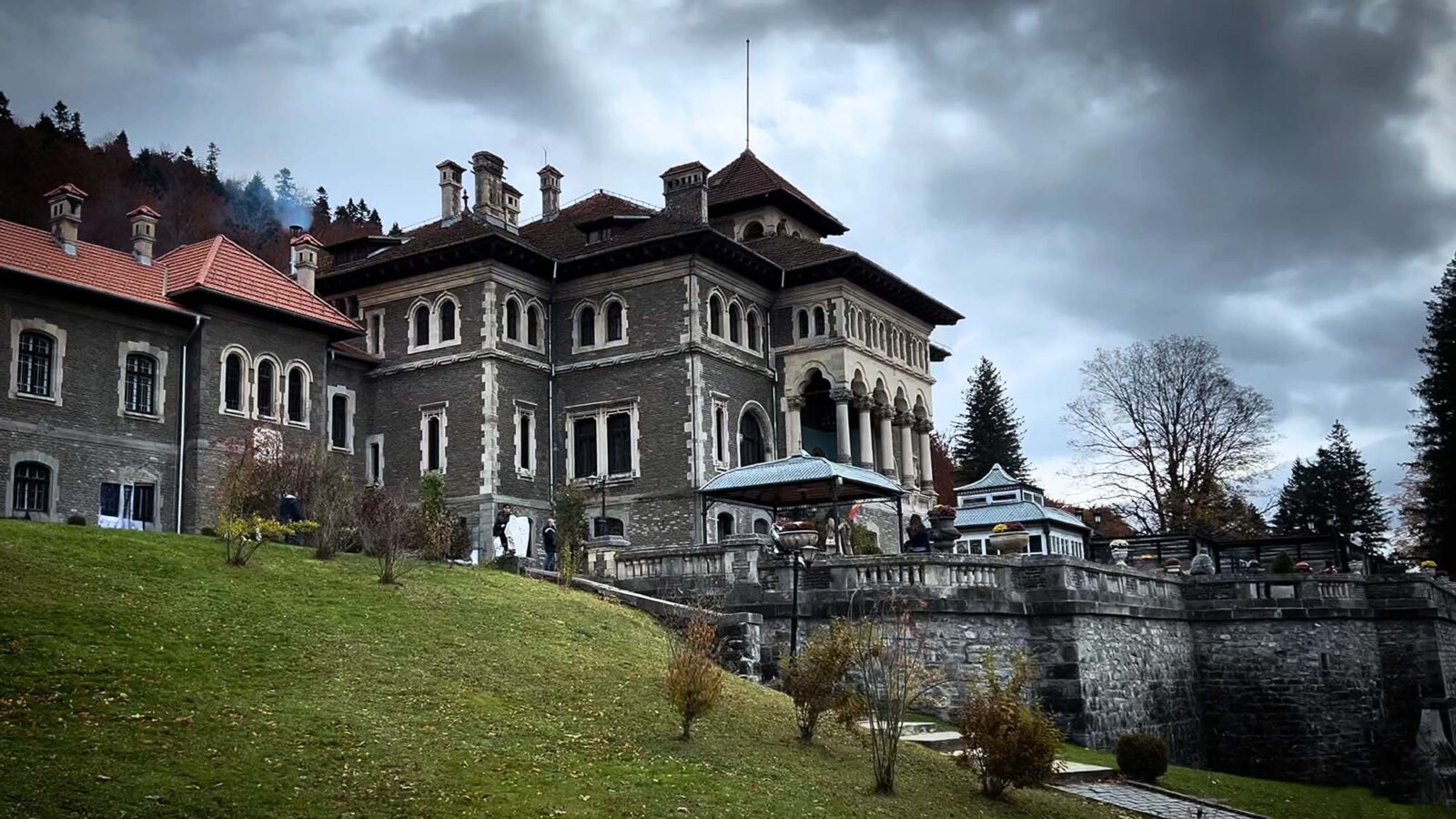
Cantacuzino Castle
Cantacuzino Castle has appeared in Wednesday (2022–), serving as the principal exterior of Nevermore Academy throughout the first season.

Bran Castle
Bran Castle appears in Old Dracula (1974) and Dracula 2012 (2013). It is also widely promoted as “Dracula’s Castle” in popular culture.

Potemkin Stairs
Potemkin Stairs is used in "Battleship Potemkin" (1925) for the legendary Odessa Steps sequence.

Monastery of the Holy Trinity
The Monastery of the Holy Trinity has appeared in Boy on a Dolphin (1957), Tintin and the Golden Fleece (1961), For Your Eyes Only (1981) and Meteora (2012).