
Capela Ghica, also known as the Ion Ghica Family Chapel, is a nineteenth-century funerary chapel within the historic Ghica estate in Ghergani, part of the town of Răcari in Dâmbovița County, Romania, approximately 40 kilometres northwest of Bucharest. It was commissioned by Ion Ghica (1816–1897), a prominent Romanian politician, diplomat, writer and five-time prime minister, as part of an extensive redevelopment of his family’s country residence. Construction began around 1869, based on Ghica’s own architectural sketches, which were subsequently developed with architect Dimitrie Berindei. Financial difficulties prolonged the project, and the chapel was not completed and consecrated until 1896, shortly before Ghica’s death. Unlike the neighbouring manor house, which was extensively influenced by Western European architecture, the chapel combines Byzantine religious traditions with early Neo-Romanian decorative elements. Its elevated main structure features a domed roof, an elaborate three-arched entrance portico supported by slender columns, ornamental stonework and a richly decorated interior. Beneath the principal floor is a funerary crypt containing the tombs of Ion Ghica, his wife Alexandrina and other members of the family. The white marble sarcophagi were commissioned in Constantinople and feature classical decoration, including carved garlands. The surrounding park also contains several family burial monuments, notably the tomb of Ghica’s daughter-in-law Irina, born Cantacuzino, created by Italian sculptor Serafino Bianchi. Following nationalisation of the estate in 1948, the neighbouring manor served various institutional functions, including a hospital, while the chapel gradually deteriorated. Both buildings suffered earthquake damage during the twentieth century before the property was eventually returned to the family’s descendants and conservation work began.
Capela Ghica has appeared in BloodRayne (2005), the vampire action-horror film directed by Uwe Boll and starring Kristanna Loken, Ben Kingsley, Michael Madsen and Michelle Rodriguez. The historic chapel is used for the residence of Leonid, a decadent vampire lord played by Meat Loaf, who provides temporary shelter for Kagan’s lieutenant Domastir after the latter kidnaps Rayne. Introduced approximately 37 minutes into the film, the location becomes the setting for an extended confrontation involving Leonid, Domastir and two members of the vampire-hunting Brimstone Society.
In BloodRayne (2005), Capela Ghica portrays the isolated residence of Leonid, played by Meat Loaf, an eccentric vampire lord who surrounds himself with women and lives a life of considerable excess. The location is introduced after Domastir, played by Will Sanderson, attacks the Solambria Monastery and captures Rayne, played by Kristanna Loken, who has recently absorbed the Eye of Beliar, one of three ancient talismans capable of granting vampires immunity to their traditional weaknesses. With daylight approaching, Domastir is forced to interrupt his journey to Kagan’s fortress and seek temporary shelter at Leonid’s residence. The historic chapel establishes the exterior of the vampire’s isolated stronghold, while the subsequent sequence introduces Leonid reclining among a group of scantily clad women. Initially willing to accommodate his visitor, Leonid becomes fascinated by the unconscious Rayne and expresses a desire to add her to his personal collection. Domastir insists that she belongs to Kagan, but his protests become increasingly ineffective when Leonid discovers that Rayne possesses the Eye of Beliar. Deciding that such a valuable prize should remain with him, Leonid orders Domastir detained and prepares to claim Rayne for himself. Meanwhile, Brimstone members Vladimir, played by Michael Madsen, and Sebastian, played by Matthew Davis, have followed Domastir to the property. They silently eliminate the guards outside before entering the residence to rescue their captive companion. The situation rapidly develops into a violent confrontation when Leonid refuses to surrender Rayne and attacks her. Vladimir eventually covers Rayne with a blanket and shoots out the windows, allowing daylight to penetrate the vampire’s sanctuary and destroy Leonid and his followers. The rescuers subsequently escape with Rayne and take her to the headquarters of the Brimstone Society. The extended sequence transforms the real nineteenth-century Ghica funerary chapel into a vampire’s residence, providing a particularly unusual contrast between the building’s original religious purpose and its fictional use in the film.

Peleș Castle
Peleș Castle appears in The Brothers Bloom, A Princess for Christmas, the A Christmas Prince movies, and Royal Matchmaker.
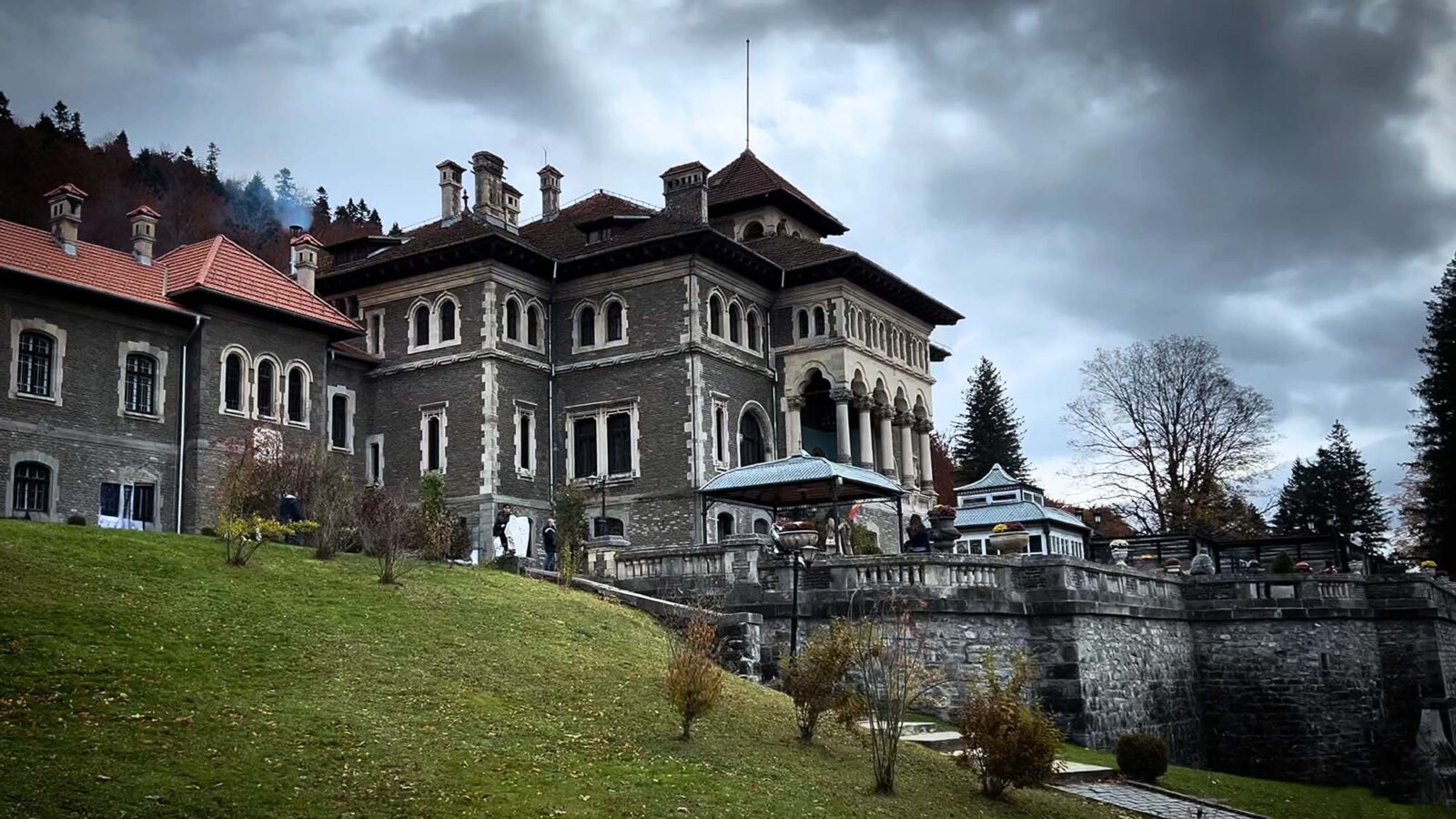
Cantacuzino Castle
Cantacuzino Castle has appeared in Wednesday (2022–), serving as the principal exterior of Nevermore Academy throughout the first season.

Bran Castle
Bran Castle appears in Old Dracula (1974) and Dracula 2012 (2013). It is also widely promoted as “Dracula’s Castle” in popular culture.

Saschiz Fortified Church
Saschiz Fortified Church appears in Elvira’s Haunted Hills (2001). Only part of the building is visible on screen.

Corvin Castle
Corvin Castle is in BloodRayne, Ghost Rider: Spirit of Vengeance, Fright Night 2, Singh Is Bliing, Dragonheart: Battle for the Heartfire, The Nun and Nosferatu.

Potemkin Stairs
Potemkin Stairs is used in "Battleship Potemkin" (1925) for the legendary Odessa Steps sequence.

Grand Bazaar
Grand Bazaar has appeared in From Russia with Love (1963), The International (2009), Argo (2012), Taken 2 (2012), Skyfall (2012), Inferno and Charlie’s Angels.

Basilica Cistern
Basilica Cistern has appeared in From Russia with Love, The International and Brotherhood of Tears. It is also strongly associated with Inferno.

Hagia Sophia
Hagia Sophia has appeared in several international films, including "From Russia with Love" (1963), "Argo" (2012) and "Inferno" (2016).