
Back to the Future Part II is a 1989 American science-fiction adventure comedy directed by Robert Zemeckis and the second instalment in the Back to the Future trilogy. Michael J. Fox returns as Marty McFly, who travels with eccentric inventor Doc Brown (Christopher Lloyd) to the year 2015 to prevent a disaster involving his future children. Their intervention allows an elderly Biff Tannen (Thomas F. Wilson) to steal the DeLorean and deliver a sports almanac to his younger self in 1955, creating an alternative 1985 in which Biff has become a wealthy and powerful businessman. Marty and Doc must return to 1955 to restore the original timeline without interfering with the events of the first film. The film also stars Lea Thompson, Elisabeth Shue and James Tolkan.
Back to the Future Part II (1989) was filmed around Los Angeles, including Universal Studios and locations in El Monte, Whittier, Monrovia and South Pasadena. Principal photography took place between February and August 1989, with filming continuing directly into Back to the Future Part III (1990). The production returned to several locations used in the original film, including Courthouse Square at Universal Studios, the McFly residence in Arleta and Whittier High School. Other locations around Southern California represented the futuristic residential neighbourhood of Hilldale, the damaged streets of an alternative 1985 and various parts of Hill Valley in 1955. The different versions of Hill Valley required extensive reconstruction of the existing studio backlot, particularly its courthouse, shops and central square.
The opening scene returns to the McFly family home at 9303 Roslyndale Avenue in Arleta, in the San Fernando Valley. The same house had appeared in Back to the Future (1985), and the sequel recreates the original film’s ending, in which Doc Brown suddenly arrives in his flying DeLorean and urges Marty and Jennifer to accompany him into the future. Elisabeth Shue replaced Claudia Wells as Jennifer, requiring the scene to be filmed again rather than simply reusing the original footage. The modest single-storey house and its driveway are clearly visible as Doc lands the DeLorean outside and explains that something must be done about Marty and Jennifer’s future children. The house also appears later when Marty returns to the altered 1985 and discovers that the property is occupied by an entirely different family.
The centre of Hill Valley was once again filmed at Courthouse Square, the permanent town set at Universal Studios in Universal City. For the scenes set in 2015, production designer Rick Carter transformed the familiar square into a futuristic shopping and entertainment district while retaining the courthouse and its clock tower. The parking area seen in the original film was replaced with a landscaped plaza containing trees, waterfalls and a large artificial pond. A section measuring approximately 60 by 80 feet was excavated and filled with more than 80,000 gallons of water, creating a feature above the fictional underground shopping centre. The courthouse itself became the entrance to the Courthouse Mall, with its clock still stopped at 10:04 following the lightning strike of 1955.
The redesigned square appears when Marty arrives in 2015 and begins exploring the unfamiliar town. He passes futuristic businesses, including the Café 80’s, where he encounters Griff Tannen, Biff’s grandson, and is drawn into a confrontation with Griff and his gang. The café was created within the Universal Studios town set, as were the surrounding shops and streets. The encounter leads to a hoverboard chase through the square, with Marty escaping across the artificial pond while Griff and his companions crash into the courthouse entrance. Other buildings on the backlot were adapted into futuristic businesses, including the former Essex Theatre, which advertises the fictional film Jaws 19 using a three-dimensional shark display. The same courthouse and surrounding façades had represented Hill Valley in 1955 and 1985 in the original film.
Another important location from the 2015 sequences is Hilldale, the residential development where the older Marty and Jennifer live with their children. The exterior scenes were filmed in the Arbor Oaks neighbourhood of El Monte, particularly around the intersection of Somerset Street and Oakhurst Street. Doc parks the DeLorean near the entrance while Marty prepares to investigate the future of his family. The neighbourhood also appears when the elderly Biff takes advantage of Doc and Marty’s absence to steal the time machine and travel back to 1955. The residential streets were dressed with futuristic vehicles and signs to represent the supposedly deteriorating suburb.
The future McFly residence is a house at 3793 Oakhurst Street in El Monte. It appears when two police officers discover Jennifer unconscious and return her to the address recorded in their computer system, unaware that she is actually the younger version of the woman who lives there. The officers carry Jennifer into the house, where she encounters the older members of the McFly family and learns about the life she will share with Marty. The interior scenes include the futuristic kitchen, where the family prepares a dehydrated pizza, and the living room where Marty receives a video call from his employer. The sequence also features a wedding photograph of Marty and Jennifer standing outside the fictional Chapel O’ Love in Las Vegas. The photograph was taken at a small wedding chapel on North Avon Street in Burbank.
After Marty and Doc return to 1985, they discover that Biff has transformed Hill Valley into a corrupt and dangerous city. Courthouse Square was extensively modified again to represent this alternative timeline, with many of the familiar businesses replaced by adult entertainment establishments, bars and gambling facilities. The production actually filmed these scenes before constructing the more elaborate 2015 version of the square. According to Carter, the schedule required the designers to complete the deteriorated town first, then remove its signs, decorations and damaged architectural features within a few weeks to prepare the futuristic version. The transformation allowed the same buildings to represent the different consequences of Biff’s interference with history.
The most prominent addition to the alternative Hill Valley is Biff Tannen’s Pleasure Paradise Casino & Hotel, constructed around the former courthouse. Its enormous tower was based on the Plaza Hotel & Casino at 1 South Main Street in Las Vegas, Nevada. Rather than constructing a full-sized hotel on the Universal Studios backlot, the filmmakers created a scale model approximately nine feet tall and combined it with footage of the courthouse and surrounding streets. The original building’s clock tower remains incorporated into the fictional hotel, with enormous neon signs and decorative structures concealing much of its former appearance. The casino entrance and surrounding square appear when Marty arrives to investigate Biff’s wealth, and the interior becomes the setting for his confrontation with the older Biff, who reveals how he obtained the sports almanac.
The casino’s staircase was filmed at the Hilton Universal City hotel, at 555 Universal Hollywood Drive, close to Universal Studios. The production used the stairwell of the hotel’s parking garage for the sequence in which Marty escapes Biff’s henchmen and makes his way towards the roof. Biff follows him and eventually corners him high above the city, where Marty appears to fall from the building before Doc arrives in the flying DeLorean and rescues him. The casino sequence therefore combines the Universal Studios town set, the Hilton’s existing architecture and constructed sets for the hotel’s upper levels.
Several residential locations around Los Angeles were used to establish the effects of Biff’s alternative timeline. After returning from 2015, Doc and Marty leave the unconscious Jennifer outside her family home at 161 North Magnolia Avenue in Monrovia. The property, a two-storey house dating from the early twentieth century, appears as they place Jennifer on the front porch before continuing towards Marty’s neighbourhood. Their journey then takes them through the entrance to Lyon Estates, filmed at the intersection of Kagel Canyon Street and Sandusky Avenue in Arleta. The location had previously appeared in the original film, but now the surrounding area is depicted as increasingly rundown and dangerous.
Marty’s attempts to understand the altered world take him to Bailey Street in Whittier, where he encounters his former school principal, Mr Strickland (James Tolkan). The house at 12511 Bailey Street was used as Strickland’s residence, with the porch and front garden appearing when Marty approaches to read a discarded newspaper. Strickland emerges carrying a shotgun, believing Marty is trying to steal his newspapers, but their confrontation is interrupted when a passing vehicle opens fire on the house. The street scenes also feature Whittier High School in the background, with the school building visible at the end of the road. The two properties are close together in reality, even though the film presents the school and Strickland’s home as separate parts of Hill Valley.
Another location from the alternative 1985 is Oak Park Cemetery, where Marty discovers that his father George McFly was murdered in 1973. The cemetery was not a functioning burial ground but a temporary set constructed on land belonging to an oil refinery at 2402 East Anaheim Street in Wilmington, in the industrial harbour area of Los Angeles. The filmmakers placed gravestones and cemetery landscaping on an open section of the property, with the surrounding oil tanks and industrial structures providing the background. The cemetery appears as Marty visits George’s grave and struggles to understand how drastically the family’s history has changed. Doc subsequently arrives and explains the consequences of Biff receiving the sports almanac. The cemetery set was removed after filming, and the site has since undergone further industrial development.
For the return to 1955, the production used a mixture of recreated studio sets and locations from the first film. One of these was the undeveloped land representing the future Lyon Estates neighbourhood, filmed near Cucamonga Avenue in Chino, east of Los Angeles. Marty and Doc conceal the DeLorean behind the large Lyon Estates entrance sign while discussing how to recover the almanac from the younger Biff. The open terrain represents the same suburban development that becomes Marty’s residential neighbourhood in 1985, decades before its houses have been constructed.
The home of Biff’s grandmother, Gertrude Tannen, was filmed at 1809 Bushnell Avenue in South Pasadena. The house appears when the elderly Biff arrives in 1955 and approaches his younger self, who lives with his grandmother. Marty watches as the two versions of Biff meet and the older man attempts to convince his teenage counterpart that the sports almanac contains information that can make him enormously wealthy. The sequence also includes young Biff stealing a ball from children and throwing it onto a neighbouring porch at 1803 Bushnell Avenue. Although much of the footage was filmed on Bushnell Avenue, the production combined it with shots of a house on Universal Studios’ Colonial Street backlot. The location consequently appears to be part of one continuous residential street even though some of the buildings were filmed miles apart. The Bushnell Avenue house is also close to the properties used for George McFly and Lorraine Baines in the first film.
Whittier High School at 12417 East Philadelphia Street in Whittier again represented Hill Valley High School during the 1955 sequences. Marty follows Biff through the school grounds and corridors while attempting to recover the sports almanac without attracting the attention of his younger parents or his other self. Several scenes were filmed around the building’s eastern entrance, off Whittier Avenue, including the moments when Biff arrives for the school dance and when the almanac changes hands. The production returned to the same school used in Back to the Future (1985), recreating the appearance of Hill Valley High as it had been established four years earlier.
The Enchantment Under the Sea dance was also reconstructed at its original filming location, the gymnasium of Hollywood United Methodist Church at 6817 Franklin Avenue in Hollywood. The production restored the elaborate underwater decorations, stage and dance-floor arrangements from the first film, using photographs and original footage to reproduce the earlier scenes as accurately as possible. Several of the original background performers returned, allowing the filmmakers to recreate the school dance from a different perspective. Marty moves through the event attempting to retrieve the almanac from Biff while avoiding contact with the younger version of himself, who is preparing to perform “Johnny B. Goode” on stage. Portions of the original film’s dance scenes were recreated with new camera angles, allowing events previously shown in Back to the Future (1985) to appear alongside Marty’s new actions.
One of the sequel’s most recognisable new locations is the Mount Hollywood Tunnel in Griffith Park, Los Angeles. The short road tunnel lies on Mount Hollywood Drive, near the approach to Griffith Observatory, and appears as the fictional River Road Tunnel outside Hill Valley. It is first seen when Marty hides in the back of Biff’s car as he drives towards the school dance, attempting to learn where the almanac has been taken. Later, the tunnel becomes the setting for the final pursuit between Marty and Biff. Marty follows Biff’s car on a hoverboard and attempts to retrieve the almanac while Biff repeatedly tries to run him down. The surrounding wooded road and tunnel entrances were photographed on location, while the tunnel itself was visually extended to make the chase appear to take place over a greater distance. The same tunnel had previously appeared in WarGames (1983) and Who Framed Roger Rabbit (1988).
The film returns to Courthouse Square for its final 1955 scenes, which take place simultaneously with the clock tower sequence from the original film. Marty must avoid interfering with his earlier self as Doc prepares the DeLorean for its journey back to 1985. The filmmakers recreated the square’s 1955 appearance and repeated several shots from the first film, including the lightning strike that sends the original Marty into the future. Director of photography Dean Cundey later recalled that the returning crew used their memories of the original production to reproduce individual lighting arrangements, including the placement of lights and filters around the courthouse entrance. The sequence ends when lightning strikes the flying DeLorean, sending Doc back to 1885 and leaving Marty stranded in 1955. The film then returns to the courthouse, where Marty approaches the younger Doc immediately after he has sent the first Marty back to 1985.
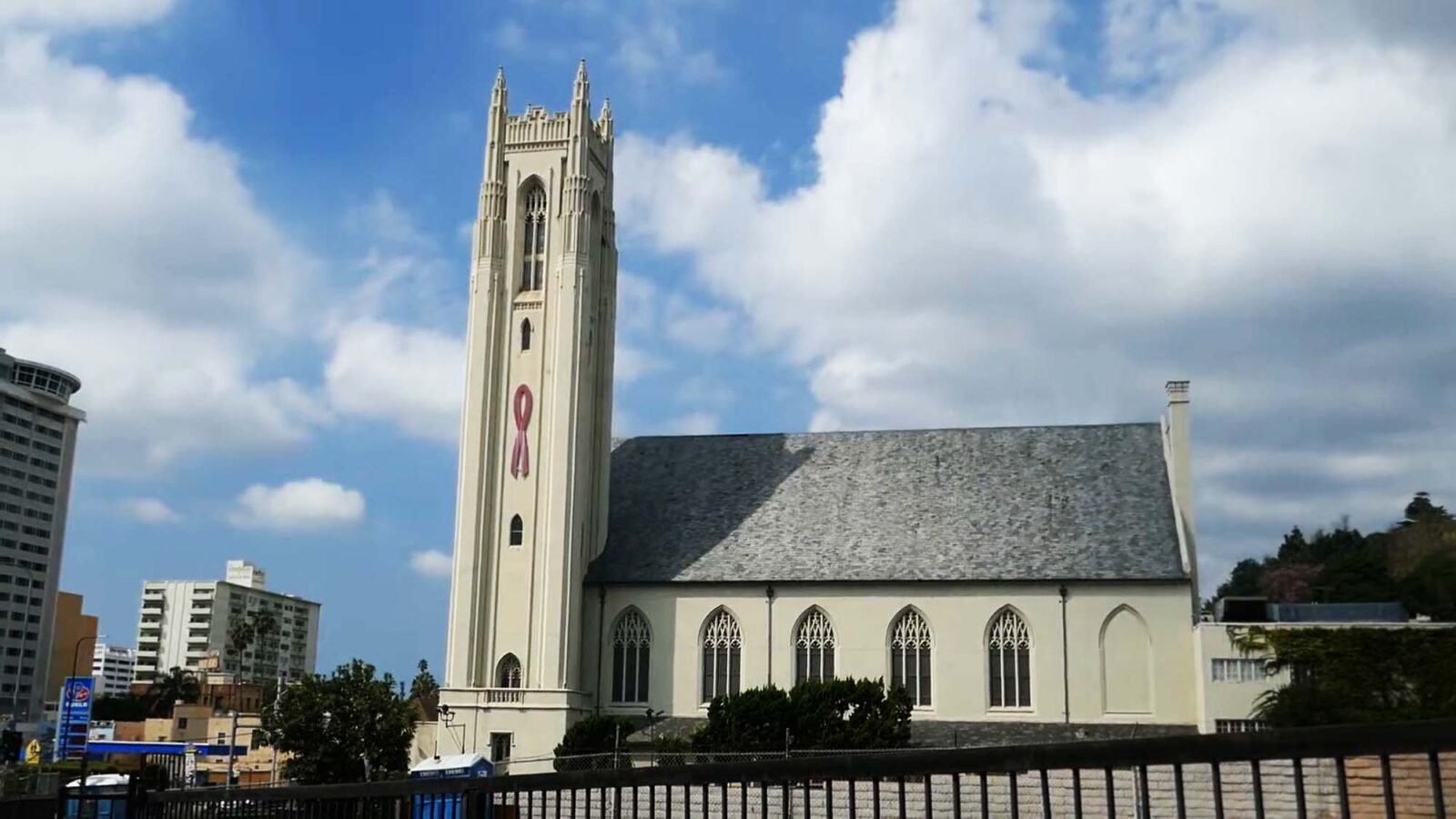
Hollywood United Methodist Church
Hollywood United Methodist Church is in What Price Hollywood?, Imitation of Life, Back to the Future, Back to the Future Part II, Sister Act and many more.

Whittier High School
Whittier High School is best known from "Back to the Future" (1985) and "Back to the Future Part II" (1989), where it appears as Hill Valley High School.