
The Devil Rides Out (1968), released in the United States as The Devil’s Bride, is a British supernatural horror film directed by Terence Fisher for Hammer Film Productions. Adapted by American screenwriter Richard Matheson from Dennis Wheatley’s 1934 novel, the film stars Christopher Lee as Nicholas, Duc de Richleau, an aristocrat with extensive knowledge of the occult who discovers that his young friend Simon Aron, played by Patrick Mower, has become involved with a Satanic cult. Together with his American friend Rex Van Ryn, played by Leon Greene, he attempts to rescue Simon and the mysterious Tanith Carlisle, portrayed by Niké Arrighi, from the influence of the cult’s leader, Mocata, played by Charles Gray. Sarah Lawson and Paul Eddington also appear as Marie and Richard Eaton, whose country house becomes the setting for a terrifying confrontation with supernatural forces. The film was unusual for Hammer in casting Lee as the hero rather than the villain, and became one of his personal favourites. Its combination of ritual magic, country-house settings and elaborate supernatural effects established it as one of the studio’s most distinctive occult horror productions.
The Devil Rides Out was filmed entirely in England between 7 August and 29 September 1967, with location work in Hertfordshire, Buckinghamshire, Bedfordshire and the northwest London area. Although Hammer is closely associated with Bray Studios in Berkshire, this production was based at Elstree Studios in Borehamwood, where the company had begun making several films following its departure from Bray. The filmmakers used a collection of real country houses, private estates, rural roads and woodland locations, with the principal interiors and supernatural sequences completed on soundstages. Among the most important locations were the Edgwarebury Hotel in Elstree, High Canons near Borehamwood and Black Park in Buckinghamshire. Additional filming took place at Panshanger Aerodrome, Grims Dyke House and the village of Milton Bryan.
The film begins with the Duc de Richleau meeting Rex Van Ryn at an airfield, where they discuss their concerns about their mutual friend Simon. This scene was filmed at Panshanger Aerodrome, situated east of Welwyn Garden City in Hertfordshire. The airfield had been established during the 1930s and was used for military training during the Second World War before becoming a centre for private aviation. Its modest buildings and open surroundings provided a convincing setting for the arrival of Rex’s aircraft. The original control tower has since been demolished, and the airfield ceased operations in September 2014. The location was identified by film-location researchers through comparisons of the surviving buildings with the opening scene. Panshanger was also used for other British productions, including The Abominable Dr. Phibes (1971).
The early investigation takes the two men to a country house where Simon has gathered a mysterious group of acquaintances. What initially appears to be an ordinary social occasion becomes increasingly suspicious when the visitors discover an elaborate observatory and evidence of occult rituals. The production used High Canons, a large country house on Buckettsland Lane in Well End, north of Borehamwood, for the estate associated with Mocata and his followers. The building stands at the end of a long private driveway, approached through a distinctive entrance gate and surrounded by mature trees. Its imposing façade and pillared entrance are visible when Rex watches Mocata and Simon emerge from the house before departing with other members of the cult. The entrance gate also appears during the investigation. High Canons became a familiar filming location and was later used in several productions, including Murder on the Orient Express (1974), The Satanic Rites of Dracula (1973) and To the Devil a Daughter (1976).
The rural roads around Borehamwood and Elstree were used extensively during the pursuit of Tanith, who attempts to escape while under Mocata’s influence. Rex follows her through the countryside, but his journey becomes increasingly dangerous as supernatural forces interfere with his driving. At one point, his windscreen turns completely opaque, while a mysterious fog later causes him to crash. The filmmakers combined actual road footage with studio scenes using rear projection, allowing the actors to perform inside stationary vehicles while previously recorded images of the countryside were projected behind them. Second-unit director Christopher Neame supervised much of the car-chase filming, which reportedly involved several mishaps, including a vehicle accident and a camera being run over. The production also used country lanes familiar from the television series The Avengers, which frequently filmed in the same area during the 1960s.
One of the rural locations identified by Reelstreets is Milton Bryan, a small village in Bedfordshire. A shot showing the characters travelling through a picturesque English village includes the historic Red Lion public house beside the road. The building and surrounding streets were identified through comparisons with the film, and the location was revisited by researchers more than fifty years after the production. The scene is relatively brief, but it is a good example of how Hammer used ordinary villages and country roads to establish a convincing English landscape without requiring extensive sets or alterations.
The film’s most elaborate outdoor sequence was photographed in Black Park, a large woodland area in Buckinghamshire adjoining Pinewood Studios. The park had already become a favourite location for Hammer, having appeared in productions including The Brides of Dracula (1960), and its dense woodland was well suited to the film’s nocturnal Satanic gathering. Rex discovers the cult assembling in a forest clearing and summons the Duc de Richleau, who recognises the ceremony as an attempt to initiate Simon and Tanith into the group. The scene involves a large gathering of robed participants, ritual fires, the sacrifice of a goat and the eventual appearance of a horned supernatural figure known as the Goat of Mendes. The Duc and Rex interrupt the ritual by driving directly into the gathering with their headlights blazing, allowing them to rescue Simon and Tanith.
Filming the Black Park ceremony was more difficult than the finished sequence suggests. Much of the work took place at night, with actors and extras required to move through muddy woodland while wearing ceremonial costumes. The production used smoke, artificial lighting and carefully positioned fires to illuminate the clearing. The Goat of Mendes was portrayed by stunt performer Eddie Powell, wearing a specially constructed mask created by Hammer make-up artist Roy Ashton. The creature’s appearance required a combination of prosthetic make-up, costume design and visual effects to create the impression of a demonic being materialising before the cult. Contemporary accounts of the production describe the difficulties of controlling the large group of performers and maintaining the elaborate arrangement of the ritual during the night shoot.
After rescuing Simon and Tanith, the Duc takes them to the country home of Richard and Marie Eaton. The exterior of the house was filmed at the Edgwarebury Hotel on Barnet Lane in Elstree, a distinctive half-timbered building with steep gables, white plasterwork and dark wooden beams. Originally known as the Elstree Country Club, the building later operated as the Edgwarebury Hotel and subsequently became The Manor. It appears repeatedly throughout the film, particularly when the characters arrive or depart in their cars. The broad driveway, front lawn and entrance are recognisable in several sequences, and the building’s Tudor-style appearance provides a convincing setting for the wealthy English household.
Edgwarebury is particularly important because the house becomes the centre of the film’s supernatural conflict. Mocata arrives and attempts to persuade Marie Eaton to surrender Simon and Tanith, using hypnotic powers when she refuses. The Duc subsequently prepares a protective circle inside the house, instructing the others to remain within it throughout the night, regardless of what they see or hear. What follows is one of the film’s most famous sequences, as the group is confronted by terrifying apparitions, including a giant spider and the skeletal Angel of Death riding a black horse. Although the building’s exterior is the actual Edgwarebury Hotel, the elaborate drawing room and the confrontation inside the protective circle were filmed on a specially constructed set at Elstree Studios. Production designer Bernard Robinson recreated the appearance of an affluent country-house interior while providing the space required for the supernatural effects and camera equipment.
The distinction between the real house and its studio recreation is particularly interesting because the film repeatedly moves between the two without an obvious visual break. Outdoor scenes show characters arriving at the genuine entrance, while the action continues inside a room designed specifically for Fisher’s carefully arranged shots. The protective circle sequence depended on precise blocking, with the actors remaining inside a relatively small area while the supernatural manifestations appeared around them. Robinson’s set allowed furniture and lighting to be adjusted for the different attacks, while the effects technicians could introduce the spider, smoke and other elements without risking damage to a historic building.
The Angel of Death proved especially troublesome to film. The skeletal rider was portrayed using a combination of costume, make-up, a real horse and optical effects. Roy Ashton created the skull-like mask, while special-effects technician Les Bowie supervised the creature’s appearance. According to production accounts, the horse was old and difficult to control, and the artificial wings attached to it fell off during an early attempt to film the scene. The crew struggled to obtain the dramatic movements required, eventually relying on editing and visual effects to give the rider its supernatural appearance. The resulting sequence became one of the film’s most frequently discussed effects, admired for its ambition but also criticised for the limitations of the techniques available at the time.
Another country-house location associated with The Devil Rides Out is Grims Dyke House on Old Redding in Harrow Weald, northwest London. The large Victorian residence was designed by architect Richard Norman Shaw for the painter Frederick Goodall and completed in 1872. It later became the home of dramatist W. S. Gilbert, one half of the celebrated Gilbert and Sullivan partnership. By the 1960s, the house was being used regularly for film and television production, particularly because of its Gothic-influenced architecture and extensive wooded grounds. Its use in The Devil Rides Out is documented in Hammer filming-location records, although the precise scene has not been as firmly established as those at Edgwarebury and High Canons. The property also appeared in The Blood Beast Terror (1968), The Curse of the Crimson Altar (1968) and the Doctor Who serial The Evil of the Daleks (1967). It was converted into a hotel in 1970.
The main studio work took place at Elstree Studios on Shenley Road in Borehamwood, rather than at Hammer’s former base at Bray. Production designer Bernard Robinson was responsible for the film’s elaborate interiors, including Simon’s observatory, the Eaton drawing room and other spaces needed for the occult confrontations. The observatory was particularly important during the early scenes, with its astronomical equipment, polished floor and hidden occult symbols revealing the true nature of Simon’s supposed scientific interests. The studio sets also allowed the filmmakers to stage scenes involving fire, apparitions and other effects that would have been difficult to achieve inside the real country houses. Cinematographer Arthur Grant photographed the film in Technicolor, while composer James Bernard provided the dramatic orchestral score.
The production brought together several experienced Hammer technicians, including make-up artist Roy Ashton and special-effects supervisor Michael Stainer-Hutchins. Many of the supernatural manifestations relied on optical compositing, with separately photographed images combined to make figures appear within the same room as the actors. Some of the results proved technically difficult, particularly the giant spider and the Angel of Death. The driving sequences also used rear projection to create the illusion of characters travelling along country roads while supernatural forces interfered with their vehicles. These effects have become an important part of the film’s visual character, even if some have dated more noticeably than Fisher’s direction and Robinson’s sets.
The film also has a direct connection to its original author. On 15 September 1967, Dennis Wheatley visited Elstree Studios while The Devil Rides Out was in production. He met Christopher Lee, Terence Fisher and producer Anthony Nelson Keys on the set, before continuing to another Hammer production, The Lost Continent (1968), also adapted from one of his novels. Wheatley was reportedly so pleased with the completed adaptation that he presented Lee with a first edition of The Devil Rides Out. Lee later described the film as one of his personal favourites and expressed interest in seeing it remade with more advanced special effects.
Released in Britain in July 1968, The Devil Rides Out remains one of Hammer’s most distinctive supernatural films, partly because it replaces the studio’s familiar castles and Gothic monsters with an occult conspiracy unfolding in recognisable English surroundings. The real locations contribute considerably to its atmosphere, from the peaceful country houses of Hertfordshire to the isolated woodland clearing at Black Park. Several of these properties have long histories as filming locations, while others, including Panshanger Aerodrome, have since been closed or altered. The combination of actual locations, elaborate studio interiors and practical supernatural effects demonstrates how Hammer created a convincing world of black magic using the English countryside and the production facilities available during the late 1960s.
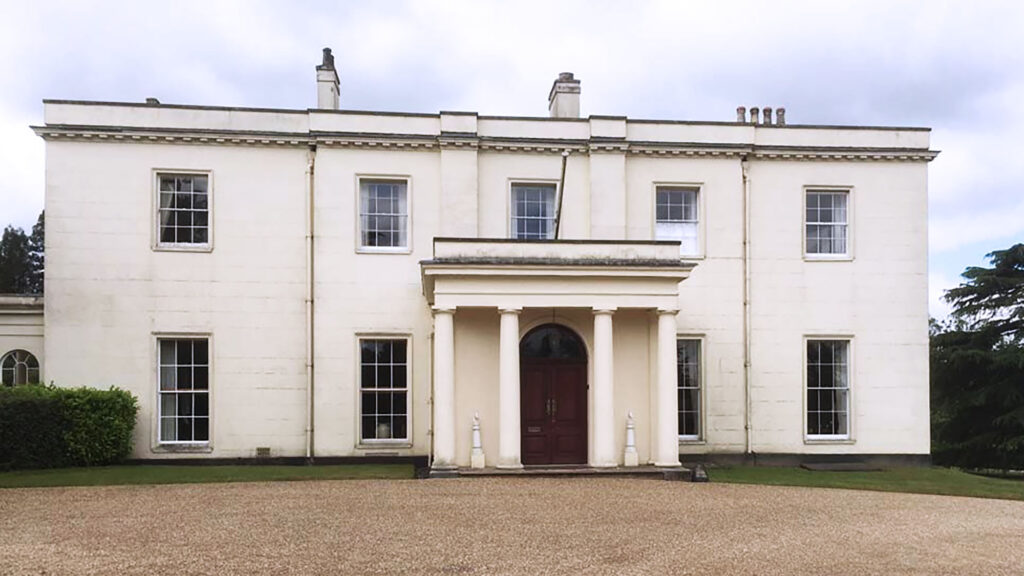
High Canons
High Canons appears in The Devil Rides Out, The Satanic Rites of Dracula, Murder on the Orient Express, Half Moon Street, and many more.
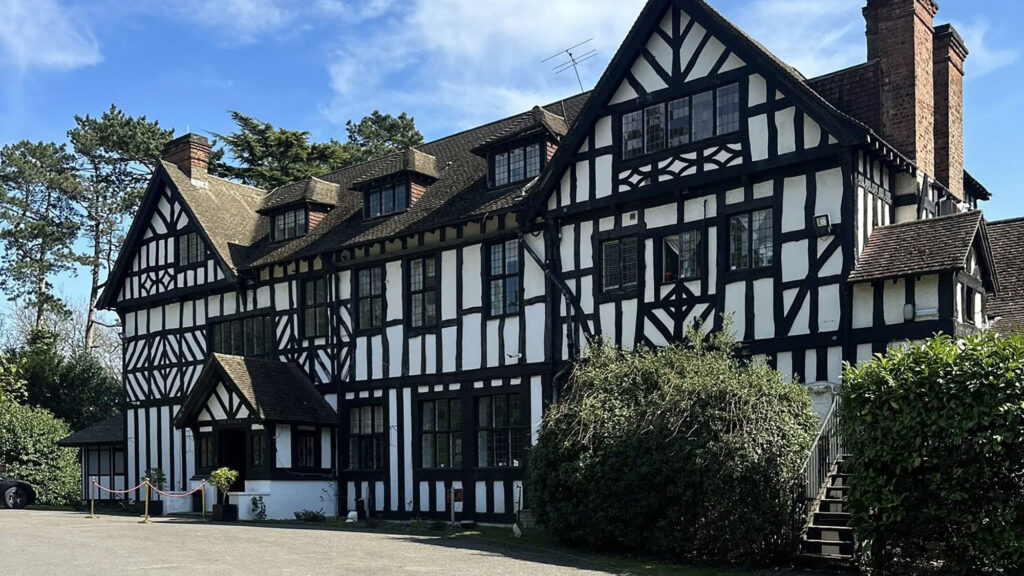
The Manor Elstree
The Manor Elstree is in School for Scoundrels, The Avengers, The Devil Rides Out, A Clockwork Orange, Dracula, Stardust, Hot Fuzz, and many more.