
Diamonds Are Forever (1971) is a British spy film directed by Guy Hamilton and the seventh instalment in the James Bond series produced by Eon Productions. Sean Connery returns as James Bond after George Lazenby’s appearance in On Her Majesty’s Secret Service (1969). Investigating an international diamond-smuggling operation, Bond assumes the identity of criminal Peter Franks and follows the stolen gems from Amsterdam to Las Vegas, where the trail leads to reclusive billionaire Willard Whyte and his mysterious business empire. Jill St. John plays diamond smuggler Tiffany Case, Charles Gray portrays Ernst Stavro Blofeld, Jimmy Dean appears as Willard Whyte, and Lana Wood plays Plenty O’Toole. The film also introduces the eccentric assassins Mr. Wint and Mr. Kidd, played by Bruce Glover and Putter Smith. Loosely adapted from Ian Fleming’s 1956 novel, the film moves away from the darker atmosphere of its predecessor towards a mixture of espionage, comedy and elaborate action sequences. Its best-known moments include the moon buggy escape, the Ford Mustang chase through Las Vegas and Shirley Bassey’s title song.
Diamonds Are Forever was filmed in the United States, the Netherlands, England, France and West Germany, with much of the location work taking place in Nevada and California. Principal photography began on 5 April 1971 in the Nevada desert, which was used to represent South Africa during the early diamond-smuggling sequences. Production subsequently moved to Las Vegas, where several famous hotels and casinos were used during a period of rapid expansion in the city’s history. Producer Albert R. Broccoli’s friendship with billionaire Howard Hughes proved particularly valuable, as Hughes owned several Las Vegas properties and helped the filmmakers secure permission for filming in the city. Some of its busiest streets were closed overnight for the elaborate car chase, while hotel interiors, casinos and other public areas remained recognisable on screen. Additional filming took place in Amsterdam, Palm Springs, Los Angeles and the English countryside, with extensive interior sets constructed by production designer Ken Adam at Pinewood Studios.
The film’s opening sequence follows Bond as he searches for Blofeld, questioning people in several locations before discovering a secret facility where his enemy is creating doubles of himself. Part of this sequence was filmed on the French Riviera at Cap d’Antibes, near the Hôtel du Cap-Eden-Roc. Bond encounters a woman on the beach and demands information about Blofeld’s whereabouts. The scene features Denise Perrier, who had been crowned Miss World in 1953. Connery travelled to France in July 1971 for a single day of filming after completing much of his work in Britain. The surrounding Mediterranean coastline provides one of the few traditionally glamorous European settings in a film otherwise dominated by casinos, desert landscapes and industrial facilities.
The diamond-smuggling investigation takes Bond to Amsterdam, where he adopts the identity of Peter Franks and makes contact with Tiffany Case. Before arriving in the Netherlands, Bond is shown travelling through the hovercraft terminal at Dover in Kent. The Dover hoverport had opened only a few years earlier, in 1968, and the film features one of the enormous cross-Channel hovercraft operated between England and France. The terminal has since disappeared following the closure of the hovercraft service in 2000. The film also includes scenes filmed in the customs and transport facilities associated with Dover, providing a brief record of a form of international travel that was considered technologically advanced at the time.
In Amsterdam, the filmmakers made use of the city’s historic canals and narrow streets. One of the first recognisable locations is Magere Brug, the famous wooden drawbridge across the Amstel River. A sightseeing boat passes beneath the bridge as the body of Mrs. Whistler, one of the diamond smugglers murdered by Wint and Kidd, is recovered from the water. The bridge, whose present structure dates from 1934, is among Amsterdam’s best-known landmarks. Another important location is Reguliersgracht 36, the canal-side building used as Tiffany Case’s apartment. Bond arrives there posing as Peter Franks and finds himself in a complicated situation when the real Franks unexpectedly appears. The ensuing fight takes place inside the building’s lift, although the confined interior was recreated at Pinewood Studios. The stunt was choreographed by Bob Simmons and Gerry Crampton, with Connery and actor Joe Robinson performing much of the physical action themselves. The production also used additional canal views around central Amsterdam, incorporating real streets and waterways into the diamond-smuggling storyline.
After killing Franks and switching identities, Bond arranges to transport the diamonds to the United States inside the dead man’s coffin. The characters arrive at Los Angeles International Airport, where Bond meets his CIA contact Felix Leiter, played by Norman Burton. The airport’s distinctive Theme Building, completed in 1961, is visible during the arrival sequence. Its futuristic arches were still a relatively recent addition to the airport when the film was made. Further airport footage was filmed at Frankfurt Airport in West Germany, including material associated with its Lufthansa facilities. The use of different airports reflects the production’s frequent combination of locations to represent a continuous journey.
Once the coffin reaches Nevada, Bond is taken to the fictional Slumber Inc. Mortuary, where the diamonds are supposed to be recovered during cremation. The exterior was filmed at Palm Henderson Mortuary & Cemetery on South Boulder Highway in Henderson, southeast of Las Vegas. The building’s unusual diamond-shaped window made it particularly suitable for the strange funeral establishment. However, the elaborate interiors were built at Pinewood Studios, where Ken Adam recreated elements of the real mortuary’s architecture while adding exaggerated decorative features. Adam visited several funeral homes around Las Vegas while researching the sets, drawing inspiration from their elaborate furnishings and funeral displays. The Garden of Remembrance, where Bond leaves the urn containing the supposed diamonds before being knocked unconscious, was filmed at Palm Downtown Cemetery on North Main Street in Las Vegas. The sequence in which Bond is placed inside a coffin and nearly cremated was completed on the studio sets in England.
The action subsequently moves to the fictional Whyte House, the enormous casino-hotel supposedly owned by billionaire Willard Whyte. The building was represented by the International Hotel at 3000 Paradise Road, which had opened in 1969 and was among the largest hotels in the world at the time. It became the Las Vegas Hilton in 1971 and is now known as Westgate Las Vegas Resort & Casino. The production used its exterior, entrance and surrounding grounds, while additional architectural elements were added through special effects to create Blofeld’s private penthouse at the top of the building. Whyte himself was loosely modelled on Howard Hughes, who had become famous for living in seclusion in Las Vegas hotels. The filmmakers incorporated aspects of Hughes’ reputation into the character, including his reluctance to appear in public and the extraordinary influence exercised through his business interests.
Although the International Hotel represents the exterior of the Whyte House, several casino interiors were filmed at the Riviera Hotel and Casino on Las Vegas Boulevard. This is where Bond meets Plenty O’Toole while gambling at a craps table and wins $50,000. The pair subsequently return to Bond’s room, only for Plenty to be thrown from a window into the swimming pool below. The Riviera was one of the city’s best-known hotels, having opened in 1955, but closed in May 2015 and was demolished the following year. The film also preserves the hotel’s original casino interiors before decades of renovations changed their appearance. Entertainer Sammy Davis Jr. filmed a brief cameo at the casino, but his appearance was removed from the finished film.
Bond himself stays at the Tropicana Hotel on the southern Las Vegas Strip, rather than at the Whyte House. The Tropicana had opened in 1957 and was famous for its lavish entertainment and the Folies Bergère revue. Its entrance and hotel surroundings appear in the film, including scenes connected to Bond’s meetings with Tiffany Case. The resort remained in operation for another five decades after the production, but closed in April 2024 and was demolished on 9 October that year to make way for redevelopment. The Tropicana therefore joins several other Las Vegas locations from Diamonds Are Forever that no longer exist.
Another major casino location is Circus Circus, which had opened in 1968 and combined conventional gambling with live circus performances above the gaming floor. The filmmakers used the real casino during the sequence in which Tiffany attempts to collect the diamonds while Bond follows her movements. Trapeze artists, acrobats and other entertainers perform above the gamblers, creating a particularly chaotic setting for the exchange. The casino’s original owner, Jay Sarno, also appears briefly as a sideshow announcer. The unusual arrangement of the building allowed the camera to capture gambling tables, circus performers and spectators within the same scenes. Circus Circus remains in operation, although its surroundings have changed substantially since 1971.
One of the film’s most elaborate action sequences takes place on the streets of Las Vegas, where Bond and Tiffany are pursued by police officers while escaping in a red 1971 Ford Mustang Mach 1. The chase passes through downtown Las Vegas, including Fremont Street, which was then an ordinary road lined with casinos, hotels and enormous illuminated signs. Among the recognisable buildings are the Mint Hotel and Casino, the Pioneer Club and the surrounding gambling establishments. Several of these businesses have since closed, changed names or been absorbed into neighbouring properties. The Mint was incorporated into Binion’s Horseshoe in 1988, while the Pioneer Club ceased operating as a casino in 1995. Fremont Street itself was transformed into a pedestrian entertainment district during the 1990s, with a massive overhead canopy installed as part of the Fremont Street Experience. The film therefore provides an unusually detailed record of the old downtown Las Vegas before these changes.
Filming the Mustang chase was complicated because many of the streets had to be closed to ordinary traffic. The production worked with local authorities and casino operators to arrange night-time filming, with the city’s neon signs providing much of the required illumination. Ford supplied vehicles for the chase, having negotiated an arrangement that included the prominent appearance of its new Mustang. Several stunt cars were damaged while the filmmakers attempted the more demanding manoeuvres. One section involving the Mint’s parking area was recreated at Universal Studios in California, despite appearing to be part of the downtown Las Vegas chase.
The sequence’s most famous stunt occurs when Bond drives the Mustang onto two wheels to pass through a narrow alley. The stunt was originally performed successfully in Las Vegas, but the footage could not be used because spectators and other vehicles were visible beyond the alley. The filmmakers therefore recreated the manoeuvre at Universal Studios with another stunt team. Unfortunately, the second team drove the car on the opposite pair of wheels, creating a continuity problem when the footage was combined. Director Guy Hamilton attempted to disguise the mistake by inserting an additional interior shot showing Bond and Tiffany shifting from one side of the vehicle to the other. The result remains one of the best-known continuity errors in the Bond series, with the Mustang entering the alley on one side and emerging on the other.
Las Vegas also provided the setting for Bond’s investigation of Willard Whyte’s mysterious operations. The former Landmark Hotel and Casino, an unusual tower near the Las Vegas Convention Center, was used for the exterior lift sequence in which Bond climbs towards Blofeld’s penthouse. Completed in 1969, the Landmark had a distinctive circular observation area near the top of its narrow tower. Its futuristic design made it particularly useful for a Bond film, even though the building was separate from the International Hotel used for the Whyte House exterior. The Landmark closed in 1990 and was demolished in November 1995. The building subsequently appeared in the science-fiction comedy Mars Attacks! (1996), which incorporated footage of its actual demolition.
The investigation eventually leads Bond into the Nevada desert, where Willard Whyte’s Techtronics research establishment conceals Blofeld’s satellite project. The exterior of the facility was filmed at the Johns-Manville Gypsum Plant east of Las Vegas, near Lake Mead Boulevard. The industrial complex, with its large buildings, processing equipment and surrounding barren terrain, was transformed into a secret aerospace installation. Bond infiltrates the facility and discovers a mock lunar landscape where technicians are preparing equipment for the space programme. The artificial lunar environment and several interior sections were constructed at Pinewood Studios, while the exterior chase used the real gypsum plant and surrounding desert.
Bond’s escape from Techtronics introduces one of the film’s strangest vehicles, a moon buggy equipped with mechanical arms and a transparent cockpit. Production designer Ken Adam developed the original concept, while vehicle specialist Dean Jeffries built the machine in California for approximately $10,000. Unlike the lunar rover used during NASA’s Apollo missions, the Bond vehicle was designed to look deliberately exaggerated and futuristic. Only one example was constructed. Filming took place at the gypsum plant between 1 and 4 May 1971, but the vehicle proved unreliable in the rough desert terrain. The original plan had involved Bond driving through a breakaway wall and escaping along a service road. After seeing the location, however, Hamilton decided to expand the sequence into a chase across the rocky landscape. The moon buggy had not been engineered for such demanding driving and repeatedly broke down, even losing a wheel during filming. The detached wheel can briefly be seen bouncing across the screen in the finished sequence.
Other desert scenes were filmed around Las Vegas, including the material representing South African diamond mines and the later sequence in which Wint and Kidd attempt to dispose of Bond in a remote construction area. The assassins transport him into the desert and leave him inside a drainage pipe intended to become part of a new road. Locations around the eastern edge of the Las Vegas Valley and the Lake Mead area provided the isolated terrain. The film also includes footage from the Black Rock Desert farther north in Nevada. These wide, barren landscapes provided a strong contrast to the crowded casinos and illuminated streets, allowing the production to move between apparently remote environments and the centre of Las Vegas without leaving the state.
Several scenes supposedly taking place in Las Vegas were actually filmed in Palm Springs, California. Tiffany Case’s luxurious home, including the swimming pool where Plenty O’Toole is discovered dead, was filmed at a property on West Via Lola owned at the time by actor Kirk Douglas. The house’s private garden and pool provided the setting for Bond’s conversations with Tiffany as he investigates the diamond-smuggling conspiracy. The pool sequence involving Plenty proved more dangerous than expected. Lana Wood later recalled that her feet had been loosely attached to a weight beneath the water while crew members remained nearby to assist her between takes. During one attempt, the weight shifted into deeper water, creating a frightening situation before she was helped to the surface.
Palm Springs also provided one of the film’s most distinctive architectural locations, the Elrod House at 2175 Southridge Drive. Designed by American architect John Lautner for interior designer Arthur Elrod and completed in 1968, the residence stands on a hillside overlooking the Coachella Valley. Its enormous circular living room features a concrete roof divided into curved sections, floor-to-ceiling glass and natural boulders incorporated directly into the interior. The building’s unusual architecture was so well suited to the Bond series that it closely resembled the futuristic environments normally created by Ken Adam. In the film, it represents Willard Whyte’s winter residence, where Bond finally discovers the kidnapped billionaire.
Filming at the Elrod House began on 15 May 1971. Bond enters the building and encounters two athletic guards, Bambi and Thumper, played by Lola Larson and Trina Parks. Rather than relying on conventional weapons, the women attack him using acrobatics, kicks and gymnastic movements. The fight moves through the circular living room, past the enormous natural rock formations and eventually into the swimming pool, where Bond manages to overpower his opponents. Hamilton had originally envisaged the two guards as male characters, but changed the concept after watching female gymnasts perform. The decision allowed the filmmakers to stage a fight that made full use of the house’s open floor plan, furniture and swimming pool. After defeating the guards, Bond discovers Whyte imprisoned in a room on the lower level.
The film’s later stages move away from Las Vegas as Bond uncovers Blofeld’s plan to use a diamond-powered laser satellite to destroy military targets. The satellite launch sequence incorporates footage filmed at Vandenberg Air Force Base on the California coast. For the climactic confrontation, the production used a disused offshore oil platform near Oceanside in Southern California, which represented Blofeld’s secret base in the Pacific Ocean. The platform was fitted with weapons, special-effects equipment and explosive charges for the helicopter assault that ends the operation. During preparations, a misunderstanding reportedly caused the explosions to be triggered prematurely during a rehearsal. Fortunately, a cameraman aboard one of the helicopters had already begun filming, and some of this footage was incorporated into the finished sequence. Since much of the platform could only be destroyed once, the production had little opportunity to repeat the action.
The final scene returns to Bond and Tiffany aboard an ocean liner, where Wint and Kidd make one last attempt to murder them. The ship is presented as part of their voyage home, but the exterior footage was filmed aboard the P&O liner Canberra while it was docked at Southampton on 15 July 1971. The luxury cabin interiors were constructed at Pinewood Studios, where the confrontation was filmed in early August. During the fight, one of the assassins catches fire before falling overboard, a dangerous stunt performed by veteran stuntman George Leech. The completed sequence combines the actual passenger liner with studio interiors and stunt work to create the impression of a continuous journey at sea.
Much of the remaining production took place at Pinewood Studios in Buckinghamshire, where Ken Adam supervised several large sets, including the funeral home, the underground lunar environment, Blofeld’s control facilities and numerous hotel interiors. Adam had already established the Bond series’ reputation for enormous, futuristic production designs, but Diamonds Are Forever required him to combine those imaginary environments with the exaggerated architecture of real Las Vegas. The production therefore moves between actual casinos and buildings, carefully reconstructed interiors and fantastical technology, often without clearly revealing where one ends and another begins.
Diamonds Are Forever preserves an especially revealing picture of Las Vegas during the early 1970s. The International Hotel was still relatively new, Circus Circus was developing its unusual entertainment concept, and Fremont Street remained open to traffic beneath the original neon signs. Several buildings that appear prominently in the film, including the Riviera, Tropicana, Landmark and Mint, have since disappeared or been substantially transformed. The combination of these locations with Amsterdam’s canals, Palm Springs’ modernist architecture and the industrial landscapes of Nevada and California makes the film one of the most geographically varied entries in the early James Bond series.
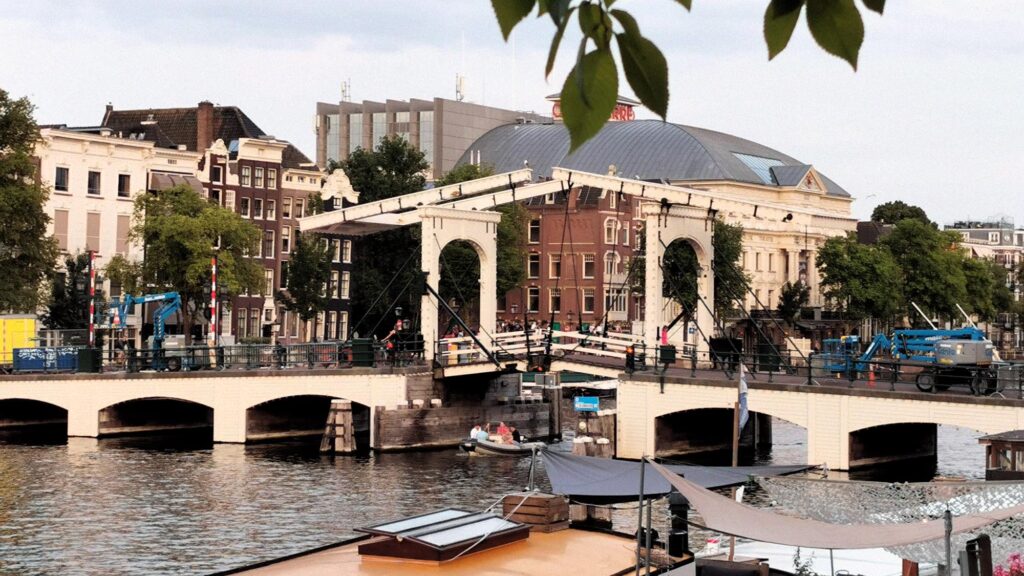
Skinny Bridge
In Diamonds Are Forever (1971), the iconic Skinny Bridge serves as a key location where the body of Mrs. Whistler is removed from the Amstel River.
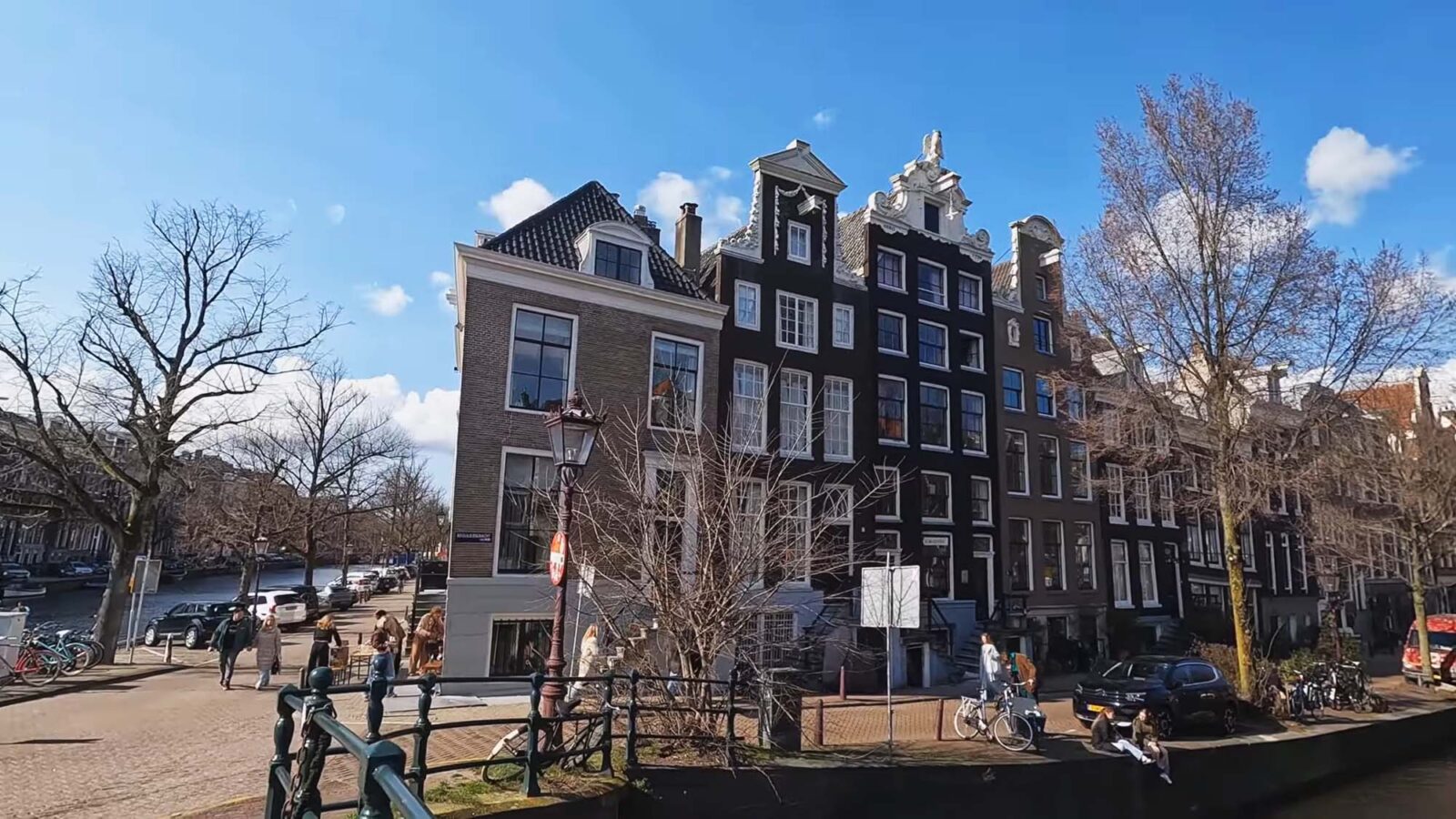
Tiffany Case’s House
Tiffany Case’s House has appeared in Diamonds Are Forever (1971), where its exterior represents the Amsterdam apartment of diamond smuggler Tiffany Case.
Westgate Las Vegas Resort & Casino
Westgate Las Vegas Resort & Casino is in Elvis: That's the Way It Is, Diamonds Are Forever, Over the Top, Elvis and Me, Kill Me Again, Roseanne and many more.