
Star Wars: A New Hope is a 1977 American space opera written and directed by George Lucas and originally released simply as Star Wars. Mark Hamill stars as Luke Skywalker, a young farm boy who becomes involved in the rebellion against the Galactic Empire after acquiring two droids carrying secret plans for the Death Star. Alongside Alec Guinness as Obi-Wan Kenobi, Harrison Ford as Han Solo and Carrie Fisher as Princess Leia, Luke joins the mission to destroy the Empire’s enormous space station. The film also stars Peter Cushing as Grand Moff Tarkin and David Prowse as Darth Vader, voiced by James Earl Jones.
Principal photography began in Tunisia on 22 March 1976, with the majority of the production subsequently filmed at EMI Elstree Studios in Borehamwood, Hertfordshire. Additional filming took place at Shepperton Studios in Surrey, the Cardington Airship Sheds in Bedfordshire, Death Valley National Park in California and the ancient Maya city of Tikal in Guatemala. Tunisia provided most of the real locations for the desert planet Tatooine, while Tikal became the jungle moon of Yavin 4. The film’s numerous spacecraft and space battle sequences were created through miniature photography at Industrial Light & Magic in California.
The first scenes were filmed on the Chott el-Djerid salt flats near Nefta in southwestern Tunisia, where the production constructed the exterior of the Lars family homestead. The location featured the small, dome-shaped entrance to Luke Skywalker’s underground home, surrounded by moisture vaporators and a desert landscape. The first shot recorded on 22 March featured Luke and his uncle Owen Lars (Phil Brown) examining a collection of droids brought to the farm by Jawa traders. The scene includes the purchase of C-3PO and R2-D2 after the initially selected red astromech droid, R5-D4, develops a malfunction. Several technical problems complicated the filming, including malfunctioning robots and difficulties operating Anthony Daniels’ restrictive C-3PO costume.
The same location was used for one of the film’s most recognisable sequences, in which Luke stands alone outside the homestead watching Tatooine’s twin suns set on the horizon. The scene was not completed during the first day’s filming because of unsuitable weather, and the final shots were obtained on 29 March 1976. The second sun was added through visual effects. The salt flats also appear when Luke discovers that Imperial stormtroopers have attacked the homestead and killed Owen and Aunt Beru. The exterior set was later rebuilt for the prequel films, and the dome has undergone several restorations, including a fan-funded project in 2012.
The interior of the Lars homestead was filmed approximately 265 kilometres away at Hotel Sidi Driss in Matmata. The hotel occupies a traditional underground dwelling, with rooms excavated into the earth around open-air courtyards. One of these courtyards became the central area of Luke’s home, while an adjoining cave room was used for the family dining room. The dining scene, in which Luke argues with his uncle about leaving Tatooine to attend the Academy, was filmed here. The courtyard also appears when Owen searches for Luke. Other interior spaces, including Aunt Beru’s kitchen, were constructed at Elstree Studios rather than filmed at the hotel. Hotel Sidi Driss remains in operation, and parts of its Star Wars interiors have retained or recreated decorations associated with the production.
The sand dunes west of Nefta provided another major Tatooine location. Here, C-3PO and R2-D2 wander through the desert after escaping the Imperial attack on Princess Leia’s ship. The two droids disagree about which direction to travel and eventually separate. C-3PO continues across the dunes and passes the enormous bleached skeleton of a fictional krayt dragon. The same desert area was used for shots of Imperial stormtroopers investigating the escape pod and searching for the missing droids. Additional shots of the droids in the desert were later filmed in Death Valley, allowing the two landscapes to be combined into a single environment.
The rocky gorge at Sidi Bouhlel, near Tozeur, became the Jundland Wastes and is commonly known as Star Wars Canyon. Several important sequences were filmed among its steep cliffs and narrow passages. R2-D2 is captured here by Jawas, who disable the droid and carry him towards their sandcrawler. Later, Luke and C-3PO enter the canyon while searching for the missing R2-D2. Luke is attacked by Tusken Raiders, who knock him unconscious and begin searching his landspeeder before being frightened away by the arrival of Obi-Wan Kenobi. The canyon also appears when Luke recovers the damaged C-3PO and when Obi-Wan discovers the wreckage of a Jawa sandcrawler destroyed by Imperial stormtroopers. Luke realises that the attack places his aunt and uncle in danger and immediately returns home. The aftermath of the massacre, including the burning of the Jawa bodies, was also filmed in this area.
Another sequence filmed at Sidi Bouhlel shows Obi-Wan and Luke standing on a rocky overlook above Mos Eisley. Obi-Wan points out the spaceport below and warns Luke about the criminals who inhabit it. The distant view was created by combining the Tunisian foreground with an altered landscape based on Dante’s View in Death Valley, California. Sidi Bouhlel was later used again by Lucasfilm for Raiders of the Lost Ark (1981), including the scene in which Indiana Jones threatens to destroy the Ark of the Covenant with a rocket launcher.
The production moved to the island of Djerba for several scenes set around Mos Eisley. A small whitewashed building near Ajim, originally part of the Amghar Mosque complex overlooking the Gulf of Gabès, served as the exterior of Obi-Wan Kenobi’s desert home. The building appears as Luke, Obi-Wan and the droids arrive at the dwelling following the Tusken Raider attack. The interior scenes, in which Obi-Wan gives Luke his father’s lightsaber and R2-D2 plays Princess Leia’s holographic message, were filmed on constructed studio sets. The real exterior location stands close to the Mediterranean coast, although the film presents it as an isolated dwelling in Tatooine’s inland desert.
The town of Ajim itself was used for the streets of Mos Eisley. One of the main sequences takes place at an Imperial checkpoint, where stormtroopers stop Luke’s landspeeder and question its occupants about the two missing droids. Obi-Wan uses a Jedi mind trick to persuade the soldiers to let them pass. The surrounding streets and buildings were modified with props, additional structures and set dressing to create the spaceport. Ajim also provided the exterior of the Mos Eisley cantina, where Luke and Obi-Wan arrange passage aboard the Millennium Falcon. The building was originally a bakery, and the production attached a temporary wooden and plaster façade to create the cantina entrance. Most of the interior scenes, including the confrontation between Han Solo and Greedo, were filmed at Elstree Studios, with additional close-up photography of alien characters completed at Hollywood Center Studios in Los Angeles.
Another Djerba location was the Sidi Jemour Mosque complex on the island’s western coast. On 4 April 1976, the production filmed several scenes here set around Tosche Station in the settlement of Anchorhead. These sequences introduced Luke’s friends Biggs Darklighter (Garrick Hagon), Camie (Koo Stark) and Fixer (Anthony Forrest). Luke arrives in his landspeeder and discusses the space battle taking place above Tatooine, while Biggs later tells him about his intention to join the Rebellion. The Anchorhead scenes were removed during editing and do not appear in the original theatrical version. The Sidi Jemour area also supplied footage of the outskirts of Mos Eisley, although the approach to the city was significantly altered with additional digital scenery for the 1997 Special Edition.
The Tunisian shoot lasted approximately two and a half weeks and encountered several difficulties. Unexpected heavy rain and storms disrupted filming, damaged sets and created problems for vehicles and equipment in the desert. The conditions were especially difficult for the actors portraying the droids. Anthony Daniels struggled with the uncomfortable C-3PO costume, while Kenny Baker frequently experienced mechanical problems inside R2-D2. The production nevertheless completed its scheduled location work before moving to England.
At EMI Elstree Studios in Borehamwood, production designer John Barry and his team constructed approximately 30 sets across the studio’s nine sound stages. These included the corridors and detention areas of the Death Star, the interior of the Millennium Falcon, the Mos Eisley cantina and the various control rooms aboard Imperial and Rebel spacecraft. The opening sequence aboard Princess Leia’s captured ship, the Tantive IV, was filmed here, including the stormtroopers’ assault and Darth Vader’s first appearance. Elstree was also used for the rescue of Princess Leia, the escape through the Death Star’s corridors, the trash compactor sequence and Obi-Wan’s lightsaber duel with Darth Vader. The Millennium Falcon’s cockpit and main interior compartments were constructed as separate sets, allowing scenes involving Han Solo, Chewbacca, Luke and Leia to be filmed without requiring a complete spacecraft.
The enormous Rebel Alliance hangar on Yavin 4 required more space than Elstree could provide. The production therefore moved to Shepperton Studios, where a large stage accommodated the hangar set with X-wing and Y-wing fighters and Rebel personnel preparing for the attack on the Death Star. Shepperton was also used for additional scenes at the Rebel base, including the mission briefing and the final medal ceremony, where Princess Leia honours Luke Skywalker and Han Solo following the destruction of the Death Star.
The exterior entrance to the Rebel base was filmed at the Cardington Airship Sheds in Bedfordshire. The enormous former airship hangars provided the scale needed for the entrance to the Massassi Temple, with a matte painting used to transform the industrial structure into an ancient stone building. The location was later revisited for Rogue One: A Star Wars Story (2016), which recreated the Rebel base on Yavin 4 using another of the Cardington sheds.
For the exterior views of Yavin 4, a small second-unit crew travelled to Tikal National Park in northern Guatemala in March 1977. The ancient Maya city, surrounded by tropical rainforest, provided the view of the Rebel base as the Millennium Falcon approaches the jungle moon. The camera was positioned on Temple IV, overlooking several other temples rising above the forest canopy. The distinctive Maya structures became the ancient buildings of the Rebel Alliance headquarters. The footage was also used with visual effects to create the impression of a Rebel lookout watching the approaching spacecraft. These scenes were filmed separately from the principal cast and combined with the studio footage of the Rebel base in England.
Further Tatooine photography was carried out in Death Valley National Park in California, where several different areas were used to match the footage already obtained in Tunisia. The Mesquite Flat Sand Dunes appear in the sequence following the escape pod’s arrival on Tatooine, while Artists Palette was used for R2-D2’s solitary journey through a rocky canyon. Nearby Golden Canyon provided shots of Jawas watching the droid before his capture. The area around Artists Drive was also used for the Jawas’ sandcrawler. At Desolation Canyon, additional footage was filmed of Tusken Raiders riding banthas, extending the canyon sequences originally shot at Sidi Bouhlel. Dante’s View supplied the distant landscape used in the view over Mos Eisley. Through editing and visual effects, these California locations were combined with the Tunisian material to represent different parts of the same fictional planet.
The film’s spacecraft sequences were created at Industrial Light & Magic, established by George Lucas in 1975. The company operated from a converted industrial warehouse on Valjean Avenue in Van Nuys, Los Angeles, where models of the Millennium Falcon, Imperial Star Destroyers, X-wing fighters, TIE fighters and the Death Star were constructed and photographed. Visual effects supervisor John Dykstra and his team developed a motion-control camera system known as the Dykstraflex, allowing complex camera movements to be repeated precisely for multiple photographic passes. This technology was used extensively for the space battles, particularly the climactic attack on the Death Star, combining miniature spacecraft, laser effects, explosions and independently photographed backgrounds into the finished sequences.
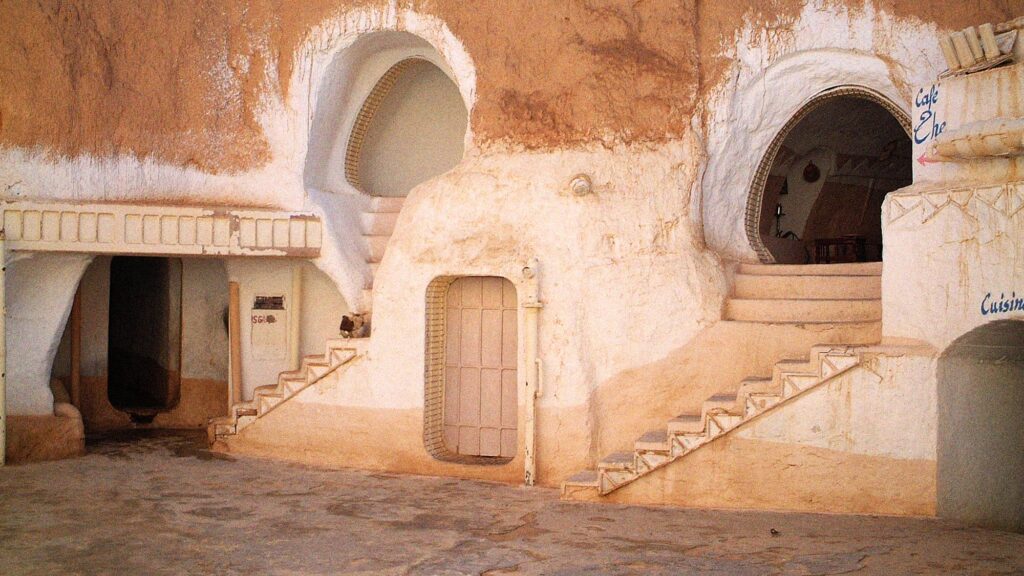
Hotel Sidi Idriss
Hotel Sidi Driss is a historic, traditional Berber troglodyte hotel in Matmata, Tunisia, famous for serving as the interior filming location in Star Wars.