
Mark Richard Hamill was born on 25 September 1951 in Oakland, California, United States, to William Thomas Hamill, an officer in the United States Navy, and Virginia Suzanne Johnson. The middle of seven children, he grew up with two brothers and four sisters in a family that moved frequently as his father received new military assignments. His childhood took him through several parts of California, Virginia, New York and eventually Japan, exposing him to different communities and educational environments. His father, who attained the rank of captain, expected his children to pursue conventional careers and was initially sceptical of Mark’s fascination with acting, comic books, puppetry and popular entertainment. His mother was more supportive of his creative interests, and Hamill frequently entertained his siblings with impressions, magic tricks and homemade performances. He developed an early enthusiasm for cinema and television, particularly science fiction, fantasy and animated cartoons, interests that would continue to influence his work throughout his career.
The family’s repeated relocations meant that Hamill attended numerous schools. During his early years in Virginia, he studied at Walsingham Academy in Williamsburg and Edgar Allan Poe Middle School in Annandale. Following another transfer, the family settled temporarily in San Diego, California, where he attended Hale Junior High School and began his secondary education at James Madison High School. They subsequently returned to Virginia, where he studied at Annandale High School, before his father’s naval career took them to Japan. Hamill spent his final school years in the Yokohama and Yokosuka area, attending Nile C. Kinnick High School at the United States naval base in Yokosuka. He became involved in the school’s drama club, served as student council president and was voted among the most talented members of his graduating class. He completed his education there in 1969 and retained particularly fond memories of Japan. Nearly a decade later, in June 1978, he returned to the school while visiting the country to promote Star Wars, addressing students and teachers and touring the naval base where his father had once been stationed.
After graduating, Hamill returned to California and enrolled at Los Angeles City College, where he studied theatre arts. He had initially travelled to Los Angeles for his older brother’s wedding but decided to remain and pursue acting professionally. Unlike many performers who began their careers in regional theatre before moving into television, Hamill concentrated on finding work in Hollywood from the outset. His first professional television appearance came in The Bill Cosby Show in 1970, followed by guest roles in The Partridge Family, Cannon, Room 222 and Night Gallery. He also secured a recurring part as Kent Murray in the daytime soap opera General Hospital (1972–1973) and played Doobie Wheeler in the short-lived comedy series The Texas Wheelers (1974–1975). These early jobs provided a modest income, although he continued living economically while attending auditions across Los Angeles. His work gradually brought him into contact with casting directors and producers, and in 1976 he was selected to play David Bradford in the pilot episode of the family drama Eight Is Enough. The programme was subsequently commissioned as a series, but another opportunity had already begun to change the direction of his career.
In late 1975, Hamill auditioned for a science-fiction film being developed by writer and director George Lucas. The project, initially regarded by many in Hollywood as an uncertain commercial prospect, became Star Wars (1977). Hamill was cast as Luke Skywalker, a young farmer drawn into a rebellion against a galactic dictatorship, alongside Harrison Ford as Han Solo and Carrie Fisher as Princess Leia. Principal photography began on 22 March 1976 in Tunisia, where the production used the salt flats around Chott el Djerid, the desert near Nefta and the traditional underground buildings of Matmata to represent Luke’s home planet of Tatooine. The interior of the Lars family homestead was filmed at Hotel Sidi Driss in Matmata, while much of the remaining production took place at EMI Elstree Studios in Borehamwood, Hertfordshire, England. Hamill had never previously worked on a feature film of comparable scale, and the production introduced him to extensive location filming, elaborate studio sets and the technical demands of special-effects filmmaking. Its eventual release on 25 May 1977 transformed the careers of its principal cast members and established one of the most successful film franchises in cinema history.
Shortly before the release of Star Wars, Hamill was seriously injured in a road accident in California. He lost control of his car on a motorway slip road and sustained facial injuries, including fractures to his nose and cheekbone, which required reconstructive surgery. The accident delayed the beginning of filming on Corvette Summer (1978), a romantic comedy directed by Matthew Robbins in which Hamill played a Los Angeles high-school student searching for a stolen Chevrolet Corvette. Production eventually began in July 1977, with filming at locations including Burbank High School, Verdugo Hills High School in Tujunga and various streets and motorways around Los Angeles and the San Fernando Valley. Additional scenes were filmed in Las Vegas, where the character follows clues concerning the missing car. The film introduced Annie Potts in her feature-film debut and gave Hamill an opportunity to demonstrate his abilities outside science fiction. He subsequently took a more demanding dramatic role as Private Griff in Samuel Fuller’s The Big Red One (1980), a Second World War film starring Lee Marvin. Based on Fuller’s own wartime experiences, the production was filmed largely in Israel and Ireland, with additional work in California. Locations around Caesarea, Jerusalem and the Irish countryside were used to recreate the military campaigns in North Africa and Europe.
By the time The Big Red One reached cinemas, Hamill had already returned to the role of Luke Skywalker in The Empire Strikes Back (1980), directed by Irvin Kershner. Filming began in February 1979 in Finse, a mountain village on the Bergen Line railway in Norway, where the surrounding snowfields and Hardangerjøkulen glacier were used to represent the frozen planet of Hoth. Hamill travelled to Norway after several months of physical preparation involving fencing, martial arts and strength training. The production encountered exceptionally severe winter weather, with snowstorms disrupting transport and preventing the crew from reaching some of its planned locations. As a result, several scenes were filmed immediately outside Finse 1222, the hotel used as the production’s base. Hamill spent extended periods lying in deep snow while portraying the injured Luke Skywalker, occasionally removing his protective clothing for takes in the freezing temperatures. The scenes proved among the most physically demanding of his career, and he later recalled the unusual experience of filming within sight of hotel guests watching from their windows. Further production continued at Elstree Studios in England, where elaborate sets were constructed for the scenes on Dagobah and Cloud City.
During the same period, Hamill established a family life in southern California. He met Marilou York, a dental hygienist, and the couple married on 17 December 1978. They purchased a house in Malibu that year, using money he had earned from Star Wars, and held their wedding in its garden. The property became their principal home and would remain in the family for decades. Their first son, Nathan, was born in June 1979, while Hamill was working on The Empire Strikes Back. A second son, Griffin, followed in March 1983, and their daughter Chelsea was born in July 1988. Despite the international success of Star Wars, Hamill and his wife maintained a relatively private family life, with their Malibu home providing a permanent base between professional engagements. The actor also retained connections to northern California, where several relatives continued to live, and his second son was born in San Francisco during a period when Hamill was performing on stage in the city.
Following The Empire Strikes Back, Hamill returned for the concluding instalment of the original trilogy, Return of the Jedi (1983), directed by Richard Marquand. Principal photography began in January 1982, with substantial studio filming at Elstree in Hertfordshire. The production also used locations in California and Arizona, including Buttercup Valley in the Imperial Sand Dunes for scenes set around Jabba the Hutt’s desert palace. Forest locations near Smith River and elsewhere in northern California represented the moon of Endor, although not every actor appearing in those sequences participated in the location photography. Return of the Jedi completed Hamill’s initial commitment to Luke Skywalker and became another major international success. By then, however, he had begun deliberately seeking work that would separate his professional identity from the character.
His interest in theatre brought him to New York, where he made his Broadway debut in June 1981 as John Merrick in Bernard Pomerance’s The Elephant Man at the Booth Theatre on West 45th Street. Hamill joined the production near the end of its Broadway run, following actors including David Bowie and Bruce Davison in the central role. The engagement required him to portray a severely disfigured Victorian man largely through physical performance, without elaborate prosthetic makeup. He subsequently appeared as Wolfgang Amadeus Mozart in Peter Shaffer’s Amadeus, beginning with an American touring production before joining the Broadway company. The tour took him to several American cities, including San Francisco, where his son Griffin was born during the engagement. In 1985, he originated the role of Tony Hart in Harrigan ‘n Hart, a musical about the nineteenth-century American theatrical partnership of Edward Harrigan and Tony Hart. The production opened on Broadway at the Longacre Theatre after earlier performances at Goodspeed Opera House in East Haddam, Connecticut, and earned Hamill a Drama Desk Award nomination for Outstanding Actor in a Musical. Although the Broadway run was brief, the project involved demanding singing, dancing and character work beyond the roles for which film audiences knew him.
Hamill continued his theatre career with a 1986 Off-Broadway revival of Room Service, directed by Alan Arkin, in which he played the unscrupulous theatrical producer Gordon Miller. He returned to Broadway in 1987 in Larry Shue’s comedy The Nerd, appearing as architect Willum Cubbert at the Helen Hayes Theatre. These performances allowed him to explore a wider range of characters at a time when film producers still tended to associate him with Luke Skywalker. He later explained that the commercial success of Star Wars had made casting directors reluctant to consider him for roles that departed significantly from his established screen image. The theatre offered opportunities to audition for demanding parts without the same restrictions, and he became increasingly comfortable alternating between New York productions and television or film work in California. In 2003, he returned to Broadway opposite Polly Bergen in Richard Alfieri’s Six Dance Lessons in Six Weeks, performing at the Belasco Theatre on West 44th Street. The production again demonstrated his continued interest in live theatre more than twenty years after his Broadway debut.
Away from the stage, Hamill appeared in a succession of independent and genre films during the late 1980s and early 1990s, including Slipstream (1989), Midnight Ride (1990), The Guyver (1991) and Time Runner (1993). He also returned to television, playing the villainous James Jesse, known as the Trickster, in The Flash (1990–1991). The character allowed him to adopt a more exaggerated style of performance and became a precursor to the role that would establish his second major career in entertainment. In 1992, he was cast as the Joker in Batman: The Animated Series, developed by Bruce Timm and Eric Radomski for Warner Bros. Animation. Hamill had initially provided the voice of another character, Ferris Boyle, before being invited to audition for Batman’s most famous adversary. His interpretation combined theatrical delivery, rapidly changing vocal tones and a distinctive laugh, creating a character almost unrecognisable as the actor who had played Luke Skywalker. The role also provided a professional connection to his lifelong interest in comic books, allowing him to portray a character he had known since childhood.
The success of Batman: The Animated Series developed into a substantial career in voice acting. Hamill continued portraying the Joker in animated productions including Batman: Mask of the Phantasm (1993), The New Batman Adventures (1997–1999), Batman Beyond: Return of the Joker (2000) and Batman: The Killing Joke (2016). His frequent collaborator Kevin Conroy provided the voice of Batman, and their performances became closely associated with several generations of animated adaptations. Hamill subsequently reprised the Joker in the Batman: Arkham video games, beginning with Batman: Arkham Asylum (2009). His other voice roles included the villain Fire Lord Ozai in Avatar: The Last Airbender (2005–2008), the Hobgoblin in Spider-Man: The Animated Series (1994–1998), and various characters in Justice League, Regular Show and other productions. He also provided voices for the video game Full Throttle (1995) and portrayed Colonel Christopher Blair in the live-action filmed sequences of the Wing Commander series, beginning with Wing Commander III: Heart of the Tiger (1994). These projects gave him regular work in animation and interactive entertainment while providing greater variety than many of the live-action roles available to him.
Hamill’s enthusiasm for comics extended into writing and directing. Together with artist and writer Eric Johnson, he created The Black Pearl, a five-part comic-book series published by Dark Horse Comics in 1996. The story drew on his interest in superheroes and the darker consequences of public attention. He later directed and starred in Comic Book: The Movie (2004), a mockumentary about comic-book fandom and the commercialisation of popular characters. Much of the production was filmed during San Diego Comic-Con in August 2002, with Hamill appearing in character among actual convention visitors, artists and collectors. The film also brought together several performers from the voice-acting industry, including Billy West, Jess Harnell and Roger Rose, alongside appearances by comic-book creators and other figures associated with popular culture. The convention setting was central to the project, allowing Hamill to combine scripted comedy with interactions involving real attendees. Although released directly to home video, the film represented an independent project over which he exercised considerable creative control.
His interest in science fiction and fantasy continued to bring him into occasional live-action productions during the 2000s and early 2010s. He appeared in television programmes including The Simpsons, Just Shoot Me! and Chuck, while maintaining a busy schedule of voice acting. He also participated in fan conventions and public events connected to Star Wars, increasingly acknowledging the lasting importance of Luke Skywalker to his career. In interviews, Hamill described how he had initially resisted being permanently associated with the character, particularly during his years on Broadway, but eventually came to appreciate the enthusiasm of audiences who had grown up with the films. His professional relationship with George Lucas and his friendship with fellow cast members Harrison Ford and Carrie Fisher endured long after the original trilogy had concluded.
When Lucasfilm began developing a new Star Wars trilogy following its acquisition by Disney, Hamill was invited to reprise Luke Skywalker after more than three decades. His first appearance came in Star Wars: The Force Awakens (2015), directed by J. J. Abrams. Although his role was brief, it required him to travel to Skellig Michael, a small island approximately twelve kilometres off the coast of County Kerry, Ireland. The island contains the remains of an early medieval monastery perched high above the Atlantic, reached by hundreds of steep stone steps. Hamill filmed the final scene alongside Daisy Ridley, who played Rey, during location work in 2014. He later described the climb to the summit as exhausting and had assumed that the experience would not need to be repeated. When he received the screenplay for the next instalment, Star Wars: The Last Jedi (2017), directed by Rian Johnson, he discovered that Luke’s story would continue at the same location.
Filming for The Last Jedi began in September 2015 with preliminary photography at Skellig Michael, followed by principal photography from February 2016. Although some scenes were filmed on the island itself, restrictions designed to protect its wildlife and historic structures meant that much of the additional location work took place around the Dingle Peninsula in County Kerry. A large recreation of the island’s stone huts was constructed on the Ceann Sibéal headland near Ballyferriter, while further filming took place at Pinewood Studios in Buckinghamshire, England. Hamill worked extensively with Daisy Ridley on the new film, which portrayed an older and more disillusioned Luke Skywalker. His performance attracted considerable attention and earned him the Saturn Award for Best Actor. He subsequently appeared in Star Wars: The Rise of Skywalker (2019), completing his involvement in the sequel trilogy, and returned once more through digitally assisted appearances in the television series The Mandalorian (2019–) and The Book of Boba Fett (2021–2022).
The renewed success of Star Wars coincided with several other notable screen appearances. In 2017, Hamill played Ted Mitchum in Brigsby Bear, an independent comedy-drama about a man whose life has been shaped by an unusual childhood television programme. He subsequently appeared in the historical television drama Knightfall (2017–2019), portraying Talus, a veteran member of the Knights Templar. The series was filmed largely in the Czech Republic, where medieval European settings were recreated at studios and locations around Prague. Hamill’s participation required him to undergo physical preparation for the role, which involved an older warrior rather than the youthful characters associated with his early career. His growing recognition across film, television and voice acting was formally acknowledged on 8 March 2018, when he received a star on the Hollywood Walk of Fame. The ceremony took place outside the El Capitan Theatre at 6834 Hollywood Boulevard, with George Lucas and Harrison Ford attending to honour their longtime colleague.
Hamill continued working in animation, including providing the voice of Chucky in the 2019 remake of Child’s Play and portraying Skeletor in Masters of the Universe: Revelation (2021) and Masters of the Universe: Revolution (2024). He also voiced Merv Pumpkinhead in Netflix’s adaptation of The Sandman (2022–) and appeared as the eccentric and intimidating lawyer Arthur Pym in Mike Flanagan’s horror miniseries The Fall of the House of Usher (2023). Although the series is set largely in the United States, production took place in Vancouver, British Columbia, including at Bridge Studios in Burnaby. Hamill had worked in Vancouver on earlier occasions and spoke positively about returning to the Canadian film industry. The role gave him an opportunity to appear in a substantial dramatic television production without relying on his associations with Star Wars or animated characters.
His collaboration with Mike Flanagan continued with The Life of Chuck (2024), an adaptation of a Stephen King novella starring Tom Hiddleston. Hamill played Albie Krantz, the grandfather of the title character, in a story told through several periods of a man’s life. The film was shot principally in Alabama, including Mobile and Baldwin County, and premiered at the Toronto International Film Festival in September 2024 before receiving a wider theatrical release in 2025. The performance required Hamill to portray an emotionally complicated older man and included extended dramatic dialogue, providing one of his most substantial live-action roles in several years. During the same period, he voiced Thorn, a grizzly bear, in DreamWorks Animation’s The Wild Robot (2024), and returned to villainous material in The Long Walk (2025), another Stephen King adaptation. Directed by Francis Lawrence, the latter film featured Hamill as the Major, the authoritarian official overseeing a deadly endurance competition involving a group of young men. Principal photography took place during the summer of 2024 in Manitoba, Canada, particularly around Winnipeg and rural communities in the surrounding region. The production used long stretches of roads and open countryside, with the actors frequently working outdoors for extended periods.
During the 2020s, Hamill also became increasingly vocal about political and social issues in the United States, using public appearances and social media to express support for democratic institutions, humanitarian causes and political candidates. He participated in fundraising activities for Ukraine following Russia’s invasion in 2022 and became an ambassador for the country’s United24 initiative, supporting the acquisition of reconnaissance drones. His involvement included recorded appeals and public discussions about the humanitarian consequences of the war. Although he continued travelling for film productions and promotional engagements, his family remained based in southern California, where he and Marilou had lived for most of their marriage.
In January 2025, the Hamill family was directly affected by the devastating wildfires that swept through parts of Los Angeles County. As the Palisades Fire spread towards Malibu, Hamill and his wife evacuated their longtime home, driving along the Pacific Coast Highway as flames approached the road. They initially took refuge with their daughter Chelsea in Hollywood. Although their house survived, much of the surrounding neighbourhood was destroyed, and the property became temporarily uninhabitable because of fire damage and contamination. A retired firefighter who had been staying in the property’s guesthouse helped prevent embers from spreading into the main residence. The family subsequently rented accommodation in Los Feliz, Los Angeles, while repairs and recovery work continued. In an interview with the Los Angeles Times in June 2025, Hamill explained that the house had been his home since 1978, that he and Marilou had married in its garden and that their children had grown up there. The prospect of returning to the property remained important to the couple, although the extent of destruction in the surrounding community made the process uncertain.
By 2026, Hamill had reached his seventy-fifth birthday and continued receiving offers for film and television work, although he had become more selective about accepting roles. His three children were adults, and he increasingly valued spending time at home with his wife and family. He retained particular affection for the San Francisco Bay Area, where he was born and where relatives continued to live, while his decades in Los Angeles had established lasting connections to the city’s film and animation industries. The disruption caused by the 2025 wildfires had brought an unexpected change to the family home he had purchased at the beginning of his Star Wars success, nearly half a century earlier.
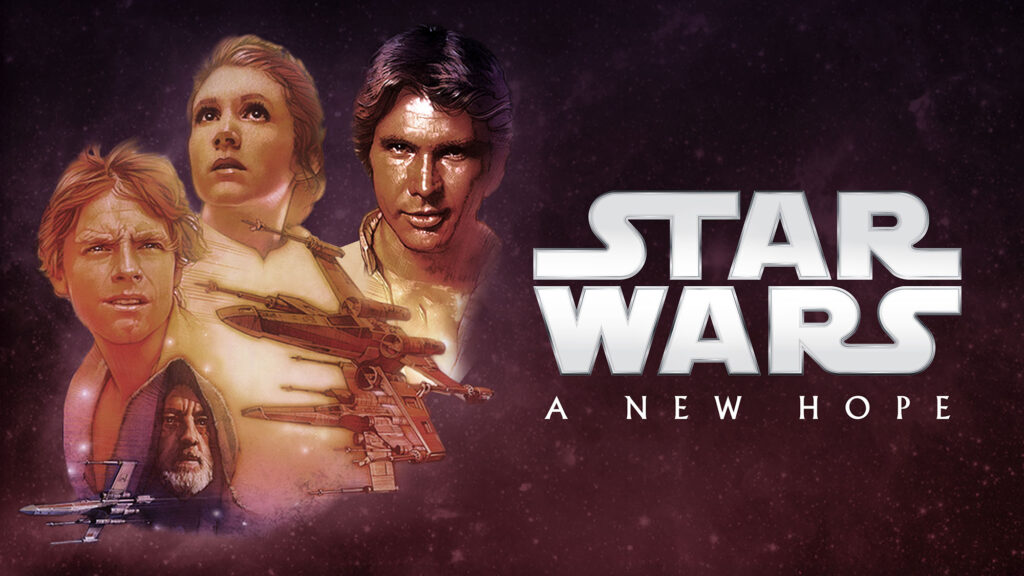
Star Wars
Star Wars: A New Hope was primarily filmed at Elstree Studios in Hertfordshire, England, with extensive on-location shooting in Tunisia and Guatemala.