
Midnight Madness is a 1980 American comedy written and directed by Michael Nankin and David Wechter. The film follows Leon (Alan Solomon), an eccentric graduate student who organises an elaborate overnight treasure hunt called The Great All-Nighter, inviting five groups of college students to compete by deciphering clues hidden throughout Los Angeles. David Naughton stars as Adam Larson, leader of the yellow team, alongside Debra Clinger as Laura, Stephen Furst as Harold, Eddie Deezen as Wesley, Maggie Roswell as Donna and Brad Wilkin as Lavitas. Michael J. Fox makes his feature film debut as Adam’s younger brother Scott. Produced by Walt Disney Productions, the film turns Los Angeles into an enormous playing field, with each new puzzle sending the competitors to another recognisable location across the city.
Midnight Madness (1980) was filmed across Los Angeles County, California, including Hollywood, Downtown Los Angeles, the San Fernando Valley and Long Beach. Principal photography began on 2 July 1979, with the production using approximately 25 locations, including Occidental College, Griffith Observatory, Hollywood Tower Apartments, the Hollywood Wax Museum, Johnie’s Coffee Shop, the Pabst Brewery and the Bonaventure Hotel. Additional filming took place at established restaurants, nightclubs, amusement facilities and Los Angeles International Airport, while interior sets were constructed at Walt Disney Studios in Burbank. Approximately three-quarters of the filming schedule involved nighttime photography, reflecting the story’s progression from the beginning of the competition at dusk to its conclusion the following morning.
The film opens at Occidental College, 1600 Campus Road in the Eagle Rock neighbourhood of Los Angeles. Founded in 1887, the private liberal arts college provided the campus setting where Leon’s assistants Candy (Debi Richter) and Sunshine (Kirsten Baker) distribute invitations to the prospective team leaders. Wearing roller skates, the two women travel around the campus delivering messages to Adam, Harold, Wesley, Donna and Lavitas. The scenes introduce the characters in their everyday college surroundings before their rivalries draw them into Leon’s competition. Adam initially refuses to participate, preferring to concentrate on his studies and responsibilities, but eventually agrees after his friends encourage him. The production used the college’s existing grounds and buildings, which also appeared in numerous other films, including The Tall Story (1960) and Clueless (1995).
Leon’s headquarters were represented by the Hollywood Tower Apartments at 6200 Franklin Avenue in Hollywood. Completed in 1929, the distinctive French Norman-style apartment building stands near the intersection of Franklin Avenue and Gower Street, immediately beside the Hollywood Freeway. Its steep roofs, turrets and ornamental architecture make it one of the more recognisable residential buildings in the neighbourhood. In the film, the building becomes the location of Leon’s Game Control centre, where he monitors the progress of the five teams through a large map, radio equipment and information supplied by his assistants. Before the competition begins, the participants gather outside the apartment building to receive their instructions and first clue. The exterior and surrounding street were used for these scenes, while the elaborate Game Control interior was constructed at Walt Disney Studios.
Hollywood Tower also appears during the parallel storyline involving Leon’s increasingly frustrated landlady, Mrs Grimhaus (Irene Tedrow). As the game progresses, the noise and activity in Leon’s apartment begin disturbing the other residents. Mrs Grimhaus repeatedly threatens to evict him, eventually contacting the police and attempting to have the game stopped. The building’s entrance and surrounding streets appear as the authorities become involved, while Leon continues directing the competitors towards their final destination. The production used the actual apartment building for the exterior scenes, combining it with the studio-built control room where most of Leon’s activities take place.
The first clue sends the competitors searching for stars, although the teams interpret the instruction in different ways. Wesley’s white team visits Hollywood Boulevard, believing that the reference concerns the Hollywood Walk of Fame. They search among the pavement stars commemorating entertainers, including the area around Grauman’s Chinese Theatre at 6925 Hollywood Boulevard. The famous cinema, opened in 1927 and known for the celebrity handprints and footprints embedded in its forecourt, provides a recognisable setting for their unsuccessful search. Elsewhere, the green team visits the Hollywood Wax Museum at 6767 Hollywood Boulevard, looking for stars among the wax figures of famous actors and entertainers. The museum, established in 1965, remains at the same address.
Donna’s red team interprets the clue as a reference to entertainment celebrities and visits Stargate Disco, filmed at the former Osko’s Disco on South La Cienega Boulevard near San Vicente Boulevard. The nightclub was a well-known Los Angeles disco during the 1970s and provided the setting for the team’s attempts to find the next clue among the dancers and nightclub customers. The sequence includes an altercation involving Berle (Robyn Petty), one of Donna’s teammates, as the women become increasingly frustrated with their unsuccessful search. Osko’s subsequently closed, and the property was demolished as the surrounding area was redeveloped for the Beverly Center shopping complex, which opened in 1982.
The correct destination is Griffith Observatory at 2800 East Observatory Road in Griffith Park. Opened in 1935, the observatory stands on the southern slope of Mount Hollywood and overlooks much of the Los Angeles Basin. Its public astronomy exhibits, telescopes and distinctive Art Deco architecture are central to the sequence in which the teams attempt to decipher Leon’s first major puzzle. The clue contains a series of numbers that must be entered as telescope coordinates. When the instrument is correctly positioned, it directs the players towards an illuminated sign displaying the next instruction, which tells them to search for thousands of keys.
Several teams converge on the observatory, including Adam’s yellow team and Lavitas’s green team. Adam and his companions work out the correct telescope settings, but the football players arrive before they can complete their investigation. Adam secretly changes the instrument’s coordinates before leaving, preventing his rivals from immediately obtaining the same information. The sequence incorporates the observatory’s real exhibition spaces and astronomical equipment, including the large model of the Moon and the telescope displays. The building’s exterior, terraces and surrounding hillside also appear during the nighttime scenes as the competing vehicles arrive and depart.
The next clue leads the players to the Sherman Clay Piano Museum in Los Angeles. The instruction refers to the keys of a piano, directing the teams towards a collection of musical instruments. Inside the museum, they discover a small piano displaying sheet music entitled “Leon’s Theme”. The competitors must play the notes and recognise the melody as the advertising jingle for Pabst Blue Ribbon beer. One of the football players unexpectedly identifies the tune, inadvertently giving the solution to several rival teams. The scene uses the piano displays as part of the puzzle, with the instruments themselves providing the next stage of the competition. The museum was associated with the Sherman Clay musical instrument business, which operated several properties in Los Angeles during the twentieth century.
The Pabst Blue Ribbon Brewery on North Main Street in Lincoln Heights became the next major stop. The extensive industrial complex had originally been developed by the Los Angeles Brewing Company, founded in the late nineteenth century, and was acquired by Pabst in 1948. Its production buildings, warehouses and large beer-storage facilities provided the setting for a guided tour that several teams join while searching for the next clue. Adam’s group and the football players move through the brewery with other visitors, examining the equipment and surrounding industrial spaces. Scott Larson, who has joined his older brother’s team, causes trouble when he attempts to drink beer despite being underage, resulting in Adam’s group being removed from the tour.
The competitors eventually discover the next instruction displayed on beer cartons inside the brewery warehouse. The clue directs them to a restaurant through a word puzzle referring to a well-known television personality and an overweight child. During the search, one of the football players jumps into a large container of beer, leaving him violently ill for much of the following journey. The brewery scenes make use of the actual industrial environment, including its storage areas and substantial brick buildings. Pabst closed its Los Angeles brewery in 1979, the same year the film was produced. Beginning in 1982, the former complex was converted into Brewery Artist Lofts, an extensive community of artists’ studios and live-work spaces that preserves many of the original industrial structures.
While the other teams continue towards the brewery, two members of Donna’s red team become distracted by a carnival. Peggy and Lulu, played by twins Betty Lynn Thompson and Carol Gwynn Thompson, spend time enjoying the attractions while their teammates attempt to continue the competition. These scenes were filmed at the Long Beach Pike, the historic seaside amusement district beside the waterfront in Long Beach. Established in the early twentieth century, the Pike once contained roller coasters, amusement rides, games, restaurants and entertainment businesses extending along the city’s shoreline. By the late 1970s, much of the district had fallen into decline. The amusement park closed in 1979, and the surviving attractions were demolished during redevelopment of the waterfront. The film consequently preserves footage of a popular Southern California entertainment district shortly before its disappearance.
The next major destination is Johnny’s Fat Boy Restaurant, represented by Johnie’s Coffee Shop at 6101 Wilshire Boulevard, on the corner of Fairfax Avenue in Los Angeles. Built in 1956 as Romeo’s Times Square, the restaurant was designed by architects Louis Armet and Eldon Davis in the futuristic Googie style, with a sharply angled roof, expansive glass windows and prominent roadside signage. It was renamed Johnie’s in 1966 and became a familiar landmark along Wilshire Boulevard. In the film, the building represents the restaurant where the teams must solve the next clue, which concerns two enormous melons. The players initially search among pieces of watermelon and cantaloupe before discovering that the answer involves a necklace worn by a waitress.
The restaurant’s car park becomes the setting for one of the blue team’s acts of sabotage. Harold, increasingly determined to win regardless of the rules, orders his companions to let the air out of the yellow team’s tyres and siphon fuel from their vehicle. Adam and his friends only discover the damage when they attempt to leave, allowing their rivals to gain a substantial advantage. The parking area and Johnie’s distinctive exterior are visible during the sequence. The real restaurant remained in operation until 2000 and was designated a Los Angeles Historic-Cultural Monument in 2013. Its surviving architecture has also appeared in numerous other productions, including Miracle Mile (1988), Reservoir Dogs (1992) and The Big Lebowski (1998).
The restaurant clue eventually directs the teams to Miniature Golf World, a miniature-golf attraction in the San Fernando Valley. The solution comes from rearranging the letters on the waitress’s necklace to reveal a reference to the enormous letter M displayed at the course. Once there, the competitors must play their way through the miniature-golf course to discover another instruction. Harold attempts to cheat by proceeding directly to the eighteenth hole instead of completing the course in the proper order. The football players also arrive, continuing their increasingly destructive competition with the other teams. The sequence uses an established miniature-golf facility, with its decorative structures, artificial obstacles and landscaped playing areas becoming part of the challenge.
The next clue directs the competitors to Los Angeles International Airport. The players must recognise the initials LAX and tune their radios to an airport information broadcast, which instructs them to proceed to Terminal 3. The airport scenes show the teams arriving at the terminal and searching for additional instructions among the passengers and public facilities. A group of Hare Krishna devotees distributes leaflets containing another clue, although the competitors initially fail to recognise their importance. The teams eventually discover that they must search the airport’s luggage lockers, where a wrapped package contains photographs and objects that can be assembled into the name of their next destination. The production used the actual airport terminal facilities, which have undergone extensive redevelopment since the filming in 1979.
The objects collected at the airport lead the teams to Pinball City, a video-game arcade in the Los Angeles area. The location becomes particularly important when the competitors discover that they must beat the Star Fire arcade game to obtain the final clue. The arcade sequence features numerous period amusement machines, including video games, pinball equipment and mechanical attractions that were available in the late 1970s. Paul Reubens, several years before achieving international fame as Pee-wee Herman, makes a brief appearance as the arcade proprietor. A mechanical fortune teller called Madame Leona directs the players towards the correct game, but the yellow team initially struggles to obtain the required score.
Scott eventually succeeds where the older competitors have failed, completing the game and activating a prerecorded message from Leon. The message reveals that the finish line is somewhere inside the Bonaventure Hotel in Downtown Los Angeles. Adam initially fails to acknowledge his younger brother’s contribution, prompting Scott to leave the group. The resulting disagreement delays the yellow team while the remaining competitors attempt to reach the hotel. Meanwhile, the rival teams continue fighting inside and outside the arcade, eventually causing the red team’s vehicle to roll into the Los Angeles River.
The final destination is the Bonaventure Hotel at 404 South Figueroa Street in Downtown Los Angeles. Designed by architect John Portman and opened in 1976, the hotel is one of the city’s most distinctive examples of late modern architecture. Its five cylindrical glass towers, enormous central atrium, suspended walkways and external glass elevators provide the setting for the film’s climactic race. The competitors arrive expecting to discover the finish line somewhere within the building, only to find themselves confronted with another complicated clue. Leon has reserved a hotel room where he intends to welcome the winners, but the teams must first determine its location.
The search takes the contestants through the hotel’s enormous atrium, reception areas, pool facilities, corridors and glass elevators. When Leon instructs the players to look towards the pool area and emphasises the word “expressly”, several teams misunderstand the clue and rush towards the swimming pool. Adam eventually realises that the instruction concerns the hotel’s express elevators. As the yellow and blue teams race upwards in neighbouring lifts, they discover a message indicating that the finish line is Room 2704. The building’s actual glass elevators, which ascend through the atrium and continue along the exterior towers, are central to the sequence. Their unusual design allows the filmmakers to show the competitors racing one another while suspended high above the hotel lobby.
The final race continues through the hotel’s upper floors, where Harold sabotages an elevator mechanism and attempts to prevent the yellow team from reaching Leon’s room. The confrontation ends when Adam and his companions arrive on the twenty-seventh floor, while Harold is stopped by hotel security after using a fire hose against his rivals. The room and adjoining corridor used for the final confrontation were recreated on a soundstage rather than filmed in an actual Bonaventure guest room. The film concludes with Leon declaring the yellow team the winners and organising a celebratory banquet for the participants. The Bonaventure’s striking architecture provides the setting for the final stages of the game, bringing the overnight journey across Los Angeles to an end inside one of the city’s most recognisable hotels.
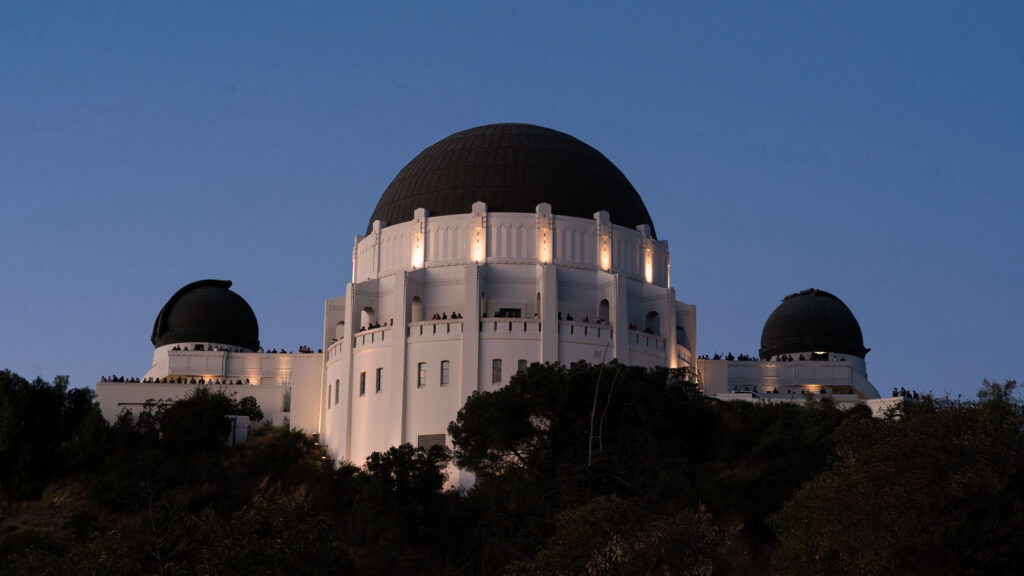
Griffith Observatory
Griffith Observatory is in Rebel Without a Cause, Midnight Madness, The Terminator, Charlie’s Angels: Full Throttle, La La Land, Transformers, and many more.
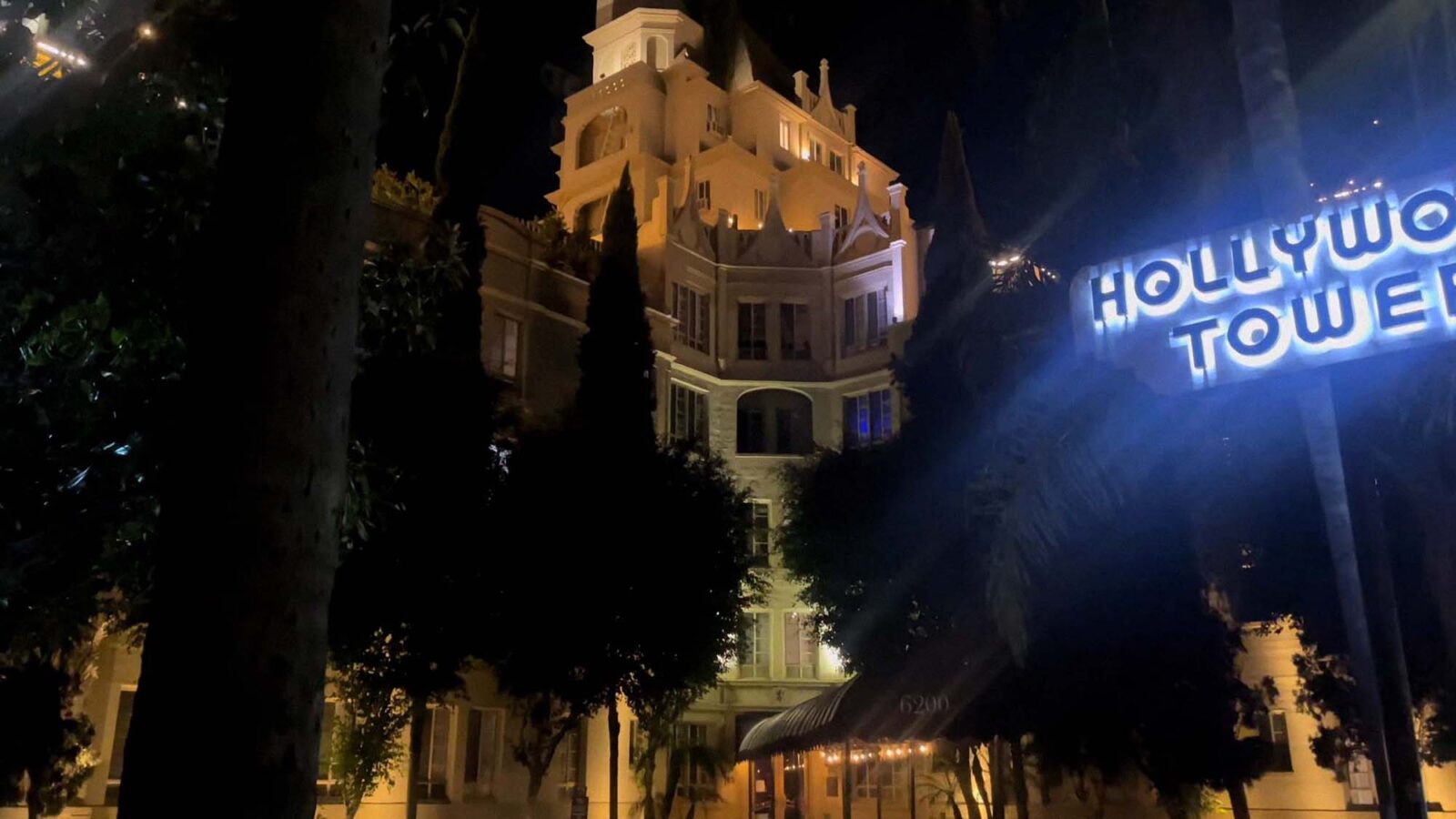
Hollywood Tower Apartments
Hollywood Tower Apartments, also known simply as Hollywood Tower, is a historic apartment building at 6200 Franklin Avenue in Hollywood, Los Angeles,…

Johnie’s Coffee Shop
Johnie’s Coffee Shop is in Midnight Madness, Miracle Mile, Reservoir Dogs, Volcano, City of Angels, The Big Lebowski, American History X and Gone in 60 Seconds.

Occidental College
Occidental College is in Pat and Mike, Midnight Madness, Star Trek III: The Search for Spock, Real Genius, Beverly Hills, 90210, Clueless and many more.
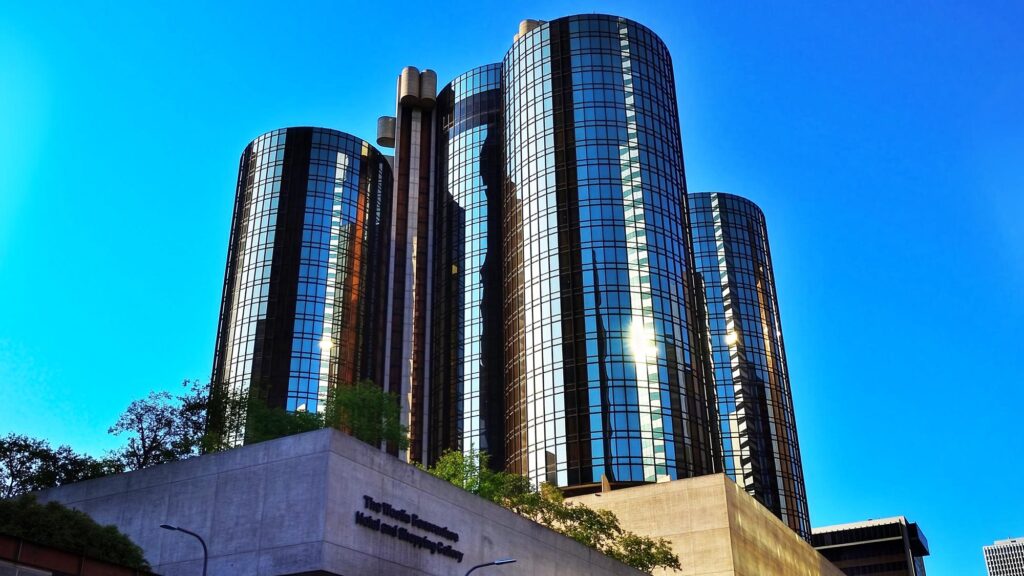
Westin Bonaventure Hotel
Westin Bonaventure Hotel has appeared in The Driver, Heaven Can Wait, Midnight Madness, Blue Thunder, Breathless, This is Spinal Tap, Rain Man and many more.