
Kull the Conqueror (1997) is an American fantasy adventure film directed by John Nicolella and starring Kevin Sorbo as Kull, a barbarian warrior who unexpectedly becomes king of Valusia after defeating its previous ruler in combat. His claim to the throne is challenged by General Taligaro, played by Thomas Ian Griffith, who conspires to resurrect the ancient sorceress Akivasha, portrayed by Tia Carrere. Karina Lombard plays Zareta, a slave and fortune teller who helps Kull fight the sorceress, while Harvey Fierstein appears as the pirate trader Juba. The film was produced by Raffaella De Laurentiis, who had previously worked on Conan the Barbarian (1982) and Conan the Destroyer (1984). It was originally developed as a third Conan film, based partly on Robert E. Howard’s novel The Hour of the Dragon, before the screenplay was reworked around Howard’s earlier character Kull. The film marked one of Sorbo’s first major cinema roles during his successful run on the television series Hercules: The Legendary Journeys.
Kull the Conqueror was filmed in Slovakia and Croatia between August and October 1996, with much of the production based in Bratislava. Producer Raffaella De Laurentiis had already worked in Slovakia on Dragonheart (1996), and returned to use several of the country’s medieval castles and the facilities at Koliba Studios. The production made extensive use of historic buildings rather than relying entirely on constructed sets, with filming taking place at Devín Castle, Červený Kameň Castle and Spiš Castle. The Croatian coastline and islands provided locations for the maritime sequences, including Kull’s voyage in search of the mystical Breath of Valka, the only power capable of destroying Akivasha.
Devín Castle, standing on a rocky hill above the confluence of the Danube and Morava rivers near Bratislava, was one of the production’s principal castle locations. The ruined fortress, whose history extends back to the early medieval period, provided an imposing setting for the fictional kingdom of Valusia. The production constructed additional scenery among the ruins, incorporating artificial structures into the existing stonework. This allowed the filmmakers to use the castle as part of a larger fantasy environment without having to build an entire fortress from scratch. The exposed walls, elevated courtyards and surrounding cliffs were particularly useful for the film’s exterior sequences. Additional scenes involving water were filmed on the nearby Danube, making the area around Devín an important part of the production.
Another Slovak location was Červený Kameň Castle, situated in the Little Carpathian Mountains near the village of Častá, northwest of Bratislava. Unlike the largely ruined Devín Castle, Červený Kameň is a substantial Renaissance fortress with enclosed courtyards, defensive walls and extensive historic interiors. Originally built as a medieval stronghold, it was substantially rebuilt during the sixteenth century and later became a residence of the Pálffy noble family. Its preserved architecture provided another setting for the film’s royal and fortified environments. The production used the castle alongside the more heavily ruined locations elsewhere in Slovakia, allowing different parts of the fictional kingdom to be represented by buildings with distinct architectural styles.
Filming also took place at Spiš Castle in eastern Slovakia, near the town of Spišské Podhradie. The enormous medieval fortress occupies a limestone hill overlooking the surrounding countryside and is one of the largest castle complexes in Europe. Originally established during the twelfth century, it was expanded repeatedly before a major fire in 1780 left much of the complex in ruins. By the time Kull the Conqueror was filmed there, its extensive walls, towers and open courtyards provided a ready-made setting for a large-scale fantasy adventure. The castle had already appeared in Dragonheart (1996), and would later be used for productions including The Last Legion (2007). Its appearance in Kull the Conqueror was part of a period during which Slovakia’s historic castles became increasingly popular with international film productions.
The interior filming was largely handled at Koliba Studios in Bratislava, one of Slovakia’s principal film production facilities. The studios provided space for the constructed interiors and more technically demanding sequences that could not easily be filmed inside protected historic buildings. The production combined traditional sets, practical effects and early computer-generated imagery, particularly for scenes involving Akivasha and her transformation into a demonic creature. Special make-up effects were used during the different stages of her transformation, while Tia Carrere was suspended on wires for scenes in which the sorceress floats above the flames. The fire and other supernatural elements were subsequently enhanced through visual effects. The film’s icy environments also required extensive studio work, with large water tanks and mechanical equipment used to create the dangerous conditions encountered during Kull’s journey.
The production’s second major filming area was the Croatian coast, where the Kornati archipelago and Murter Island were used for the maritime sequences. The Kornati islands, a group of mostly barren limestone islands in the Adriatic Sea, provided the rocky coastlines and open water needed for Kull’s voyage towards the Isle of Ice. In the film, Kull travels with Zareta and her brother Ascalante to the port of Tatheli, where he approaches his old acquaintance Juba about obtaining a ship. Their journey soon turns dangerous when Juba betrays them and Kull is forced to fight for control of the vessel. The open-water sequences were among the most difficult parts of the production.
For the Croatian filming, the crew constructed an entire village and rebuilt a ship for sequences filmed near Split. According to producer Raffaella De Laurentiis, the Croatian shoot lasted approximately three weeks and involved around sixty local crew members supplied through Jadran’s production facilities. Filming at sea proved particularly troublesome. The vessel experienced mechanical problems, including engine failures and water entering the hull, while wind and waves made it difficult to maintain consistent camera positions. The moving ship also created problems for the fight choreography, with actors and stunt performers having to maintain their balance while carrying weapons and wearing heavy costumes.
Some of the water sequences were especially demanding for the actors. Karina Lombard recalled being repeatedly lowered into the sea while wearing a harness for a scene involving Zareta. Harvey Fierstein also encountered difficulties filming in the water because Juba’s heavy leather costume considerably restricted his movement. Sorbo later described the shipboard fight scenes as physically exhausting, with performers suffering cuts and minor injuries during the action. The conditions were particularly demanding because many of the fights involved several actors moving across the deck simultaneously.
The international production brought together performers and technicians from several countries. Sorbo later recalled that twelve different languages were spoken on the set, occasionally making even simple instructions difficult to communicate. Before filming began, he had spent two months training in martial arts and sword fighting with Jerry Poteet and Fran Joseph while continuing his television work in New Zealand. He also took additional horse-riding lessons in preparation for the film. During production, Sorbo performed many of his own stunts and worked long shooting days, sometimes extending to fourteen hours. He later remembered the experience of filming in Slovakia and Croatia particularly fondly, especially the opportunity to work among the country’s historic castles.
Kull the Conqueror was released in August 1997 but performed poorly at the box office, earning approximately $6.1 million in North America against a production budget estimated at $30 million. Despite its commercial failure, the film remains an example of the large-scale fantasy productions that used Central and Eastern European locations during the 1990s. Several of its most prominent settings were actual medieval fortresses, while the Croatian sequences involved the construction of an entire village and the demanding practical work of filming aboard a ship at sea.
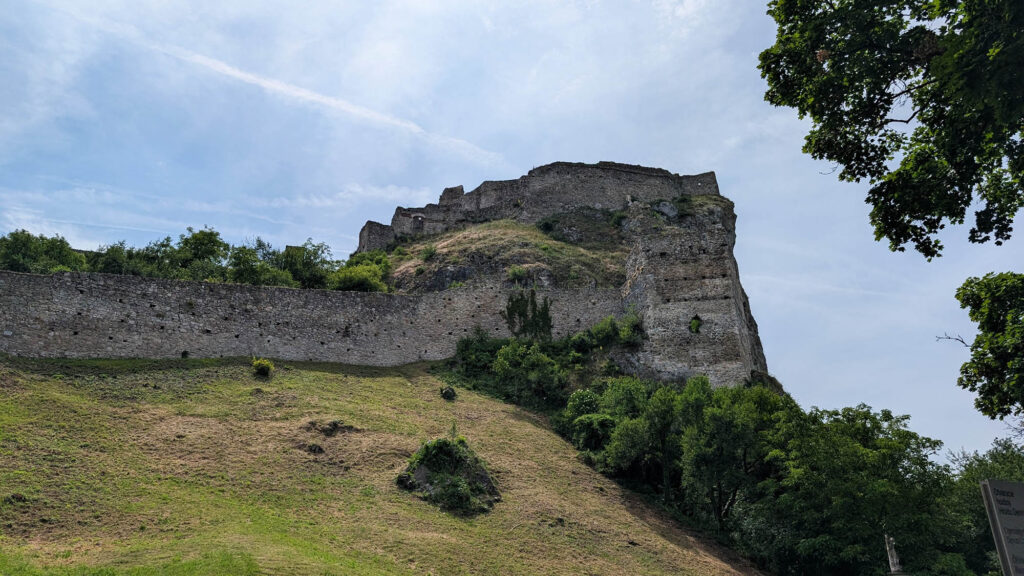
Devín Castle
In Kull the Conqueror (1997), Devín Castle is used as one of the film’s fortress locations.
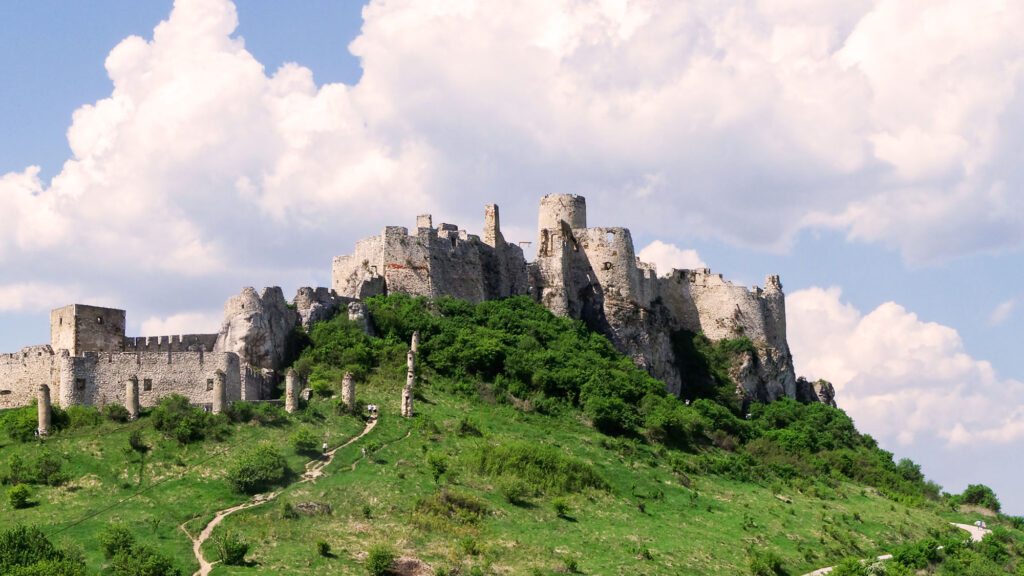
Spiš Castle
Spiš Castle is a vast medieval castle, and appears in Dragonheart (1996), Kull the Conqueror (1997), The Lion in Winter (2003) and The Last Legion (2007).