
Joker (2019) is an American psychological crime thriller directed by Todd Phillips and co-written with Scott Silver, starring Joaquin Phoenix as Arthur Fleck, a struggling party clown and aspiring stand-up comedian living with his mother in Gotham City in 1981. Isolated, frequently humiliated and increasingly unable to cope with his circumstances, Arthur gradually descends into violence while a growing protest movement transforms him into an unlikely symbol of rebellion. Robert De Niro plays television host Murray Franklin, whom Arthur idolises, while Frances Conroy portrays his mother Penny, Zazie Beetz appears as his neighbour Sophie Dumond, and Brett Cullen plays billionaire Thomas Wayne. Drawing considerable inspiration from Martin Scorsese’s Taxi Driver (1976) and The King of Comedy (1982), the film presents a version of Gotham far removed from the elaborate superhero environments of earlier Batman films. Joker won the Golden Lion at the Venice Film Festival and received eleven Academy Award nominations, winning Best Actor for Phoenix and Best Original Score for Hildur Guðnadóttir.
Joker was filmed in New York City and New Jersey between September and December 2018, with locations in the Bronx, Manhattan, Brooklyn, Newark, Jersey City and Long Island. Although the story takes place in the fictional Gotham City, production designer Mark Friedberg based its appearance on the New York he remembered from the 1970s and early 1980s. He and Phillips spent months searching for streets and buildings that could represent different parts of the city, eventually constructing their own geographical layout of Gotham. Older commercial districts, elevated railway lines and surviving Art Deco buildings became essential to the film’s appearance. The production also brought in period vehicles, created fictional businesses and filled selected streets with rubbish to recreate the effects of a citywide garbage strike. Some locations were modified with computer-generated imagery, but much of Gotham was assembled from real buildings and neighbourhoods rather than extensive digital environments.
The opening scene was filmed on Market Street in Newark, New Jersey, near the former Paramount Theatre at 195 Market Street. Arthur is working outside the fictional Kenny’s Music Shop, twirling a promotional sign while dressed as a clown. A group of teenagers steals the sign and runs along Market Street before leading him into an alley, where they break the sign and assault him. The shop was a vacant commercial property beside the old cinema, which the production transformed into a rundown adult theatre called the Newart. The Paramount had originally opened as a theatre in 1886 and had been closed since 1986, but its surviving marquee and vertical sign made it particularly suitable for the film. The crew added fictional shopfronts, period advertising, graffiti and piles of rubbish, while digital effects extended the surrounding buildings. Friedberg later explained that the intersection of Market and Broad Streets reminded him of Times Square before its redevelopment. Newark also became the setting for the film’s climactic riots.
Arthur’s neighbourhood was filmed primarily in Highbridge in the Bronx, where the production found a residential district with steep streets, ageing apartment blocks and elevated railway lines. The exterior of the building where he lives with his mother Penny is on Anderson Avenue, close to West 167th Street. Its recessed entrance, distinctive arches and worn exterior helped establish the family’s modest circumstances. The apartment itself, along with the building’s narrow corridors and ageing lift, was reconstructed at Steiner Studios in Brooklyn. Friedberg designed the interiors to suggest a home that had once been reasonably comfortable but had changed very little over several decades. The production even installed a temporary lift door in the real building’s lobby to match the studio set, allowing the filmed interiors and exteriors to appear part of the same property.
Immediately beside the apartment building is one of the film’s most recognisable locations, the long public staircase connecting Anderson Avenue and Shakespeare Avenue at West 167th Street. Arthur is initially seen climbing the steps on his way home, exhausted and carrying his belongings up the steep hillside. Later, after fully embracing his Joker identity, he descends the same staircase wearing his red suit, green hair and clown make-up, dancing to Gary Glitter’s “Rock and Roll Part 2”. The sequence was filmed on the actual steps, with the surrounding apartment buildings and metal handrails remaining clearly visible. The staircase appears again when detectives Burke and Garrity attempt to arrest Arthur, prompting him to flee towards the elevated railway. Following the film’s release, the steps became internationally known as the Joker Stairs, attracting large numbers of visitors and creating some frustration among residents who use them as an everyday pedestrian route.
Several other Bronx locations appear during Arthur’s daily routine. He visits a pharmacy on East 174th Street to collect his medication and watches his neighbour Sophie take her daughter to school outside P.S. 73 on Anderson Avenue. The story subsequently follows Sophie towards Gotham’s financial district, with the former City Bank–Farmers Trust Building at 20 Exchange Place in Lower Manhattan standing in for Gotham Savings Bank. The Art Deco skyscraper, completed in 1931, provides a striking contrast to Arthur’s neglected neighbourhood. Another scene involving Arthur and Sophie was filmed at the former Twin Donut shop at 3396 Jerome Avenue in the Norwood section of the Bronx. The characters sit together at the small coffee shop after an evening out, although the film later reveals that their apparent relationship existed largely in Arthur’s imagination. The original Twin Donut location has since closed, and the premises were subsequently occupied by Starbucks.
Arthur’s employer, Ha-Ha’s Talent Booking, was filmed at 2335 12th Avenue in Manhattanville, beneath the elevated Riverside Drive Viaduct near the Hudson River. The building was a commercial property used by a rug-cleaning business, but its industrial surroundings suited the rundown clown agency where Arthur changes costumes, argues with his colleagues and receives the gun that eventually changes his life. The production decorated the surrounding walls with large murals referring to Amusement Mile, a fictional amusement district associated with the Joker in DC Comics. Friedberg originally considered using the Coney Island Boardwalk for the agency, but eventually preferred the more isolated industrial setting in Manhattanville. After Arthur loses his job, he leaves the building and angrily defaces the agency’s sign. The location also appears during scenes showing him sitting alone beneath the viaduct, surrounded by the city’s traffic and neglected commercial buildings.
New York’s subway system plays an equally important role in the film, particularly during the sequence in which Arthur shoots three wealthy businessmen who harass him on a train. The killings begin inside a subway carriage before the final victim attempts to escape through an underground station. Much of the station sequence was filmed on the abandoned lower level of Ninth Avenue station in Sunset Park, Brooklyn, a platform that had been closed to regular passenger service since 1975. Arthur follows the injured man onto the platform and shoots him before fleeing through the station. The same disused platform had previously appeared in Crocodile Dundee (1986). Other parts of Arthur’s escape were filmed around Chambers Street in Lower Manhattan and beneath the Manhattan Bridge, including the passage along Cherry Street. Arthur then enters a public lavatory, where he performs a strange, solitary dance following the murders. Although the exterior approach was filmed on location, the lavatory interior was constructed at Steiner Studios, giving Phillips and Phoenix greater control over the lighting and performance.
Additional subway scenes were filmed across Brooklyn and the Bronx, including Bedford Park Boulevard station and the elevated 170th Street station. Towards the end of the film, Arthur is pursued through the Bronx by two detectives and escapes onto a train crowded with protesters wearing clown masks. The sequence moves between several real stations, with altered signage and editing making them appear to belong to a continuous fictional transit system. The production worked with the Metropolitan Transportation Authority to obtain access to both operating stations and disused platforms, while some carriage interiors were recreated in the studio. Friedberg’s team even designed a complete Gotham transit map, incorporating fictional neighbourhoods and references to characters and creators from the Batman comics. Period buses were also used, including a 1970s vehicle obtained from an automotive museum in New Jersey.
Arthur’s investigation into his mother’s past takes him to several locations associated with the wealthy Wayne family. Wayne Manor was filmed at the Webb Institute in Glen Cove on Long Island, a naval architecture college occupying a former private estate known as The Braes. The large house, now called Stevenson Taylor Hall, stands above Long Island Sound and had already appeared as Wayne Manor in Batman Forever (1995) and the television series Gotham (2014–2019). Arthur approaches the property’s entrance and speaks to a young Bruce Wayne through the gates before being confronted by the family butler, Alfred. Elsewhere in Manhattan, the Seagram Building at 375 Park Avenue was used to represent Wayne Enterprises. Designed by Ludwig Mies van der Rohe and completed in 1958, the modernist skyscraper provides a deliberately different environment from the older neighbourhoods where Arthur spends most of his time.
The fictional Wayne Hall, where Arthur attempts to confront Thomas Wayne during a screening of Charlie Chaplin’s Modern Times (1936), was created using two separate historic buildings. Its exterior was filmed at the William J. Brennan Courthouse, formerly the Hudson County Courthouse, at 583 Newark Avenue in Jersey City. Completed in 1910, the courthouse features a monumental Beaux-Arts exterior that suited the elaborate charity event organised by Gotham’s wealthy residents. Large crowds of protesters wearing clown masks gather outside while Arthur slips past security. The production employed 455 background performers during its largest day of filming at the location. Once Arthur enters the building, the action moves to the Kings Theatre at 1027 Flatbush Avenue in Brooklyn. The theatre originally opened in 1929 as Loew’s Kings Theatre, closed in 1977 and underwent an extensive restoration before reopening in 2015. Its richly decorated auditorium provides the setting for the Chaplin screening, where Arthur watches Thomas Wayne from a balcony. The lavish bathroom in which he subsequently confronts Wayne was constructed separately on a soundstage.
Another important Brooklyn location is the former Brooklyn Army Terminal in Sunset Park, used as the exterior of Arkham State Hospital. The enormous industrial complex, originally constructed as a military supply terminal during the First World War, provided the intimidating architecture needed for Gotham’s psychiatric institution. Arthur enters the building while searching for records concerning his mother’s treatment, although the production digitally altered the exterior to make it appear more institutional. Inside, the action moves to NYC Health + Hospitals/Metropolitan at 1901 First Avenue in East Harlem. The hospital’s corridors, lift and basement offices were used for the scenes in which Arthur obtains Penny’s medical file and discovers disturbing information about his childhood. Metropolitan Hospital was also used elsewhere in the film, including the scenes following Penny’s admission to hospital. Arthur is questioned by detectives outside its Second Avenue entrance, while another hospital sequence shows him entertaining children before accidentally dropping a gun from his costume.
For the television sequences, the filmmakers returned to Steiner Studios at the Brooklyn Navy Yard. The exterior of the fictional NCB television building was created using a building on Washington Avenue within the studio complex, while the programme itself was filmed on an elaborate soundstage. Friedberg designed the set for Live with Murray Franklin to resemble an American late-night talk show from the early 1980s, drawing particular inspiration from Johnny Carson’s Tonight Show. The studio included an audience area, dressing rooms, backstage corridors, a working control room and the brightly coloured television set. These were not simply separate rooms built for individual camera angles, but parts of a larger studio environment intended to make the fictional television production feel convincing. The sequence culminates in Arthur appearing as Joker on live television and murdering Murray Franklin in front of the studio audience.
The resulting unrest brings the film back to Market Street in Newark, where the production staged the climactic riot. Arthur is being transported in a police car when a stolen ambulance crashes into it near the intersection of Market and Halsey Streets. Protesters dressed as clowns pull him from the wreckage and gather around the vehicle while fires burn and shop windows are smashed. The surrounding streets were filled with overturned vehicles, period advertising, rubbish and large numbers of extras. Arthur eventually stands on top of the damaged police car and uses blood from his mouth to paint a grotesque smile across his face. Some of the film’s most recognisable images were photographed here, with the abandoned shopfronts and older commercial architecture of Newark providing the setting for Gotham’s violent collapse.
At the same time, Thomas and Martha Wayne leave a cinema with their young son Bruce, unaware that the riots have spread across the city. The exterior was filmed at Loew’s Jersey Theatre, 54 Journal Square Plaza in Jersey City, another elaborate cinema dating from 1929. As the family walks away from the theatre, they are followed into a nearby alley, where a masked rioter shoots both parents in front of their son. The scene recreates one of the central events in Batman’s fictional history, but places it within the social unrest established throughout Joker. The cinema had been saved from demolition through local preservation efforts and was undergoing a long-running restoration when the film was made. Its surviving marquee and historic entrance provided a convincing setting for a Gotham movie theatre without requiring the construction of an elaborate exterior set.
The film’s locations were carefully selected to give Gotham a consistent appearance despite being spread across several cities and boroughs. Friedberg’s team created an imaginary street layout, altered real buildings and designed period-specific details that could be repeated across different locations. The project employed approximately 4,000 extras, while the combination of real subway infrastructure, ageing commercial buildings and carefully controlled studio sets allowed Phillips to portray Gotham without relying on the large-scale digital environments associated with many comic-book films. The completed film also brought renewed attention to several previously overlooked locations, most notably the staircase in Highbridge, which has become one of the most recognisable filming locations in New York City.

Church Avenue Station
Church Avenue Station is a New York City Subway station in Brooklyn, served by the F and G trains. The station is…
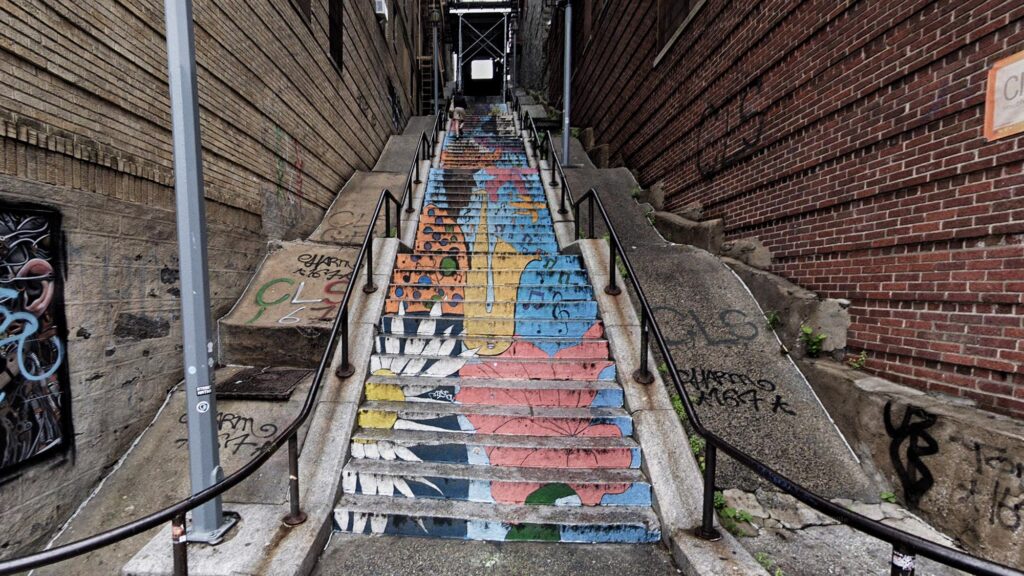
Joker Stairs
Joker Stairs appears in Joker (2019). The staircase is one of the film’s defining locations and associated with Arthur Fleck’s transformation into the Joker.