
Bathory (2008) is a historical drama written and directed by Slovak filmmaker Juraj Jakubisko, starring Anna Friel as Elizabeth Báthory, the Hungarian noblewoman whose life became associated with accusations of torture and the murder of numerous young women during the late sixteenth and early seventeenth centuries. Rather than following the traditional legend of the Blood Countess, Jakubisko presents Báthory as a powerful aristocrat caught in a struggle over wealth, religion and political influence. The film also stars Karel Roden as György Thurzó, Vincent Regan as Ferenc Nádasdy, Hans Matheson as the painter Caravaggio and Franco Nero as King Matthias II. An international co-production between Slovakia, the Czech Republic, Hungary and the United Kingdom, it was among the most expensive films produced in Central Europe at the time.
Bathory (2008) was filmed mainly in Slovakia and the Czech Republic, using numerous historic castles, palaces and medieval towns to recreate sixteenth- and seventeenth-century Hungary. Filming began in late 2005 and continued through 2006, with the production using approximately 42 different locations, including around 20 castles and châteaux. Among the principal locations were Čachtice Castle in Slovakia and the Czech castles of Točník, Pernštejn, Křivoklát, Buchlov and Jindřichův Hradec, together with the Renaissance châteaux of Doudleby nad Orlicí, Telč and Velké Losiny. Additional filming took place at the Pribylina open-air museum in Slovakia, around the High Tatras and at Koliba Studios in Bratislava. The production frequently combined several historic buildings to represent the same fictional residence, with parts of Báthory’s castle assembled from locations hundreds of kilometres apart.
The film opens with an aerial view of the ruins of Čachtice Castle, standing on a hill above the village of Čachtice in western Slovakia. The medieval fortress was one of the real residences associated with Elizabeth Báthory and became the place where she was confined following her arrest in 1610. The opening footage shows the surviving stone walls and ruined towers in their present condition, establishing the historical setting before the story moves into the past. Although the actual castle appears in the introduction, most of the scenes portraying it as an inhabited Renaissance fortress were filmed at other locations, primarily in the Czech Republic. The production therefore used the real Čachtice ruins as a historical reference while recreating much of the building’s earlier appearance elsewhere.
One of the most extensively used locations was Točník Castle, a late fourteenth-century royal fortress near the village of Točník in Central Bohemia. Built for King Wenceslaus IV, the castle retains substantial medieval walls, courtyards, gateways and residential buildings. In Bathory, these structures became major parts of Elizabeth’s castle at Čachtice. The opening scenes depicting the fortress in its inhabited state were filmed here, including views of the castle entrance, its interior courtyard and the rooms of the former royal palace. The production constructed temporary wooden structures and additional architectural details within the courtyard to give the existing ruins the appearance of a functioning noble residence.
Točník appears repeatedly during Elizabeth’s relationship with the young Italian painter Caravaggio, played by Hans Matheson. The painter arrives at the castle to work on her portrait, and several scenes involving their growing attachment take place in and around the castle’s residential buildings. The former royal palace was used for scenes in which Elizabeth visits Caravaggio, while the surrounding courtyard and entrances appear as messengers and visitors travel through the fortress. Another sequence shows György Thurzó, played by Karel Roden, arriving at the castle with news concerning Elizabeth’s husband. The existing stone architecture was combined with temporary sets, particularly in the second courtyard, where much of the open space was occupied by newly constructed scenery.
The Czech castle of Pernštejn, near Nedvědice in South Moravia, supplied additional interiors and passages for the fictional Čachtice Castle. Built during the thirteenth century and substantially developed during the late Gothic and Renaissance periods, Pernštejn is known for its narrow stairways, enclosed courtyards and complicated arrangement of corridors. These features were incorporated into the film’s castle interiors, particularly the passages connecting Elizabeth’s private rooms with other parts of the fortress. One scene shows Elizabeth wandering through the corridors in distress after a violent encounter with her husband Ferenc, while other sequences involve servants moving through the castle and attempting to escape punishment.
Pernštejn was also used for the sequence involving the servant Erika, who falls from a castle window while attempting to escape. The film shows her body lying on the stone paving below, with the actual castle courtyard providing the setting. Additional scenes were filmed around its smaller courtyards, staircases and entrances to underground areas. The production combined these spaces with those photographed at Točník and the studio interiors in Bratislava, creating the impression of a much larger and more complicated castle than any of the individual locations.
Another major location was Doudleby nad Orlicí Château in eastern Bohemia. Constructed in the late sixteenth century, the Renaissance residence is particularly recognisable for its enclosed courtyard decorated with elaborate sgraffito patterns. Director Juraj Jakubisko selected the property because its architecture closely matched his conception of the residence where Elizabeth Báthory lived. The courtyard, formal garden and several interior rooms were incorporated into the film, including the dining room with its historic Baroque stove. Unlike the ruined medieval castles used elsewhere, Doudleby provided the appearance of a comfortable aristocratic residence that had remained in regular use.
The château appears during the scenes involving Elizabeth and Caravaggio, including a sequence in which the painter is working on her portrait outdoors when he is bitten by a venomous snake. Elizabeth and her attendants rush to help him and carry him through the château courtyard for medical treatment. The distinctive sgraffito-covered walls are visible as the group moves across the property. Later scenes include the arrival of a carriage carrying the body of a dead servant, and a sequence in the garden where the monks Peter and Cyril secretly observe the preparations for her burial. The production also filmed around a large copper beech tree in the château park, a local landmark that was subsequently destroyed by Storm Emma in March 2008. The château’s management has preserved photographs and accounts of the filming, including Jakubisko’s explanation of why the building was chosen.
The fictional village below Čachtice Castle was recreated at the Museum of the Liptov Village in Pribylina, northern Slovakia. Established to preserve historic buildings from the Liptov region, the open-air museum contains traditional wooden houses, agricultural buildings, a church and reconstructed village streets. The production used the museum to represent the settlement inhabited by Báthory’s subjects, adding temporary structures to the existing buildings. Among these was a tavern built specifically for the film, where the monks Peter and Cyril stay while investigating the accusations against the countess. The surrounding buildings and village paths appear as residents travel through the settlement and discuss the mysterious deaths attributed to Elizabeth.
The Pribylina village also appears in a sequence where local inhabitants stop Elizabeth’s carriage to show her the body of a dead man whom they believe has been killed by a vampire. Another scene shows the countess travelling through the village while the buildings of the fictional castle settlement rise in the background. For wider views, the filmmakers digitally added a castle based on the architecture of Doudleby nad Orlicí, combining the Slovak open-air museum with a Czech Renaissance residence that stood hundreds of kilometres away.
One of the museum’s most important buildings is the Church of the Virgin Mary, originally constructed in the thirteenth century in the village of Liptovská Mara and later moved to Pribylina when the original settlement was affected by the construction of the Liptovská Mara reservoir. The historic church was used for scenes in which a priest preaches against Elizabeth Báthory, contributing to the growing suspicions surrounding her. Its surviving medieval wall paintings and interior architecture appear during the sermon, while another brief sequence shows a dove entering the church. These scenes were filmed inside the real historic building rather than on a reconstructed church set.
Telč, a historic town in the Vysočina Region of the Czech Republic, provided several locations associated with Elizabeth’s early life, marriage and later relationship with her husband. Telč Château, a Renaissance residence developed from an earlier medieval castle, was used together with its formal gardens, courtyards and richly decorated interiors. The château garden appears during the marriage ceremony between the young Elizabeth and Ferenc Nádasdy, whose union has been arranged by their influential families. The ceremony takes place outdoors, with the formal garden and surrounding architecture forming the setting. Other scenes involving the younger characters were filmed inside the château, including moments leading up to their wedding night.
The production returned to Telč for scenes involving the adult Elizabeth. The château’s interiors were used for several rooms associated with the Nádasdy residence at Sárvár, including a dining room where Elizabeth confronts Caravaggio about their feelings for one another. Later, the Chapel of St George within Telč Château became the setting for the mourning of Ferenc Nádasdy. Elizabeth remains beside her husband’s body when Thurzó arrives to speak with her. The funeral sequences also use the château’s courtyards, where tensions between Elizabeth and Thurzó develop into an open confrontation. The town’s historic streets and squares, including areas around Jan Kypta Square and the entrance to the château, provided additional Renaissance surroundings for the production.
Further childhood and interior scenes were filmed at Jindřichův Hradec Castle and Château in South Bohemia. One of the country’s largest historic castle complexes, the property combines medieval fortifications with Renaissance courtyards and residential buildings. Its interiors were used for the young Elizabeth’s wedding-night sequence and later became part of the countess’s private apartments. Several scenes show Thurzó arriving to speak with Elizabeth or moving through the residence, while another depicts Caravaggio painting her portrait. The historic kitchens were also used for scenes associated with Darvulia, the mysterious woman who acts as Elizabeth’s adviser and healer. The complex’s surviving rooms and corridors were incorporated into the fictional residence alongside interiors from other Czech castles.
Velké Losiny Château, a Renaissance residence in northern Moravia, represented several aristocratic properties in the film. Its rooms were used for scenes involving the young Elizabeth, including a music lesson, and later for the residence of her relative Sigmund Báthory. During a visit to Sigmund, Elizabeth examines portraits and documents concerning her family history inside the château. The same property was used to represent Sárvár, where Elizabeth travels after receiving news that her husband has been wounded during his military campaigns. The château’s entrance and courtyard appear as she arrives, only to discover that Ferenc has already departed.
The Sárvár sequences at Velké Losiny also include Elizabeth’s increasingly violent treatment of her servants. In one scene, she orders several maids to be whipped in the courtyard, while other confrontations take place inside the château’s private rooms. These interiors were combined with additional Sárvár scenes filmed at Telč, creating another composite residence assembled from separate historic properties. Velké Losiny also has its own association with seventeenth-century witch trials, which took place on the estate during the late 1600s, although this history is separate from the events depicted in Bathory.
Buchlov Castle, near Buchlovice in southeastern Moravia, was used for the sequences involving Ferenc Nádasdy and György Thurzó during their imprisonment by Ottoman forces. The medieval fortress, built during the thirteenth century, provided the stone corridors, windows and courtyards of the fictional Turkish prison. Ferenc is shown watching from a window as captured soldiers are executed below, while other scenes depict the two noblemen being informed that they are to be executed the following morning. Their subsequent escape takes place through the castle’s passages and exterior areas. The production also used the castle’s historic kitchen for a confrontation between two servants.
Křivoklát Castle, west of Prague, represented the Transylvanian residence of Elizabeth’s relative Sigmund Báthory. The extensive medieval royal castle provided the courtyards, entrances and architectural surroundings for the scenes in which Elizabeth visits her family. She is shown arriving at the property and speaking with Sigmund and other members of his household. Later, she learns that Ferenc has been wounded and prepares to leave for Sárvár. The departure scenes were filmed around the castle courtyard, with its stone buildings and enclosed entrance clearly visible. Other parts of Sigmund’s residence were photographed at Velké Losiny, while digitally altered views of the High Tatras in Slovakia were used for the surrounding landscape.
The landscape near Štrba, in northern Slovakia, appears in a wide shot establishing Sigmund’s castle. The view was photographed from an open meadow near the road between Tatranská Štrba and Mengusovce, with the High Tatras visible in the distance. A fictional castle was subsequently added to the landscape, since no such fortress exists at the location. Other Slovak landscapes used in the film include the area around Liptovský Trnovec, near the Liptovská Mara reservoir. Here, Elizabeth and Caravaggio walk through the countryside as she shows him her extensive estates. The same landscape appears when Elizabeth demonstrates her skill with a hunting weapon, shooting at deer on the surrounding property. The reservoir and distant mountains remain recognisable in the background.
Lednice Château and its landscaped park in South Moravia provided another aristocratic setting. The estate’s extensive gardens were used for a chess game between Elizabeth and Thurzó during her visit to her Transylvanian relatives. Their conversation becomes increasingly hostile as Thurzó attempts to challenge her and she responds with equal determination. The scene was filmed outdoors, with the gardens representing part of Sigmund’s residence. The real château, now known primarily for its nineteenth-century Gothic Revival appearance, was not presented as the principal castle exterior in this sequence.
The winter landscape around Telč was used for several scenes involving Elizabeth travelling by carriage and sleigh. One of the main locations was the road between Třeštice and Růžená, where the production filmed the countess meeting Thurzó during a journey through the snow. Elizabeth enters his carriage while her servant Lucia, played by Lucie Vondráčková, follows in a sleigh. During their conversation, Thurzó becomes increasingly aggressive, and Elizabeth eventually forces him out of the carriage. The surrounding snowy fields and woodland appear throughout the sequence. Additional scenes involving Lucia’s attempted escape and her pursuit by soldiers were filmed in the nearby countryside, including areas around Sedlejov.
Several further castles were incorporated into the film’s medieval environments. Sovinec Castle in the Moravian-Silesian Region provided exterior walls, defensive structures and views of a castle tower used as part of the fictional Čachtice fortress. The ruins of Žebrák Castle, close to Točník, were used for a narrow doorway representing a secret escape route from Elizabeth’s castle. The location appears when the servant Erika attempts to flee through the entrance to a small tower. Zvíkov Castle, situated above the confluence of the Vltava and Otava rivers in southern Bohemia, was also used to represent the religious establishment associated with Cardinal Forgách, one of the figures involved in the political campaign against Elizabeth.
The production used St Barbara’s Church in Kutná Hora to represent the interior of St Stephen’s Cathedral in Vienna. The large Gothic church, begun in the fourteenth century, has an elaborate vaulted ceiling and numerous architectural features that allowed it to serve as the setting for the film’s Viennese religious scenes. Exterior views show the real St Stephen’s Cathedral in Vienna, but the principal church interiors were filmed in Kutná Hora. The production therefore combined two separate Gothic buildings to create the same location.
Large-scale military scenes were filmed in the Czech countryside, including the area around the small village of Mělník near Úžice in the Kutná Hora district. The open fields provided the setting for battles involving Nádasdy’s soldiers and Ottoman forces. Additional period streets and urban environments were constructed near Miloslavov, outside Bratislava, where the production recreated parts of Buda and other settlements associated with the military campaigns. These outdoor sets allowed the filmmakers to stage scenes involving soldiers, horses and large groups of extras without relying on existing modern towns.
Much of the film’s underground material was constructed at Koliba Studios in Bratislava. The studio sets represented the cellars, secret passages and chambers beneath Elizabeth’s castle, including a hidden room containing the body of a dead infant, Darvulia’s prison cell and the rooms associated with the accusations of torture. Other constructed interiors included Elizabeth’s private bedroom, the chamber where Thurzó informs her about her husband’s military activities and the passage in which she kills a servant. The production used these artificial interiors alongside the real corridors, courtyards and underground entrances at Točník and Pernštejn, allowing the fictional castle to contain an extensive network of spaces that did not exist together at any of the actual filming locations.
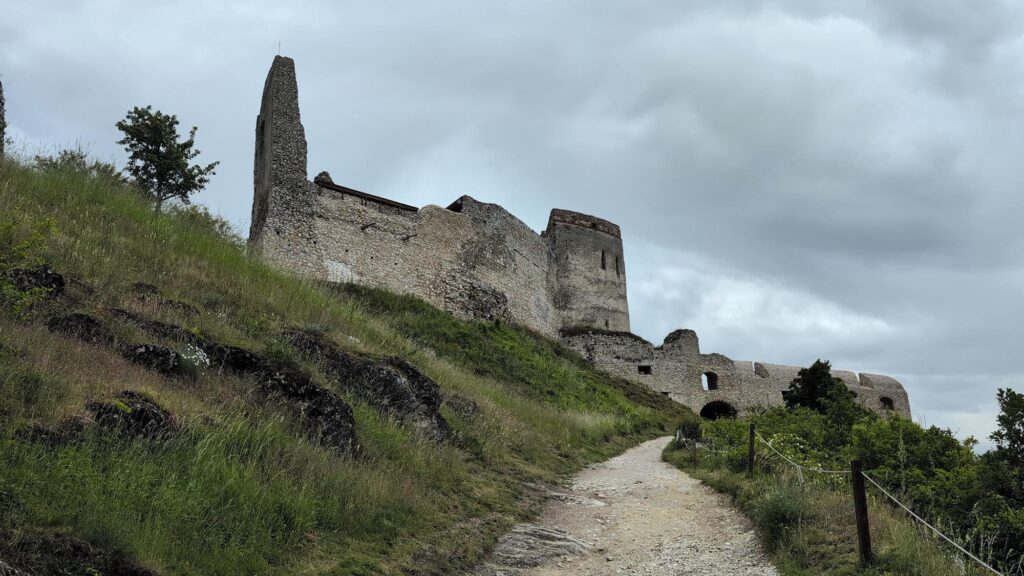
Čachtice Castle
Čachtice Castle has appeared in movies like The Mystery of the Carpathian Castle (1981), Dragonheart (1996) and Bathory (2008).