
Martin’s Tavern is a historic restaurant at 1264 Wisconsin Avenue NW, on the corner of N Street in the Georgetown neighbourhood of Washington, D.C. Established in 1933 by former professional baseball player William Gloyd «Billy» Martin and his father, William S. Martin, it is regarded as the oldest continuously operating family-owned restaurant in the American capital. The restaurant opened during the Great Depression, shortly after the repeal of Prohibition, and quickly attracted politicians, government employees, university students and residents of Georgetown. It has remained in the Martin family for four generations, with William A. «Billy» Martin Jr. and his wife Gina taking over ownership in 2001. The interior retains much of its traditional appearance, including dark wooden panelling, leather-upholstered booths, a long mahogany bar, Tiffany-style lamps and walls decorated with historic photographs and memorabilia. Several booths are associated with prominent political figures who regularly visited the establishment. Harry S. Truman often ate with his wife Bess and daughter Margaret in Booth 6, while Richard Nixon favoured Booth 2 during his years in Congress. John F. Kennedy was another regular customer, particularly while living just a few blocks away during the 1950s. He frequently visited for breakfast after attending Mass at Holy Trinity Catholic Church and reportedly worked on parts of his presidential inaugural address at the restaurant. According to a longstanding family tradition, Kennedy proposed marriage to Jacqueline Bouvier in Booth 3 on 24 June 1953, although other establishments have also claimed to be the location of the proposal. The booth is still marked by a commemorative plaque. Martin’s Tavern also attracted members of the sporting world, with baseball players including Mickey Mantle, Yogi Berra and Ty Cobb visiting its Dugout Room. During the Second World War, the restaurant became a gathering place for military officers, and its popularity continued through the political changes of the following decades. The Martin family has preserved much of the original interior and the restaurant’s traditional American menu, maintaining a business that has remained closely connected to Georgetown’s political and social history since the 1930s.
Martin’s Tavern appears in The Exorcist (1973), the supernatural horror film directed by William Friedkin and based on the novel by William Peter Blatty. The restaurant provides the setting for a conversation between Father Damien Karras and Tom, the president of Georgetown University, in which Karras admits that he is struggling with his responsibilities as a priest and has begun losing his religious faith. The scene was originally intended to take place at The Tombs, a popular Georgetown restaurant near the university that appears in Blatty’s novel. However, the filmmakers were refused permission to use that establishment and instead filmed the conversation inside Martin’s Tavern, approximately half a mile away.
In The Exorcist (1973), Martin’s Tavern appears during an early scene involving Father Damien Karras, played by Jason Miller, and Tom, the president of Georgetown University, played by the real-life Jesuit priest Thomas Bermingham. Karras is a psychiatrist and priest whose duties include counselling fellow members of the Catholic clergy, but he has become increasingly troubled by his own doubts about religion and his inability to help those who depend on him. The sequence begins inside the restaurant, where Karras collects two glasses of beer from the bar and carries them to a wooden booth occupied by Tom. The Allman Brothers Band’s «Ramblin’ Man» can be heard playing in the background, providing a contrast to the serious conversation that follows. Karras explains that he is worried about his elderly mother, who lives alone in New York City. He regrets having left her behind and believes that he should be living closer to her, particularly as her health deteriorates. Tom offers to investigate the possibility of transferring him to New York, but Karras explains that simply moving to another city will not solve his problems. He wants to leave his present assignment altogether, having become convinced that he can no longer provide the spiritual guidance expected of him. Although Tom reminds him that he is one of the best counsellors available, Karras argues that his work involves much more than psychiatry. Many of the priests who approach him are struggling with questions about their faith, their vocation and the meaning of their lives, and he no longer believes that he is capable of helping them. He finally admits that he thinks he has lost his own faith. The scene was filmed in the actual Martin’s Tavern, with the two characters seated in the booth subsequently identified as the Paul Scully-Power Booth. Although the restaurant is never named in the film, its wooden interior and traditional seating are visible throughout the conversation. The location has frequently been misidentified as The Tombs, the Georgetown restaurant associated with Blatty’s original novel. According to Michael Blatty, son of William Peter Blatty, the filmmakers initially wanted to shoot the sequence at The Tombs, but its owner refused permission because of religious objections to the story. Martin’s Tavern was consequently selected as the alternative filming location. The conversation is one of the first occasions in the film when Karras openly acknowledges his crisis of faith, establishing the personal doubts that will become central to his involvement in the exorcism of Regan MacNeil.

The Exorcist
The Exorcist (1973) was primarily filmed in Georgetown (Washington, D.C.), New York City, and Iraq.

The Exorcist Steps
The Exorcist Steps the famous 75-step stairway in Washington, D.C., have appeared in The Exorcist (1973), The Exorcist III (1990) and Ghosted (2023).

The Tombs
The Tombs appears in The Exorcist III (1990), the supernatural horror film written and directed by William Peter Blatty.

The Exorcist House
The Exorcist House refers to the private residence in Georgetown, Washington, D.C., which was used for exterior filming of the 1973 horror movie The Exorcist.
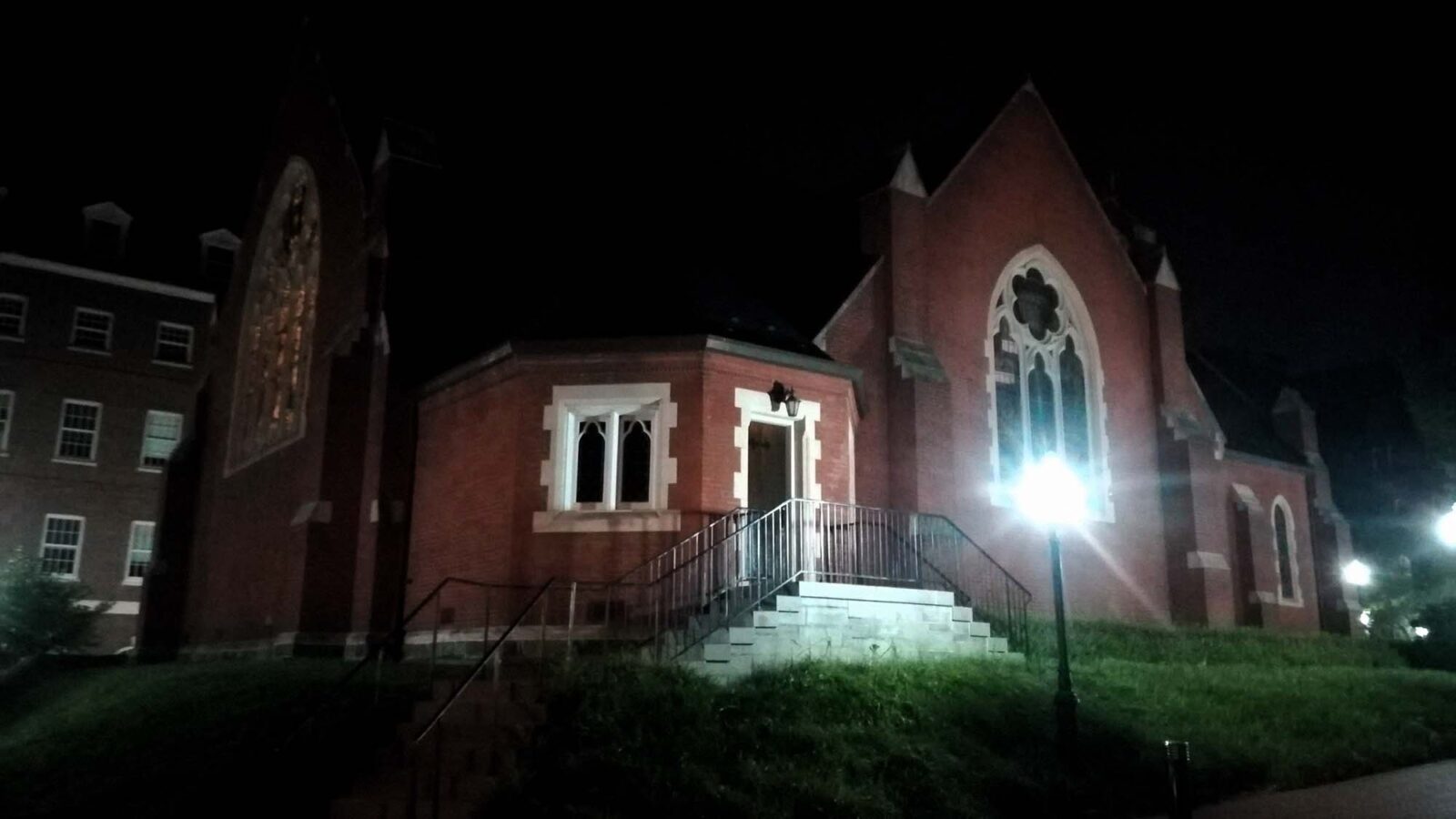
Dahlgren Chapel of the Sacred Heart
Dahlgren Chapel of the Sacred Heart appears in The Exorcist (1973) and The Exorcist III (1990), two horror films associated with Georgetown University.

Garrett Jacobs Mansion
The Garrett Jacobs Mansion has been used in productions as Bedroom Window, Clara’s Heart, Her Alibi, The Accidental Tourist, He Said, She Said, Major League II, 12 Monkeys, Diner, Species II, and My One and Only.

Miller School of Albemarle
Miller School of Albemarle has appeared in Morgan Stewart's Coming Home (1987), Toy Soldiers (1991) and Major Payne (1995).

Philadelphia Museum of Art Steps
Philadelphia Museum of Art Steps appear most famously in Rocky (1976), and later returned in several other Rocky and Creed films. They also appear in Shazam.

Rocky Statue
The Rocky Statue appears in Rocky III (1982), Rocky V (1990), Philadelphia (1993), Creed II (2018), and several later Rocky-related screen works.

Eastern State Penitentiary
As a filming location, Eastern State Penitentiary is used in three feature films: 12 Monkeys, Return to Paradise, and Transformers: Revenge of the Fallen.