
The Exorcist is a 1973 American supernatural horror film directed by William Friedkin and based on William Peter Blatty’s 1971 novel of the same name. Ellen Burstyn stars as Chris MacNeil, an actress living in Georgetown, Washington, D.C., whose twelve-year-old daughter Regan (Linda Blair) begins exhibiting increasingly disturbing behaviour. After medical examinations fail to explain her condition, Chris turns to two Catholic priests, Father Damien Karras (Jason Miller) and Father Lankester Merrin (Max von Sydow), who attempt to free Regan from demonic possession. The film also stars Lee J. Cobb, Jack MacGowran and Kitty Winn.
Principal photography began in August 1972, with filming taking place in Washington, D.C., New York City, New Jersey and northern Iraq. Georgetown provided the main exterior locations for the MacNeil residence and the surrounding neighbourhood, while much of the house’s interior was recreated at CECO Studios in Manhattan. Additional filming took place at Georgetown University, several New York hospitals and Fordham University in the Bronx. The Iraqi locations were used for the opening sequences involving Father Merrin, establishing his earlier encounter with the ancient demon Pazuzu.
The opening archaeological excavation was filmed at Hatra, the ancient fortified city approximately 100 kilometres southwest of Mosul in northern Iraq. Founded during the Parthian period, Hatra is known for its monumental temples, stone arches and extensive ruins, which were used to represent the excavation site where Father Merrin discovers an unusual amulet depicting the demon Pazuzu. Merrin examines the object before visiting a larger excavation area, where he eventually confronts a towering statue of the same demon. The climactic image of Merrin standing opposite the statue was filmed among Hatra’s ancient temple ruins, with the real stone architecture forming the background. The location was later designated a UNESCO World Heritage Site in 1985.
Further Iraqi scenes were filmed in Mosul, where Merrin moves through busy streets, markets and an outdoor café following his discovery at Hatra. The scenes include the priest examining antiquities, experiencing a moment of unease at a crowded market and taking medication while resting at a café. The local streets, traditional buildings and market activity were photographed on location rather than reconstructed in a studio. Filming in northern Iraq was particularly challenging because of the extreme summer temperatures, which sometimes reached approximately 54°C. Much of the outdoor photography consequently had to be undertaken during the cooler hours of the day.
The American section of the film is centred on Georgetown, where the production used real streets, historic buildings and university facilities. One of the first locations is Healy Hall at Georgetown University, a large Gothic Revival building completed in 1879. The steps and surrounding campus were used for the sequence in which Chris MacNeil is working on a fictional film about student unrest. The scene features crowds of protesting students, with Chris directing the action before arguing with one of the demonstrators. Approximately 300 Georgetown students, faculty members and staff appeared as extras during the university filming, including several Jesuit priests. The university archives preserve photographs and contemporary newspaper reports documenting the production, which took place on campus during October and November 1972.
After finishing work, Chris is seen leaving the university and walking towards her home. She descends the steps beside Lauinger Library, the university’s main library, before continuing through the residential streets of Georgetown. Part of her journey follows P Street and 36th Street NW, where the film shows the neighbourhood’s distinctive rows of brick townhouses. Another location along her route is Christ Church Georgetown on O Street, where she notices Father Karras speaking with another priest. These street scenes were filmed in the actual neighbourhood where the story takes place, placing the fictional MacNeil residence within the surrounding Georgetown community.
Georgetown University also supplied several locations associated with Father Karras. Kehoe Field, the university’s former outdoor running track, appears in the scene where Lieutenant William Kinderman (Lee J. Cobb) approaches Karras while the priest is exercising. Kinderman questions him about the death of film director Burke Dennings, whose body has been discovered at the bottom of the steep staircase near the MacNeil house. Their conversation continues as they walk through the campus, eventually entering Dahlgren Quadrangle, the historic courtyard surrounded by university buildings. The exterior of Dahlgren Chapel, a Catholic chapel completed in 1893, appears during these sequences and is also associated with the earlier discovery of a desecrated religious statue.
The university’s administrative buildings were also used for interior scenes. The president’s office in Healy Hall became the archbishop’s office, where Church officials discuss Regan’s condition and the possibility of authorising an exorcism. The film additionally used spaces associated with Old North, one of the university’s oldest surviving buildings. Father Karras’s modest living quarters were recreated to resemble a room occupied by Georgetown theology professor Father Thomas M. King, a Jesuit priest who also assisted the production. Another local religious location was Holy Trinity Catholic Church at 3513 N Street NW, where the interior was used for the brief sermon scene involving Karras.
The MacNeil residence is one of the film’s most recognisable locations. Its exterior was filmed at 3600 Prospect Street NW, a private house at the corner of 36th Street in Georgetown. The building stands immediately west of the steep staircase descending towards M Street, although its original architecture differed significantly from the house shown in the film. For the production, the crew constructed a temporary extension on the eastern side of the property, bringing the fictional bedroom window much closer to the staircase. A mansard-style roof section was also added to provide the attic space required by the story. These additions allowed the house to appear physically connected to the neighbouring stairway, an important detail for the film’s climax.
The house appears repeatedly as Chris becomes increasingly concerned about Regan’s behaviour and as doctors, police officers and priests begin visiting the property. Its best-known appearance comes at night when Father Merrin arrives to perform the exorcism. Carrying a suitcase and wearing a dark coat and hat, Merrin stands outside beneath a streetlamp while a bright beam of light shines from Regan’s upstairs bedroom window. This composition became the basis for one of the most famous promotional images in horror cinema. The temporary extension that created the illuminated bedroom window was removed after filming, leaving the original building largely intact.
Beside the house are the steps that became internationally known as the Exorcist Steps. The steep staircase runs between Prospect Street and M Street, alongside the former Capital Traction Company building. Constructed in the late nineteenth century, it was originally an ordinary pedestrian connection between the two streets. The steps appear several times in the film, first in connection with the mysterious death of Burke Dennings and later during the final confrontation with the demon.
For the climax, Father Karras demands that the demon leave Regan and possess him instead. After briefly losing control, he throws himself through the upstairs window and falls down the staircase, eventually coming to rest at its base. The production covered the steps with a layer of protective rubber, allowing a stunt performer to tumble down them during the sequence. The temporary extension to the MacNeil house was essential for this shot because the real bedroom windows were too far from the staircase to make the fall possible. Father Dyer (William O’Malley) subsequently arrives and administers the last rites to the dying priest. The staircase also appears near the film’s ending when Chris and Regan leave Georgetown. In 2015, the location received a commemorative plaque recognising its connection to the film.
Martin’s Tavern at 1264 Wisconsin Avenue NW in Georgetown was used for the bar scene in which Father Damien Karras (Jason Miller) meets with the president of Georgetown University to discuss his growing doubts about his vocation and religious faith. During their conversation, Karras admits that he feels unable to continue his work as a priest and requests reassignment. The scene was originally intended to be filmed at The Tombs, a nearby restaurant that also appears in William Peter Blatty’s 1971 novel. According to Blatty’s son Michael, the owner of The Tombs refused permission because of his deeply held religious beliefs, forcing the production to find another location. Martin’s Tavern subsequently accommodated the filming, and the scene was shot inside the historic restaurant, which has operated in Georgetown since 1933.
Another important Georgetown location is the Chesapeake and Ohio Canal, close to the Francis Scott Key Bridge. A small footbridge over the canal, known as the Alexandria Aqueduct Footbridge, was used for the conversation in which Chris approaches Father Karras about Regan’s condition. Having exhausted conventional medical explanations, she asks whether he knows anything about exorcism and explains her growing conviction that her daughter is possessed. The scene was filmed on the actual pedestrian bridge beside the historic canal, with the neighbouring buildings and waterway visible around the actors. The Francis Scott Key Bridge and Potomac River also appear in wider views establishing the Georgetown neighbourhood.
Although the story remains largely in Washington, several scenes involving Father Karras were filmed in New York City. His elderly mother’s apartment building was represented by a residential property at 424 West 48th Street in Manhattan. Karras visits his mother, Mary (Vasiliki Maliaros), who lives alone and struggles with declining health. The scenes establish his concern for her welfare, which becomes an important part of the psychological torment he experiences later in the film. The original entrance to the building has since been altered, with the former doorway replaced by windows.
New York also provided locations for Karras’s disturbing dream about his mother. The sequence includes a subway entrance at the intersection of Essex Street and Delancey Street on Manhattan’s Lower East Side. In the dream, Karras sees his mother emerge from the subway while he attempts to attract her attention from the opposite side of the street. The surrounding street footage was filmed near the Williamsburg Bridge, allowing the sequence to combine separate views of the subway entrance and the nearby road system. The dream ends with his mother disappearing back into the station, leaving Karras unable to reach her.
Several real New York hospitals were used for the film’s medical sequences. Bellevue Hospital at 462 First Avenue in Manhattan and Goldwater Memorial Hospital on Roosevelt Island provided hospital interiors connected with Father Karras’s mother and the psychiatric treatment depicted in the story. Goldwater Memorial Hospital, located at the southern end of Roosevelt Island, was a large public medical facility that opened in 1939. The hospital closed in December 2013 and was subsequently demolished, with part of the former site redeveloped for the Cornell Tech campus.
The medical examination of Regan was filmed at the New York University Medical Center on First Avenue in Manhattan. The most prominent sequence shows Regan undergoing a cerebral angiography procedure, during which a catheter is inserted and contrast material is introduced into her bloodstream. The scene was filmed in the hospital’s actual radiology department, using working medical equipment rather than a specially constructed studio set. Several members of the hospital staff appeared in the sequence, including radiology technician Paul Bateson. Director of photography Owen Roizman later recalled that the crew had access to the rooms for only a limited period on a Saturday afternoon and filmed much of the sequence using the existing fluorescent lighting. The original facilities and medical personnel helped give the examination an unusually realistic appearance.
The production also used Fordham University’s Rose Hill campus in the Bronx. In the basement of Keating Hall, the university’s principal administration building, a room was converted into a language laboratory for the scene in which Father Karras studies recordings of Regan’s voice. Wearing headphones, Karras repeatedly listens to the recordings and discovers that some of the strange sounds contain intelligible speech when played backwards. The room’s institutional surroundings provided the setting for his investigation before he becomes directly involved in the exorcism. William O’Malley, who portrayed Father Dyer, was himself a Jesuit priest and theology professor at Fordham University.
The interior of the MacNeil residence was constructed at CECO Studios on West 54th Street in Manhattan. The studio sets recreated the house’s living room, kitchen, staircase, hallways and bedrooms, allowing the filmmakers to maintain a consistent interior layout even though the real Georgetown house was located more than 300 kilometres away. Regan’s bedroom was particularly elaborate, with removable walls and a ceiling designed to accommodate camera movements and the physical disturbances shown during the exorcism. The set was also fitted with a powerful refrigeration system that could reduce the temperature sufficiently for the actors’ breath to become visible. The cold room appears throughout the extended exorcism sequence, in which Fathers Merrin and Karras confront the possessed Regan.
Filming at CECO Studios was interrupted when a fire destroyed much of the MacNeil house set, forcing the production to rebuild several interior rooms. Regan’s bedroom, however, survived the blaze. The rebuilt interiors were subsequently used to complete the remaining scenes, including the final confrontation and the moments leading to Karras’s fall from the bedroom window. Through the combination of the Georgetown exterior, the temporary architectural additions and the studio interiors in New York, the filmmakers created the illusion that the events inside Regan’s bedroom were taking place directly above the real Georgetown staircase.
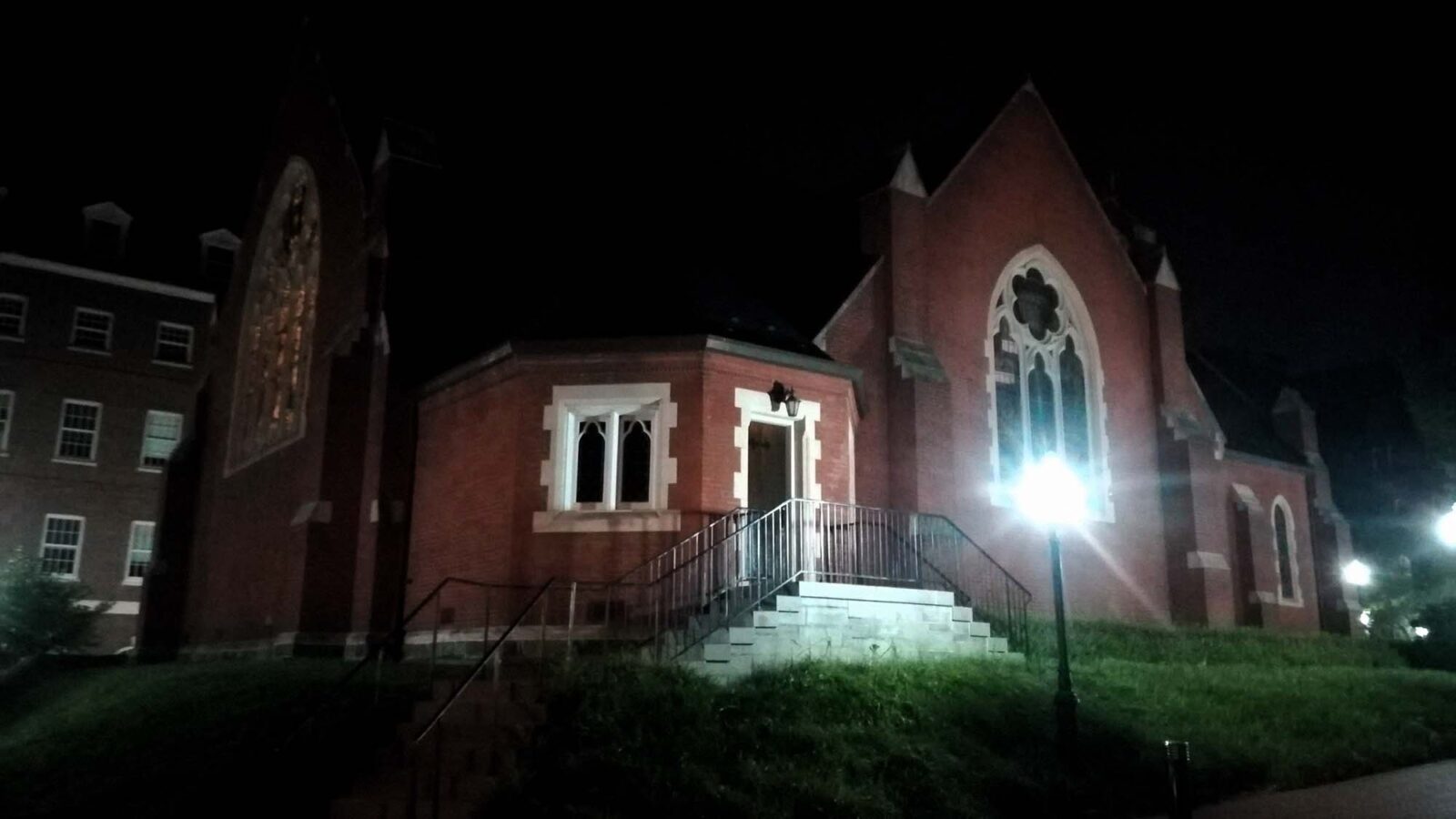
Dahlgren Chapel of the Sacred Heart
Dahlgren Chapel of the Sacred Heart appears in The Exorcist (1973) and The Exorcist III (1990), two horror films associated with Georgetown University.

Martin’s Tavern
Martin's Tavern appears in The Exorcist (1973), the supernatural horror film directed by William Friedkin and based on the novel by William Peter Blatty.

The Exorcist House
The Exorcist House refers to the private residence in Georgetown, Washington, D.C., which was used for exterior filming of the 1973 horror movie The Exorcist.

The Exorcist Steps
The Exorcist Steps the famous 75-step stairway in Washington, D.C., have appeared in The Exorcist (1973), The Exorcist III (1990) and Ghosted (2023).