
Pia Merete Tjelta was born on 12 September 1977 in Stavanger, Norway, and grew up in Sola, a municipality on the Jæren coastal plain immediately west of the city. Her family lived on a smallholding in the countryside, surrounded by relatives who also lived in the area. Her father worked as a baggage handler at Stavanger Airport, while her mother, Tone Tjelta, was a flight attendant with the Norwegian airline Braathens SAFE. She grew up with a younger sister and attended a Steiner school, where creative subjects and artistic activities formed an important part of her education. Although she would eventually establish her career in Oslo, she retained close connections to Stavanger and the surrounding Jæren region, frequently returning to visit family and friends. The beaches and coastal landscape of her childhood have remained particularly important to her, and she has spoken about returning to the sand dunes of Jæren whenever she visits the area.
Tjelta’s interest in performance took her abroad before she began her formal acting education. In 1996, she joined Sláva Theatre, an experimental theatre company based outside Stockholm, Sweden, under the artistic direction of Erik Nolin. The group worked from a barn in the Swedish countryside and developed productions involving music, movement and physical performance rather than conventional dialogue-driven acting. During approximately three years with the company, Tjelta participated in performances and educational activities and travelled on tours through parts of Eastern Europe. She subsequently moved to Oslo, where she studied music at the Norwegian Institute of Stage and Studio, commonly known as NISS, before gaining admission to the Norwegian National Academy of Theatre in 2000. Her studies were interrupted by maternity leave following the birth of her daughter Sofia, but she eventually graduated in 2006. By that time, she had already established herself as a recognisable film actress.
Her breakthrough came with Mongoland (2001), an independent comedy directed by Arild Østin Ommundsen and produced in Stavanger without conventional public film funding. Tjelta played Pia, a young woman who returns home from England shortly before Christmas and searches for her absent boyfriend. The film was made by a group of young performers and filmmakers with strong connections to Stavanger, including Kristoffer Joner, Silje Salomonsen, Vegar Hoel and Kyrre Haugen Sydness. Filming took place in Stavanger and the surrounding Jæren district, using familiar urban and residential locations rather than expensive studio sets. Produced with borrowed equipment and considerable voluntary assistance, Mongoland attracted approximately 90,000 cinema admissions and became an important early example of the independent filmmaking movement that developed around Stavanger. For Tjelta, it provided her first leading screen role and introduced her to a national audience while she was still a student in Oslo.
Her next substantial success came with Morten Tyldum’s Buddy (2003), a romantic comedy centred on a group of young people sharing an apartment in Oslo. Tjelta played Henriette alongside Nicolai Cleve Broch, Aksel Hennie and Anders Baasmo Christiansen. The film made extensive use of Oslo’s streets and residential neighbourhoods, reflecting the lives of young adults in the Norwegian capital. That same year, she appeared in Alexander Eik’s Kvinnen i mitt liv (The Woman in My Life, 2003), another popular Norwegian romantic comedy. These productions established her as a familiar presence in mainstream Norwegian cinema, while she continued to work with the independent filmmaking community in her home region. She reunited with Arild Østin Ommundsen for Monstertorsdag (Monster Thursday, 2004), a drama closely connected to the surfing culture of Jæren and the beaches along the southwestern Norwegian coast. She also appeared as Petra Stockmann in Erik Skjoldbjærg’s contemporary adaptation of Henrik Ibsen’s An Enemy of the People (2005).
Following her graduation in 2006, Tjelta became associated with Det Norske Teatret in central Oslo, where she appeared as Lila in Fyrverkerimakarens dotter (2006) and Maria in Få meg på, for faen (2007), an adaptation of Olaug Nilssen’s novel. Her theatre career soon expanded to other Oslo institutions. At Oslo Nye Teater, she played the title role in Sophocles’ Electra (2008) and Fantine in the musical Les Misérables (2009). During the summer of 2009, she travelled to Gålå in Gudbrandsdalen to portray Anitra in the annual outdoor production of Henrik Ibsen’s Peer Gynt. The performances were staged beside Lake Gålåvatnet, where the surrounding countryside has long formed part of the production’s theatrical setting. Later that year, she made her debut at Nationaltheatret in Oslo as Petra in a stage adaptation of Ingmar Bergman’s Fanny and Alexander. The engagement marked the beginning of a longstanding association with Norway’s National Theatre, situated on Stortingsgata in the centre of the capital.
Throughout the late 2000s and early 2010s, Tjelta alternated between theatre, cinema and television. She appeared in the marital comedy Mars & Venus (2007), receiving an Amanda Award nomination, and continued with films including 5 løgner (2007), Lønsj (2008) and the Bergen-based crime thriller Varg Veum – Falne engler (2008). Her television work included Hombres and the crime series Kodenavn Hunter, while her theatrical engagements became increasingly demanding. At Nationaltheatret, she portrayed Thea Elvsted in Ibsen’s Hedda Gabler (2010), Sonja in the Christmas production Reisen til julestjernen (2010) and Kitty in Anna Karenina (2012). Another significant screen performance came in Eva Sørhaug’s 90 minutter (90 Minutes, 2012), a drama examining violence within intimate relationships, for which she received another Amanda nomination. She subsequently appeared in Nini Bull Robsahm’s psychological thriller Amnesia (2014). From 2014 to 2017, she also played Anki in the television comedy Neste sommer, bringing her to a wider Norwegian television audience.
One of her most substantial stage roles came in 2014 when she portrayed Rita Allmers in Henrik Ibsen’s Little Eyolf at Nationaltheatret, opposite Kåre Conradi as Alfred Allmers. Directed by Sofia Jupither, the production was first staged in Oslo in September 2014 and subsequently revived several times. It eventually travelled beyond Norway, including performances at the Coronet Theatre in London’s Notting Hill district in April 2018 and at the Radu Stanca National Theatre in Sibiu, Romania, later that year. The production demonstrated Tjelta’s growing reputation as an interpreter of Ibsen, whose plays remained an important part of her theatrical work. In 2019, she returned to the Coronet Theatre at 103 Notting Hill Gate, this time playing Ellida Wangel in The Lady from the Sea. The production, presented by the Norwegian Ibsen Company and the theatre’s Print Room, ran from February to March and combined Norwegian and English dialogue. Directed by Marit Moum Aune, it brought Tjelta and Conradi together again in a production that explored Ibsen’s Norwegian characters through an international theatrical collaboration.
Her film career reached another significant turning point with Blindsone (Blind Spot, 2018), written and directed by Swedish actress and filmmaker Tuva Novotny. Tjelta portrayed Maria, a mother confronted by a sudden family tragedy involving her teenage daughter, opposite Anders Baasmo Christiansen. The production was technically demanding because its entire 98-minute narrative was filmed in a single continuous take, requiring the actors and camera crew to move between locations without conventional editing. Beginning in a residential area of Oslo, the story follows its characters through a series of increasingly distressing events, with Tjelta remaining central to much of the action. The film premiered at the Norwegian International Film Festival in Haugesund in August 2018 before screening internationally. At the San Sebastián International Film Festival in Spain, Tjelta received the Silver Shell for Best Actress, one of the festival’s principal acting honours. The performance subsequently earned her the Amanda Award for Best Actress and the Norwegian Film Critics’ Award in 2019, confirming her reputation beyond the romantic comedies that had characterised much of her earlier screen career.
During the same period, Tjelta returned professionally to the region where she had grown up through Lykkeland (State of Happiness, 2018–), NRK’s historical television drama about the transformation of Stavanger following the discovery of oil in the North Sea during the late 1960s. She played Ingrid Nyman, a wealthy shipowner’s wife whose family occupies an influential position in the city’s established social circles. The series follows the changes that affected Stavanger as shipping, fishing and traditional commerce increasingly gave way to the rapidly expanding petroleum industry. Filming took place in Stavanger and other parts of Rogaland, with locations including the area around Stokkavatnet, where Tjelta participated in scenes for the second season. The production gave her an opportunity to work in familiar surroundings while portraying a woman from an earlier generation of Stavanger society. Her performance earned her the Gullruten Award for Best Supporting Actress in 2022, and she continued playing Ingrid as the series progressed into the economic and social changes of the 1980s.
Tjelta’s association with Ibsen continued alongside these television commitments. Following her London performance in The Lady from the Sea, she appeared in further Norwegian productions, including August Strindberg’s The Dance of Death at Nationaltheatret, where she played Alice opposite Thorbjørn Harr. In October 2023, she took the title role of Nora Helmer in A Doll’s House, Part 2, American playwright Lucas Hnath’s sequel to Ibsen’s A Doll’s House, at Christiania Teater in Oslo. Directed by Mattis Herman Nyquist, the production also featured Anne Marit Jacobsen and Ola G. Furuseth. It was her first opportunity to portray Nora, one of the most celebrated characters in Norwegian theatre, although the story takes place fifteen years after the events of Ibsen’s original play. In July 2025, she returned to Ellida Wangel in a new Norwegian staging of The Lady from the Sea at Fjæreheia near Grimstad. The performances took place in a former granite quarry converted into an outdoor amphitheatre, close to the coastal town where Ibsen had worked as an apothecary’s apprentice during his youth. The production was adapted from the version Tjelta had performed in London six years earlier.
Outside acting, Tjelta established a career in fashion design. Her involvement began in 2014 through a collaboration with Norwegian designer Tine Mollatt, founder of the Oslo-based clothing company byTiMo. The partnership produced collections of dresses that attracted considerable attention in Norway and were worn at public events by prominent figures, including Crown Princess Mette-Marit. In 2017, Tjelta founded her own fashion label, Pia Tjelta Studio, drawing on her experience of theatrical costume design and her work with professional tailors at Nationaltheatret. The company developed collections of dresses and other women’s clothing, eventually establishing a showroom at Thereses gate 1 in Oslo. Tjelta has remained involved in the business alongside a team of designers, combining her theatrical commitments with the development of an independent commercial enterprise.
Her television career continued with Made in Oslo (2022), an eight-part drama created by Kathrine Valen Zeiner. Tjelta played Elin, a doctor running a fertility clinic in Oslo who struggles with her own inability to have children. The series also featured Tobias Menzies and Anders Baasmo Christiansen and examined the personal and professional consequences of Elin’s increasingly desperate attempts to become a mother. The role gave Tjelta another leading part centred on a morally complicated character, and she received the Gullruten Award for Best Actress in 2023. She also appeared in the Swedish film Diorama (2022), directed by Tuva Novotny, continuing a professional relationship established during Blindsone. Her later television work included further appearances in Lykkeland, while her stage commitments remained centred on Oslo and occasional productions abroad.
In 2025, Tjelta reunited with Kristoffer Joner for Se meg (Don’t Call Me Mama), the feature-film debut of Norwegian director Nina Knag. The production brought the two actors together more than two decades after their appearances in Mongoland. Tjelta played Eva, a secondary-school teacher married to a local mayor who begins a relationship with a young asylum seeker, played by Tarek Zayat. The film was shot during the summer of 2024 in Bergen and Odda in western Norway, including residential locations in Bergen’s Øyjorden district. Its story explores the power imbalance within the relationship and the consequences for the people involved. Se meg had its world premiere at the Karlovy Vary International Film Festival in the Czech Republic in July 2025, where Tjelta received the award for Best Actress. The film subsequently opened the Bergen International Film Festival in October before its Norwegian cinema release later that month. Her performance brought further recognition in 2026, when she won her second Norwegian Film Critics’ Award and her second Amanda Award for Best Actress.
That same period also saw her return to comedy with Ingen kommentar (No Comment, 2025), directed by Petter Næss. The political satire, inspired by scandals involving Norwegian politicians and their families, featured Tjelta as Karianne Moen, a media adviser responsible for managing a crisis surrounding the prime minister’s husband. She appeared alongside Laila Goody and Anders Baasmo Christiansen in a production released shortly before Norway’s parliamentary election in September 2025. The character provided a contrast to her dramatic work in Se meg, with both films reaching Norwegian cinemas during the same year.
Another major television project was Jo Nesbø’s Detective Hole (2026), Netflix’s adaptation of the internationally successful Norwegian crime novels. Tjelta portrayed Rakel Fauke, the woman involved in a complicated relationship with Oslo detective Harry Hole, played by Tobias Santelmann. Joel Kinnaman appeared as the corrupt police officer Tom Waaler. Filming began in Oslo on 23 May 2024 and continued until December, covering 113 shooting days and more than 160 locations across the capital. The production made extensive use of real places associated with Nesbø’s novels, including Restaurant Schrøder in St. Hanshaugen and the surrounding streets of central Oslo. Rakel’s house, situated beside the Oslofjord, also provided a distinctive residential setting for scenes involving Tjelta and Santelmann. The series premiered internationally on Netflix on 26 March 2026, introducing her to a broad audience beyond Scandinavia in a role closely associated with one of Norway’s best-known fictional characters.
Tjelta has lived and worked primarily in Oslo since moving to the capital as a young woman, maintaining her connection to Nationaltheatret while continuing to take roles in film and television. She has three children: her eldest daughter, Sofia, from an earlier relationship with actor Kyrre Haugen Sydness, and twins born in December 2015 with her long-term partner, actor Oddgeir Thune. Despite her professional commitments in Oslo, she continues to visit Stavanger and Jæren, where much of her family remains. Her work has repeatedly taken her back to that part of Norway, from the independent Stavanger production of Mongoland at the beginning of her screen career to the later filming of Lykkeland and her reunion with Kristoffer Joner in Se meg.
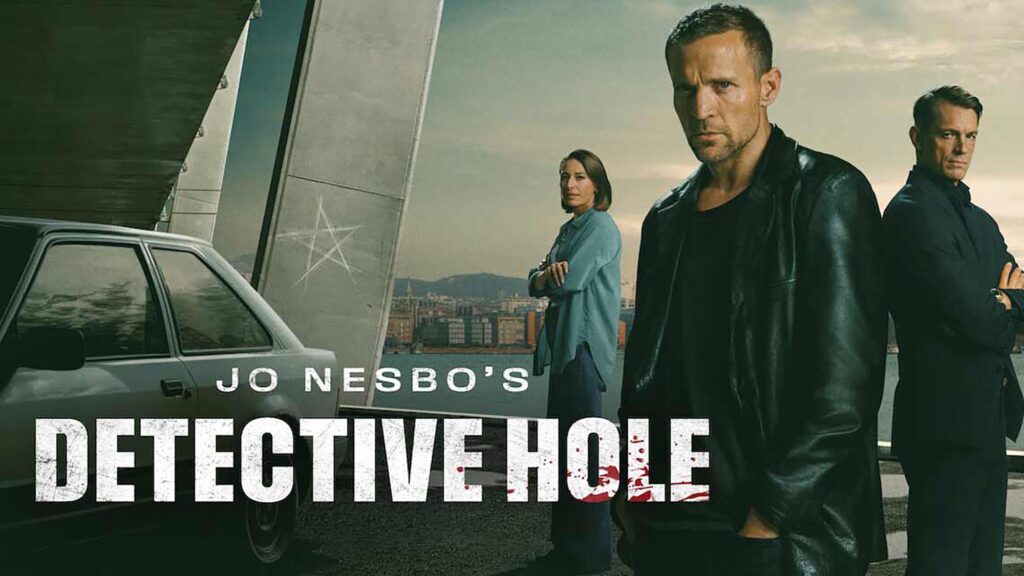
Jo Nesbo’s Detective Hole
Jo Nesbø’s Detective Hole is very closely tied to Oslo, and the city appears to have been used as a real dramatic environment rather than just a generic Scandinavian backdrop.