
Paul Leonard Newman (26 January 1925 – 26 September 2008) was an American actor, director, producer, racing driver and philanthropist whose career spanned more than five decades. Born in Cleveland Heights, Ohio, and raised in neighbouring Shaker Heights, he was the younger son of Arthur Sigmund Newman and Theresa Fetzer. His father helped run Newman-Stern, a sporting goods business in Cleveland, where his mother also worked. Newman grew up with his older brother, Arthur, and developed an interest in acting through school productions and the Cleveland Play House, appearing in its children’s theatre production of Saint George and the Dragon when he was ten. He attended Shaker Heights High School, graduating in 1943, and briefly studied at Ohio University in Athens before joining the United States Navy during the Second World War. Colour blindness prevented him from qualifying as a pilot, and he instead trained as a radioman and aircraft gunner, serving in the Pacific until his discharge in 1946.
After the war, Newman returned to Ohio and enrolled at Kenyon College in Gambier, where he became increasingly involved in theatre and graduated in 1949 with a degree in drama and economics. He subsequently worked with the Belfry Players in Williams Bay, Wisconsin, and the Woodstock Players in Woodstock, Illinois, gaining experience in repertory theatre. During this period he met actress Jacqueline Witte, whom he married in December 1949. The death of his father in 1950 interrupted his theatrical ambitions, and Newman returned to the Cleveland area to help manage the family sporting goods business. After approximately eighteen months, he resumed his training at the Yale School of Drama in New Haven, Connecticut, before moving to New York City, where he studied at the Actors Studio. His early professional work included appearances in live television dramas, while his Broadway debut came in William Inge’s Picnic in 1953. The production also brought him into contact with Joanne Woodward, then another young actress working in the New York theatre.
Newman’s first film, The Silver Chalice (1954), was an unsuccessful historical drama that he later openly criticised, but his portrayal of boxer Rocky Graziano in Somebody Up There Likes Me (1956) established him as a leading Hollywood actor. He also continued to work on stage, appearing in The Desperate Hours on Broadway in 1955. By the end of the decade, he had become closely associated with psychologically complex characters, notably in The Long, Hot Summer (1958), opposite Woodward, and Cat on a Hot Tin Roof (1958), in which he played Brick Pollitt alongside Elizabeth Taylor. The latter earned him his first Academy Award nomination for Best Actor. His marriage to Witte, with whom he had three children, Scott, Susan and Stephanie, ended in divorce in January 1958. He married Woodward in Las Vegas later that month, beginning a personal and professional partnership that continued for the remaining fifty years of his life. They subsequently had three daughters, Nell, Melissa and Claire, and appeared together in several productions, including From the Terrace (1960), A New Kind of Love (1963) and, much later, Mr. & Mrs. Bridge (1990).
Although Hollywood provided much of Newman’s film work, he and Woodward chose to establish their family home on the East Coast. During the early 1960s, they settled in Westport, Connecticut, where they maintained a farmhouse property and became involved in the local community. Their home offered a base within reach of the New York theatre world while Newman continued to travel extensively for film productions. His work during this period ranged from the Mediterranean to the American South and the streets of Manhattan. Otto Preminger’s Exodus (1960), in which Newman portrayed Ari Ben Canaan, was filmed in Cyprus and Israel, including locations associated with the historical events depicted in the story. The following year, he starred in Robert Rossen’s The Hustler (1961), playing ambitious pool player Eddie Felson. Filmed in New York City, the production used real billiard halls, including Ames Billiard Academy on West 44th Street in Manhattan, and Newman prepared for the role with professional billiards champion Willie Mosconi. His performance brought another Academy Award nomination and became one of the defining roles of his career.
Newman continued this run with Hud (1963), directed by Martin Ritt, in which he portrayed the selfish and rebellious son of a Texas rancher. Unlike many Western dramas produced largely on Hollywood sound stages, substantial portions of Hud were filmed in the Texas Panhandle. The production used the small town of Claude and the historic Goodnight Ranch, with location work taking place during the spring of 1962. Newman received another Academy Award nomination for his performance. He also maintained his connection to theatre through Tennessee Williams’s Sweet Bird of Youth, appearing in the original Broadway production in 1959 and reprising his role in the 1962 film adaptation. Other major roles of the decade included the detective drama Harper (1966), the Western Hombre (1967) and Cool Hand Luke (1967). In the latter, he played a prisoner who repeatedly defies the authorities of a Southern prison camp. Although the story takes place in the American South, much of the filming was carried out around Stockton and the Sacramento–San Joaquin River Delta in California, where an extensive prison camp set was constructed. The opening sequence, in which Newman cuts the heads from parking meters, was filmed in nearby Lodi.
In 1968, Newman made his feature-film directing debut with Rachel, Rachel, starring Woodward as a lonely schoolteacher in a small Connecticut town. Rather than moving the production to Hollywood, he filmed in the region surrounding the family’s home, using locations in Danbury, Bethel and Georgetown, Connecticut. Their daughter Nell also appeared in the film, portraying Woodward’s character as a child. The production received four Academy Award nominations, including Best Picture, while Newman won a Golden Globe for his direction. He subsequently directed Woodward in The Effect of Gamma Rays on Man-in-the-Moon Marigolds (1972) and The Glass Menagerie (1987). His acting career, meanwhile, reached another commercial high with Butch Cassidy and the Sundance Kid (1969), in which he played the outlaw Butch Cassidy opposite Robert Redford. Filming took place across Utah, Colorado and Mexico, with the abandoned settlement of Grafton, near Zion National Park, used for the well-known bicycle sequence featuring Newman and Katharine Ross. Railway scenes were filmed around Durango and Silverton in Colorado, while Mexican locations represented Bolivia. The film established a screen partnership with Redford that developed into a lasting friendship.
Newman and Redford reunited in George Roy Hill’s The Sting (1973), a crime comedy set in Depression-era Chicago. Although some location footage was filmed in Chicago, much of the production was made at Universal Studios in California, with additional Los Angeles-area buildings and streets standing in for the Midwestern city. The film won seven Academy Awards, including Best Picture, and became one of Newman’s greatest commercial successes. He continued to move between different genres, appearing alongside Steve McQueen in the disaster film The Towering Inferno (1974) and returning to work with Hill on Slap Shot (1977). For the latter, Newman portrayed Reggie Dunlop, the player-coach of a struggling professional ice hockey team. The production was closely connected to Johnstown, Pennsylvania, where filming began in 1976 and continued for several weeks, using the city’s hockey facilities and industrial surroundings. The screenplay drew on the experiences of players with the real Johnstown Jets, and several professional hockey players appeared in the film. Outside the cinema, Newman became increasingly involved in political and social causes, supporting the civil rights movement, opposing the Vietnam War and campaigning for Democratic presidential candidate Eugene McCarthy in 1968. His political activities eventually earned him a place on President Richard Nixon’s list of opponents.
Motor racing developed into a second professional career after Newman trained for his role as a racing driver in Winning (1969). He began competing seriously in the early 1970s and spent considerable time at Lime Rock Park in north-western Connecticut, a circuit within driving distance of his Westport home. Entering races under the name P. L. Newman, he developed a longstanding association with Connecticut-based racing specialist Bob Sharp and competed in Datsun and Nissan cars. His achievements included multiple Sports Car Club of America national championships and victories in the Trans-Am series. In June 1979, he competed in the 24 Hours of Le Mans in France, sharing a Porsche 935 with Dick Barbour and Rolf Stommelen. Their car finished second overall and won its class. Newman also became involved in team ownership, establishing Newman/Haas Racing with Carl Haas in 1983. The team subsequently achieved considerable success in American open-wheel racing with drivers including Mario Andretti, Michael Andretti and Nigel Mansell. Newman continued racing well beyond the age at which most professional drivers retire, and in 1995, aged seventy, he was part of the team that won the GTS-1 class at the 24 Hours of Daytona in Florida.
The death of Newman’s son Scott from an accidental drug overdose in November 1978 was a major personal tragedy. Scott, who had followed his father into acting, was twenty-eight years old. Newman subsequently established the Scott Newman Center in California to support education and prevention programmes concerning drug and alcohol misuse. During the 1980s, he also took on several demanding dramatic roles, including a journalist’s target in Absence of Malice (1981) and the troubled Boston lawyer Frank Galvin in Sidney Lumet’s The Verdict (1982). The latter was filmed in Boston and New York, using locations including South Boston and the Massachusetts State House, and brought Newman another Academy Award nomination. He finally won the Oscar for Best Actor for The Color of Money (1986), Martin Scorsese’s continuation of the story of Eddie Felson from The Hustler. The film paired Newman with Tom Cruise and returned the character to the world of professional pool, this time using billiard halls and other locations around Chicago. Chris’s Billiards on Milwaukee Avenue was among the filming sites, while Chicago’s Navy Pier was used to recreate the film’s Atlantic City tournament. Newman received the award in 1987, having been presented with an honorary Academy Award the previous year.
By this time, Newman had also established an enterprise quite separate from his work in cinema. In 1980, he and his friend and Westport neighbour, writer A. E. Hotchner, began making batches of homemade salad dressing as Christmas presents. Encouraged by the response, they developed the idea into a commercial business, Newman’s Own, which began selling bottled dressing in 1982. The first products were distributed locally through Gold’s Delicatessen in Westport and Stew Leonard’s in neighbouring Norwalk. Rather than keeping the profits, Newman and Hotchner committed the company’s earnings after tax to charitable causes. Newman’s Own subsequently expanded into pasta sauces, popcorn and numerous other food products, while Newman became directly involved in distributing the money to charitable organisations. In 1993, his daughter Nell helped establish Newman’s Own Organics, expanding the family’s involvement in the food business.
One of the most significant beneficiaries of Newman’s philanthropy was the Hole in the Wall Gang Camp, which he founded in 1988 in Ashford, Connecticut. Named after the outlaw gang associated with Butch Cassidy and the Sundance Kid, the camp was established to provide free recreational experiences for children living with cancer and other serious illnesses. Its facilities were designed to accommodate their medical needs without excluding them from ordinary childhood activities. The programme subsequently inspired similar camps in other parts of the United States and abroad, developing into the international network now known as SeriousFun Children’s Network. Newman also supported educational institutions, environmental organisations and local charities. In 2007, he donated $10 million towards scholarships at Kenyon College, returning substantial financial support to the institution where he had studied after the Second World War.
Newman’s later screen work increasingly centred on older, more complicated characters. He appeared in the Coen brothers’ The Hudsucker Proxy (1994) and received another Academy Award nomination for his portrayal of Donald Sullivan in Robert Benton’s Nobody’s Fool (1994). Set in a fictional community in upstate New York, the latter was filmed extensively in the Hudson Valley, particularly in Beacon, where Main Street businesses, residential neighbourhoods and other local buildings were used to represent the town of North Bath. Newman later appeared in Twilight (1998) and Message in a Bottle (1999), before taking one of his final major film roles in Sam Mendes’s Road to Perdition (2002). Playing Irish-American crime boss John Rooney opposite Tom Hanks, he received his ninth acting nomination at the Academy Awards. The production used locations in Illinois and Michigan, including Chicago’s historic Pullman district, which provided several settings for its Depression-era story. Newman subsequently appeared alongside Woodward in the television miniseries Empire Falls (2005), filmed in Maine and based on Richard Russo’s novel. His supporting performance earned him a Primetime Emmy Award.
Throughout his later years, Newman remained closely associated with Westport Country Playhouse, where Woodward served as artistic director and helped oversee an extensive renovation. In 2002, he returned to the stage as the Stage Manager in Thornton Wilder’s Our Town, initially performed at the Westport theatre before transferring to the Booth Theatre on Broadway in New York. The production was subsequently recorded for television in 2003. Newman also expanded his involvement in Westport’s local food and cultural scene. In 2006, he worked with chef Michel Nischan to establish Dressing Room, a restaurant beside the playhouse that focused on locally produced food and helped support the theatre financially. The same year, the two men established the Westport Farmers Market, originally held in the playhouse car park. These activities connected his interests in agriculture, food production and community organisations with the town where he had spent much of his adult life.
Newman’s final years included a small number of film and television projects, notably his voice performance as the retired racing car Doc Hudson in Pixar’s Cars (2006), a role that drew on his extensive experience in motorsport. He announced his retirement from acting in 2007, although he remained involved in charitable work and racing-related activities. Paul Newman died of cancer on 26 September 2008 at his home in Westport, Connecticut, aged eighty-three. He was cremated following a private funeral, and there is no public gravesite. His personal history was explored further in the posthumously published memoir The Extraordinary Life of an Ordinary Man (2022), assembled from interviews conducted with Newman, members of his family and friends during the 1980s. The book provided additional insight into his childhood in Ohio, his marriages, his relationship with his children and the private life he had maintained largely away from Hollywood.
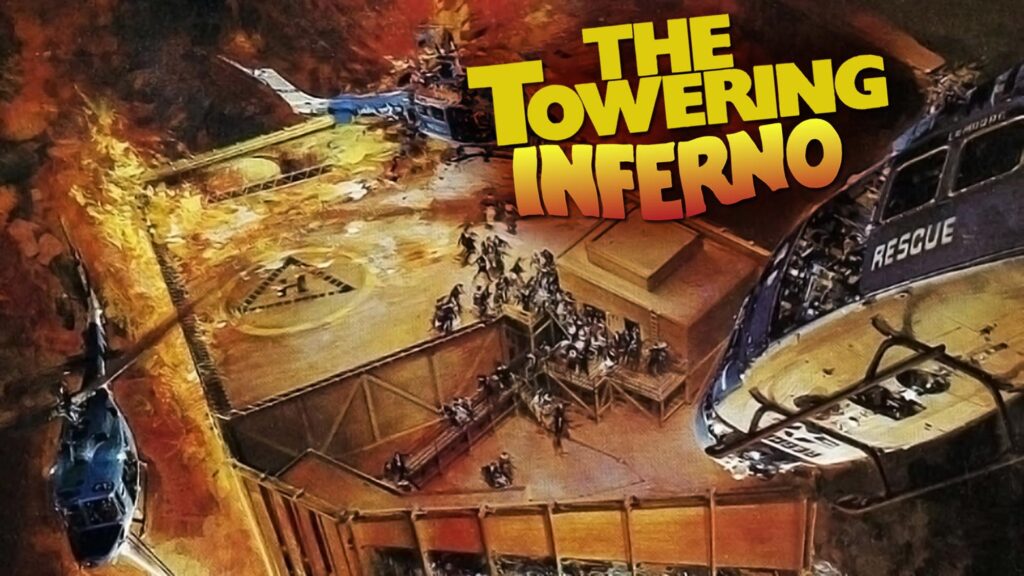
The Towering Inferno
The Towering Inferno is set in San Francisco, and gives the fictional Glass Tower a real-world identity, while the production was at the Fox studio lot.