
Mimi Rogers (born Miriam Ann Spickler on 27 January 1956) is an American actress and producer whose career has encompassed film, television and theatre since the early 1980s. She was born in Coral Gables, Florida, the daughter of Philip C. Spickler, a civil engineer, and Kathy Talent, who had studied dance and drama. Her father was Jewish and her mother came from an Episcopalian background, although the family became involved with Scientology before Mimi was born. Her father’s engineering career required frequent moves, and she spent her childhood in Virginia, Arizona, Michigan, England and California. The family eventually settled in the Los Angeles area, but the years of travelling had a lasting influence on her personality. Rogers later recalled that she rarely remained at the same school for long and became accustomed to establishing friendships in unfamiliar places. The experience also encouraged her independence, although she had little opportunity to develop the longstanding neighbourhood connections that characterised many of her contemporaries’ childhoods.
An academically gifted student, Rogers completed high school by her mid-teens and decided not to proceed directly to university. Instead, she became involved in community work in Northern California, spending several years in the San Francisco Bay Area. Her activities included working at a hospital for patients with severe disabilities near Palo Alto and providing counselling and assistance to people experiencing drug-related problems. This work occupied approximately six years and exposed her to people whose circumstances differed substantially from those of her own relatively comfortable upbringing. During the same period, she continued developing an interest in acting but did not initially consider it a practical career. In 1976, she married Jim Rogers, a Scientology counsellor, and adopted his surname, which she retained professionally after their divorce in 1980. She subsequently moved to Los Angeles, having saved enough money to support herself while attempting to establish an acting career. Although she had become interested in performing as a teenager, she was already in her twenties when she began pursuing the profession seriously.
In Los Angeles, Rogers studied acting with Milton Katselas, whose teaching combined techniques associated with classical theatre and contemporary American performance. She spent approximately nine months attending classes before concentrating on finding professional representation, a process that took another six months. Her first important television role came in Hill Street Blues (1981–1987), the police drama created by Steven Bochco and Michael Kozoll. Rogers appeared as a romantic interest of police officer Andy Renko, played by Charles Haid, and subsequently accepted guest appearances in Quincy, M.E. (1976–1983) and Magnum, P.I. (1980–1988). Her feature-film debut came in the baseball comedy Blue Skies Again (1983), directed by Richard Michaels and starring Harry Hamlin. Although the film attracted relatively little attention, it provided her with experience in a substantial commercial production. A regular television role followed in Paper Dolls (1984), an ABC drama set in the New York fashion industry, in which Rogers played Blair Fenton-Harper. The series was cancelled after thirteen episodes, but it helped establish her as a familiar face to American television audiences.
Her film career developed further when Ron Howard cast her as Audrey, the girlfriend of Michael Keaton’s character Hunt Stevenson, in Gung Ho (1986). The comedy follows workers in a financially troubled Pennsylvania automobile factory that is purchased by a Japanese corporation, creating conflicts between the employees and their new management. Although the story takes place in the fictional town of Hadleyville, filming involved several locations in western Pennsylvania, including Beaver, Duquesne, East Pittsburgh, McKees Rocks and the Pittsburgh neighbourhoods of Garfield and Highland Park. Additional scenes were filmed at an industrial facility in Shadyside, Ohio, while a former automobile assembly plant in Argentina represented the principal factory interiors. The production also involved a short period of filming in Japan. Rogers appeared alongside Keaton, Gedde Watanabe, George Wendt and John Turturro, playing a character whose relationship with Hunt becomes increasingly complicated by his involvement in the attempt to save the factory. Gung Ho provided her with one of her first widely distributed feature-film roles, followed by Jerry Schatzberg’s Street Smart (1987), in which she played the girlfriend of a magazine journalist portrayed by Christopher Reeve.
Her major breakthrough came with Ridley Scott’s Someone to Watch Over Me (1987), a romantic crime thriller starring Tom Berenger and Lorraine Bracco. Rogers portrayed Claire Gregory, a wealthy Manhattan socialite who witnesses a murder and is placed under police protection. Berenger played Mike Keegan, a married detective from Queens assigned to guard her, whose growing attraction to Claire threatens his family life. Scott used the contrast between the characters’ social backgrounds as a central element of the story, with Claire’s expensive Manhattan apartment representing a different world from Mike’s more modest home. Principal photography began in New York City in December 1986, with Rogers filming at locations including the Solomon R. Guggenheim Museum on Fifth Avenue, where her character attends a reception, and around the Upper East Side. Other scenes involved Bergdorf Goodman and Central Park, while the exteriors of Mike’s family home were photographed in Long Island City, Queens. The production subsequently moved to Los Angeles, where interiors representing Claire’s apartment and the Keegan residence were constructed at Burbank Studios. The opening nightclub sequence was filmed aboard the RMS Queen Mary, permanently moored at Long Beach, California. The film gave Rogers her first major leading role and established her as an actress capable of combining emotional vulnerability with a confident screen presence.
During the same year, her personal life attracted considerable public attention when she married actor Tom Cruise on 9 May 1987 in Bedford, New York. Cruise had recently become an international star following the success of Top Gun (1986), and their relationship made Rogers a frequent subject of entertainment reporting. Both had connections with Scientology, which Rogers had known since childhood, and she was widely reported to have introduced Cruise to the organisation. Their marriage coincided with a period when her own career was beginning to develop substantially, but the attention surrounding her husband often overshadowed her professional achievements. Rogers subsequently explained that she continued working throughout their relationship, although several films she completed experienced distribution difficulties and were not immediately released in the United States. The couple separated in late 1989, and their divorce was finalised in February 1990. Rogers later spoke about the frustration of being identified primarily through the marriage rather than her acting, particularly after the substantial critical attention she received for her work during the early 1990s.
Her next films included The Mighty Quinn (1989), directed by Carl Schenkel and starring Denzel Washington as Xavier Quinn, a police chief investigating a murder on a Caribbean island. Rogers played Hadley Elgin, a wealthy woman whose relationship with the local community and Quinn complicates the investigation. The production was filmed in Jamaica during the spring of 1988, principally around Port Antonio on the island’s north-eastern coast. Locations included the ruins of the Folly estate and Trident Castle, where actual coastal buildings and landscapes provided the setting for the fictional island. Rogers subsequently appeared opposite Gary Busey in Hider in the House (1989), a psychological thriller about a disturbed man secretly occupying the attic of a suburban family’s home, and worked in Italy on Francesco Rosi’s Dimenticare Palermo (1990), released internationally as The Palermo Connection or The Sicilian Connection. The latter starred James Belushi as an American politician whose campaign against drug trafficking becomes entangled with organised crime in Sicily. Rogers spent several months involved in the Italian production, although its delayed American release contributed to the impression that she had been working less frequently during her marriage.
She returned to a prominent American film role in Michael Cimino’s Desperate Hours (1990), a remake of the 1955 thriller about escaped criminals who take a suburban family hostage. Rogers played Nora Cornell, the wife of a lawyer portrayed by Anthony Hopkins, whose household is threatened by an escaped prisoner played by Mickey Rourke. The film’s violence and confrontational subject differed from the romantic suspense of Someone to Watch Over Me, and it allowed Rogers to portray a woman attempting to protect her family under extreme circumstances. Around the same period, she appeared as a magazine photographer in Oliver Stone’s The Doors (1991), the biographical drama about musician Jim Morrison and the American rock group. The production was filmed in Los Angeles and other locations associated with the band’s career, with Val Kilmer portraying Morrison. Although her part was relatively small, it placed her in another major studio production while she was preparing for the film that would become the most critically acclaimed performance of her career.
That opportunity came with Michael Tolkin’s The Rapture (1991), an independent drama examining religious belief, moral responsibility and the possibility of divine judgement. Rogers played Sharon, a Los Angeles telephone operator whose seemingly directionless personal life changes after she becomes involved with a Christian group convinced that the end of the world is approaching. David Duchovny appeared as Randy, a man who develops a relationship with her, while Kimberly Cullum played Sharon’s young daughter. Rogers was attracted to the screenplay because it required her to portray profound changes in a character’s beliefs and behaviour without presenting an uncomplicated moral judgement. The material was particularly challenging because she had grown up within Scientology rather than the evangelical Christian traditions explored in the film. To prepare, she read biblical texts, studied different Christian denominations and attended church services with Tolkin. She later recalled that listening to a sermon about surrendering personal burdens to Jesus helped her understand the emotional experience that might lead Sharon towards religious conversion.
The Rapture was filmed during a six-week period beginning in August 1990, using locations around Los Angeles and the surrounding region. The early scenes involving Sharon’s work and personal life were photographed in the city, including around Melrose Avenue, while the later sections moved into the stark landscapes of Southern California. Vasquez Rocks Natural Area Park near Agua Dulce and locations around Santa Clarita provided the isolated desert environments associated with the character’s increasingly extreme spiritual journey. Rogers appeared in almost every scene, carrying a production that depended heavily on her ability to make Sharon’s beliefs and actions psychologically convincing. The film premiered at the Cannes Film Festival in May 1991 before receiving its American theatrical release that October. Its uncompromising treatment of religion divided audiences, but Rogers received particularly strong reviews for her performance. She was nominated for the Independent Spirit Award for Best Female Lead in 1992, and the film became an important turning point in her career. Rogers subsequently described The Rapture as the most challenging and rewarding work she had undertaken, particularly because it allowed her to move beyond the glamorous supporting characters for which she had previously been cast.
The critical response to The Rapture encouraged Rogers to pursue more unusual independent productions. She played Molly Dolezal in Roger Donaldson’s White Sands (1992), appearing alongside Willem Dafoe, Mary Elizabeth Mastrantonio and Mickey Rourke in a crime thriller set in the American Southwest. She subsequently appeared in Robert Altman’s Hollywood satire The Player (1992), joining an extensive ensemble of established actors and filmmakers. During the same period, she accepted leading roles in smaller psychological dramas, including the television thriller Ladykiller (1992) and Reflections on a Crime (1994), in which she portrayed a woman awaiting execution for murder. The latter film was structured around conversations and memories, allowing Rogers to develop a character whose account of events becomes increasingly uncertain. She also appeared in the Canadian-produced thriller Bulletproof Heart (1994), opposite Anthony LaPaglia and Peter Boyle. These projects did not achieve the commercial reach of her earlier studio films, but they offered opportunities to portray morally ambiguous and emotionally complicated characters. In March 1993, Rogers also appeared on the cover of Playboy magazine, accompanied by a photographic feature and interview, a decision that attracted publicity but did not prevent her from continuing to pursue demanding dramatic work.
Her personal life became more settled after she met producer Christopher Ciaffa during production of the television film Fourth Story (1991), directed by Ivan Passer. The two began a relationship in 1990 and established a family together in Los Angeles. Their daughter, Lucy, was born in November 1994, followed by their son, Charlie, in July 2001. Although Rogers had previously been married twice, she and Ciaffa remained together for thirteen years before marrying at the Beverly Hills courthouse on 20 March 2003. Rogers later joked that their wedding had been encouraged by practical considerations rather than a sudden change in their relationship. The family continued living in Southern California, where Rogers could combine regular film and television work with raising her children. Her daughter subsequently developed a career in film production, eventually collaborating on independent features including Night Nurse (2026).
During the middle of the 1990s, Rogers continued alternating between family-oriented entertainment and adult drama. In Far from Home: The Adventures of Yellow Dog (1995), she played Katherine McCormick, the mother of a teenager whose sailing trip leads to a struggle for survival in the wilderness of British Columbia. The production was filmed extensively in Canada, using the province’s coastal landscapes and forests for its adventure sequences. Rogers subsequently worked with British director Nicolas Roeg on Full Body Massage (1995), an intimate television drama in which she played Nina, a successful art dealer who develops an increasingly personal relationship with a masseur portrayed by Bryan Brown. The largely dialogue-driven production provided another opportunity to explore a character’s personal history through an extended encounter rather than an elaborate external plot. She followed it with Steve Buscemi’s Trees Lounge (1996), an independent drama about a man struggling with alcoholism and unsuccessful relationships in a suburban community on Long Island.
A more prominent role came in Barbra Streisand’s The Mirror Has Two Faces (1996), in which Rogers played Claire, the sister of Streisand’s character Rose Morgan. The romantic comedy centres on Rose, a literature professor at Columbia University, and Gregory Larkin, a mathematics professor portrayed by Jeff Bridges, whose attempt to build a marriage without sexual attraction becomes increasingly complicated. Rogers had actively pursued the part, meeting with Streisand to discuss the characters and develop the relationship between the sisters. The film was shot entirely in New York City, where Rogers worked alongside Streisand, Lauren Bacall and other members of the cast. Claire’s wedding reception was filmed at Tavern on the Green in Central Park, while additional scenes used Columbia University and other Manhattan locations, including residential buildings on the Upper West Side. The production allowed Rogers to play a relatively conventional family role in a major studio romantic comedy, contrasting with the darker independent dramas that had occupied much of her recent work.
She reached another large international audience with Austin Powers: International Man of Mystery (1997), directed by Jay Roach and starring Mike Myers. Rogers played Mrs Kensington, a British intelligence agent who works with Austin Powers during the 1960s and is later revealed to be the mother of his modern-day colleague Vanessa Kensington, played by Elizabeth Hurley. The film parodied the James Bond series and other popular representations of British espionage, giving Rogers an opportunity to work in broad comedy. Although parts of the story take place in London and Las Vegas, principal photography was based in Southern California, with extensive studio work at Paramount Studios in Hollywood. Additional locations around Los Angeles and Santa Clarita were used to recreate the fictional environments. The success of the film became particularly important to Rogers, who later described it as helping renew interest in her work after several years of comparatively limited mainstream exposure.
Her next major production was Lost in Space (1998), directed by Stephen Hopkins and adapted from the American science-fiction television series of the 1960s. Rogers portrayed Dr Maureen Robinson, a scientist and mother travelling with her family on a mission to colonise another planet. William Hurt played her husband John Robinson, while the supporting cast included Matt LeBlanc, Heather Graham, Gary Oldman and Lacey Chabert. The film was produced principally in England, with filming beginning in March 1997 at Shepperton Studios in Surrey. Elaborate spacecraft interiors, alien environments and other science-fiction settings were constructed on the studio’s sound stages, requiring Rogers and the other performers to work extensively with practical and digital effects. Although Lost in Space received a mixed critical response, it was a major commercial production and gave Rogers another substantial role in a film intended for international audiences. Her character, unlike many of the wives and romantic partners she had portrayed earlier in her career, was an active participant in the family’s scientific mission and attempts to survive.
During the same period, Rogers joined the cast of The X-Files (1993–2002), the supernatural crime drama created by Chris Carter. She played FBI Special Agent Diana Fowley, a former colleague and romantic partner of Fox Mulder, portrayed by David Duchovny. Her character first appeared in the fifth-season finale, The End, broadcast in May 1998, and returned during the sixth and seventh seasons. The role reunited Rogers with Duchovny, with whom she had worked on The Rapture several years earlier. Fowley’s ambiguous loyalties placed her at the centre of the series’ mythology concerning government secrecy and extraterrestrial activity, creating tension between Mulder and Dana Scully, played by Gillian Anderson. The X-Files was originally produced in Vancouver, British Columbia, before relocating to Los Angeles for its sixth season, meaning Rogers’s appearances spanned both production centres. The programme introduced her to another large international television audience and became one of her most recognisable roles of the late 1990s.
Rogers returned to darker material with the Canadian horror film Ginger Snaps (2000), directed by John Fawcett and starring Katharine Isabelle and Emily Perkins as teenage sisters whose lives are disrupted after one of them is attacked by a werewolf. Rogers played Pamela Fitzgerald, their mother, whose attempts to manage the family’s increasingly disturbing circumstances become part of the film’s mixture of horror and domestic comedy. The production was filmed in Ontario during the autumn of 1999, using suburban neighbourhoods in Brampton, Toronto, Mississauga and Markham to represent the fictional town of Bailey Downs. The Fitzgerald family home was a real residential property in Brampton, while other scenes used local schools, streets and industrial areas. Ginger Snaps subsequently developed a considerable following among horror audiences, and Rogers’s portrayal of an apparently ordinary suburban mother became one of its memorable supporting performances. Her participation was another example of her willingness to work in relatively modest independent productions rather than confine herself to major Hollywood films.
Her early twenty-first-century film work also included The Door in the Floor (2004), directed by Tod Williams and adapted from the opening section of John Irving’s novel A Widow for One Year. Rogers played Evelyn Vaughn, a woman who becomes involved with a successful children’s author portrayed by Jeff Bridges, whose marriage to a character played by Kim Basinger has been devastated by the deaths of their two sons. Set in the wealthy coastal community of East Hampton, New York, the production was filmed extensively on Long Island during 2003, including locations around East Hampton, Sea Cliff and Roslyn. Rogers’s character becomes involved in one of the film’s complicated personal relationships, with the story examining the consequences of grief, infidelity and emotional isolation. The production allowed her to work with established dramatic performers in another relatively intimate film. Other projects during this period included the comedy Seeing Other People (2004) and the independent dramas Dancing in Twilight (2005) and Big Nothing (2006).
Television became an increasingly important part of her career during the 2000s. In The Loop (2006–2007), a Fox workplace comedy created by Pam Brady and Will Gluck, Rogers played Meryl St James, a powerful airline executive who repeatedly makes advances towards a younger employee, Sam Sullivan, played by Bret Harrison. The series was set in Chicago but produced in Los Angeles, and Rogers appeared throughout its two seasons alongside Philip Baker Hall and Eric Christian Olsen. The role was written specifically with her in mind, giving her an opportunity to return to regular television comedy after years of working primarily in dramatic films. She subsequently made guest appearances in programmes including Two and a Half Men (2003–2015), where she played Robin Schmidt, the mother of Ashton Kutcher’s character Walden Schmidt, and Mad Men (2007–2015). Her work on Mad Men placed her in another drama set in New York but produced in the Los Angeles area, allowing her to move between different television formats without lengthy periods away from home.
Away from acting, Rogers developed a serious interest in competitive poker. Although she initially played recreationally, she began participating in professional and televised tournaments during the early 2000s, becoming one of the more experienced celebrity competitors in the game. On 6 November 2003, she won the World Poker Tour’s Hollywood Home Game, defeating opponents including Fred Savage, Aisha Tyler, Drew Carey and Jack Black. The invitational event was staged on a Hollywood sound stage and carried a first-place prize of $35,500. She subsequently competed in the World Poker Tour’s Bay 101 Shooting Star championship in San Jose, California, in March 2004, finishing among the players who received prize money. Rogers also entered tournaments associated with the World Series of Poker in Las Vegas and participated in events in the San Francisco Bay Area. Her involvement extended beyond celebrity appearances, and she served on the World Poker Tour’s board of directors. Poker became a substantial interest outside her professional acting work, bringing her into contact with players and organisations unrelated to the entertainment industry.
Her later feature films included Hope Springs (2012), directed by David Frankel and starring Meryl Streep and Tommy Lee Jones as a married couple attempting to repair their relationship through intensive counselling. Rogers appeared in a supporting role, with the production filmed largely in Connecticut, where locations around Stonington and surrounding communities represented the fictional Maine town of Great Hope Springs. She also appeared in the independent comedy For a Good Time, Call… (2012), starring Ari Graynor and Lauren Anne Miller, and subsequently played Lois Palmer in The Wedding Ringer (2015), opposite Kevin Hart and Josh Gad. During this period, her television appearances included Wilfred (2011–2014), the American adaptation of an Australian comedy-drama, and guest roles in other network and cable productions. Although many of these parts were comparatively small, they allowed Rogers to remain active while selecting film projects that interested her rather than pursuing only large commercial roles.
A new and substantial phase of her television career began when she was cast as Honey Chandler in Bosch (2014–2021), the Amazon crime drama adapted from Michael Connelly’s novels and starring Titus Welliver as Los Angeles homicide detective Harry Bosch. Chandler, a highly successful defence lawyer, initially appears as a formidable adversary whose courtroom tactics expose difficult aspects of Bosch’s professional and personal history. Rogers first appeared in the series during its opening season, which premiered in 2015, and gradually developed the character through recurring legal cases and increasingly complicated relationships. The series was filmed extensively on location around Los Angeles, an important part of Connelly’s approach to adapting his novels for television. Rogers worked at actual downtown buildings, including the Bradbury Building on South Broadway, where Chandler appears during the fourth season, and locations around Bunker Hill and the city’s legal district. Other scenes involved offices, restaurants and streets across Los Angeles, giving her character a geographical connection with the city in which Rogers had spent much of her adult life.
Rogers later explained that Chandler appealed to her because she was intelligent, professionally successful and frequently willing to challenge the programme’s central character. Unlike some of the supporting women she had played earlier in her career, Chandler possessed considerable authority and professional independence. Her relationship with Bosch gradually developed from adversarial courtroom encounters into a complicated partnership based on mutual respect. In Bosch’s final season, Chandler becomes directly involved in a dangerous criminal investigation and survives an assassination attempt, an event that has substantial consequences for her later life. Rogers worked closely with Welliver and Connelly during these seasons, developing a character whose legal work often raises questions about justice, professional ethics and the difference between protecting a client and uncovering the truth. The part became one of the longest and most important commitments of her television career.
When the original series ended, Rogers continued as Honey Chandler in Bosch: Legacy (2022–2025), which follows Bosch after he leaves the Los Angeles Police Department and begins working as a private investigator. Chandler becomes a more central figure in the new series, now recovering from the attack and attempting to establish a different professional direction. Rogers appeared alongside Welliver and Madison Lintz, who played Bosch’s daughter Maddie, with the relationship between the three characters becoming an important part of the show’s continuing story. Production remained firmly based in Los Angeles, including downtown offices, parking structures, restaurants and other locations around the city. Chandler’s office was represented by a building on South Figueroa Street, while further scenes involved locations around Hollywood and the Pico-Union neighbourhood. In the final season, filmed during 2024 and released in March and April 2025, Chandler’s campaign for district attorney becomes increasingly important to the story. Rogers subsequently reprised the character in the first season of Ballard (2025), the spin-off starring Maggie Q as detective Renée Ballard, appearing in the season finale released in July 2025.
The extended Bosch productions also led to a professional friendship with Madison Lintz, with whom Rogers began exploring theatrical work. They participated in an all-female production of Twelve Angry Men, directed by Beejan Land, and subsequently agreed to reunite in John Patrick Shanley’s Doubt: A Parable. The production was announced by Ensemble Theatre Company in Santa Barbara, California, as part of its 2026–2027 season. Rogers was cast as Sister Aloysius Beauvier, the headmistress of a Catholic school in the Bronx during 1964, while Lintz was cast as Sister James. The play concerns suspicions surrounding a priest’s relationship with a student and examines questions of authority, evidence and moral certainty. Rogers described it as one of her favourite plays and welcomed the opportunity to return to demanding dramatic theatre after many years of working primarily in film and television. Directed by Land, Doubt was scheduled to run at the New Vic Theatre in Santa Barbara from 7 to 25 April 2027.
Her film work continued alongside Bosch, including the independent drama What Still Remains (2018), in which she played Judith, and Affairs of State (2018), a political thriller starring David Corenswet, Thora Birch and Adrian Grenier. Rogers subsequently appeared as Mimi in Adult Children (2025), an independent family comedy directed by Rich Newey and starring Betsy Brandt, Aya Cash, Ella Rubin and Thomas Sadoski. The story follows a teenager attempting to understand adulthood through her relationships with older half-siblings whose personal lives are considerably less stable than she imagines. The film premiered at the Bentonville Film Festival in Arkansas in June 2025, winning a special jury award for its ensemble, and subsequently received recognition at the Galway Film Fleadh in Ireland. Rogers’s participation continued her interest in independent productions built around complicated family relationships rather than elaborate commercial premises.
Her most recent film role came in Night Nurse (2026), the feature directing debut of Georgia Bernstein. The psychological thriller stars Cemre Paksoy as Eleni, a young nurse working at an affluent retirement community who becomes increasingly involved in the private life of a mysterious elderly patient, played by Bruce McKenzie. Rogers portrayed Doctor Mann, alongside Eléonore Hendricks and Colleen Rose Trundy. The production was filmed in Chicago during the autumn of 2024, with its retirement-community setting providing the environment for a story involving deception, manipulation and obsession. The project was also a family collaboration: Rogers’s daughter Lucy Rogers was among the film’s producers. Night Nurse premiered at the Sundance Film Festival in Park City, Utah, on 26 January 2026, with Rogers attending alongside the director and other members of the cast. It subsequently received a limited American theatrical release through Independent Film Company on 10 July 2026.
By October 2026, Rogers had reached the age of seventy and remained professionally active, with her recent work extending from the Bosch franchise to independent cinema and a forthcoming stage production in Santa Barbara. Her career had begun after several years in social work and developed through commercial thrillers, controversial independent dramas, science-fiction films and television series. The Rapture remained a particularly important achievement for her personally, while Honey Chandler provided an unusually sustained opportunity to develop a character over more than a decade. Her work also maintained strong geographical connections with Los Angeles, where she established her acting career, and with New York, where several of her most prominent early films were produced. Beyond acting, she continued her involvement in family life, independent film production and competitive poker, interests that had developed alongside rather than apart from her professional career.
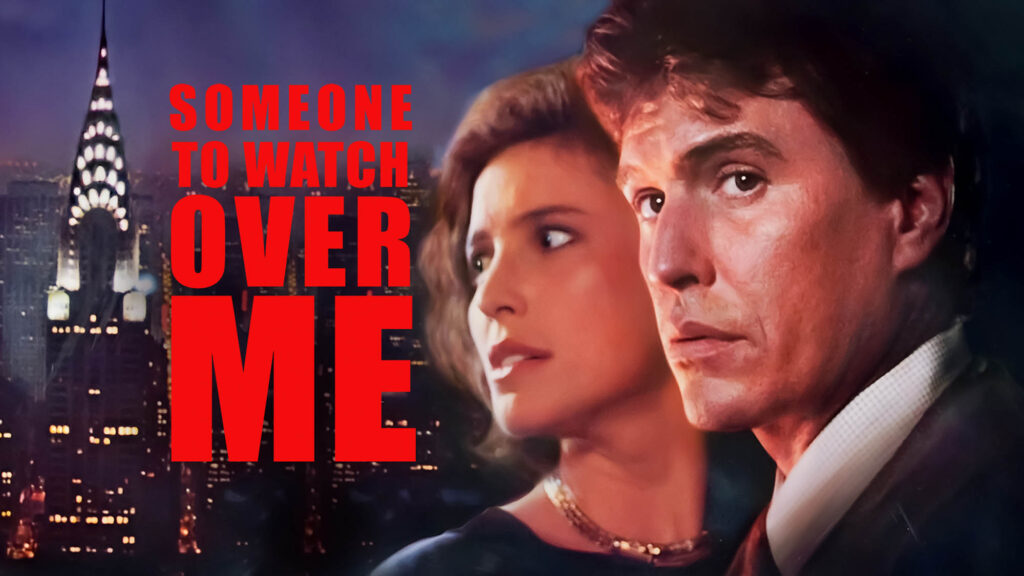
Someone to Watch Over Me
Someone to Watch Over Me is a 1987 American romantic thriller directed by Ridley Scott and starring Tom Berenger, Mimi Rogers and…