
Madeleine Stowe (born 18 August 1958) is an American actress known for Stakeout (1987), Revenge (1990), The Last of the Mohicans (1992), Unlawful Entry (1992), Short Cuts (1993), Blink (1994), Bad Girls (1994), 12 Monkeys (1995), The General’s Daughter (1999) and the television series Revenge (2011–2015). Born in Los Angeles and raised in the Eagle Rock neighbourhood, she initially trained to become a concert pianist before pursuing acting at the University of Southern California and a small theatre in Beverly Hills. Her film career has taken her to locations across the United States, Canada, Mexico and Europe, while her personal life has been closely connected with California, the Texas Hill Country and, more recently, Memphis, Tennessee. After becoming one of Hollywood’s prominent leading actresses during the 1990s, she reduced her film commitments to raise her daughter and later returned to television, finding renewed success with Revenge and the horror series It: Welcome to Derry (2025).
Madeleine Marie Stowe Mora was born at Queen of Angels Hospital in Los Angeles, the eldest of three children of Robert Alfred Stowe and Mireya Maria Mora Steinvorth. Her father was a civil engineer from Oregon, while her mother came from a prominent Costa Rican family with a long history in the country’s political and professional life. Among her maternal ancestors was Bruno Carranza, who briefly served as President of Costa Rica in 1870, while another relative, José Joaquín Mora Porras, was the younger brother of President Juan Rafael Mora Porras. Although Stowe was raised in California, her mother’s family provided an important connection to Central America. The family lived in Eagle Rock, a residential district in northeastern Los Angeles situated between Glendale and Highland Park. At the time, the neighbourhood was predominantly working-class, with older houses, small commercial streets and communities of different ethnic backgrounds. Her childhood was complicated by her father’s multiple sclerosis, which progressively affected his mobility and health. Stowe frequently accompanied him to medical appointments, while her mother assumed much of the responsibility for supporting the household.
At the age of ten, Stowe began taking piano lessons with Sergei Tarnowsky, a Russian-born pianist and teacher who had studied at the Saint Petersburg Conservatory and emigrated to the United States. Tarnowsky had previously taught Vladimir Horowitz and brought considerable experience in classical music to his work with younger students. Stowe became devoted to the instrument, practising for several hours each day with the intention of becoming a concert pianist. Her training continued throughout her adolescence, largely within the Los Angeles area, until Tarnowsky died in 1976. She subsequently abandoned her musical ambitions, later explaining that her years of piano study had also allowed her to withdraw from social activities and spend much of her time alone. She enrolled at the University of Southern California, where she studied cinema and journalism, but became increasingly dissatisfied with academic life. Instead, she began volunteering at the Solari Theatre in Beverly Hills, helping with productions and occasionally appearing in performances. The theatre later became known as the Canon Theatre and occupied a position within the city’s established theatrical community. It was there that she met talent agent Meyer Mishkin, who was representing Richard Dreyfuss in a production of Paddy Chayefsky’s The Tenth Man. Mishkin encouraged her to pursue professional acting, and Stowe left university to concentrate on auditions.
Her earliest work came through Los Angeles television productions, beginning with an appearance in the police drama Baretta in 1978. She subsequently appeared in The Amazing Spider-Man, Barnaby Jones, Little House on the Prairie and several television films, including The Nativity (1978), in which she played Mary. These productions provided regular employment but relatively little public recognition. A more substantial role came in the NBC miniseries The Gangster Chronicles (1981), which followed organised crime figures operating in American cities during the early twentieth century. Stowe played Ruth Lasker opposite actor Brian Benben, who portrayed Michael Lasker. The two met during production, began a relationship and married during the 1980s. Benben subsequently became known for starring in the HBO comedy series Dream On (1990–1996). Stowe continued working primarily in television during the first half of the decade, appearing in Beulah Land (1980), Amazons (1984) and Blood & Orchids (1986). Her work remained centred in Southern California, although individual productions required occasional travel to other locations.
Her breakthrough in feature films came with Stakeout (1987), directed by John Badham and starring Richard Dreyfuss and Emilio Estevez as two police detectives assigned to observe the home of a woman whose former boyfriend has escaped from prison. Stowe played Maria McGuire, the woman under surveillance, in a role that gave her considerably more screen time than her previous television appearances. Although the story takes place in Seattle, Washington, the production was filmed in Vancouver, British Columbia. The Canadian city provided residential streets, commercial buildings and waterfront locations that could represent the American Pacific Northwest without requiring the crew to work in Seattle itself. Stowe had initially struggled to obtain substantial feature roles, but Stakeout became a commercial success and established her as a recognisable Hollywood actress. She followed it with Tropical Snow (1988), a drama involving political violence and drug trafficking in South America, and the romantic comedy Worth Winning (1989), starring Mark Harmon. Her career was also beginning to attract directors interested in casting her in more dramatic and psychologically complicated roles.
One of her most extensive international assignments came with Revenge (1990), directed by Tony Scott and starring Kevin Costner and Anthony Quinn. Stowe played Miryea Mendez, the wife of a wealthy Mexican businessman who begins an affair with a visiting American pilot. Principal photography began in September 1988 and continued for approximately twelve weeks at around fifty locations across Mexico. These included Puerto Vallarta on the Pacific coast, Cuernavaca in Morelos, Mexico City, Durango and the rural communities of Chupaderos and Tres Molinos. The production also used the Sierra de Órganos near Sombrerete in Zacatecas, where the unusual rock formations and surrounding countryside provided locations for exterior scenes. Approximately two-thirds of the 150-member production unit were Mexican, and Stowe spent considerable time working with local crews. Her Costa Rican family background was among the reasons producers considered her suitable for the role, although the character herself was Mexican. Stowe later recalled her enjoyment of filming in Mexico, particularly the opportunity to work outdoors and experience places beyond the familiar Hollywood production environment.
She returned to Los Angeles for The Two Jakes (1990), Jack Nicholson’s sequel to Chinatown (1974), playing Lillian Bodine in a story set during the post-war development of Southern California. She then appeared in Closet Land (1991), an independent psychological drama starring Alan Rickman, before taking a leading role opposite Kurt Russell and Ray Liotta in Unlawful Entry (1992). The latter film was photographed in Los Angeles during the winter of 1991–1992 and made extensive use of actual residential and institutional buildings. The house occupied by Stowe’s character, Karen Carr, and her husband was represented by a property at 546 Wilcox Avenue, near Hancock Park. Dorris Place Elementary School at 2225 Dorris Place was used for scenes at Karen’s workplace, while the Mayan Theatre at 1038 South Hill Street in downtown Los Angeles represented her husband’s nightclub. Additional scenes used buildings in Hollywood, Echo Park and the industrial districts east of downtown. The production kept Stowe close to the city where she had grown up, while the success of Stakeout and Revenge had established her as a regular presence in major American feature films.
Her career reached another level with The Last of the Mohicans (1992), directed by Michael Mann and starring Daniel Day-Lewis as Hawkeye, a frontier scout during the French and Indian War. Stowe played Cora Munro, the daughter of a British military officer, in an adaptation of James Fenimore Cooper’s nineteenth-century novel. Although the story takes place in colonial New York during the 1750s, almost the entire production was filmed in western North Carolina. Principal photography began in June 1991, with the Blue Ridge Mountains providing the forested terrain and dramatic mountain scenery required for the period setting. One of the production’s largest constructions was Fort William Henry, built beside Lake James near the communities of Nebo and Marion. The wooden fortress was erected specifically for the film, with surrounding land cleared and parts of North Carolina Highway 126 temporarily closed during filming. The production also used the Biltmore Estate in Asheville, particularly the grounds surrounding the historic mansion, while the former Manor Inn on Charlotte Street represented part of colonial Albany.
The most recognisable outdoor scenes were filmed in the mountains surrounding Chimney Rock and the waterfalls of western North Carolina. The climactic pursuit involving Stowe’s character and the other survivors was photographed at Chimney Rock Park, including locations around Hickory Nut Falls, where the film’s final confrontation takes place. Other sequences used Hooker Falls, Triple Falls and High Falls in the area now protected as DuPont State Recreational Forest, along with additional waterfalls and mountain paths across the region. Filming continued until October 1991 and involved extensive outdoor work, sometimes in difficult weather and terrain. Stowe later recalled her enthusiasm for the North Carolina production and its location filming. The Last of the Mohicans was released in September 1992 and became a major commercial success, with Stowe’s performance attracting considerable attention. The film changed the kinds of roles she was offered, allowing her to move beyond supporting characters and become the leading actress in several subsequent productions.
Her increased recognition coincided with a particularly busy period during 1992 and 1993. Robert Altman cast her in Short Cuts (1993), an ensemble drama adapted from stories by Raymond Carver. Whereas Carver’s original fiction had been associated mainly with the Pacific Northwest, Altman relocated the interconnected stories to contemporary Los Angeles. Stowe played Sherri Shepard, the wife of a police officer portrayed by Tim Robbins, alongside an ensemble that included Julianne Moore, Jennifer Jason Leigh, Lily Tomlin, Andie MacDowell and Frances McDormand. Filming took place throughout Los Angeles County during the summer and autumn of 1992, using residential neighbourhoods, commercial buildings and locations in Hollywood, Griffith Park and Downey. The production incorporated Johnie’s Broiler at 7447 Firestone Boulevard in Downey, while other scenes used the Bronson Canyon area of Griffith Park. Short Cuts premiered at the Venice International Film Festival in September 1993, sharing the Golden Lion with Krzysztof Kieślowski’s Three Colours: Blue. Stowe received the National Society of Film Critics Award for Best Supporting Actress, one of the most important critical honours of her career.
By the beginning of 1994, Stowe was being offered projects in which she carried much of the film herself. In Blink (1994), directed by Michael Apted, she played Emma Brody, a blind musician who begins experiencing disturbing visual memories following a corneal transplant. The production was filmed in Chicago between March and May 1993, making use of the city’s streets, residential buildings and music venues. The local band The Drovers appeared in the film and contributed several songs, connecting the fictional story to Chicago’s actual music scene. Stowe also appeared in China Moon (1994), a crime thriller co-starring Ed Harris and Benicio del Toro. Although released in 1994, the film had been shot in Florida during 1990, particularly around Lakeland, Bartow, Tampa and St. Pete Beach. The production used the region’s ordinary commercial streets and residential communities rather than relying on studio representations of Florida. Both films gave her more substantial leading roles, although neither achieved the commercial success of The Last of the Mohicans.
Another major production during this period was Bad Girls (1994), a Western starring Stowe, Andie MacDowell, Drew Barrymore and Mary Stuart Masterson as four women travelling through the American frontier. The film was shot in Texas and California during 1993, including locations at Alamo Village near Brackettville, a Western film set originally constructed for John Wayne’s The Alamo (1960). Additional filming took place near Del Rio, along the Sierra Railroad at Jamestown, California, and at Red Hills Ranch near Sonora. Stowe played Cody Zamora, the leader of the group, in one of her most physically demanding roles of the period. Although the production underwent a change of director and other difficulties, the experience had a lasting personal consequence: Stowe became particularly interested in Texas and its rural way of life. She later recalled enjoying the outdoor filming and began considering a permanent move away from Los Angeles.
By early 1994, Stowe and Brian Benben were preparing to establish a residence in the Texas Hill Country. They eventually acquired a working ranch near Johnson City, west of Austin and southeast of Fredericksburg, in a region of limestone hills, agricultural properties and small communities. The property was considerably different from the suburban Los Angeles neighbourhoods where Stowe had spent most of her life. The couple maintained cattle, horses and sheep, and Stowe became involved in the practical responsibilities of ranching. She had already developed an interest in horses and outdoor activities, but the move gave her the opportunity to spend extended periods away from the entertainment industry. The ranch also provided a base from which she could accept film assignments without remaining permanently in Hollywood. During the mid-1990s, the Texas property became increasingly important to her personal life, particularly as she and Benben began raising a family.
Before substantially reducing her film commitments, Stowe completed one of her best-known performances in 12 Monkeys (1995), directed by Terry Gilliam. She played Dr Kathryn Railly, a psychiatrist who becomes involved with a man portrayed by Bruce Willis claiming to have travelled back in time from a devastated future. The production was filmed between February and May 1995, primarily in Philadelphia, Pennsylvania, and Baltimore, Maryland, with additional work in New Jersey and Canada. Gilliam used numerous abandoned or historic buildings to create the film’s different time periods, particularly locations whose unusual architecture could support the story without extensive reconstruction. In Philadelphia, Eastern State Penitentiary at 2027 Fairmount Avenue represented part of the psychiatric hospital, while Girard College supplied additional institutional settings. The former prison, opened in 1829, had closed in 1971 and was undergoing preservation work when it became a filming location. Other Philadelphia scenes used City Hall, Memorial Hall in Fairmount Park, and the former Wanamaker department store at 1300 Market Street.
Baltimore provided several locations closely associated with Stowe’s character. The Garrett-Jacobs Mansion at 11 West Mount Vernon Place represented the home of scientist Dr Goines, while the Senator Theatre at 5904 York Road was used for the scene in which Kathryn Railly and James Cole attend an Alfred Hitchcock film festival. Opened in 1939, the Senator is one of Baltimore’s surviving Art Deco cinemas and has appeared in several other productions. The film’s climactic airport sequence combined photography at Baltimore/Washington International Airport with interiors constructed inside the former Reading Terminal train shed at the Pennsylvania Convention Center in Philadelphia. Other Baltimore locations included the Walters Art Museum and the historic Hotel Kernan building on West Franklin Street. Gilliam’s production required Stowe to work in some particularly unusual environments, moving between abandoned industrial buildings, institutional interiors and actual city streets during the cold months of early 1995. The film was released in December and became a significant commercial and critical success, with Brad Pitt receiving an Academy Award nomination for Best Supporting Actor.
Following 12 Monkeys, Stowe stepped away from regular filmmaking to spend more time with her family. Her daughter, May Theodora Benben, was born in 1996, and the Texas ranch became the principal setting of their domestic life. In interviews from the period, Stowe spoke enthusiastically about working with livestock and spending time outdoors, contrasting the experience with the demands of Hollywood publicity and production schedules. She continued receiving film offers but became more selective, eventually returning with The Proposition (1998), a period drama starring William Hurt and Kenneth Branagh, and Playing by Heart (1998), an ensemble romantic drama filmed in Los Angeles. The latter reunited her professionally with a city she had been increasingly willing to leave between assignments.
Her return to larger studio productions came with The General’s Daughter (1999), directed by Simon West and starring John Travolta. Stowe played Warrant Officer Sara Sunhill, a military investigator assigned to a murder case at an American Army base. Although the story is set at a fictional installation, the production was filmed extensively in Georgia, particularly around Savannah. Locations included Savannah State University, the historic Wormsloe estate on Skidaway Road and Tybee Island on the Atlantic coast. Wormsloe’s long avenue of live oak trees, planted during the nineteenth century, provided one of the film’s most recognisable exterior locations. The production also photographed material around the Sacramento–San Joaquin River Delta in California, although Stowe’s principal scenes were associated with the Georgia locations. She later recalled enjoying the opportunity to work in Savannah, placing it alongside North Carolina and Mexico among her favourite filming experiences.
Stowe continued accepting selected film projects during the early 2000s. She appeared in the science-fiction thriller Impostor (2001), adapted from a story by Philip K. Dick, and starred opposite Mel Gibson in We Were Soldiers (2002), directed by Randall Wallace. In the latter, she played Julie Moore, the wife of Lieutenant Colonel Hal Moore, whose experiences during the Vietnam War formed the basis of the film. Although the battle sequences were filmed mainly at Fort Hunter Liggett in Monterey County, California, the domestic and military-base scenes used actual locations at Fort Benning, near Columbus, Georgia. The Riverside Commandant’s House at 102 Vibbert Avenue represented one of the important social settings, while another residence on Miller Loop was used as the Moore family home. The production also incorporated streets and buildings in Columbus and additional locations in California. Stowe’s performance centred on the families of American soldiers rather than the combat sequences, making the Fort Benning locations particularly relevant to her part of the story.
She returned to international location filming with Octane (2003), a British-Luxembourg horror thriller in which she played a mother whose teenage daughter becomes involved with a mysterious group of young people during a road journey. Although the story takes place in the United States, the production was filmed largely in Luxembourg. The filmmakers used a newly constructed motorway that had not yet opened to public traffic, providing approximately twelve kilometres of road for nighttime driving sequences. American road markings were painted onto the surface, while vehicles were imported from Britain and the United States to create the appearance of an American highway. Principal photography began in June 2002, with much of Stowe’s work taking place inside vehicles or at specially adapted roadside locations. The film was an unusual example of a European production recreating contemporary American infrastructure almost entirely outside the United States.
After Octane, Stowe largely withdrew from feature films, although she continued occasional television work. She portrayed political activist Milly Kondracke in Saving Milly (2005), a television drama based on the experiences of journalist Morton Kondracke and his wife, who developed Parkinson’s disease. She also appeared in the NBC crime drama Raines (2007), starring Jeff Goldblum, and the television film The Christmas Hope (2009). During this period, she devoted considerable attention to developing a screenplay titled Unbound Captives, a historical Western set in the American frontier during the nineteenth century. Stowe wrote the project with Brian Benben and spent several years attempting to bring it into production. In 2009, plans were announced for her to make her directorial debut with a cast including Rachel Weisz, Hugh Jackman and Robert Pattinson. The film would have involved extensive period locations, but the project did not proceed into principal photography and remained unrealised.
Outside filmmaking, Stowe became involved in humanitarian projects in Haiti. She travelled to the country in 2008 and subsequently supported the establishment of Artists for Peace and Justice, a charitable organisation concentrating on education and opportunities for disadvantaged young people. The organisation has supported schools and training facilities in and around Port-au-Prince, including the Academy for Peace and Justice, which was established following the devastating earthquake of January 2010. Stowe’s involvement created another connection with the Caribbean region, although her charitable work was separate from her professional filming assignments. Her other personal interests remained closely associated with family life, and she and Benben eventually returned to Southern California, establishing a residence in Pacific Palisades while maintaining connections with Texas.
Stowe made a substantial return to television in Revenge (2011–2015), the ABC drama created by Mike Kelley. She played Victoria Grayson, the wealthy and influential matriarch of a family living in the Hamptons, whose past becomes the target of an elaborate revenge plot. Emily VanCamp starred as Emily Thorne, a young woman who moves into the same exclusive coastal community. Although the fictional setting was eastern Long Island, most of the series was filmed in Southern California, where the production could use permanent soundstage sets and readily accessible outdoor locations. The pilot episode was photographed in North Carolina, particularly around Wilmington and Southport. A coastal house at 6249 Pebble Shore Lane in Southport represented Emily’s original beachfront residence, while another property on Ocean Point Drive in Wilmington supplied interiors for the Grayson family home.
Once Revenge was ordered as a series, production moved to the MBS Media Campus, formerly Raleigh Manhattan Beach Studios, at 1600 Rosecrans Avenue in Manhattan Beach, California. The interiors of the Grayson mansion and Emily’s residence were reconstructed on soundstages, allowing the principal actors to work in consistent surroundings throughout the programme’s four seasons. The fictional Grayson mansion was based on an actual estate at 257 Further Lane in East Hampton, New York, but its screen appearance was digitally altered, incorporating additional architectural features and changes to the building’s proportions. Exterior scenes involving the Grayson residence were also photographed at a property on Winding Way in Malibu, while other California locations represented the streets and waterfront businesses of the Hamptons.
The production used Malibu, Manhattan Beach, Marina del Rey, South Pasadena and several communities in the South Bay. Fisherman’s Village in Marina del Rey supplied the setting for Porter’s Stowaway Tavern and the marina where the characters’ boats were moored. Buster’s Coffee on Mission Street in South Pasadena appeared as a Hamptons establishment, while Torrance Beach, Dockweiler State Beach and the surrounding coastline provided locations for outdoor scenes. In December 2012, a substantial production unit filmed at Torrance Beach, using the Pacific coastline and the Palos Verdes Peninsula to represent the Atlantic coast of Long Island. Stowe’s role required extensive studio work at Manhattan Beach, with her character’s residence and social environment forming central parts of the series. Revenge became a major international television success, and her portrayal of Victoria Grayson earned her a Golden Globe nomination for Best Actress in a Television Series – Drama in 2012. The programme ran for four seasons before concluding in May 2015.
Following Revenge, Stowe again reduced her acting commitments, although she continued exploring television projects. In 2018, she joined the cast of the musical drama Soundtrack, originally developed for Fox under the title Mixtape before moving to Netflix. The series was set in contemporary Los Angeles and followed several interconnected characters whose relationships were expressed partly through musical performances. Stowe played Margot Weston in the production, which premiered on Netflix in December 2019. The series was cancelled after one season, but it marked another return to the city where she had established her career more than forty years earlier.
Her next major television role took her to Canada for It: Welcome to Derry (2025), the HBO supernatural horror series developed as a prequel to the films It (2017) and It Chapter Two (2019). Based on the world created by Stephen King, the programme takes place in the fictional town of Derry, Maine, during the early 1960s. Stowe played Ingrid Kersh, a woman employed at the Juniper Hill psychiatric facility whose background becomes increasingly connected to the supernatural events surrounding the town. The production was filmed almost entirely in Ontario, particularly around Toronto, Hamilton, Port Hope and other communities in the Greater Toronto Area.
Port Hope, a historic town on the northern shore of Lake Ontario, had already represented Derry in the two earlier It films and was extensively used again for the television series. Walton Street, the town’s principal historic commercial thoroughfare, was transformed with period vehicles, shop signs and other details to represent an American town in 1962. The Capitol Theatre, an atmospheric cinema built in 1930, returned as the fictional Derry cinema, while the Westdale Theatre in Hamilton supplied additional interiors. One particularly relevant location for Stowe’s character was a nineteenth-century house at 108 Bruton Street in Port Hope, which represented Ingrid Kersh’s home in the fifth episode. Constructed in 1854, the property is among the town’s surviving historic residences. The production also filmed at Delta Secondary School in Hamilton, Canadian Forces Base Borden and numerous other Ontario locations, with Toronto studios supplying controlled interior environments. It: Welcome to Derry premiered in October 2025 and brought Stowe back to the horror genre more than two decades after Octane.
By the time the series was released, Stowe had also established a new personal connection with the American South. In 2024, she and Brian Benben moved to Memphis, Tennessee, purchasing a home near Chickasaw Gardens, a historic residential neighbourhood developed during the early twentieth century. The area lies east of central Memphis and is characterised by substantial older houses, landscaped streets and a central public park. The couple’s arrival became public knowledge in January 2025, when Stowe became involved in a dispute over a proposal to restrict vehicle access to several streets in Chickasaw Gardens. The neighbourhood’s homeowners’ association argued that additional gates would improve safety and reduce traffic, while Stowe and other residents opposed the proposal because they believed it would restrict access to public streets and parkland. She attended local meetings and spoke publicly about the issue, bringing national attention to what had previously been a dispute among Memphis residents. The city council subsequently delayed consideration of the proposed road closures indefinitely. Her involvement was a notable departure from the publicity normally associated with her film and television work, reflecting her participation in the affairs of the community where she had chosen to live.
Stowe also appeared in the Netflix crime miniseries Harlan Coben’s I Will Find You (2026), adapted from the author’s 2023 novel. She played Gertrude Payne, a wealthy heiress whose family history becomes connected to the investigation at the centre of the story. The eight-part series starred Sam Worthington, Britt Lower, Milo Ventimiglia and Chi McBride and premiered in June 2026. Although the story is set in the northeastern United States, much of the production was filmed in Ontario, Canada. Locations included Toronto, Mississauga and Kingston, where the former Kingston Penitentiary provided prison facilities for the fictional setting. Other scenes were filmed at the University of Toronto Mississauga campus, while additional exterior photography took place in New York City. The production brought Stowe back to Canada after her work on It: Welcome to Derry, continuing an association with the country’s film industry that had begun nearly forty years earlier with Stakeout.
Stowe has maintained a long marriage to Brian Benben and has one daughter, May Theodora, who was born during the period when her film career was at its commercial peak. Her decision to establish a working ranch in the Texas Hill Country during the 1990s was an unusual choice for a Hollywood leading actress, and she spent many years dividing her time between the responsibilities of the property and her professional commitments. The family later lived in Pacific Palisades before relocating to Memphis, while Stowe continued accepting selected acting assignments in the United States and Canada. In recent years, she has remained active in television without returning to the intensive film schedule she maintained during the early 1990s.
Madeleine Stowe’s life has been particularly closely connected to several different parts of North America. Eagle Rock and Beverly Hills were central to her upbringing and early career, Vancouver provided the setting for her first major feature success, and the mountains of North Carolina became associated with the performance that established her as a leading actress. Her work in Mexico, Texas, Chicago, Philadelphia, Baltimore and Georgia added other distinctive geographical connections, while the ranch near Johnson City represented a substantial period of her personal life outside the film industry. More recently, the studios of Manhattan Beach, the historic streets of Port Hope and the residential neighbourhoods of Memphis have become associated with her television career and later family life.

12 Monkeys
12 Monkeys was primarily filmed in Philadelphia, Pennsylvania, and Baltimore, Maryland, included the Eastern State Penitentiary (asylum) and BWI Airport.
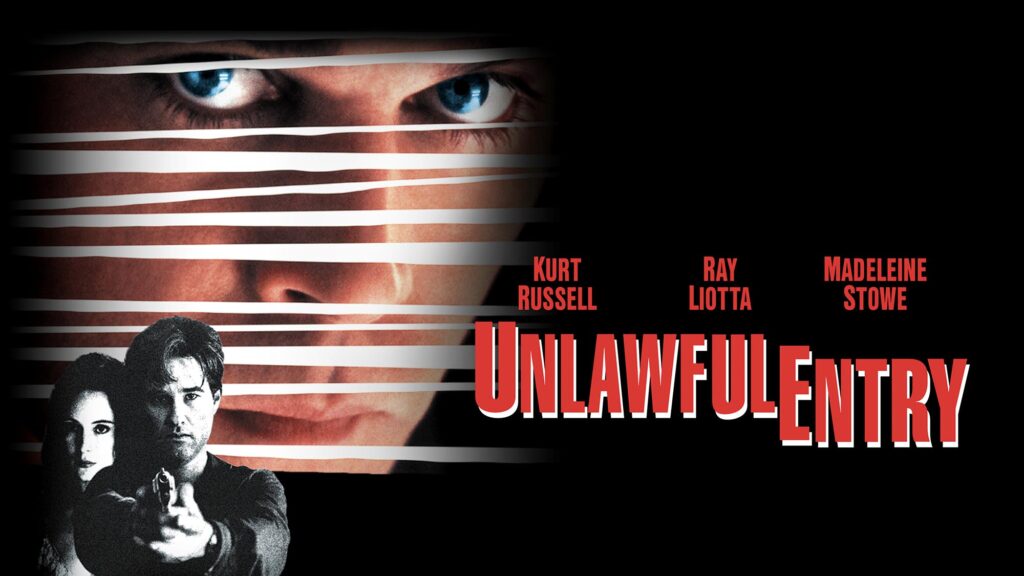
Unlawful Entry
Unlawful Entry was shot in and around Los Angeles, which fits its atmosphere of suburban comfort under threat.