
Edgar Wright is a British film director, screenwriter and producer born on 18 April 1974 in Poole, Dorset, England. He spent his early childhood in the seaside town of Swanage before his family moved to Wells in Somerset when he was seven. His older brother, Oscar Wright, became an artist and designer. Growing up in relatively small towns, Wright developed an enthusiasm for cinema, particularly horror films, science fiction, American action films and comedy. He has recalled seeing Star Wars at a cinema on Westover Road in Bournemouth as a young child, an experience that helped establish his lifelong interest in filmmaking. During his teenage years in Wells, he regularly visited the Regal Cinema, sometimes attempting to gain admission to films for which he was underage. He also watched horror films at friends’ houses before acquiring his own video recorder, which he paid for through a Saturday job at a local supermarket. He attended The Blue School in Wells between 1985 and 1992, where he began experimenting with amateur filmmaking.
Wright started making films using a Super 8 camera given to him by a relative and later obtained a Video8 camcorder after winning a competition on the BBC children’s television programme Going Live!. Working with school friends, he made short comedies inspired by the films he admired, frequently recreating elaborate action sequences using improvised equipment and whatever locations were available around Wells. His early productions included Carbolic Soap, a superhero parody, and Dead Right, a comedy influenced by American police thrillers. Rather than simply filming conversations between actors, Wright experimented with camera movement, rapid editing and elaborate visual jokes. Many of these films were made in residential streets, gardens and public spaces around his hometown, with friends and family taking part as performers. After leaving school, he studied Audio-Visual Design at Bournemouth and Poole College of Art and Design, now part of Arts University Bournemouth, from 1992 to 1994. During his studies, he spent considerable time using the college’s editing equipment and developed a greater understanding of professional film production. He later credited this period with helping him turn his interest in cinema into practical filmmaking skills.
Following college, Wright made his first feature-length film, A Fistful of Fingers (1995), a low-budget Western comedy inspired by the films of Sergio Leone and other directors. The production was financed partly through support from a local businessman and involved friends and fellow students working with limited resources in the West Country. The film received a small theatrical release, although Wright later expressed dissatisfaction with aspects of the finished production. Nevertheless, it attracted the attention of comedians Matt Lucas and David Walliams, who invited him to direct their television comedy Mash and Peas. Wright subsequently worked on several British television productions, including Asylum (1996), an experimental comedy series featuring Simon Pegg and Jessica Stevenson, later known professionally as Jessica Hynes. He also directed episodes of Is It Bill Bailey? and Sir Bernard’s Stately Homes, gaining experience working with established comedians and professional television crews. By this time, he had moved to London, where his work brought him into contact with performers and writers who would become important collaborators throughout his career.
His breakthrough in television came when Simon Pegg and Jessica Hynes invited him to direct Spaced (1999–2001), a Channel 4 sitcom they had created together. The series followed Tim Bisley and Daisy Steiner, two young Londoners who pretend to be a couple to secure a flat and become involved with an eccentric group of friends. Nick Frost, a friend of Pegg who had little previous acting experience, joined the cast as Tim’s military-obsessed friend Mike Watt. Wright directed all fourteen episodes, introducing a visual approach that borrowed heavily from feature films, music videos and video games. The production was filmed around London, with the exterior of the characters’ house represented by a Victorian property at 23 Carleton Road in Tufnell Park. Studio work took place at Twickenham Film Studios for the first series and Ealing Studios for the second. Other locations included Camden, Islington and Wood Green, neighbourhoods that reflected the everyday experiences of young adults living in the capital. Spaced developed a devoted following, establishing Wright, Pegg and Frost as a creative partnership and bringing Wright wider recognition as a director.
Wright and Pegg subsequently began developing Shaun of the Dead (2004), a comedy that combined their interest in George A. Romero’s zombie films with the ordinary routines of contemporary London life. Pegg played Shaun, an electronics shop employee whose attempts to repair his relationships are interrupted by a zombie outbreak, while Frost portrayed his irresponsible flatmate Ed. The film was shot over approximately nine weeks in London during 2003, using locations around Crouch End, Highgate, Finsbury Park and East Finchley. Shaun’s house was filmed on Weston Park in Crouch End, while the neighbourhood shop he visits during the opening sequences was located nearby. One of the most important locations was the Duke of Albany pub at 39 Monson Road in New Cross, which supplied the exterior of the fictional Winchester Tavern. The pub’s interiors were constructed at Ealing Studios, allowing Wright to stage the increasingly elaborate action scenes under controlled conditions. The real Duke of Albany closed several years later and was converted into residential accommodation. Shaun of the Dead premiered in 2004 and became an international success, earning Wright and Pegg a British Independent Film Award for Best Screenplay and a BAFTA nomination for Outstanding British Film. It also established Wright’s working relationship with producers including Nira Park and Working Title Films, who would support many of his subsequent projects.
For his next feature, Hot Fuzz (2007), Wright returned to Wells, the Somerset city where he had spent much of his childhood. Written with Pegg, the film follows an exceptionally dedicated London police officer who is transferred to the apparently peaceful village of Sandford, where he uncovers a conspiracy involving members of the local community. The fictional village was created primarily from locations in Wells, with its Market Place, historic streets, shops and surrounding countryside providing much of the setting. The Crown at Wells appeared as the town’s pub, while the Bishop’s Palace and its grounds were used for several sequences. The production also filmed around St Cuthbert’s Church, which became the village’s principal landmark. Because Wright wanted Sandford to appear smaller than Wells, the city’s medieval cathedral was digitally removed from shots in which it would otherwise have been visible. The director also included personal references to his childhood, with his former drama teacher Peter Wild appearing in a cameo alongside the mothers of Wright and Pegg. Additional filming took place at police training facilities in London and at Elstree Studios. The film reunited Pegg and Frost, this time as police officers Nicholas Angel and Danny Butterman, and became another commercial success. Shaun of the Dead and Hot Fuzz were subsequently recognised as the first two instalments of the informal Three Flavours Cornetto trilogy, named after the ice creams that appeared in each film.
Wright’s growing reputation brought him to North America for Scott Pilgrim vs. the World (2010), an adaptation of Bryan Lee O’Malley’s graphic novel series. Starring Michael Cera as a young musician who must defeat the seven former partners of the woman he loves, the film combined romantic comedy with the visual language of comics, arcade games and action cinema. Principal photography took place in Toronto, Canada, in 2009, with Wright choosing to preserve the city’s identity rather than substitute it for an American location. The production filmed at recognisable Toronto landmarks including Casa Loma, Lee’s Palace on Bloor Street West, the Baldwin Steps and Artscape Wychwood Barns. Other scenes used the Pizza Pizza restaurant at Bloor and Bathurst, the former Sonic Boom record shop and residential streets around the city. Studio facilities in Toronto accommodated the more complicated action sequences, including elaborate fights requiring extensive visual effects. Although Scott Pilgrim vs. the World was a commercial disappointment on its initial release, it gradually developed a substantial following, particularly through home video and streaming. Wright also became involved in Steven Spielberg’s animated adventure The Adventures of Tintin (2011), sharing screenplay credit with Steven Moffat and Joe Cornish.
Wright reunited with Pegg and Frost for The World’s End (2013), completing the Three Flavours Cornetto trilogy. The story follows five former school friends who return to their hometown to recreate an ambitious pub crawl from their youth, only to discover that the community has changed in unexpected ways. The fictional town of Newton Haven was assembled from locations in Letchworth Garden City and Welwyn Garden City in Hertfordshire, with additional filming at Elstree Studios. Several actual pubs were used, including The Peartree in Welwyn Garden City, which represented the first stop, The First Post, and The Gardener’s Arms in Letchworth, which stood in for the final destination, The World’s End. Other locations included Letchworth railway station, the Broadway Cinema and businesses around Howardsgate in Welwyn Garden City. Wright and Pegg had developed the story partly from their experiences of returning to places associated with their youth and finding that both the surroundings and their former friendships had changed. Unlike the previous two films, which centred on characters gradually accepting responsibility, The World’s End placed particular emphasis on ageing, alcoholism and the difficulty of moving beyond adolescence. Its release concluded a collaboration that had begun with Spaced more than a decade earlier, although Wright and Pegg continued to work together on other projects.
During this period, Wright was also developing a much larger American production. He had been attached to direct Marvel Studios’ Ant-Man, working with Joe Cornish on the screenplay since the mid-2000s. The project underwent several years of development, but Wright departed in May 2014 following disagreements with Marvel over the creative direction of the film. Peyton Reed subsequently took over as director, and the finished production was released in 2015. Wright retained a story credit alongside Cornish but did not direct the film. Following his departure, he concentrated on Baby Driver (2017), an original action thriller he had been developing intermittently since the 1990s. The concept originated while he was living in a flat in Wood Green, London, listening to the Jon Spencer Blues Explosion song Bellbottoms and imagining a car chase synchronised to the music. Wright had already experimented with the idea in a 2003 music video for Mint Royale’s Blue Song, featuring Noel Fielding as a getaway driver. For the feature film, he developed the story of Baby, a young driver played by Ansel Elgort who relies on music to manage his tinnitus and coordinate his movements during robberies.
Although Wright had initially considered setting Baby Driver in Los Angeles, the film was ultimately shot in Atlanta, Georgia, where principal photography took place between February and May 2016. Rather than disguising the city as another American location, Wright incorporated Atlanta’s streets, commercial districts and architecture directly into the story. The opening getaway sequence used roads around Downtown Atlanta, while an extended scene in which Baby walks to collect coffee was filmed along Peachtree Street, Forsyth Street and Poplar Street. The former Octane Coffee location on Poplar Street was used during the sequence, while an abandoned restaurant in Forest Park, south of Atlanta, became Bo’s Diner, where Baby meets the waitress Debora, played by Lily James. Other filming took place around the Healey Building, the Peachtree Center area and streets in the city’s central business district. Wright worked closely with editor Paul Machliss and choreographers to coordinate dialogue, camera movement, vehicle stunts and gunfire with specific musical recordings, an approach that required unusually detailed planning before production began. Baby Driver premiered at South by Southwest in Austin, Texas, in March 2017 and became Wright’s most commercially successful film. It received three Academy Award nominations for editing and sound, while editors Machliss and Jonathan Amos won the BAFTA Award for Best Editing in 2018.
In June 2018, Wright returned to Arts University Bournemouth, where he received an Honorary Fellowship recognising his achievements in filmmaking. During the visit, he spoke to students about his experiences at the college and the importance of developing practical skills through short films and experimentation. His association with music remained central to his work, and he subsequently directed The Sparks Brothers (2021), his first feature-length documentary. The film examined the history of American musical duo Sparks, formed by brothers Ron and Russell Mael, whose career had fascinated Wright since he discovered their recordings. He conducted approximately eighty interviews with musicians, producers, actors and other admirers, assembling a history of the group through archival footage, animation and contemporary conversations. The documentary premiered at the Sundance Film Festival in January 2021. Wright had become acquainted with the Mael brothers through their performances in Los Angeles, and their willingness to participate gave him access to extensive material documenting the group’s career. The project allowed him to explore his interest in popular music without the narrative conventions of his earlier comedies and thrillers.
Wright returned to fiction with Last Night in Soho (2021), a psychological horror film written with Krysty Wilson-Cairns and starring Thomasin McKenzie, Anya Taylor-Joy and Matt Smith. The story follows a young fashion student who moves to London and experiences visions of the city’s nightlife during the 1960s. Wright had lived in London for much of his adult life and developed the film from his familiarity with Soho, a district where he regularly visited cinemas, music venues, restaurants and record shops. Principal photography took place in central London during 2019, with extensive location work in Soho and neighbouring Fitzrovia. The production filmed around Dean Street, Greek Street, Carlisle Street and Goodge Place, as well as the London College of Fashion’s former building on John Prince’s Street. Ramsay Hall on Maple Street represented the main character’s student accommodation, while the Toucan pub on Carlisle Street appeared in several scenes. For a sequence set outside the historic Café de Paris nightclub, the filmmakers transformed the exterior of the Empire Cinema on Haymarket, with the nightclub’s interior reconstructed on a studio set. The film also featured Diana Rigg and Terence Stamp, performers whose careers were closely associated with British cinema and television during the period depicted. Last Night in Soho premiered out of competition at the Venice International Film Festival in September 2021, before receiving its general theatrical release the following month.
In 2023, Wright returned to the world of Scott Pilgrim as an executive producer of the animated Netflix series Scott Pilgrim Takes Off. Developed by Bryan Lee O’Malley and BenDavid Grabinski, the series brought back much of the original film’s cast, including Michael Cera, Mary Elizabeth Winstead, Kieran Culkin, Chris Evans and Anna Kendrick, to voice their former characters. Although produced as animation rather than filmed on location in Toronto, the series retained the Canadian setting and drew on the visual and musical approach established in the 2010 film. Wright was involved in bringing the cast back together and supporting the project, which offered a substantially different interpretation of the original story rather than simply reproducing the feature film. His production work during this period also included involvement in the development of other film and television projects through Complete Fiction, the company he established with longtime collaborators Nira Park, Joe Cornish and Rachael Prior.
Wright’s next major feature was The Running Man (2025), a new adaptation of Stephen King’s dystopian novel, originally published in 1982 under the pseudonym Richard Bachman. Wright had read the book as a teenager and had expressed interest in adapting it independently of the earlier film version starring Arnold Schwarzenegger. He developed the screenplay with Michael Bacall, with Glen Powell cast as Ben Richards, a struggling father who enters a televised competition in which contestants are hunted for entertainment. The production also featured Josh Brolin, Colman Domingo, Lee Pace, Emilia Jones and Michael Cera. Principal photography began in November 2024 and took place in England, Scotland and Bulgaria, with the different locations representing cities and landscapes across a fictional future United States. London locations included Canary Wharf, Wembley and Battersea, while Glasgow supplied streets and buildings representing parts of New York and Boston. The OVO Hydro arena in Glasgow was used for scenes involving the televised competition, and Buchanan Bus Station represented a transportation terminal in Boston. Additional production work took place at Warner Bros. Studios Leavesden in Hertfordshire and Nu Boyana Film Studios in Sofia, Bulgaria. Wright also filmed action sequences on stretches of unused motorway in Bulgaria, where the road layout more closely resembled American highways than comparable routes in Britain. The Running Man was released in November 2025, the same year in which King’s original novel was set.
The Running Man marked Wright’s return to large-scale action filmmaking following the more intimate production of Last Night in Soho. In developing its futuristic environments, he worked with Industrial Light & Magic to combine real urban locations, practical sets and extensive digital alterations, allowing familiar European buildings to become part of an imagined American society. The project also brought him into direct contact with Stephen King, whom he met in person shortly before completing the film in 2025 after years of correspondence. Wright continued discussing possible future collaborations with Simon Pegg and Nick Frost, although no further feature reuniting the trio had been formally completed by October 2026. His career had by then taken him from amateur filmmaking in Somerset and television comedy in London to studio productions in Canada, the United States and continental Europe. Wells, London, Toronto and Atlanta remained particularly important locations in his work, each providing more than a conventional filming backdrop: they were places whose streets, buildings and local culture had directly influenced the stories he chose to tell.

Baby Driver
Baby Driver is set in Atlanta and was shot in and around the city, making strong use of its downtown streets, highways, car parks and modern urban architecture.
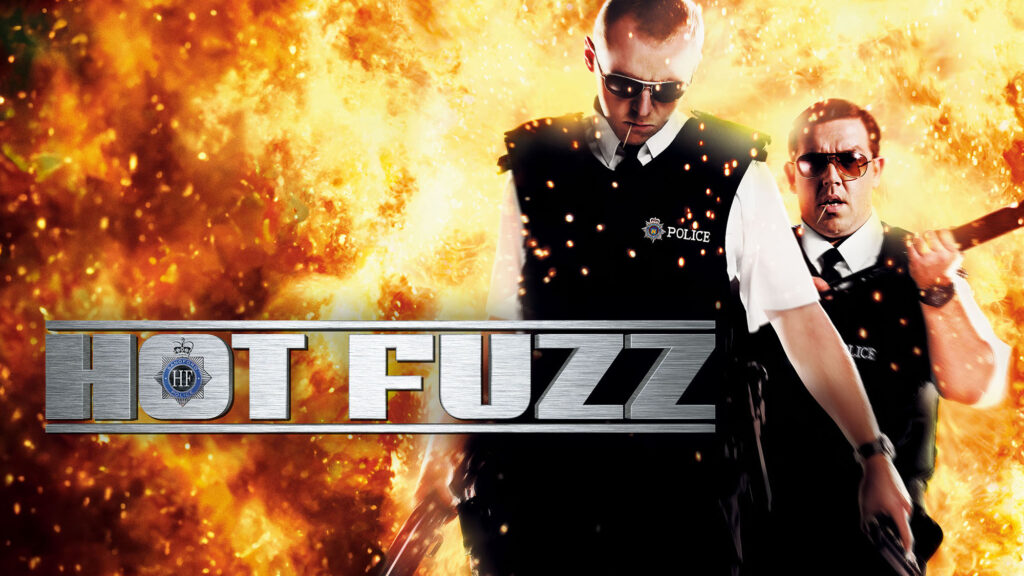
Hot Fuzz
Hot Fuzz was shot primarily in Wells, Somerset, Edgar Wright’s home city, and the place is used so thoroughly that it becomes one of the film’s main characters.