
Coral Castle is an unusual open-air stone complex at 28655 South Dixie Highway in unincorporated Miami-Dade County, near Homestead, Florida. It was created by Latvian-American sculptor and self-taught engineer Edward Leedskalnin (1887–1951), who spent nearly three decades quarrying, transporting and carving more than 1,100 tons of locally sourced oolitic limestone. Despite its name, the structure is not built from coral but from a porous sedimentary rock containing fossilised marine material. Leedskalnin began construction in 1923 on a small property in Florida City, reportedly inspired by the collapse of his engagement to a sixteen-year-old Latvian girl whom he subsequently referred to as his Sweet Sixteen. During the late 1930s, he relocated his increasingly elaborate collection of stone sculptures approximately ten miles north to its present site beside U.S. Highway 1, where he continued working until his death in December 1951. The resulting complex, originally known as Rock Gate, combines massive perimeter walls, an elevated residential tower, an obelisk, a precisely carved sundial and numerous pieces of functional stone furniture, including rocking chairs, a heart-shaped table, a table representing the state of Florida and a crescent moon. One of its most remarkable features is a nine-ton revolving gate, originally balanced on a central metal shaft and truck bearing so accurately that it could be moved with remarkably little effort. Leedskalnin performed most of his construction work alone, frequently at night, using hand-operated hoists, pulleys, tripods and equipment assembled from discarded mechanical parts. His reluctance to explain his methods encouraged speculation about supernatural forces and unusual applications of magnetism, although the surviving tools demonstrate his extensive use of conventional mechanical principles. Following his death, the property passed through several owners and developed into a commercial attraction under the name Coral Castle. It was added to the National Register of Historic Places in 1984 and remains preserved as a museum and sculpture garden.
Coral Castle has appeared in The Wild Women of Wongo (1958), Nude on the Moon (1961) and Jimmy, the Boy Wonder (1966), three low-budget American fantasy productions that used its extraordinary limestone sculptures to represent entirely fictional worlds. In The Wild Women of Wongo (1958), the complex becomes a prehistoric temple dedicated to a crocodile-like dragon god, while Nude on the Moon (1961) transforms its stone garden into an extraterrestrial settlement inhabited by a civilisation of telepathic lunar women. Jimmy, the Boy Wonder (1966) makes particularly extensive use of the property, representing both the home of a magical astronomer and a labyrinth at the end of the world. Coral Castle also appears in the colour music video for Billy Idol’s «Sweet Sixteen» (1987), a song directly inspired by Edward Leedskalnin’s story of lost love and the enormous stone monument he created in response.
In The Wild Women of Wongo (1958), directed by James L. Wolcott, Coral Castle represents the Temple of the Dragon God on a fictional tropical island inhabited by two neighbouring tribes, Wongo and Goona. The inhabitants of Wongo are characterised by beautiful women and unattractive men, while the neighbouring Goona tribe has precisely the opposite arrangement. When Engor, a handsome young man from Goona, arrives seeking assistance against a tribe of hostile ape-men, his appearance creates considerable unrest among the women of Wongo, particularly Omoo, who becomes attracted to him. The jealous Wongo men subsequently attempt to kill Engor, but the women intervene and help him escape, offending their tribe’s crocodile-like deity in the process. Coral Castle provides the setting for the religious ceremonies that follow, with its large limestone blocks, carved furniture and enclosed stone spaces forming the supposedly ancient temple. The High Priestess summons the women to explain that the Dragon God is angry because the postponed wedding ceremony has deprived him of his expected sacrifice. Sitting on a carved stone throne, she performs an elaborate ritual in which her spiritual form appears as a dancer wearing a glittering costume and a crocodile headdress. The women are instructed to perform a vigorous ceremonial dance before being banished into the surrounding wilderness until the deity has received a suitable blood sacrifice. The temple returns during the film’s conclusion, when Omoo and the other women capture the handsome men of Goona and bring them before the priestess to receive a marriage blessing. Their arrival is followed by the men of Wongo, who have independently brought the women of Goona, resulting in a final ceremony that resolves the film’s unusual romantic conflicts. Coral Castle is particularly recognisable during the extended temple dance, which makes direct use of the existing stone structures rather than conventional studio scenery. The production filmed at several attractions around South Florida, including Tahiti Beach, Parrot Jungle and Fairchild Tropical Garden, and specifically acknowledges Coral Castle for its temple sequences in the opening credits.
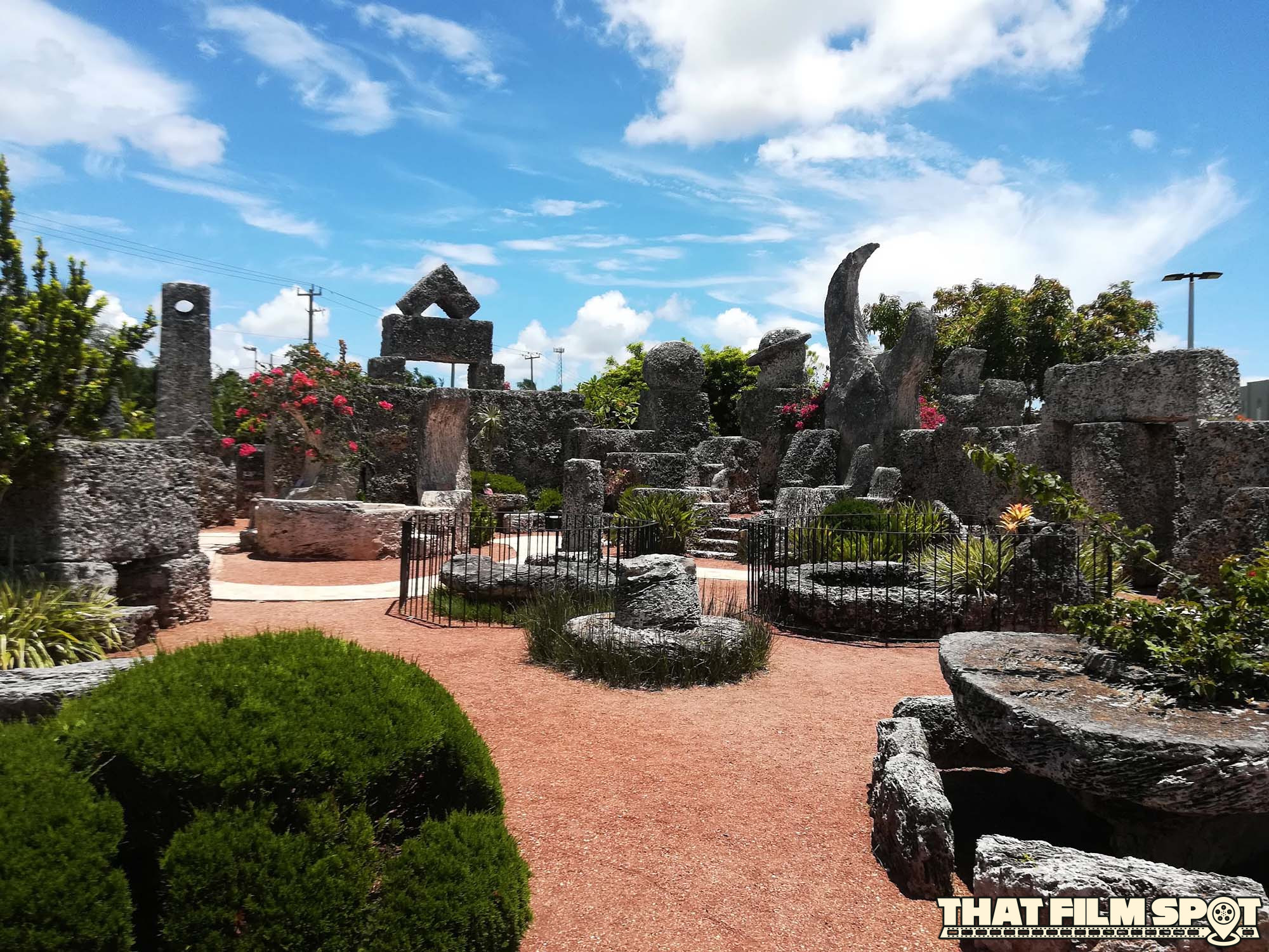
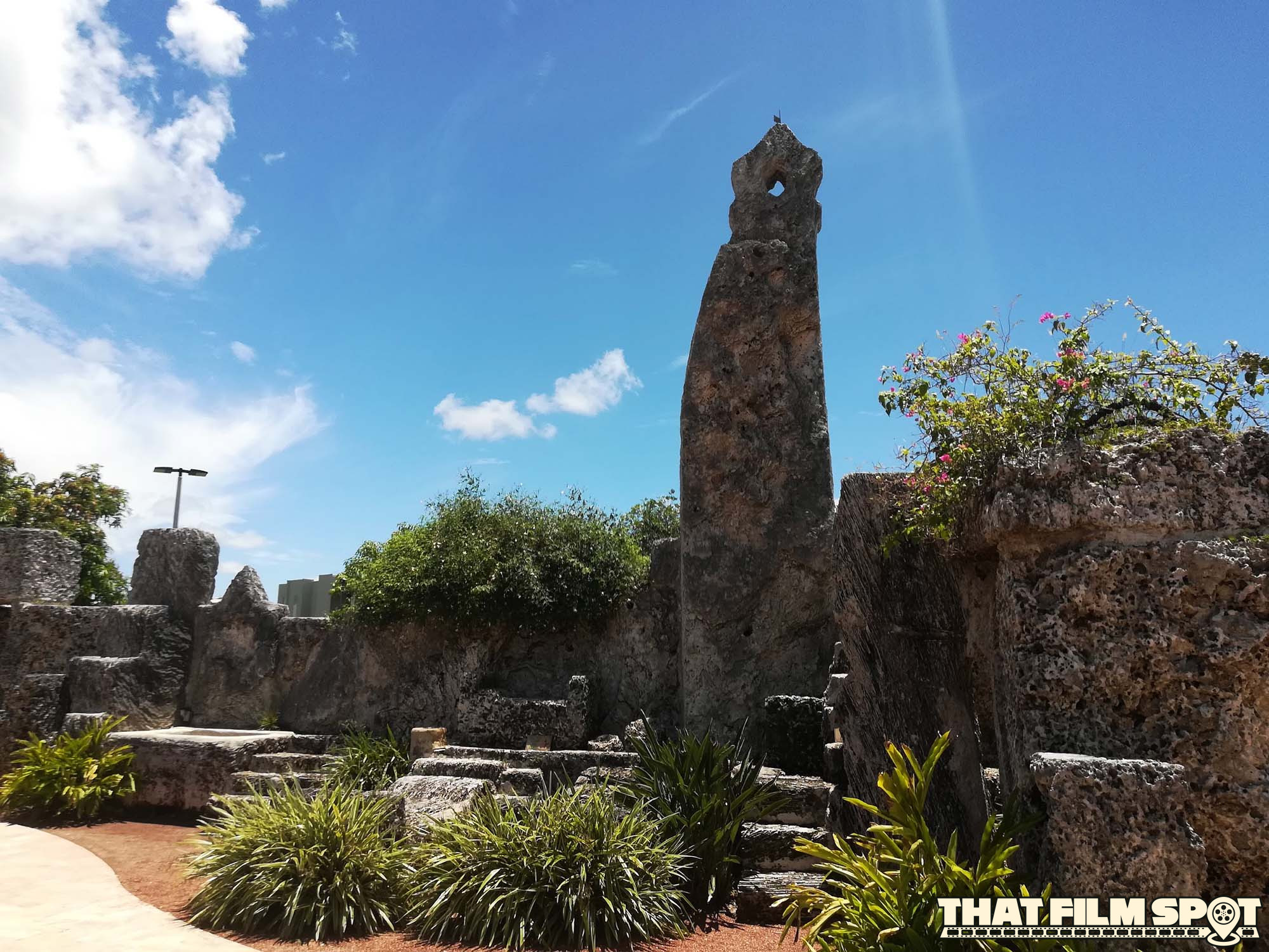
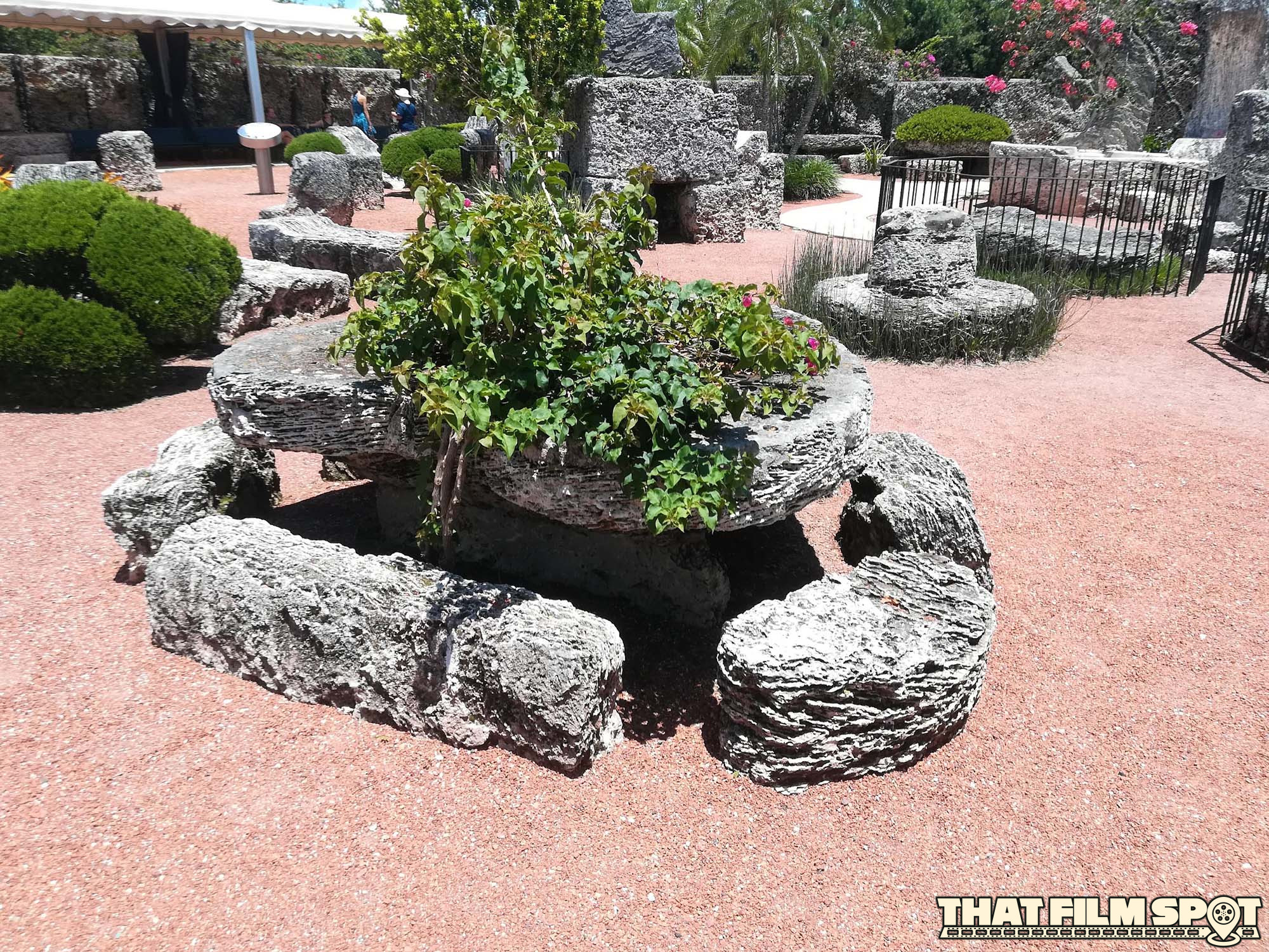
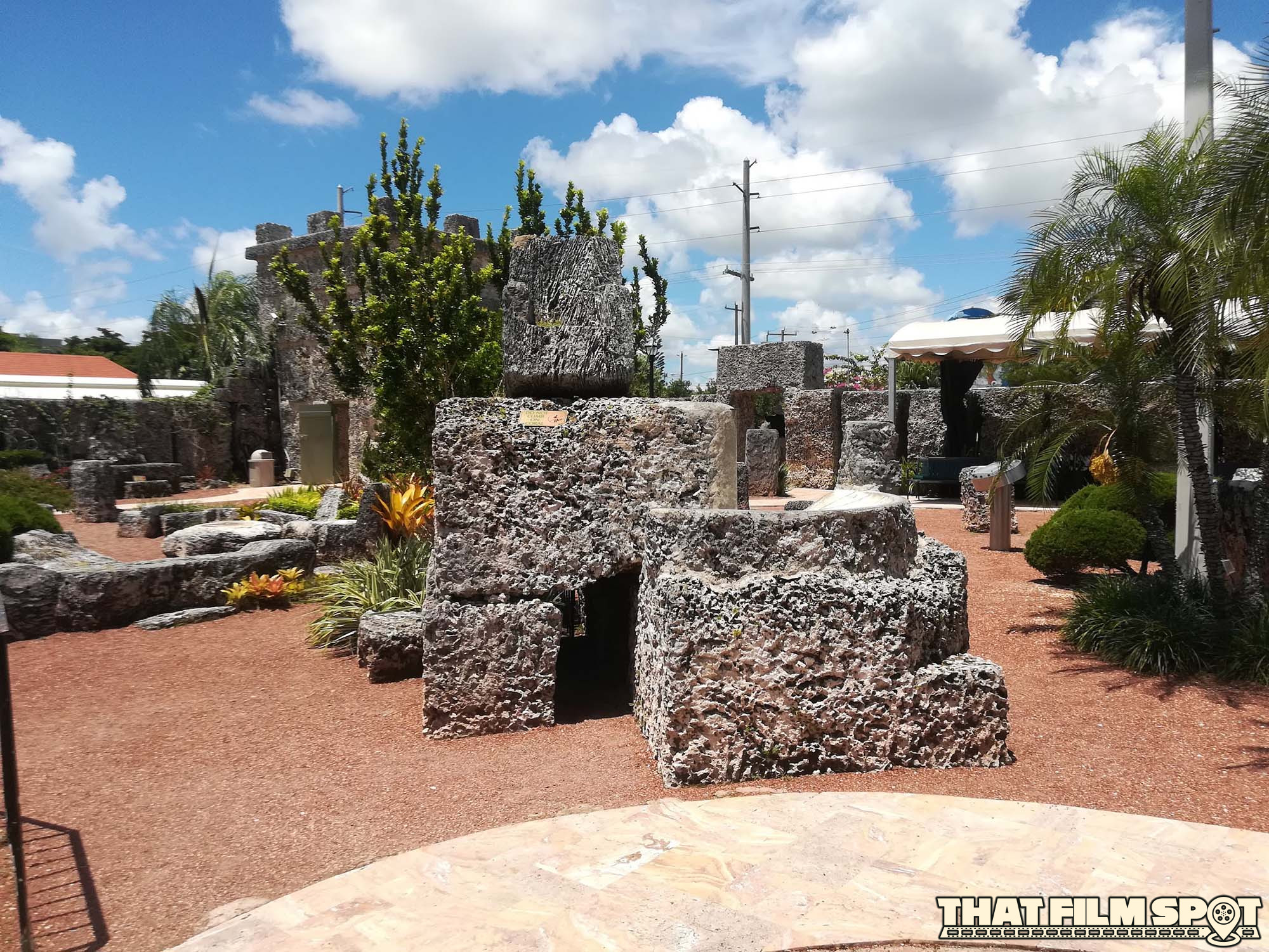
In Nude on the Moon (1961), co-directed by Doris Wishman and Raymond Phelan, Coral Castle provides the principal setting for the film’s imaginary lunar civilisation. Scientist Dr. Jeff Huntley, played by Lester Brown, inherits three million dollars from his uncle and uses the money to finance the construction of a rocket with the assistance of his older colleague, Professor Nichols, played by William Mayer. After successfully travelling to the Moon, the two men are surprised to discover that its surface resembles a lush tropical garden rather than the barren landscape they had expected. Their exploration eventually leads them to a peculiar settlement surrounded by enormous carved stone walls, where they encounter a civilisation of scantily clad women and men who communicate through telepathy. The supposed lunar settlement is actually Coral Castle, with Leedskalnin’s stone furniture, carved tables, unusual architectural forms and enclosed garden providing much of the film’s extraterrestrial scenery. The scientists meet the Moon Queen, played by Marietta, who possesses telepathic abilities and bears a remarkable resemblance to Huntley’s secretary Cathy back on Earth. As the two visitors explore the settlement, they observe the inhabitants relaxing, socialising and participating in recreational activities among the limestone sculptures, which are presented as ordinary features of lunar life. Huntley gradually develops romantic feelings for the Queen, while the Professor remains fascinated by the apparent scientific implications of their discovery. The expedition eventually comes to an abrupt end when the men realise that their oxygen supply is running low and they must return to Earth. Unfortunately, they leave their camera behind, depriving them of photographic evidence that the remarkable civilisation actually exists. Coral Castle consequently provides the setting for much of the film’s central section rather than a brief establishing sequence. The production was completed on a very small budget, and Wishman used the existing sculptures to create an alien environment without having to construct elaborate science-fiction sets. Coral Castle is explicitly thanked in the film’s opening credits for allowing the production to use its facilities.
In Jimmy, the Boy Wonder (1966), directed by Herschell Gordon Lewis, Coral Castle represents two important locations in a children’s musical fantasy about a young boy who accidentally brings time to a standstill. Eight-and-a-half-year-old Jimmy Jaye, played by Dennis Jones, becomes frustrated with his daily routine after his mother repeatedly reminds him that he must hurry to prepare for his first day of school. Wishing that time would simply stop, Jimmy inadvertently interrupts the operation of the Great Clock, a magical mechanism responsible for keeping the world moving. The problem is discovered by a mysterious Astronomer, played by Karl Stoeber, who summons his daughter Aurora, played by Nancy Jo Berg, and instructs her to find the boy responsible. Coral Castle supplies the extraordinary stone surroundings associated with the Astronomer’s domain, its unusual architecture establishing the fantastical world from which Aurora begins her mission. She subsequently locates Jimmy and explains that only he can restore time by carrying a magical Golden Globe to the Great Clock at a place known as World’s End. Their journey is repeatedly interrupted by Mr. Fig, played by David Blight Jr., an evil magician who intends to seize the opportunity to gain control of the world. Coral Castle returns prominently during the extended final sequence, when Jimmy and Aurora arrive at World’s End and discover an enormous stone wall blocking their passage. Aurora uses the Golden Globe to open an entrance, revealing a labyrinth of limestone walls, passages and sculptural structures formed by the real Coral Castle. She points Jimmy towards a small tower containing the Great Clock and explains that he must complete the final part of the mission alone. When Mr. Fig suddenly appears, Jimmy flees through the maze, running between the massive stone blocks as the magician pursues him in an attempt to steal the Globe. Jimmy eventually reaches the tower, climbs the steps and narrowly avoids being captured before replacing the Golden Globe in the clock mechanism. Time immediately begins moving again, Mr. Fig disappears and Aurora congratulates Jimmy on saving the world. The film makes particularly effective use of Coral Castle during these sequences, transforming Leedskalnin’s actual sculpture garden into an elaborate magical environment through relatively simple camera work and editing. Jimmy, the Boy Wonder is also an unusual entry in Herschell Gordon Lewis’s filmography, as the director was primarily associated with low-budget horror and exploitation films, most notably Blood Feast (1963) and Two Thousand Maniacs! (1964).
In Billy Idol’s music video for «Sweet Sixteen» (1987), Coral Castle appears as itself, providing the setting for a song directly inspired by the life of Edward Leedskalnin. Idol became fascinated by the Latvian sculptor’s story after learning that he had supposedly spent much of his life constructing an enormous stone monument following the collapse of his engagement to a sixteen-year-old girl. The resulting song, released on Idol’s third studio album Whiplash Smile (1986) and subsequently issued as a single in 1987, explores themes of lost love, abandonment and an enduring attachment to an absent woman. Two different promotional videos were produced for the single. The alternative colour version incorporates footage filmed at Coral Castle, placing Idol among the massive limestone structures that inspired the lyrics. Filming took place on 16 March 1987, with contemporary newspaper coverage reporting that Idol had specifically wanted to use the location because of his fascination with Leedskalnin’s achievement. Unlike the earlier fictional productions that transformed Coral Castle into a prehistoric temple, lunar settlement or magical kingdom, «Sweet Sixteen» uses the real location as an integral part of the song’s subject, connecting the music directly to the monument and the personal history of its creator.

Nude on the Moon
Nude on the Moon most distinctive location is Coral Castle in Homestead, Florida, which was used for the Moon sequences and even in the film’s credits.

Vizcaya Museum & Gardens
Vizcaya Museum & Gardens has appeared in Ace Ventura: Pet Detective, Miami Rhapsody, Any Given Sunday, Bad Boys II, Iron Man 3 and Miami Vice.

Caribbean Club
Caribbean Club is best known for its connection to "Key Largo" (1948). Decades later, the bar also appeared in "Bloodline" (2015–2017).

CVS Miama Beach
In Scarface (1983), 728 Ocean Drive is used for the Sun Ray Apartments, now a CVS, where Tony Montana and Manny Ribera go to make a drug deal.

Colony Hotel
Colony Hotel has appeared in productions including Miami Rhapsody, Dexter and Bad Boys for Life. It is also strongly connected to the Scarface.

The Carlyle
The Carlyle has appeared in several productions, including Scarface (1983), Miami Vice, The Birdcage, Pronto, Random Hearts and Bad Boys II.

Miami Beach Golf Club
Miami Beach Golf Club, a public golf course in the Bayshore neighbourhood of Miami Beach, has appeared in The Bellboy (1960) and Pain & Gain (2013).

Fontainebleau Miami Beach
Fontainebleau Miami Beach appears in Goldfinger (1964), Scarface (1983), The Bodyguard (1992), Police Academy 5: Assignment Miami Beach (1988), and many more.

Swifty Laundromat
In Striptease, Swifty Laundromat is used for one of the scenes showing Erin Grant’s everyday life away from the club world that dominates much of the film.

The Moorings Village
The Moorings Village is best known as the Rayburn family inn in "Bloodline" (2015–2017). The Netflix series was filmed largely in the Upper Florida Keys.