
The Shining (1980) is a British-American psychological horror film directed by Stanley Kubrick and co-written with Diane Johnson, based on Stephen King’s 1977 novel. Jack Nicholson stars as Jack Torrance, a struggling writer and recovering alcoholic who accepts a job as the winter caretaker of the isolated Overlook Hotel in the Colorado Rocky Mountains. He moves into the enormous building with his wife Wendy, played by Shelley Duvall, and their young son Danny, portrayed by Danny Lloyd. As winter approaches and heavy snow cuts the hotel off from the outside world, Jack becomes increasingly unstable, while Danny experiences terrifying visions connected to the building’s violent history. Scatman Crothers plays Dick Hallorann, the hotel’s head chef, who shares Danny’s psychic ability known as the shining. Released in May 1980, the film was initially met with mixed reviews but gradually became one of the most influential horror films ever made. Its elaborate sets, unsettling camera movements and memorable images, including the blood-filled elevators, Room 237 and the snow-covered hedge maze, have become familiar parts of cinema history.
The Shining was filmed in the United States and England, with most of the production taking place at EMI Elstree Studios in Borehamwood, Hertfordshire, between 1978 and 1979. Although the story is set at a mountain resort in Colorado, the fictional Overlook Hotel was assembled from several entirely different locations. The exterior establishing shots were filmed at Timberline Lodge on Mount Hood in Oregon, while the opening aerial sequence follows a car through Glacier National Park in Montana. Other American locations supplied additional exterior footage, including an apartment complex in Boulder, Colorado. Almost everything else was recreated in England, where production designer Roy Walker and his team constructed an enormous collection of hotel interiors, corridors, exterior façades and a full-sized hedge maze. The production occupied much of Elstree Studios for an unusually long period, allowing Kubrick to film the hotel almost as though it were a real, functioning building.
The film opens with one of its most recognisable sequences, as a yellow Volkswagen Beetle travels along a winding mountain road towards the Overlook Hotel. These aerial shots were filmed in Glacier National Park in northwestern Montana, particularly along Going-to-the-Sun Road. The road crosses the park through a spectacular landscape of mountains, lakes and steep valleys, eventually reaching Logan Pass at the Continental Divide. Several shots follow the car beside Saint Mary Lake, with the small, tree-covered Wild Goose Island visible in the water. Other sections show the vehicle negotiating bends cut into the mountainside, with steep drops towards the valley below. Although the road is supposed to lead towards a hotel in Colorado, the actual location is hundreds of miles away in Montana.
The opening footage was photographed from a helicopter by a second-unit crew working under the supervision of executive producer Jan Harlan. Camera operator Jeff Blyth later described following the Volkswagen through the mountains, using a small black-and-white video monitor to judge the composition while directing the helicopter pilot. Kubrick did not accompany the crew to Montana, instead providing instructions about the appearance of the vehicle and the type of images he wanted. The resulting footage became inseparable from Wendy Carlos and Rachel Elkind’s ominous electronic arrangement of the medieval Dies Irae theme. Several unused aerial shots from the same filming were later supplied to Ridley Scott for the original theatrical ending of Blade Runner (1982), where they helped create a more optimistic final journey for the characters.
The first important American location after the opening sequence is the apartment building where the Torrance family lives before moving to the Overlook. The exterior was filmed at Kensington Apartments, located at 2950 Bixby Lane in Boulder, Colorado. The complex consists of several residential buildings arranged around parking areas and communal spaces, providing a relatively ordinary setting for the family’s life before their move into the isolated hotel. The building is shown briefly during the early scenes, when Jack has travelled to the Overlook for his job interview and Wendy remains at home with Danny. The apartment interiors were not filmed in Boulder. Instead, Kubrick recreated the family’s modest accommodation at Elstree Studios, including the narrow hallway, living room, kitchen and Danny’s bedroom. The small rooms were designed in deliberate contrast to the vast spaces of the Overlook Hotel that later surround the family.
The Overlook Hotel itself is represented externally by Timberline Lodge, situated on the southern slopes of Mount Hood in Oregon. Located at an elevation of approximately 1,800 metres, the historic mountain hotel was constructed during the 1930s as a Works Progress Administration project and dedicated by President Franklin D. Roosevelt in 1937. Its architecture combines massive stone walls, heavy timber construction and steep roofs designed to withstand the mountain’s severe winter conditions. The building had already become an established ski resort when Kubrick selected it to represent the Overlook. The film uses aerial and distant exterior shots of the actual lodge, particularly during the opening journey and establishing scenes showing the hotel surrounded by mountain scenery.
Despite its prominent appearance, very little of The Shining was actually filmed at Timberline Lodge. The production did not use the hotel’s guest rooms, corridors, reception area or public interiors. Nor does the real property have the enormous hedge maze that plays such an important role in the story. The scenes showing characters entering the hotel, walking around the grounds or moving between the building and the maze were filmed using constructed sets in England. The exterior façade at Elstree was modelled on the southern side of Timberline Lodge, allowing it to resemble the real building seen in the aerial footage. The filmmakers also used forced perspective to make portions of the construction appear larger than they actually were. Through careful framing and editing, the Oregon hotel and its English imitation appear to occupy the same mountain landscape.
One particularly unusual change concerned the hotel’s most notorious room. In Stephen King’s novel, the haunted room is numbered 217, a room that actually exists at Timberline Lodge. The hotel’s management asked Kubrick to change the number because they feared that guests might become reluctant to stay there after seeing the film. He agreed and changed it to Room 237, which did not exist at Timberline. Ironically, the association with The Shining subsequently made the real Room 217 one of the hotel’s most requested rooms. Timberline’s own historical material confirms the arrangement and points out that the hotel has never contained the sinister maze or the interiors portrayed in the film.
Another hotel that played an important part in creating the Overlook was The Ahwahnee in Yosemite National Park, California. Opened in 1927, the luxurious mountain hotel was designed by architect Gilbert Stanley Underwood, who also designed Timberline Lodge. Kubrick and production designer Roy Walker were particularly interested in its large public rooms, high ceilings, massive fireplaces and decorative details inspired by Native American art. The Ahwahnee’s Great Lounge became the principal reference for the Overlook’s Colorado Lounge, the enormous room where Jack attempts to write his novel. Its timber beams, tall windows, monumental fireplace and general proportions were carefully studied and adapted for the studio construction. The film’s hotel lobby also incorporates architectural influences from The Ahwahnee, although the spaces were altered to suit Kubrick’s requirements.
Walker travelled extensively across the United States photographing hotels, apartments and other buildings that might provide suitable architectural references. Kubrick later explained that Walker’s team recorded precise measurements rather than simply taking photographs for inspiration. The intention was to reproduce the proportions and details of real buildings, even when the finished sets combined features from several unrelated places. This approach helped make the Overlook’s interiors appear convincing, despite their extraordinary scale. The hotel was not designed as a faithful reproduction of Timberline or The Ahwahnee. Instead, different architectural styles, corridors and rooms were assembled into a fictional building whose layout becomes increasingly difficult to understand as the film progresses.
The enormous hotel interiors were built across several soundstages at Elstree. Stage 3 housed the Colorado Lounge, one of the production’s largest sets, while Stage 4 contained the main lobby and the office of hotel manager Stuart Ullman, played by Barry Nelson. The Gold Room, where Jack encounters the mysterious bartender Lloyd and later attends an apparently impossible party, was constructed separately. Other sets included the Torrance family’s caretaker apartment, the hotel’s industrial kitchen, storage rooms, bathrooms, corridors and guest rooms. Additional spaces were built inside workshops and other areas of the studio because the principal soundstages were already occupied. Some corridors were designed to connect directly with neighbouring sets, allowing the camera to follow characters continuously through several different parts of the fictional hotel.
The Colorado Lounge became one of the film’s most important settings. Its enormous windows, tall columns, timber beams and central fireplace create the impression of a grand mountain resort that has been emptied of visitors for the winter. Jack spends much of his time sitting at a table beside the windows, supposedly working on his novel. It is also here that Wendy eventually discovers hundreds of pages containing the repeated sentence “All work and no play makes Jack a dull boy.” The set was constructed on an extraordinary scale, with working fireplaces, carefully reproduced furniture and lighting designed to imitate sunlight entering through windows overlooking the snowy mountains. Cinematographer John Alcott later explained that the lighting required immense electrical power, with approximately 700,000 watts used to produce the bright artificial daylight outside the windows. The heat generated by the equipment created difficult working conditions for the cast and crew.
The elaborate studio environment also allowed Kubrick to create several of the film’s most disturbing interior sequences. The Gold Room, with its large dance floor, bar and elaborate decoration, becomes the setting for Jack’s conversations with Lloyd and his encounter with the former caretaker Delbert Grady, played by Philip Stone. The striking red bathroom where Grady encourages Jack to discipline his family was another specially constructed interior. Its severe geometric design, bright lighting and red surfaces contrast sharply with the rustic hotel architecture elsewhere in the film. Room 237 was likewise built at Elstree, including the bedroom and bathroom where Jack encounters a mysterious woman who first appears young and attractive before transforming into a decaying figure. None of these rooms existed at Timberline Lodge.
The hotel kitchen was another enormous studio construction. The sequence in which head chef Dick Hallorann leads Wendy and Danny through the kitchen required long, continuous camera movements between industrial ovens, preparation tables and storage equipment. The set included an elaborate arrangement of working-looking appliances, refrigerators and shelves filled with food. After showing the family around, Hallorann takes Danny aside and explains their shared psychic ability, warning him to avoid Room 237. The kitchen’s size and arrangement were particularly useful for Kubrick’s preferred moving-camera technique, allowing the camera to follow the characters through several turns without interrupting the action. According to studio records, the kitchen was built in a warehouse area beside the art department rather than on a conventional soundstage.
Much of The Shining’s distinctive visual style depended on the Steadicam, a camera stabilisation system developed by Garrett Brown only a few years before production began. Brown worked directly on the film and later described the complicated requirements of filming inside the enormous hotel sets. The camera could travel through narrow corridors, around corners and between rooms without the rails normally required for a moving camera. This was particularly important during the scenes in which Danny rides his plastic Big Wheel tricycle through the deserted hotel. The camera follows him close to the floor as the wheels alternate between wooden surfaces and thick carpets, producing the distinctive changes in sound that make the journey so unsettling.
To photograph the tricycle sequences, Brown and the camera department developed a specially modified wheelchair that could carry the Steadicam at an extremely low height. The equipment allowed Brown to follow Danny at speed through the corridors while maintaining a smooth image. A small platform was also fitted to accommodate other crew members, including the focus puller. The apparatus proved so demanding that a tyre eventually burst during filming, narrowly avoiding an accident. Brown later recalled that Kubrick frequently required more than twenty takes of individual camera movements, carefully adjusting the position, speed and framing until the result matched what he wanted. The extended production schedule allowed the filmmakers to refine these complicated shots over many months.
The hotel’s hedge maze was one of the most ambitious constructions of the entire film. The real Timberline Lodge has no such feature, and Stephen King’s original novel used moving animal-shaped topiary rather than a labyrinth as one of its supernatural threats. Kubrick replaced that element with a maze that could be explored by the camera and eventually become the setting for the film’s final pursuit. The production created different versions of the maze for different purposes. Daylight scenes involving Wendy and Danny walking through the hedges were filmed on the former MGM British Studios backlot in Borehamwood, while another version was constructed outside EMI Elstree Studios near the artificial hotel façade.
For the climactic winter sequence, an extensive section of the maze was rebuilt inside Stage 1 at Elstree. This allowed the filmmakers to control the appearance of the snow, the lighting and the atmosphere during the night scenes. The hedges were constructed from artificial materials and dressed with foliage, while deep layers of industrial dairy salt and expanded polystyrene were used to represent snow. The paths were covered with approximately two feet of artificial snow, creating difficult conditions for the performers and camera operators. Large lamps provided the cold, harsh illumination seen during the pursuit, while smoke was pumped through the set to imitate freezing mist and snowfall. Brown later recalled that the mixture of heat, smoke and salt made the indoor maze an extremely uncomfortable environment in which to work.
The maze becomes central to the story during the final confrontation between Jack and Danny. After attacking his wife and killing Hallorann, Jack pursues his son outside into the snow-covered labyrinth. Danny initially leaves tracks that Jack can follow, but eventually escapes by walking backwards through his own footprints before hiding in another passage. The final chase was photographed almost entirely with Steadicam, allowing the camera to move rapidly through the narrow paths while remaining close to the actors. Brown found these sequences especially demanding because of the need to run through deep artificial snow while operating a heavy camera. The scenes in which Jack becomes lost and eventually freezes to death were filmed entirely in England, despite appearing to take place outside a mountain hotel during an American winter.
The production also constructed a miniature version of the maze, which appears inside the Overlook when Jack examines a scale model of the grounds. The film then cuts to an overhead view of the real maze, with Wendy and Danny appearing as tiny figures moving through its passages. The sequence creates the impression that Jack is somehow observing them from above, although the camera movement involves carefully prepared model and overhead photography. The different maze constructions do not always have exactly the same layout, but the editing connects them into one apparently enormous structure.
Creating the winter exterior scenes required considerable additional work. Artificial snow was spread across the backlot, piled against the hotel’s entrance and scattered over the surrounding grounds. Polystyrene was used for broader snowy surfaces, while dairy salt provided more convincing close-up texture. Large cranes were fitted with equipment that could release artificial snow into the air, creating blizzard conditions around the building. The materials caused unexpected problems at the studio, particularly when polystyrene entered the drainage system and blocked pipes. Strong winds also carried pieces of artificial snow into nearby residential streets in Borehamwood. Additional snowstorm footage was filmed in Washington State and combined with the English material to create the impression of a remote mountain resort cut off by severe weather.
One of the few important locations outside the United States and the Elstree soundstages was London Stansted Airport in Essex. The production used the airport’s former terminal to represent Denver’s Stapleton International Airport during the sequence in which Dick Hallorann returns to Colorado after sensing that Danny is in danger. Hallorann arrives at the airport and attempts to arrange transport through the heavy snow, eventually contacting Larry Durkin about obtaining a snowcat. The airport interior was filmed in the original Stansted terminal on the northern side of the airfield, rather than the modern passenger terminal that opened in 1991. This is another example of a British location quietly representing an American setting in a film that otherwise appears to take place entirely in the United States.
The extended studio production was not without serious difficulties. During the winter of 1979, a major fire swept through part of Elstree Studios and destroyed the enormous Colorado Lounge set. The incident damaged the soundstage roof and caused substantial disruption, although the principal scenes in the lounge had already been filmed. The stage was subsequently rebuilt, with a higher roof than before. Only a few years later, the same studio space was used by Steven Spielberg for the Well of Souls sequence in Raiders of the Lost Ark (1981), where Indiana Jones discovers the Ark of the Covenant in an underground chamber filled with snakes. The connection is particularly notable because both films relied on enormous constructed environments at Elstree rather than shooting the scenes in the locations represented on screen.
The filming schedule extended far beyond its original plans. Kubrick wanted many of the elaborate sets available simultaneously so he could shoot scenes in a roughly chronological order and return to particular rooms when necessary. Maintaining those enormous environments required considerable studio space, lighting equipment and technical personnel over a prolonged period. The production also became known for the large number of takes Kubrick requested, particularly during scenes involving Shelley Duvall and the complicated Steadicam movements. His daughter Vivian Kubrick documented the work in the behind-the-scenes film Making The Shining (1980), which includes footage of the soundstages, actors, camera equipment and the director working with his crew.
The real-life hotel most closely associated with Stephen King’s original inspiration should also be distinguished from the film’s actual locations. King developed the idea for The Shining after staying at the Stanley Hotel in Estes Park, Colorado, in September 1974. He and his wife Tabitha were among the last guests before the hotel closed for the winter, and King later recalled walking through its nearly deserted corridors and imagining the beginnings of a ghost story. However, Kubrick did not use the Stanley Hotel for his 1980 adaptation. The building eventually appeared as the Overlook Hotel in the television miniseries The Shining (1997), written by King himself and directed by Mick Garris. For Kubrick’s film, the exterior came from Timberline Lodge, the interiors were inspired by several hotels including The Ahwahnee, and the fictional building was constructed in England.
The Shining is therefore an unusually elaborate example of a film creating a single fictional location from buildings and landscapes separated by thousands of miles. The mountain roads of Montana establish the journey, Timberline Lodge provides the exterior, Kensington Apartments represents the family’s former home, and the vast hotel interiors, exterior grounds and hedge maze were constructed at Elstree Studios. The buildings that inspired the sets remain recognisable, but the Overlook Hotel as seen in the film has never existed as a complete structure. Its corridors, ballrooms, apartments and impossible geography were created specifically for Kubrick’s production, giving the filmmakers complete control over the environment in which the story unfolds.
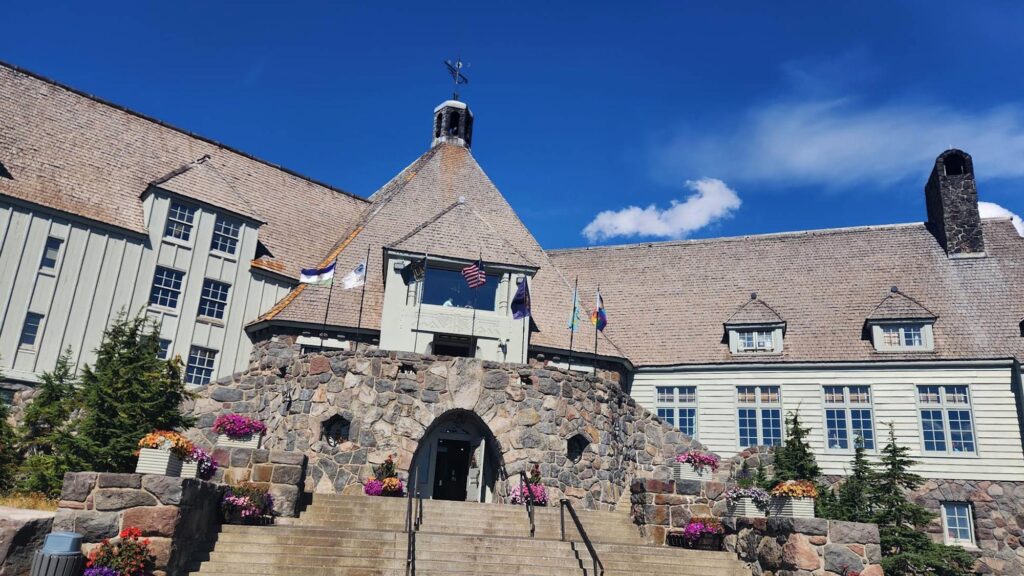
Timberline Lodge
Timberline Lodge is best known as filming locations for the exterior of the Overlook Hotel in Stanley Kubrick’s The Shining (1980).