
The Blues Brothers (1980) is an American musical action comedy directed by John Landis and starring John Belushi and Dan Aykroyd as Jake and Elwood Blues, two brothers attempting to reunite their rhythm and blues band to save the Catholic orphanage where they grew up. After Jake is released from prison, the brothers discover that the orphanage owes $5,000 in property taxes and will be closed unless they can raise the money. Their subsequent journey through Chicago involves police chases, encounters with old bandmates and performances by some of the biggest names in blues, soul and rhythm and blues. James Brown, Aretha Franklin, Ray Charles, John Lee Hooker and Cab Calloway all appear, alongside musicians including Steve Cropper, Donald “Duck” Dunn and Matt “Guitar” Murphy. Developed from Belushi and Aykroyd’s musical act on Saturday Night Live, the film became one of the most recognisable American comedies of the 1980s, particularly for its elaborate car chases, musical performances and extensive use of Chicago locations.
The Blues Brothers was filmed primarily in Chicago and the surrounding communities of Illinois, with additional production in Los Angeles, California, and Milwaukee, Wisconsin. Principal photography began in August 1979 and continued into early 1980. Director John Landis wanted Chicago itself to be a major part of the film, and production crews worked across the city’s industrial districts, neighbourhood streets, churches, restaurants and government buildings. The film preserves numerous locations that have since disappeared, including an abandoned shopping mall, historic businesses on Maxwell Street and the hotel where Elwood lives beneath the elevated railway. Mayor Jane Byrne’s administration cooperated with the production, allowing several unusually ambitious stunts to be filmed in the city centre. Other sequences were recreated on Hollywood soundstages or at Universal Studios, particularly when large musical performances or destructive special effects required greater control.
The film begins at Joliet Correctional Center, a former state prison at 1125 Collins Street in Joliet, southwest of Chicago. Its imposing limestone walls, watchtowers and cell blocks appear as Jake is released after serving three years for armed robbery. The production filmed inside the actual prison, including scenes of Jake collecting his belongings and walking through the grounds before meeting Elwood outside the gates. Completed in 1858, the prison operated for nearly 150 years before closing in 2002. The building has since become a historical attraction and has appeared in several other productions, including Natural Born Killers (1994) and Prison Break (2005–2017). Outside the prison, Elwood introduces Jake to the Bluesmobile, a battered 1974 Dodge Monaco police car that becomes central to the film’s numerous chase sequences.
The brothers soon demonstrate the car’s abilities by jumping across the raised East 95th Street Bridge over the Calumet River in South Chicago. The bridge, close to the Calumet Fisheries seafood restaurant, provided the setting for one of the film’s earliest stunts, with the Bluesmobile clearing the opening between the two raised sections. Much of the surrounding industrial landscape has since changed, but the bridge remains recognisable. The sequence also establishes the film’s unusual approach to automotive destruction, with apparently impossible stunts performed using real vehicles whenever practical.
Their next destination is the fictional Saint Helen of the Blessed Shroud Orphanage in Calumet City. The building was actually created in Chicago, in an alley near West 18th Street and South Normal Avenue, between buildings belonging to the former Schoenhofen Brewery. The production constructed a temporary frontage to represent the orphanage, while its interior was recreated on a soundstage in California. Here the brothers meet Sister Mary Stigmata, known as the Penguin, played by Kathleen Freeman, and their old mentor Curtis, portrayed by Cab Calloway. After learning about the orphanage’s financial problems, they are advised to attend church before deciding what to do. Several of the surrounding brewery buildings were demolished during the 1980s, removing much of the setting used in the film.
The church where Jake receives his revelation was filmed at Pilgrim Baptist Church, 3235 East 91st Street in the South Chicago neighbourhood. The modest brick church was transformed into the fictional Triple Rock Baptist Church, where Reverend Cleophus James, played by James Brown, leads an energetic service accompanied by a gospel choir. During his performance of “The Old Landmark”, Jake suddenly sees a divine light and realises that he must reunite the band to raise money for the orphanage. The exterior and entrance were filmed at the real church, while the elaborate interior performance was recreated at Universal Studios in Los Angeles. Landis reportedly selected the Chicago church partly because of the large, slightly leaning cross above its steeple. The production also installed decorative stained-glass windows to match the existing building. This Pilgrim Baptist Church should not be confused with the better-known church of the same name on South Indiana Avenue, designed by architects Louis Sullivan and Dankmar Adler.
The first major police pursuit begins in Park Ridge, northwest of Chicago, after Elwood runs a red light near the intersection of Cumberland Avenue and Talcott Road. When two police officers attempt to stop him, he escapes through the surrounding residential streets before driving into the Dixie Square Mall at 15151 Dixie Highway in Harvey. The shopping centre had opened in 1966 but closed in 1978, leaving a largely empty building that the production could use for an exceptionally destructive chase. Set decorators spent several weeks restoring the interior, installing working lights, electricity, shop signs and merchandise. Approximately 32 shopfronts were recreated, including stores resembling familiar Chicago businesses. Once the mall appeared to be operating normally, stunt drivers raced the Bluesmobile and pursuing police cars through its corridors, smashing windows, displays and shop fittings while shoppers scattered out of the way. The sequence became one of the most famous shopping-centre scenes in cinema history. Dixie Square subsequently remained abandoned for decades, with the remaining structures finally demolished in 2012.
After escaping the police, the brothers return to downtown Chicago, where Elwood lives in a cramped room at the former Plymouth Hotel, 22 West Van Buren Street. The building stood immediately beside the elevated railway tracks, allowing passing trains to shake the room throughout the night. When the mysterious woman pursuing the brothers, played by Carrie Fisher, attempts to kill them with explosives, the entire building collapses while Jake and Elwood emerge unharmed. The destruction was not carried out at the real hotel. Instead, the effects crew used a miniature construction incorporating a large photograph of the building and lightweight materials that could be blown apart. The actual Plymouth Hotel was later demolished, and its former site is now part of Pritzker Park.
The search for their former bandmates takes Jake and Elwood to several other locations around Chicago. They first visit the home of Mrs Tarantino, their former booking agent, at 1623 South 51st Court in Cicero. She tells them that several members of the group are performing as Murph and the Magic Tones at a Holiday Inn near O’Hare Airport. The hotel scenes were filmed at 3801 North Mannheim Road in Schiller Park, where the musicians perform uninspired lounge music to a nearly empty room. With most of the group reunited, the brothers track down their trumpet player, Mr Fabulous, who has become the maître d’ at Chez Paul, an expensive French restaurant at 660 North Rush Street. Jake and Elwood deliberately behave outrageously, harassing other diners and threatening to return every day until he agrees to rejoin the band. The restaurant was a real Chicago establishment, although it has since closed. Paul Reubens, later famous as Pee-wee Herman, appears briefly as one of the waiters.
Another memorable scene was filmed at the Music Court Bridge in Jackson Park, just south of Chicago’s Museum of Science and Industry. The brothers encounter a group of Illinois Nazis demonstrating on the narrow bridge and blocking traffic. Rather than waiting for them to move, Elwood accelerates directly towards the protesters, forcing them to leap into the lagoon below. The bridge remains part of the park’s historic landscape. The Nazis subsequently become another group of enemies pursuing the brothers, eventually arriving at Wrigley Field after Elwood gives the baseball stadium’s address, 1060 West Addison Street, as his home address during an earlier encounter. The joke works because the Nazis genuinely believe they will find him there.
The search for guitarist Matt Murphy and saxophonist Lou Marini brings the brothers to Maxwell Street, once one of Chicago’s busiest outdoor markets and an important centre of the city’s blues culture. The fictional Soul Food Cafe was filmed outside Nate’s Deli at 807 West Maxwell Street, near South Halsted Street. As Jake and Elwood approach, John Lee Hooker performs “Boom Boom” in the street, surrounded by musicians and market traders. Inside the restaurant, Aretha Franklin plays Mrs Murphy, who is furious that her husband is considering returning to the band. She launches into “Think”, accompanied by dancers moving through the restaurant. The musical interior was created in a Hollywood studio, while the exterior scenes preserved the appearance of the real Maxwell Street market. The neighbourhood underwent extensive redevelopment during the 1990s as the University of Illinois Chicago expanded, and Nate’s Deli and much of the surrounding commercial district were demolished. The film consequently preserves rare footage of a street that had played an important role in the development of Chicago blues.
The brothers next visit Ray’s Music Exchange, where they hope to obtain equipment for the reunited band. The shop was filmed at Shelly’s Loan and Jewelry, a long-established pawn shop at 300 East 47th Street in the Bronzeville neighbourhood. Ray Charles plays the shopkeeper, who demonstrates an electric piano by launching into “Shake a Tail Feather”. The song develops into a large street-dancing sequence, with performers filling East 47th Street and dancing beneath the elevated railway. The shop interior was recreated on a Hollywood set, but the exterior and extensive dance scenes were filmed in Chicago. For the production, artists painted a large mural of blues musicians, including Muddy Waters, B. B. King and Ray Charles, on the building’s wall facing Prairie Avenue. According to a Chicago Sun-Times report, the mural took approximately a month to complete, and the dance sequence cost around $600,000 to film. The artwork remained a neighbourhood landmark for decades, but the building was damaged by fire and demolished in June 2020.
Not every supposedly Illinois location was filmed in the state. Bob’s Country Bunker, the roadside bar where the band discovers that the audience enjoys both kinds of music, country and western, was constructed on the Universal Studios backlot in California. The brothers are forced to improvise a set of country songs behind protective chicken wire as the audience throws bottles at the stage. Their performance eventually wins over the crowd, but the bar owner refuses to pay them because their drinks have cost more than their fee. The neighbouring lake on the Universal backlot was also used for the scene in which the rival country band, the Good Ole Boys, drives its motorhome into the water. Additional chase footage involving the group was filmed in Griffith Park in Los Angeles.
Back in Illinois, Jake and Elwood begin promoting their major concert using a large loudspeaker mounted on the roof of the Bluesmobile. The speaker is stolen from the playground at Oscar Mayer School on North Clifton Street in Chicago. The promotional journey then takes them through several communities northwest of the city, including Long Grove and Wauconda. The Bluesmobile passes buildings on Main Street in Wauconda and drives along the shore of Bangs Lake, where beachgoers watch the passing car. The lakeside scenes were filmed around Phil’s Beach, a recreational area known for its large waterslide. After driving around advertising the show, the brothers run out of petrol near Long Grove and are forced to wait at a service station on Gary’s Mill Road in West Chicago. The petrol station was a temporary film structure, while the nearby West Wind Motel on Roosevelt Road was used for the scene in which Elwood leaves a woman, played by Twiggy, waiting for him.
The concert itself takes place at the fictional Palace Hotel Ballroom, supposedly located north of Chicago. Its exterior was filmed at the former South Shore Country Club, now the South Shore Cultural Center, at 7059 South Shore Drive on the shore of Lake Michigan. The elaborate Mediterranean-style building, completed in 1916, provided the grand entrance through which the crowds arrive for the concert. The actual musical performance, however, was filmed at the Hollywood Palladium, 6215 Sunset Boulevard in Los Angeles. The Palladium’s large auditorium became the Palace Hotel Ballroom interior, where Curtis entertains the audience with “Minnie the Moocher” before Jake and Elwood finally appear on stage. The band performs “Everybody Needs Somebody to Love” and “Sweet Home Chicago” while police officers wait outside. The contrast between the California concert hall and the Chicago country club is largely concealed by the editing, making the two buildings appear to be a single venue.
After the performance, the brothers escape through underground passages and race back towards Chicago to pay the orphanage’s tax bill. Their journey triggers the film’s enormous final car chase, with police cars, state troopers, the Illinois Nazis and the Good Ole Boys all joining the pursuit. Much of the chase was filmed on real Chicago streets, including Lower Wacker Drive, Wells Street and the roads beneath the elevated railway. The production staged elaborate collisions and pile-ups using specially prepared vehicles, many of them former police cars. Additional stunt work took place around Wauconda, including a pile-up near the intersection of US Route 12 and Illinois Route 176. The sequence required extensive planning to close streets, position cameras and keep bystanders away from the action.
One of the most spectacular moments involving the Illinois Nazis was filmed partly in Milwaukee, Wisconsin. The production used an unfinished section of Interstate 794 near the Daniel Hoan Memorial Bridge, where the Nazis pursue the Bluesmobile towards the end of an elevated roadway. The Bluesmobile performs an impossible backward flip, achieved with the assistance of a miniature model, while the Nazis’ Ford Pinto continues into empty space. For the following shot, the filmmakers dropped an actual Pinto from a helicopter at a height of more than 1,000 feet over a controlled area near Lake Shore Drive and the Chicago River. Special permission was required from the Federal Aviation Administration, and the car was tested beforehand to ensure it would fall vertically without drifting towards nearby buildings. The final impact was filmed on the Universal Studios backlot in Hollywood, meaning that the brief sequence was assembled from locations in Illinois, Wisconsin and California.
The climactic chase ends in downtown Chicago at Daley Plaza, where Jake and Elwood drive the battered Bluesmobile through the glass entrance of the Richard J. Daley Center. The enormous plaza, with its famous Picasso sculpture, became the setting for one of the largest action sequences ever staged in central Chicago at the time. Filming took place over three days during Labour Day weekend in September 1979. The production brought in hundreds of extras, police officers, National Guardsmen, military vehicles and helicopters to portray the overwhelming response to the brothers’ arrival. Mayor Jane Byrne personally supported the filmmakers’ request to drive through the building’s glass frontage. The windows were replaced with breakaway glass, although the stunt still damaged 35 granite paving stones and a bronze ventilation grille, resulting in repair costs of $7,650. Contemporary reports estimated that the elaborate final sequence cost approximately $3.5 million to film.
After crashing through Daley Center, the brothers continue to the neighbouring Chicago City Hall and Cook County Building at 118 North Clark Street. The Bluesmobile finally falls apart outside the building, leaving Jake and Elwood to run inside while police and National Guard units surround the entrances. The exterior and lobby were filmed in the actual building, but the staircase, lift and tax office were carefully recreated on a studio set. Production designers copied details from the real building, including different styles of staircase railings installed during separate periods of its history. The brothers finally reach the tax office, where a clerk played by Steven Spielberg accepts their payment just as the authorities arrive to arrest them. The closing musical number, “Jailhouse Rock”, returns the story to prison, bringing the film back to its opening setting.
The Blues Brothers was an unusually ambitious location production for its time, combining actual Chicago neighbourhoods and landmarks with expensive practical stunts and carefully matched Hollywood interiors. Several locations that once played important roles in the city’s everyday life have since disappeared, including Dixie Square Mall, the Plymouth Hotel, Nate’s Deli and the original Ray’s Music Exchange building. Others, such as Joliet Correctional Center, Pilgrim Baptist Church, Wrigley Field and the South Shore Cultural Center, remain closely associated with the film. Beyond its elaborate car chases and musical performances, The Blues Brothers has become an important visual record of Chicago at the end of the 1970s, capturing streets, businesses and communities that changed considerably during the following decades.
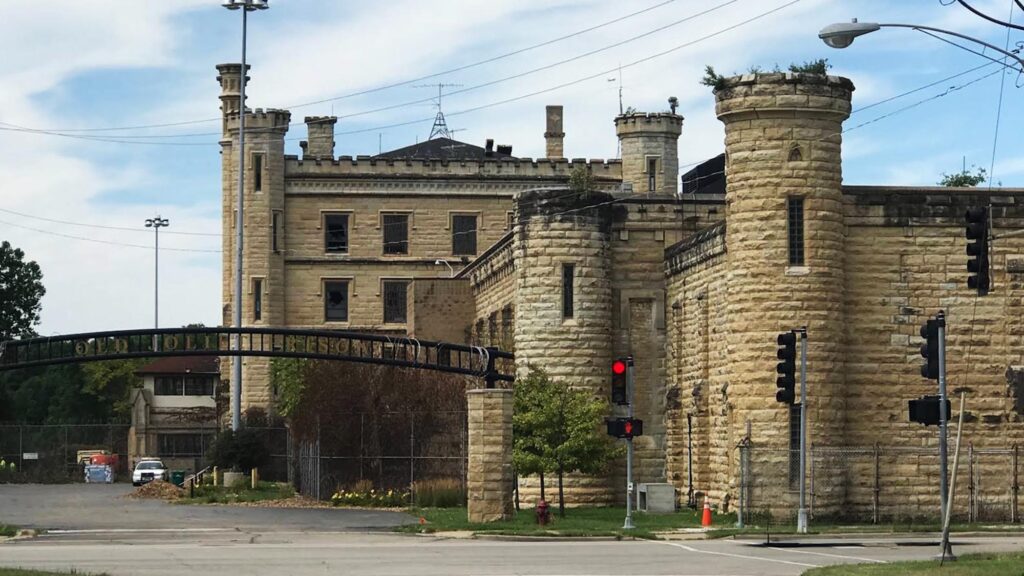
Old Joliet Prison
Old Joliet Prison appears in The Blues Brothers (1980), Prison Break (2005–2006), Let’s Go to Prison (2006), Derailed (2005), and Empire (2015–2020).