
John David Landis (born 3 August 1950) is an American film director, screenwriter, producer and occasional actor whose career has encompassed comedy, horror, music videos, television and documentary filmmaking. He was born in Chicago, Illinois, the son of Marshall Landis, an interior designer and decorator, and Shirley Levine. The family was Jewish and moved to Los Angeles when John was approximately four months old. He grew up in the Westwood neighbourhood, where his childhood was shaped by the expanding entertainment industry surrounding him. His father died when he was five, and his mother subsequently remarried. Landis attended Oakwood, a progressive private school, but found conventional education considerably less interesting than cinema. One of his most influential childhood experiences occurred in 1958, when he saw Nathan Juran’s fantasy adventure The 7th Voyage of Sinbad, featuring the elaborate stop-motion creatures created by Ray Harryhausen. The film convinced him that he wanted to work in cinema, and he began spending much of his free time watching films and studying how they were made.
Growing up in Los Angeles gave Landis opportunities to explore the film industry that would have been difficult elsewhere. He visited cinemas regularly, followed the work of directors whose films interested him and gradually became familiar with the city’s studios and production facilities. He eventually left high school and participated in an experimental educational programme at the University of California, Los Angeles. Rather than pursuing a conventional academic qualification, he obtained employment in the mailroom at 20th Century Fox during his late teens. The position allowed him to observe filmmaking from inside a major Hollywood studio, and he frequently used opportunities to visit sets, watch daily footage and meet technicians and other production employees. His enthusiasm was particularly directed towards directors, cinematographers and the practical processes involved in constructing a film. He was interested in working on productions rather than waiting for a formal opportunity to become a director, and his determination soon took him far beyond California.
In 1969, Landis travelled to Yugoslavia hoping to obtain work on Brian G. Hutton’s war comedy Kelly’s Heroes (1970), starring Clint Eastwood, Donald Sutherland, Telly Savalas and Don Rickles. He had become acquainted with members of the production team through his work at Fox and managed to find employment as a production assistant after arriving in Europe. The film was photographed in Yugoslavia, where landscapes and villages represented France during the Second World War. Landis subsequently remained in Europe, working on a succession of productions in various capacities rather than returning immediately to Los Angeles. He spent considerable time in Spain, particularly around Almería, where the region’s desert landscapes had become internationally recognised through the Westerns of Sergio Leone and other European filmmakers. During this period, he worked as a production assistant, dialogue coach, extra and occasional stunt performer, gaining practical experience with international crews and observing how films were made under difficult conditions. The work introduced him to the demands of location production and allowed him to develop professional relationships that became important when he began making his own films.
After returning to California, Landis decided to make an independent feature rather than continue waiting for an opportunity within the established studio system. The result was Schlock (1973), a low-budget horror comedy that he wrote, directed and starred in. He played the title character, a prehistoric ape-like creature who appears in a suburban Californian community and becomes responsible for a series of bizarre incidents. The production was filmed in Agoura and surrounding parts of the San Fernando Valley during 1971, using actual streets, businesses and residential properties. Landis worked with make-up artist Rick Baker, then at the beginning of his professional career, who designed the elaborate creature costume that allowed the director to portray the monster himself. The two men developed a lasting friendship and professional relationship, eventually collaborating on several films involving increasingly sophisticated special effects. Schlock was completed on a modest budget and encountered distribution difficulties before receiving a limited theatrical release in December 1973. Although it attracted relatively little attention initially, the experience taught Landis how to organise a production, direct actors, solve technical problems and complete a feature film with limited resources.
The attention eventually generated by Schlock helped Landis obtain his second feature directing assignment, The Kentucky Fried Movie (1977), an episodic comedy written by David Zucker, Jerry Zucker and Jim Abrahams. The three writers had developed their material through the Kentucky Fried Theater, a comedy group based in Los Angeles, and were seeking a director who understood their mixture of absurd humour, film parody and television satire. Landis directed a collection of short segments spoofing popular films, advertisements, news broadcasts and other familiar forms of entertainment. Production took place during the early months of 1977 at locations around Los Angeles and Pasadena, including the Rialto Theatre in South Pasadena and Yamashiro restaurant in Hollywood. The film’s limited budget required rapid filming and considerable improvisation, but its success demonstrated that the writers’ theatrical sketches could work as a feature-length production. The collaboration also established relationships with performers and technicians who would become part of Landis’s subsequent films. Although The Kentucky Fried Movie was a relatively modest independent release, it provided the commercial evidence that helped persuade Universal Pictures to employ him on a substantially larger production.
His major breakthrough came with National Lampoon’s Animal House (1978), a college comedy written by Harold Ramis, Douglas Kenney and Chris Miller and produced by Ivan Reitman and Matty Simmons. Set at the fictional Faber College in 1962, the film follows the disruptive members of the Delta Tau Chi fraternity as they repeatedly challenge the authority of Dean Vernon Wormer, played by John Vernon. Landis was still in his twenties when he was chosen to direct, and the project became his first major studio production. The ensemble included John Belushi, Tim Matheson, Peter Riegert, Tom Hulce, Karen Allen, Donald Sutherland and Kevin Bacon. Although the story was set at a fictional institution, Landis wanted to use an actual university campus rather than construct the entire setting in California. After several institutions declined to accommodate the production, the University of Oregon agreed to allow filming in Eugene.
Principal photography began in October 1977, with Landis directing scenes around the university campus, including its academic buildings, walkways and fraternity houses. A property at 751 East 11th Avenue represented the dilapidated Delta house, while the neighbouring Phi Kappa Psi fraternity house at 729 East 11th Avenue was used for the more respectable Omega fraternity. The former Delta house was subsequently demolished, but the location became closely associated with the film’s production history. Landis also filmed the climactic parade along Main Street in Cottage Grove, south of Eugene, using local streets and numerous background performers to create the chaotic finale. The production involved extensive night filming and a relatively young cast whose enthusiasm sometimes created difficulties for the crew, but Landis encouraged an atmosphere in which performers could develop their characters through improvisation. Animal House was released in July 1978 and became one of the most commercially successful American comedies of the decade. Its influence extended far beyond its original release, establishing a model for later college and youth-oriented comedies while transforming the careers of several cast members.
Landis’s collaboration with Belushi continued with The Blues Brothers (1980), a musical action comedy developed with Dan Aykroyd. The Blues Brothers had originated as a musical act on Saturday Night Live, with Belushi playing Jake Blues and Aykroyd portraying his brother Elwood. Landis and Aykroyd expanded the characters into a feature film about two musicians attempting to reunite their band to raise money for the Catholic orphanage where they grew up. The screenplay combined elaborate car chases with performances by established rhythm-and-blues, soul and gospel musicians, including James Brown, Aretha Franklin, Ray Charles, Cab Calloway and John Lee Hooker. Chicago was central to the production, not simply as a fictional setting but as a city whose musical history, neighbourhoods and industrial landscapes could become part of the story. Landis secured extensive cooperation from local authorities, allowing him to stage action sequences in locations rarely made available to filmmakers.
Filming began in Chicago in August 1979, with Landis using streets, businesses and public buildings throughout the city. The opening industrial sequences were photographed around the former South Works steel plant near the Calumet River, while the historic Maxwell Street market provided the setting for a performance by John Lee Hooker. The former Dixie Square Mall in Harvey, south of Chicago, became the location for an elaborate car chase through an abandoned shopping centre, with the production transforming several empty shops before crashing vehicles through their windows and interiors. The church sequence involving James Brown was filmed at the Triple Rock Baptist Church location on East 91st Street, while other scenes used the Cook County Courthouse and Daley Plaza in central Chicago. Landis also filmed around Joliet Correctional Center and numerous roads and bridges, creating an unusually extensive geographical portrait of the city. The production was complicated by the number of vehicles involved, the demands of the musical performances and the size of the supporting cast. Following its release in June 1980, The Blues Brothers became a commercial success and developed a particularly strong following among music and film audiences. Its Chicago locations subsequently became destinations for visitors interested in the film.
While working on these larger productions, Landis continued developing a horror screenplay that he had originally conceived during his time in Yugoslavia. The result was An American Werewolf in London (1981), in which two American students travelling through Britain are attacked by a werewolf on a remote stretch of moorland. David Naughton played David Kessler, who survives the attack but gradually discovers that he has become infected, while Griffin Dunne portrayed his dead friend Jack Goodman. Jenny Agutter appeared as Alex Price, the nurse who becomes involved with David after he is admitted to hospital in London. The film combined supernatural horror with comedy and an increasingly disturbing portrayal of physical transformation. Landis again collaborated with Rick Baker, whose special make-up effects required extensive preparation and experimentation. The production became an important development in the use of practical creature effects, particularly through the prolonged sequence depicting David’s transformation into a werewolf.
An American Werewolf in London was filmed during February and March 1981 in Wales and England. Although the opening scenes are set in Yorkshire, the moorland landscapes were photographed in the Brecon Beacons and the Black Mountains of South Wales. The village of Crickadarn, near Builth Wells, represented the fictional East Proctor, with an ordinary cottage temporarily adapted to provide the exterior of the Slaughtered Lamb pub. The pub interiors were filmed separately at the Black Swan in Martyr’s Green, Surrey. Landis subsequently worked in London, using locations including Tottenham Court Road Underground station, Trafalgar Square, Hampstead Heath and the streets surrounding Piccadilly Circus. He obtained permission to stage an elaborate traffic accident in Piccadilly Circus, a particularly demanding sequence involving stunt vehicles, pedestrians and extensive crowd control. Some interiors and special-effects sequences were filmed at Twickenham Studios. The film was released in August 1981 and became an international success, while Baker received the inaugural Academy Award for Best Make-up. Its mixture of horror and comedy established another important aspect of Landis’s directing career.
Landis’s personal life had also developed during his rise to prominence. He had begun a relationship with costume designer Deborah Nadoolman in 1975, after meeting her through mutual friends connected with the University of California, Los Angeles. Nadoolman had trained in costume design and was establishing a professional career of her own when they began collaborating. They married in 1980 and had two children, Rachel and Max. Their professional relationship extended across several of Landis’s best-known productions, including The Kentucky Fried Movie, Animal House, The Blues Brothers and Coming to America. Nadoolman also designed costumes for major films directed by other filmmakers, notably Raiders of the Lost Ark (1981), and became an influential figure in the study and preservation of film costume design. The family established its home in Los Angeles, where Landis continued working while frequently travelling to locations in other American states and abroad.
A tragic event occurred during production of Twilight Zone: The Movie (1983), an anthology film developed by Steven Spielberg and John Landis from the original television series created by Rod Serling. Landis directed the opening material and a segment featuring Vic Morrow as a prejudiced man who experiences several forms of historical persecution. During an overnight shoot on 23 July 1982 at the Indian Dunes filming location near Valencia, California, a helicopter involved in a Vietnam War sequence crashed after special-effects explosions damaged its rotor system. The accident killed Morrow, aged fifty-three, and two child performers, seven-year-old Myca Dinh Le and six-year-old Renee Shin-Yi Chen. All three were on the ground beneath the helicopter when it crashed. The incident became one of the most serious accidents in American film-production history and resulted in extensive investigations into the organisation of the sequence, the employment of the children and the safety procedures used during the shoot.
The National Transportation Safety Board investigated the helicopter accident and identified serious failures in the coordination of the special-effects explosions and the aircraft’s movements. Its report also criticised the failure to hold adequate pre-production safety discussions involving the principal personnel. Investigations established that the children had been employed in violation of California restrictions on working hours and hazardous conditions. Landis, associate producer George Folsey Jr., production manager Dan Allingham, special-effects coordinator Paul Stewart and helicopter pilot Dorcey Wingo were charged with involuntary manslaughter. The criminal trial began in 1986 and lasted approximately ten months, with extensive testimony concerning the decisions made before and during the filming. On 29 May 1987, all five defendants were acquitted. Separate civil lawsuits brought by the victims’ families were settled out of court. The accident had lasting consequences for discussions about safety in the American film industry and remained inseparable from Landis’s professional history, even as he continued directing major commercial productions.
During the period following the accident, Landis directed Trading Places (1983), a comedy starring Dan Aykroyd and Eddie Murphy. The story follows two wealthy businessmen, played by Ralph Bellamy and Don Ameche, who arrange to exchange the social positions of a privileged commodities broker and a homeless man as part of a wager. Landis used the contrast between wealth and poverty to develop a satire of social privilege, while the performances of Aykroyd and Murphy provided the film’s central comedy. Principal photography began in Philadelphia in December 1982, with locations including Rittenhouse Square, Independence Hall and the Fidelity Bank Building on South Broad Street. The latter provided the interior of the Duke brothers’ Christmas party, while New York locations included the Park Avenue Armory and the commodities exchange at the World Trade Center. The production also employed actual traders during the climactic sequences, giving the fictional trading activity a connection with the financial institutions operating in Manhattan. Trading Places was released in June 1983 and became another major success, beginning Landis’s professional collaboration with Murphy.
His work also expanded into music videos when Michael Jackson approached him to direct a short film based on the song Thriller. Jackson had been impressed by An American Werewolf in London and wanted to create something more elaborate than the conventional promotional videos of the period. Landis developed a screenplay combining elements of horror cinema, romantic comedy and musical performance, with Jackson playing a young man whose outing with his girlfriend becomes increasingly frightening. Ola Ray appeared as the girlfriend, while Rick Baker created the elaborate werewolf and zombie make-up effects. Deborah Nadoolman designed Jackson’s distinctive red leather outfit, which became one of the most recognisable costumes in popular music. The production was filmed in Los Angeles during October 1983, using the Palace Theatre on South Broadway for the cinema exterior and the Rialto Theatre in South Pasadena for interior scenes. The celebrated zombie dance was staged on Union Pacific Avenue in Boyle Heights, while the exterior of the house appearing near the conclusion was filmed at 1345 Carroll Avenue in Angeleno Heights. Additional sets were constructed inside a warehouse in Vernon, south of downtown Los Angeles.
The resulting Michael Jackson’s Thriller premiered in December 1983 and transformed expectations surrounding the music video. Rather than presenting a collection of performance sequences, Landis created an extended narrative involving dialogue, special effects and a complicated musical number. The production was accompanied by Making Michael Jackson’s Thriller, a documentary examining the filming and special-effects work, which helped finance the unusually expensive project through television and home-video distribution. The success encouraged other musicians and record companies to invest in elaborate promotional films, contributing to the development of music videos as a distinct audiovisual form. Landis subsequently reunited with Jackson for Black or White (1991), another ambitious production combining musical performance, visual effects and elaborate choreography. The video premiered simultaneously on television networks internationally in November 1991, attracting an estimated audience of hundreds of millions. Its extended concluding sequence, depicting Jackson dancing through an urban environment and destroying property, attracted criticism and was subsequently removed from some broadcasts.
Landis returned to feature filmmaking with Into the Night (1985), a crime comedy starring Jeff Goldblum and Michelle Pfeiffer. The story follows an unhappy aerospace engineer who becomes involved with a mysterious woman and finds himself drawn into a series of increasingly dangerous encounters across Los Angeles. Landis was attracted to the opportunity to depict the city at night, using actual businesses, streets and buildings rather than treating Los Angeles merely as a collection of familiar landmarks. Principal photography began in April 1984 and involved more than forty locations across the metropolitan area. Extensive scenes were filmed at Los Angeles International Airport, while other locations included Rodeo Drive, the Beverly Wilshire Hotel, Marina del Rey and Century City. The film also featured appearances by numerous directors and entertainment-industry figures, including Don Siegel, Roger Vadim, Paul Mazursky and Jonathan Demme. Landis himself appeared in a supporting role, continuing his habit of participating in the films he directed. Although Into the Night received mixed reviews, it allowed him to experiment with a different combination of comedy, crime and romantic suspense.
His next production took him to several countries for Spies Like Us (1985), starring Aykroyd and Chevy Chase as two inexperienced government employees recruited into a complicated Cold War operation. The film follows the characters from Washington, DC, through supposedly remote Soviet territories and eventually towards Afghanistan and Central Asia. Rather than attempting to recreate the entire fictional journey in California, Landis undertook a substantial international location shoot. Production began in the United States during February 1985, with filming in Washington and California before moving to Pinewood Studios in England. The crew subsequently travelled to Norway, where the landscapes around Sogndal and Sognefjorden represented remote Soviet territory. The filming involved difficult winter conditions and low temperatures, with further production work taking place in Morocco and England. Landis worked with several established filmmakers who appeared briefly in the film, including Terry Gilliam, Ray Harryhausen, Joel Coen and Sam Raimi. Spies Like Us was released in December 1985 and became another commercial success, particularly through the established comic partnership between Aykroyd and Chase.
During the following year, Landis directed Three Amigos! (1986), written by Steve Martin, Lorne Michaels and Randy Newman and starring Martin, Chase and Martin Short. Set during the silent-film era, the story follows three unemployed Hollywood actors who travel to Mexico believing that they have been invited to perform, only to discover that the village expecting them needs protection from an actual criminal gang. The production was filmed extensively in Arizona, including Old Tucson Studios, the desert surrounding Florence and landscapes around the Superstition Mountains. Other sequences were photographed at Universal Studios in California, where Mexican streets and studio interiors were constructed. Landis drew on his early experiences working on European Westerns, using familiar conventions of the genre while placing three inexperienced comic performers in increasingly dangerous circumstances. The film received mixed reviews on release but subsequently developed a substantial following. His other directing work during the middle of the decade included contributions to Amazon Women on the Moon (1987), another collection of comic sketches involving several directors and performers.
The late 1980s brought one of Landis’s greatest commercial successes when he reunited with Eddie Murphy for Coming to America (1988). Murphy developed the story of Prince Akeem Joffer, the heir to the throne of the fictional African kingdom of Zamunda, who travels to New York with his companion Semmi, played by Arsenio Hall, in search of a woman who will love him without knowing his royal identity. Landis approached the material partly as a romantic comedy in the tradition of Hollywood films from the 1930s, contrasting Akeem’s extraordinary wealth with his deliberately modest life in Queens. Principal photography began in New York in January 1988, with the cast and crew working through several periods of severe winter weather. The production used actual locations in Queens and Brooklyn, including a Wendy’s restaurant on Queens Boulevard temporarily transformed into the fictional McDowell’s restaurant. Other scenes were filmed around Williamsburg, Madison Square Garden, the Waldorf Astoria Hotel and the Brooklyn Bridge. A subway scene involving Murphy and Shari Headley was photographed aboard a specially hired train operating on unused tracks at Brooklyn’s Hoyt–Schermerhorn station. The elaborate interiors of Akeem’s royal palace were constructed separately in California.
Coming to America became one of the highest-grossing films of 1988 and consolidated Landis’s ability to direct large commercial comedies featuring prominent performers. It also reflected the importance of his collaboration with costume designer Deborah Nadoolman, whose elaborate costumes helped establish the visual distinction between Zamunda’s royal household and ordinary life in Queens. Nadoolman received an Academy Award nomination for Best Costume Design for the film. The production also attracted controversy when writer Art Buchwald alleged that the film had been developed from a story he had previously submitted to Paramount Pictures. The subsequent legal proceedings concerned contractual obligations and the origins of the screenplay, with Buchwald ultimately prevailing on important aspects of his claim. Landis continued working in commercial cinema, although the following decade brought fewer major successes than the period between Animal House and Coming to America.
During the early 1990s, he directed Oscar (1991), a comedy starring Sylvester Stallone as a gangster attempting to become a respectable businessman during the 1930s. The film was shot largely at studio facilities in California, where elaborate period interiors and street sets represented the fictional urban setting. Landis subsequently returned to horror with Innocent Blood (1992), starring Anne Parillaud as a vampire who targets organised criminals in Pittsburgh. Robert Loggia played a Mafia boss who becomes infected and begins transforming members of his organisation into vampires, while Anthony LaPaglia portrayed an undercover police officer. Unlike many contemporary productions that recreated their urban settings elsewhere, Innocent Blood was filmed extensively in Pittsburgh during the winter and spring of 1992. The production used actual downtown streets, bridges and neighbourhood businesses, including locations around East Liberty, Squirrel Hill and the former Three Rivers Stadium. Landis incorporated the city’s distinctive topography and industrial architecture into the film, combining horror with the crime-movie conventions associated with organised-crime stories. Although Innocent Blood was not a major commercial success, it returned him to the mixture of horror and comedy that had characterised Schlock and An American Werewolf in London.
His next major assignment was Beverly Hills Cop III (1994), reuniting him with Murphy and the character Axel Foley. The third film follows the Detroit detective as he investigates a criminal organisation operating through a fictional Californian amusement park. The production used Paramount’s Great America in Santa Clara to represent much of the fictional Wonderworld park, with additional filming at Knott’s Berry Farm in Buena Park and studio facilities at Universal Studios. Landis worked with Murphy, Judge Reinhold and several returning cast members, although the film received considerably weaker reviews than the earlier Beverly Hills Cop productions. He subsequently directed The Stupids (1996), a family comedy starring Tom Arnold and Jessica Lundy, before reuniting with Aykroyd for Blues Brothers 2000 (1998). The sequel returned to the musical world of Jake and Elwood Blues, although John Belushi’s death in 1982 meant that Aykroyd’s character was joined by new performers including John Goodman and Joe Morton. Filming took place in Chicago and Canada, with Toronto providing extensive studio facilities and locations representing parts of the American Midwest. Additional scenes used Millhaven Institution near Kingston, Ontario, and the Markham Fairgrounds. The sequel featured numerous blues, soul and gospel performers but did not achieve the commercial or critical success of the original.
Landis continued directing and producing independent projects during the late 1990s and early 2000s, including Susan’s Plan (1998), a dark comedy starring Nastassja Kinski, Billy Zane, Lara Flynn Boyle and Michael Biehn. The story follows a woman attempting to arrange the murder of her former husband, with an increasingly complicated series of failures involving the people she hires. Although the film received limited distribution, it reflected Landis’s continuing interest in characters whose apparently straightforward plans collapse through incompetence, coincidence and unexpected consequences. His career also expanded into television, where he directed episodes of programmes including Dream On, Masters of Horror, Psych and Franklin & Bash. For Masters of Horror, the anthology series developed by Mick Garris, he directed Deer Woman (2005) and Family (2006), returning to supernatural comedy and disturbing stories within the shorter television format.
Documentary filmmaking became another substantial area of his later work. In Slasher (2004), produced for the Independent Film Channel, Landis followed Michael Bennett, a travelling used-car salesman known for organising aggressive sales promotions at American car dealerships. Filmed in Memphis, Tennessee, during the Memorial Day weekend of 2003, the documentary explored Bennett’s methods, working relationships and personal circumstances, placing his commercial techniques within a broader examination of American sales culture. The project differed considerably from Landis’s fictional comedies because he worked with real people whose actions could not be planned in the same manner as a conventional screenplay. He subsequently directed Mr. Warmth: The Don Rickles Project (2007), a documentary examining the life and career of comedian Don Rickles. The film included extensive interviews, archival material and performances, with contributions from comedians and entertainers who had worked with Rickles throughout his career. Landis received a Primetime Emmy Award as a producer when the documentary won Outstanding Variety, Music or Comedy Special in 2008.
His final feature-film directing assignment to date was Burke & Hare (2010), a British black comedy based on the nineteenth-century Scottish murderers William Burke and William Hare. Simon Pegg and Andy Serkis portrayed the title characters, with Isla Fisher, Tom Wilkinson, Tim Curry and Jessica Hynes appearing in supporting roles. Landis was attracted to the project partly because of his admiration for the black comedies produced by Ealing Studios during the 1940s and 1950s. The story follows two men who begin supplying bodies to medical schools in Edinburgh and eventually turn to murder when the demand for cadavers exceeds their ability to obtain them legally. Production took place in Scotland and England, including Edinburgh Castle, the University of Edinburgh’s School of Anatomy, Milne’s Court, Fishmarket Close and George IV Bridge. Stirling Castle provided additional historical settings, while Knole House in Kent was transformed into an Edinburgh market. Interior production was also completed at Ealing Studios in west London. The film was released in October 2010 and marked Landis’s return to feature directing after more than a decade.
Landis also remained involved with cinema through interviews, public discussions and documentary appearances. His interest in film history had developed during childhood and continued through his professional relationships with filmmakers, performers and special-effects artists from earlier generations. He appeared in documentaries examining subjects including Ray Harryhausen, John Belushi, Boris Karloff, Alfred Hitchcock and Christopher Lee, discussing the achievements of filmmakers whose work had influenced his understanding of cinema. He also became a frequent participant in retrospectives and anniversary screenings of Animal House, The Blues Brothers and An American Werewolf in London. These events often involved discussions of the difficulties of location filming, the development of elaborate practical effects and the unusual combinations of personalities that had shaped his productions.
His family also developed substantial professional connections with the entertainment industry. Deborah Nadoolman Landis became an internationally respected costume designer, curator, author and academic, serving as president of the Costume Designers Guild and later holding a professorship associated with costume design at the University of California, Los Angeles. Their son Max Landis became a screenwriter and filmmaker, with credits including Chronicle (2012) and American Ultra (2015), while their daughter Rachel pursued work connected with the creative industries. John and Deborah continued maintaining their home in Los Angeles, where they had lived and worked for much of their married life. Although Landis had travelled extensively for film productions, Southern California remained the principal geographical centre of his personal and professional activities.
During the 2020s, Landis continued appearing in interviews and documentaries concerning the history of horror and comedy cinema. He participated in Thriller 40 (2023), directed by Nelson George and examining the production and international influence of Michael Jackson’s album Thriller, including Landis’s music video. He also appeared in The Life and Deaths of Christopher Lee (2024) and Hammer: Heroes, Legends and Monsters (2024), discussing the British horror tradition and the performers who had helped establish it. His continuing interest in fantasy and special effects brought him to the TCM Classic Film Festival in Hollywood in April 2024, where he attended a screening of Mighty Joe Young (1949), another film associated with the stop-motion animation work of Ray Harryhausen. In 2025, he contributed to the Netflix documentary Being Eddie, reflecting on his collaboration with Eddie Murphy during Trading Places, Coming to America and Beverly Hills Cop III.
By October 2026, Landis was seventy-six and remained associated principally with the films he had directed between the late 1970s and early 1990s. His professional history had taken him from the studios of Los Angeles to Yugoslavia and the Spanish film industry, the University of Oregon, the streets of Chicago, the British countryside and major European and American production centres. His work helped establish several enduring screen partnerships, including those involving John Belushi, Dan Aykroyd, Eddie Murphy and Rick Baker, while his music videos contributed to changing the scale and presentation of popular-music filmmaking. The success of Animal House, The Blues Brothers, An American Werewolf in London and Coming to America remains central to his reputation, alongside the lasting consequences of the fatal accident during Twilight Zone: The Movie. His later activities have concentrated largely on documentary appearances, cinema history and occasional production work rather than the regular feature directing that characterised the most commercially successful period of his career.
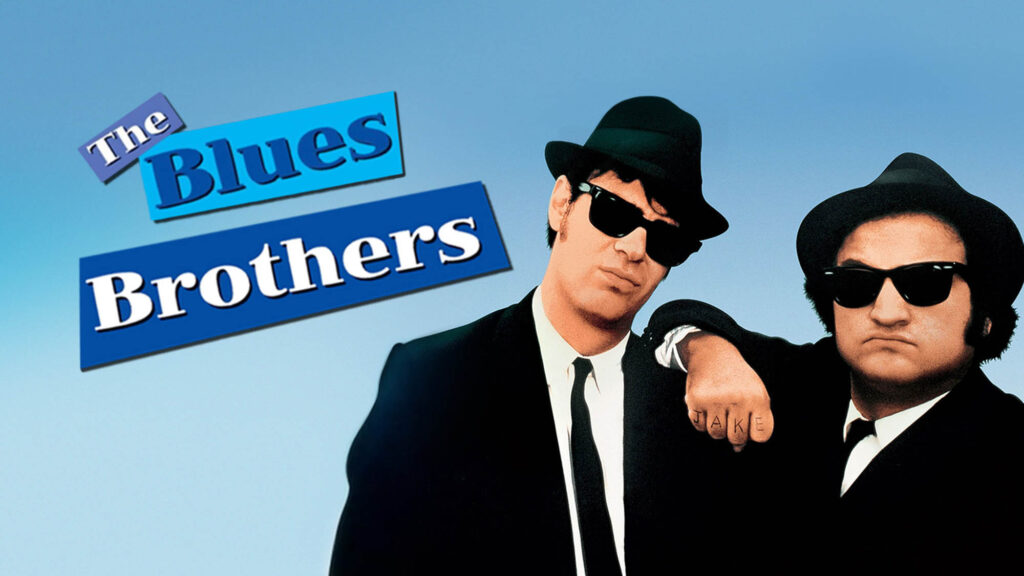
The Blues Brothers
The Blues Brothers was shot largely on location in and around Chicago, and the city is absolutely central to its identity.