
Pax (2011) is a Norwegian-Swedish drama directed by Annette Sjursen and written by Sjursen together with Lars Saabye Christensen. The film follows a group of passengers travelling from Stockholm to Oslo aboard a Boeing 737 when one of the aircraft’s engines explodes, forcing the pilots to descend into severe weather. Among those on board are journalist Kathrine (Ellen Dorrit Petersen), her partner Jon (Samuel Fröler), surgeon Erik (Kyrre Haugen Sydness), a troubled publisher named Peter (Kristoffer Joner), a young novice called Elise (Ida Elise Broch) and a conductor named Andrew (Tomas von Brömssen). Anneke von der Lippe, Ane Dahl Torp, Pia Tjelta and Olivia Nystedt also appear in the ensemble cast. As the passengers confront the possibility of death, their individual stories reveal troubled relationships, grief and unresolved decisions. Another important part of the story involves a human heart being transported for transplantation. Produced by Paradox Spillefilm, Pax was originally scheduled for release in 2009 but did not reach Norwegian cinemas until 18 March 2011.
Pax was filmed in Norway and Sweden between March and May 2008, with much of the production taking place at the film studios in Trollhättan, approximately 75 kilometres north of Gothenburg. The Swedish facilities, associated with the regional film production company Film i Väst, were already well established as a centre for Scandinavian and international cinema. Productions including Dancer in the Dark (2000), Dogville (2003) and Manderlay (2005) had previously used the studios. For Pax, the Trollhättan facilities provided the principal production base for a story that takes place largely inside an aircraft, with additional location filming in Oslo. The Norwegian production company Paradox worked with Swedish partners on the film, which had a reported budget of approximately 22.5 million Norwegian kroner.
The aircraft is the film’s main setting, bringing together passengers who would otherwise have little reason to meet. Before departure, the story introduces several characters through scenes at the airport, including a security checkpoint where Andrew, the conductor, is asked to remove an object from his hand luggage. He produces a conductor’s baton, establishing his profession before boarding the flight. Another scene takes place in an airport chapel, where Susan, a nervous flight attendant played by Anneke von der Lippe, meets Peter, the publisher played by Kristoffer Joner. The two begin an unexpected conversation about aircraft safety that develops into a brief romantic encounter. Although the film establishes the journey as a flight from Stockholm to Oslo, the precise real-world airport facilities used for these scenes have not been reliably identified.
Once the passengers are aboard, the action moves almost entirely into the confined space of the aircraft cabin. The film opens with a disorienting image of the cabin, using a slowly rotating camera, blurred images and the sound of bubbling water to introduce the story. Later, when an engine explodes and the aircraft loses cabin pressure, the passengers are forced to confront the possibility that they may never reach Oslo. The emergency scenes combine performances inside the cabin with computer-generated images of the aircraft in flight. Cinematographer Peter Mokrosinski photographed the production, while Gimmick Visual Effects worked on the digital effects. The visual effects became a particularly demanding part of the film’s post-production.
The original filming schedule was completed in May 2008, but the finished film took almost three more years to reach cinemas. In an interview with Dagsavisen in April 2009, producer Finn Gjerdrum explained that the editing had taken considerably longer than expected because of the difficulty of combining the different characters’ stories. The extended editing process also delayed the sound work and computer-generated effects. Gjerdrum maintained that the production itself had followed its schedule and described the working conditions in Trollhättan as professional. By November 2010, the film had been completed, but its release was postponed again. According to contemporary reports, the animated sequences showing the aircraft in flight had become more expensive than anticipated, requiring the producers to secure additional private financing.
The film’s most clearly identifiable Oslo location is the Oslo Opera House in Bjørvika, which appears towards the end of the story. The building is first shown from ground level before the film moves to its large, sloping roof, where a concert is taking place. Designed by the Norwegian architecture firm Snøhetta, the Opera House stands at Kirsten Flagstads plass 1 beside the Oslofjord. Its exterior is particularly distinctive because the white stone surfaces rise directly from the waterfront, allowing people to walk from the surrounding plaza onto the roof. Rather than using one of Oslo’s older cultural buildings, the film features a landmark that was almost brand new when production took place.
The Oslo Opera House officially opened on 12 April 2008, during the same spring that Pax was being filmed. Its appearance is therefore an early cinematic record of a building that would become one of the Norwegian capital’s most recognisable landmarks. The rooftop concert also connects the film’s musical elements with an actual performance setting in Oslo. Earlier in the story, Andrew’s work as a conductor and the development of a musical composition form part of the narrative surrounding the passengers. The closing images take the audience out of the aircraft and into an open public space overlooking the city and waterfront.
In addition to the film, Sjursen published a novel titled Pax through Kagge Forlag in 2010, while the cinema release was still being delayed. The book develops the characters and their relationships further, although it differs from the completed film in several respects. When the film finally opened in March 2011, it received largely negative reviews and attracted only around 3,500 cinema admissions in Norway. Despite its troubled release, Pax remains an interesting Norwegian-Swedish production from the late 2000s, combining extensive studio work in Trollhättan with location filming in Oslo. Its closing sequence at the Opera House is particularly notable for capturing the waterfront landmark during the year of its completion.
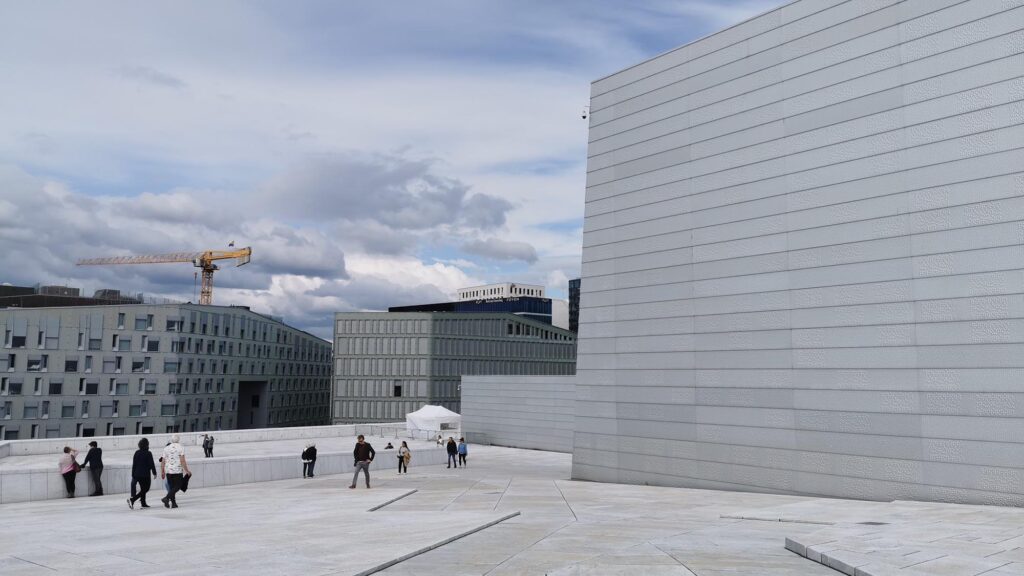
Oslo Opera House
As a screen location, the Oslo Opera House has been used in Pax (2011), 22 July, The Snowman (2017), The Worst Person in the World (2021) and Tenet (2020).