
Forrest Gump (1994) is an American comedy-drama directed by Robert Zemeckis and based on Winston Groom’s 1986 novel of the same name. Tom Hanks stars as Forrest Gump, a kind-hearted man from Alabama whose extraordinary life takes him through several major events in twentieth-century American history. The film also stars Robin Wright as Jenny Curran, Gary Sinise as Lieutenant Dan Taylor, Sally Field as Mrs. Gump and Mykelti Williamson as Benjamin Buford “Bubba” Blue. Released in July 1994, Forrest Gump became a major commercial success and won six Academy Awards, including Best Picture, Best Director and Best Actor.
Forrest Gump was filmed across the United States between August and December 1993, with the majority of the production taking place in South Carolina. The coastal region around Beaufort supplied much of the fictional town of Greenbow, Alabama, as well as locations representing Vietnam and the shrimping community of Bayou La Batre. Additional filming took place in Savannah, Georgia, Washington, D.C., Los Angeles and several other states. A separate production unit travelled across the country to photograph Forrest’s extended running sequence, using locations in North Carolina, Maine, Montana, Arizona, Utah and other states. The filmmakers combined existing buildings and landscapes with specially constructed sets and digital effects to create the different periods and geographical settings.
The film’s most recognisable location is Chippewa Square in Savannah, Georgia, where Forrest sits on a bench and tells his life story to people waiting for a bus. The bench was positioned on the northern side of the square, facing Bull Street near the intersection with West Hull Street. The surrounding trees, pathways and historic buildings appear repeatedly throughout the film, while the opening sequence follows a digitally created feather drifting through Savannah before landing near Forrest’s feet. The steeple of the Independent Presbyterian Church on Bull Street is visible during the feather’s descent. Filming at Chippewa Square lasted three days, with Hanks performing Forrest’s extended narration so the scenes could be divided and rearranged during editing.
The bus stop and bench were created specifically for the production and were not permanent features of Chippewa Square. The filmmakers also temporarily reversed the direction of traffic around the square so that buses could approach with their doors facing Forrest’s seat. After filming, the bench was removed and the square returned to its usual appearance. A replica of the film’s distinctive bench is displayed at the Savannah History Museum at 303 Martin Luther King Jr. Boulevard. Chippewa Square itself dates from 1815 and is named after the Battle of Chippawa during the War of 1812. Its central monument commemorates James Oglethorpe, the founder of the Georgia colony.
Much of Forrest’s childhood was filmed around Yemassee, South Carolina, particularly on the former Bluff Plantation beside the Combahee River. The production constructed a large, two-storey wooden house to represent the Gump family boarding house, complete with a broad veranda, columns and surrounding lawns. The approximately 3,500-square-foot building was designed to resemble an older Southern residence, although it was not a functioning house and only selected interior areas were completed. Its construction took several weeks, with the production using weathered materials and carefully aged surfaces to suggest a building that had stood for generations. The house appears throughout the film, from Forrest’s childhood to his marriage to Jenny and his later life with their son.
The same property was used for Jenny’s childhood farmhouse, which was also constructed for the production. The modest wooden building appears when young Forrest visits Jenny and discovers the difficult conditions in which she lives. The surrounding fields, dirt roads and oak-lined avenues provided many of the rural scenes supposedly taking place around Greenbow. The driveway leading towards the Gump house was used when Forrest first meets Jenny on the school bus and during the scenes in which he escapes from bullies while wearing leg braces. The road also appears near the end of the film when Forrest accompanies his own son to the school bus. Both the Gump house and Jenny’s farmhouse were demolished after production because they had not been constructed to permanent residential standards.
Another important feature of the plantation is the enormous live oak tree where Forrest and Jenny spend time together as children. The same tree returns in later scenes, including Jenny’s burial and Forrest’s visit to her grave. Known as Rosey Oak, it stands on the Plum Hill portion of the former Bluff Plantation property, surrounded by fields and mature woodland. The filmmakers chose the tree for its broad trunk, low branches and spreading canopy, which allowed the young actors to sit among its limbs. Unlike the two houses, the oak was an existing natural feature and remains standing on private land. The surrounding plantation property has since been divided into separate parcels, but the landscape has been preserved through conservation arrangements.
The fictional downtown area of Greenbow was filmed primarily along Main Street in Varnville, South Carolina, approximately 35 miles northwest of Beaufort. Its traditional shopfronts, modest commercial buildings and railway crossing provided the setting for several scenes from Forrest’s childhood and later visits to his hometown. The street appears when young Forrest first walks through town wearing his leg braces, and again when he begins his long-distance run. The production altered shop signs and other details to establish the fictional Alabama community, while the existing railway line helped preserve the appearance of a small Southern town. Several buildings remain recognisable from the film.
Forrest’s elementary school was the former Hampton Street Elementary School at 494 Hampton Street in Walterboro, South Carolina. The building appears when Mrs. Gump meets the school principal, who uses a chart to explain that Forrest’s intelligence-test score falls below the school’s admission requirements. The historic school subsequently closed and was converted into the Colleton Center, a cultural and civic facility. Its exterior remains identifiable, although the building now serves a different purpose from the school represented in the film.
Forrest’s years at the University of Alabama were largely filmed in Los Angeles. The University of Southern California campus provided several college exteriors, including Marks Hall at 612 West 35th Place, which represents Jenny’s dormitory, Margaret Mitchell Hall. Forrest visits the building and becomes involved in an argument with Jenny’s boyfriend outside the entrance. The nearby Bovard Administration Building and its surrounding campus were used for Forrest’s graduation sequence, after which he is approached by an Army recruiter. The actual University of Alabama campus was not required for these scenes.
The college football sequences were filmed at Weingart Stadium, located at East Los Angeles College, 1301 Avenida Cesar Chavez in Monterey Park. The stadium represents Alabama’s Bryant-Denny Stadium during Forrest’s unlikely career as a college football star. The filmmakers used the existing athletic field and seating areas, while digital effects were employed to enlarge the crowd and give the venue the appearance of a major university stadium. The football scenes also incorporated specially choreographed action and effects that allowed Hanks to appear alongside other players during Forrest’s improbable performances.
The Vietnam War sequences were also filmed in South Carolina rather than Southeast Asia. Hunting Island State Park and nearby Fripp Island, both east of Beaufort, supplied the tropical-looking landscapes where Forrest serves alongside Bubba and Lieutenant Dan. The filmmakers selected wooded areas, lagoons, marshes and coastal vegetation that could resemble the Vietnamese countryside. At Hunting Island, the palm-lined lagoon was used for helicopter footage and scenes involving the soldiers moving through wet terrain. Other jungle and combat sequences were filmed on Fripp Island, including areas around what became the Ocean Creek Golf Course. Mountains and other background features were added digitally to make the relatively flat coastal landscape resemble Vietnam.
The former Bluff Plantation also contributed to the Vietnam sequences. Its historic rice fields were used to represent agricultural landscapes in the Mekong Delta, while additional palmetto trees were planted to strengthen the tropical appearance. More than twenty trees were brought in for the production. The combination of genuine marshland, carefully selected vegetation and digital backgrounds allowed the filmmakers to create several distinct Vietnamese environments within a relatively small area of coastal South Carolina.
The military hospital scenes were filmed at more than one location. The Ebell of Los Angeles, a historic cultural complex at 743 South Lucerne Boulevard, supplied interiors for the hospital where Forrest recovers from his wounds and becomes acquainted with table tennis. The building was completed in 1927 and contains a large theatre, meeting rooms and other spaces frequently used for filming. Its interiors were adapted to resemble a military medical facility. In Beaufort, the University of South Carolina Beaufort Performing Arts Center at 801 Carteret Street also appears as a hospital building, later representing the Bayou La Batre hospital that Forrest finances and renames the Gump Medical Center. Digital alterations were used to change its appearance for the film.
The large anti-war demonstration was filmed at the Lincoln Memorial and the Reflecting Pool in Washington, D.C. Forrest is brought before a huge crowd gathered between the memorial and the Washington Monument, where he attempts to describe his experiences in Vietnam. When Jenny recognises him from among the demonstrators, she runs through the Reflecting Pool and Forrest enters the water to meet her. The production obtained special permission to film in the pool, something that had not previously been allowed for a feature film. Approximately 1,500 extras participated in the demonstration, with Industrial Light & Magic digitally multiplying the crowd to create the appearance of hundreds of thousands of people filling the National Mall.
Additional Washington scenes were filmed around the Tidal Basin and East Potomac Park. Following the demonstration, Forrest and Jenny walk along Maine Avenue SW near the Jefferson Memorial, where he gives her his Congressional Medal of Honor. The film also includes the Watergate complex at 2650 Virginia Avenue NW, where Forrest stays after meeting President Richard Nixon. The hotel and neighbouring buildings provide the setting for the sequence in which Forrest notices suspicious activity in an office across the street, inadvertently drawing attention to the Watergate burglary.
The scenes involving Forrest’s appearance on a television talk show and his reunion with Lieutenant Dan were filmed partly in downtown Los Angeles. The exterior of the television studio was represented by the entrance ramp beside Cole’s restaurant at 610 South Main Street, inside the historic Pacific Electric Building. The same restaurant was used for the New Year’s Eve celebration attended by Forrest and Lieutenant Dan. Cole’s opened in 1908 and became one of Los Angeles’s best-known historic restaurants, particularly for its association with the French dip sandwich. The building’s interiors and surrounding streets have also appeared in numerous other films.
The Ambassador Hotel at 3400 Wilshire Boulevard in Los Angeles supplied additional interior filming, including nightclub and entertainment scenes associated with Jenny’s travels. Opened in 1921, the hotel was famous for its Cocoanut Grove nightclub and its connections to Hollywood history. It was also the site of Robert F. Kennedy’s assassination in 1968. The property closed in 1989 and was subsequently used for numerous film productions before being demolished during the 2000s to make way for a school complex.
One of Jenny’s earlier performances takes place at a fictional nightclub in Memphis, Tennessee, where she sings Bob Dylan’s “Blowin’ in the Wind” while holding an acoustic guitar. The exterior of the venue was filmed at Love’s Seafood Restaurant beside the Ogeechee River, southwest of Savannah, Georgia. The production disguised the riverside restaurant as a truck stop and adult entertainment venue, adding temporary signs and decorations. The building and its surroundings were used to establish the location where Forrest unexpectedly finds Jenny performing.
Forrest’s later return to Savannah includes the restaurant where Jenny works as a waitress. These scenes were filmed at the former Debi’s Restaurant on the northwestern side of Wright Square, at 10 West State Street. Jenny is shown working in the restaurant when she sees Forrest on television during his cross-country run. The original restaurant subsequently relocated, and the building has been used by other businesses. The location is only a short distance from Chippewa Square, where the film’s bench scenes were photographed.
The shrimping sequences were filmed around Beaufort and the surrounding Sea Islands in South Carolina. Lucy Creek, between Lady’s Island and Coosaw Island, provided the main setting for Forrest’s shrimp boat, the Jenny. The marshes, tidal waterways and working docks represented Bayou La Batre, Alabama, where Forrest attempts to establish the shrimping business he had planned with Bubba. The boat used in the film was a genuine 55-foot shrimp trawler owned by local fisherman Jimmy Stanley, which was adapted for production. Its broad deck provided enough room for the actors, cameras and equipment needed during the fishing scenes.
The fictional Bubba Gump Shrimp Company was established at a dock and boathouse on Coosaw Island, owned by local residents Stan and Marie Lawson. The production altered the waterfront structures to represent the company’s premises, while fishing boats and working equipment helped establish the commercial setting. The dock and boathouse were subsequently damaged during Hurricane Matthew in 2016 and underwent reconstruction. Much of the filming took place on private waterfront property rather than at public marinas.
The destructive hurricane that transforms Forrest’s fortunes was filmed at the former South Carolina Ports Authority terminal in Port Royal. The production used the industrial waterfront and large dock facilities to represent the storm approaching Bayou La Batre. Powerful jet engines were positioned to generate violent winds, while artificial rain and other practical effects created the impression of a hurricane battering the shrimping fleet. The sequence combined footage of Forrest and Lieutenant Dan aboard the Jenny with shots of the surrounding harbour and other vessels. The terminal later ceased commercial operations.
The church where Forrest prays for success in his shrimping business is Stoney Creek Independent Presbyterian Chapel in McPhersonville, near Yemassee. Built in 1833, the small white wooden church has a simple rectangular design and an entrance framed by traditional columns. In the film, it represents the fictional Four Square Baptist Church, where Forrest attends services and sings with the congregation. The original chapel remains standing and is one of the surviving historic buildings associated with the South Carolina production.
Another Beaufort location is the Basil Green Sports Complex, where Forrest is shown mowing the grass of a football field after achieving financial success. The production used an existing baseball field and digitally altered it to resemble a football stadium. The location illustrates how ordinary recreational facilities in Beaufort were adapted to represent the fictional Alabama community without requiring new construction.
Forrest’s extraordinary run across the United States brought the production to a much wider collection of locations. Several early running scenes were filmed in Varnville and along roads around Beaufort, including Sea Island Parkway. The Chowan Creek Bridge, connecting Lady’s Island with St. Helena Island, was decorated with a temporary sign welcoming Forrest to Mississippi. Despite the sign, the bridge is located in South Carolina, crossing a small tidal waterway rather than the Mississippi River.
A separate bridge appears when television reporters catch up with Forrest and question him about his reasons for running. This scene was filmed on the Richard V. Woods Memorial Bridge, commonly known as the Woods Bridge, which connects downtown Beaufort with Lady’s Island across the Beaufort River. The steel swing bridge opened in 1959 and has a central section that rotates to allow boats to pass. For the film, a temporary Mississippi River sign was installed to make the South Carolina location represent a crossing much farther west. The bridge remains in operation and was added to the National Register of Historic Places in 2023.
Forrest reaches the Pacific Ocean at Santa Monica Pier in California, where he runs along the wooden pier before stopping at the water’s edge. The surrounding amusement facilities, railings and coastal views are visible as he turns around and begins running back across the country. The pier, originally opened in 1909 and later expanded with amusement attractions, is one of Southern California’s most recognisable waterfront landmarks.
The corresponding Atlantic coast sequence was filmed at Marshall Point Lighthouse in Port Clyde, Maine. Forrest runs along the narrow wooden walkway leading towards the lighthouse, reaches the end and turns back towards the mainland. The white cylindrical tower stands on a rocky point overlooking the Atlantic Ocean and has been in operation since 1858, replacing an earlier lighthouse established in 1832. The distinctive wooden walkway and keeper’s house remain recognisable from the film. The lighthouse is now maintained as a historic site with a museum.
Several running scenes were filmed in North Carolina, including the winding road leading up Grandfather Mountain near Linville. The famous hairpin bend, now known as Forrest Gump Curve, appears when Forrest runs uphill with a growing group of followers behind him. The location is on the privately operated scenic road within Grandfather Mountain, rather than on the nearby Blue Ridge Parkway. The curve lies approximately 1.2 miles from the entrance, between the Wilson Center for Nature Discovery and the Mile High Swinging Bridge.
The Grandfather Mountain sequence was filmed during October 1993, with Tom Hanks’ younger brother Jim Hanks doubling for him during the running shots. Tom himself unexpectedly visited the location on a day off, although he did not perform the running scene. Additional running footage was filmed on the Biltmore Estate near Asheville, where the production used roads passing through the extensive grounds of the former Vanderbilt country estate.
In Arizona, the production filmed several distinctive running sequences around Flagstaff. One shows Forrest travelling north along North San Francisco Street from East Aspen Avenue in downtown Flagstaff. A passing vehicle splashes mud onto him, and the scene leads to the creation of the slogan “Shit Happens”. Another sequence was filmed at the former Twin Arrows Trading Post on Historic Route 66, approximately twenty miles east of Flagstaff. The abandoned roadside business was recognisable for its two enormous wooden arrows standing upright beside the highway. Forrest is given a yellow T-shirt during the run and uses it to wipe his mud-covered face, inadvertently creating the familiar smiley-face design. The trading post had already declined following the construction of Interstate 40, and its buildings have since deteriorated considerably.
Montana supplied several of the film’s most scenic running shots. The production used agricultural landscapes around Cut Bank, where Forrest runs through open fields with distant mountains visible on the horizon. Additional footage was filmed in Glacier National Park, including the area near Saint Mary Lake and the eastern entrance to Going-to-the-Sun Road. A distinctive stone bridge and the surrounding mountain scenery appear during the running montage. These locations contrast with the desert highways and Southern towns seen elsewhere in the sequence.
The most famous location from Forrest’s run is a long, straight section of U.S. Highway 163 in southeastern Utah, overlooking Monument Valley. Approximately thirteen miles north of the Arizona border, Forrest suddenly stops running after travelling across the country for more than three years. His followers gather behind him as he announces that he has decided to return home. The camera looks south along the highway towards the enormous sandstone formations of Monument Valley, including the East and West Mitten Buttes and Merrick Butte.
The location is near mile marker 13 on U.S. Highway 163, south of Mexican Hat, and has become widely known as Forrest Gump Point. The dramatic view is created by the long descent of the highway towards the valley, with the isolated sandstone buttes rising above the desert in the distance. The scene was filmed on the actual public highway rather than inside Monument Valley Navajo Tribal Park. The road and surrounding landscape remain recognisable, and the location has become one of the film’s best-known surviving landmarks.
Marshall Point Lighthouse
Marshall Point Lighthouse has appeared in Forrest Gump (1994) and Stephen King's Thinner (1996).
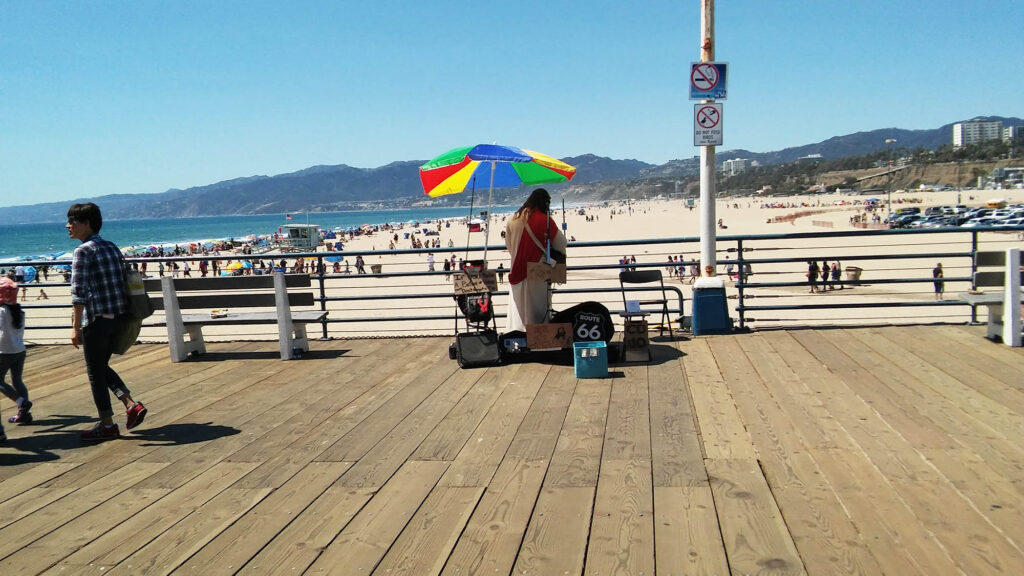
Santa Monica Pier
Santa Monica Pier appears in numerous productions, including The Sting, Forrest Gump, Ruthless People, Cellular, Iron Man, Her, Modern Family, and Seinfeld.