
A Fistful of Dollars (Per un pugno di dollari) is a 1964 Italian-Spanish-West German spaghetti western directed by Sergio Leone and starring Clint Eastwood as a mysterious gunslinger known as Joe, or the Man with No Name. Arriving in the Mexican border town of San Miguel, he discovers that two rival families, the Baxters and the Rojos, are fighting for control of the town. He begins working for both sides, manipulating their conflict while becoming involved in the fate of Marisol (Marianne Koch), a woman held captive by the ruthless Ramón Rojo (Gian Maria Volonté). Loosely based on Akira Kurosawa’s Yojimbo (1961), the film was the first instalment of Leone’s Dollars Trilogy.
Filming took place in 1964, primarily in Spain, with additional interior photography at studios in Rome, Italy. The principal filming location was the Golden City western set near Hoyo de Manzanares, northwest of Madrid, which represented most of the fictional town of San Miguel. Other locations in the Madrid region included the Casa de Campo park and the Alberche River near Aldea del Fresno. Additional scenes were filmed in the province of Almería, particularly around San José, Los Albaricoques and the Tabernas Desert. The production combined existing Spanish villages and farm buildings with purpose-built western streets, creating a fictional border town from locations hundreds of kilometres apart.
Most of the action in San Miguel was filmed at Golden City, a permanent western town constructed in 1962 in the countryside outside Hoyo de Manzanares. The set was developed by producer Eduardo Manzanos with production designers Jaime Pérez Cubero and José Luis Galicia, and had already been used for other western productions before Leone arrived. Its buildings included a saloon, sheriff’s office, shops, residential structures and a main street surrounded by the rocky landscape of the Sierra de Hoyo. The surrounding hills are visible throughout the film, providing a recognisable background to the town’s central square and streets.
Golden City appears in the early sequences following Joe’s arrival in San Miguel. After passing through the town, he encounters a group of Baxter gunmen who mock him and fire shots near his mule. Joe visits Silvanito’s saloon, where the innkeeper explains the conflict between the two families, before returning to confront the gunmen. The ensuing shootout takes place in the main street, with Joe killing four men in a matter of seconds. The same street is used repeatedly as Joe moves between the rival families, visits the local coffin maker Piripero (Joseph Egger) and observes the escalating violence.
The set also provided the exterior of the Baxter residence, where Sheriff John Baxter (Wolfgang Lukschy) and his wife Consuelo (Margarita Lozano) attempt to defend their position against the Rojos. One of the most destructive sequences takes place when Ramón Rojo’s men attack the Baxter household, setting the building on fire and shooting the surviving family members as they attempt to escape. The street and surrounding buildings were also used for the film’s final confrontation, when Joe returns to San Miguel after recovering from his injuries. Walking towards Ramón and his remaining gunmen, he repeatedly allows Ramón to shoot him in the chest, protected by a metal plate concealed beneath his poncho. The confrontation ends with a duel between Joe’s revolver and Ramón’s rifle.
Another important location was the cemetery constructed near Golden City. The nighttime cemetery sequence takes place after Joe and Silvanito recover the bodies of two soldiers killed during the attack on a military convoy. They position the dead men among the graves to make it appear that the soldiers have survived the massacre. Joe then sells information about the supposed survivors to both rival families, provoking a confrontation as the Baxters and Rojos arrive at the cemetery and exchange gunfire. The sequence was filmed on open ground near the western town, with temporary graves and cemetery structures placed against the surrounding hills. Researchers later identified the site through comparisons of the mountain skyline and distinctive rock formations visible in the nighttime footage.
The Golden City set continued to be used for western productions after A Fistful of Dollars, including Leone’s For a Few Dollars More (1965), in which it represented the town of Tucumcari. The buildings eventually deteriorated and were removed during the 1970s. Although the original western street no longer survives, the surrounding landscape remains recognisable from the film, and the municipality of Hoyo de Manzanares has developed a reconstruction project using augmented reality to show how the buildings once stood.
The opening sequence was filmed at Cortijo El Sotillo, a traditional farmhouse complex near San José in Almería. Joe arrives at a small settlement and stops beside a well to drink water. From there, he witnesses a young boy, Jesús, attempting to reach his mother Marisol, who is being held in a nearby house by Ramón Rojo’s men. Two gunmen drive the boy away by firing shots at his feet, while his father Julio is beaten when he attempts to intervene. The sequence establishes Marisol’s imprisonment before Joe continues towards San Miguel. The farmhouse buildings, with their whitewashed walls and simple rectangular structures, are still recognisable from the original footage.
Cortijo El Sotillo appears again later in the film when Joe returns to rescue Marisol. After discovering that she has been separated from her husband and son, he attacks the men guarding the property and kills them during a nighttime confrontation. He then reunites the family and gives them money to escape across the border. The scene makes use of the buildings and courtyard seen in the opening sequence, connecting Joe’s initial encounter with the family to his decision to help them. The property subsequently became a rural hotel, Hotel Cortijo El Sotillo, retaining several of the buildings used during filming.
The village of Los Albaricoques, within the area now protected as Cabo de Gata-Níjar Natural Park, supplied another part of San Miguel. Its most recognisable appearance comes during Joe’s arrival, when he encounters a dead man riding through the village on horseback. A sign reading “Adios Amigo” has been attached to the body, demonstrating the violence that dominates the settlement. The whitewashed houses and village street seen behind the rider belonged to the real Los Albaricoques, rather than the Golden City set. Through editing, the scene moves directly from the Almería village to the western street in Hoyo de Manzanares, creating the impression of a continuous journey through a single town. The village was later used extensively for For a Few Dollars More (1965), where it represented Agua Caliente.
The banks of the Alberche River near Aldea del Fresno, west of Madrid, provided the setting for the massacre of Mexican soldiers by Ramón Rojo and his gang. In the film, Mexican troops are transporting gold intended for an arms transaction when Ramón and his men launch an ambush. Disguised as American soldiers, they open fire on the unsuspecting troops, killing them and stealing the shipment. The sequence was filmed beside the real river, with the wooded banks, shallow water and surrounding landscape representing the Rio Grande border region. The location was subsequently identified by researchers who matched the surrounding hills and riverbank with the film. Since the 1960s, changes in the river’s course and increased vegetation have altered its appearance.
Within Madrid itself, the Casa de Toledo pavilion in Casa de Campo was used for the Rojo family’s residence. The building formed part of the former Feria del Campo exhibition grounds, which contained structures representing different Spanish regions. Its enclosed courtyard, large stone walls and traditional architectural features were used to represent the wealthy family’s compound in San Miguel. The location appears during Joe’s dealings with the Rojos and in the sequence where he discovers Marisol’s imprisonment. In one scene, Joe approaches the guarded residence, shoots his way past the entrance and breaks through a door to reach the captive woman. The surviving stone architecture was later identified through comparisons with the film.
Additional exterior photography took place in the Tabernas Desert in Almería, where the production used dry riverbeds, rocky hills and open desert tracks. Among the identified areas were Rambla Indalecio, Rambla Lanújar, Cortijo Genaro and El Cautivo. The dry riverbeds, locally known as ramblas, provided the setting for horseback sequences through the landscape surrounding San Miguel. Some of the nighttime riding footage was filmed here after Joe helps Marisol and her family escape, as the Rojo gang searches the countryside for him. These passages were filmed separately from the principal town scenes, with second-unit director Franco Giraldi involved in the additional action photography.
Madrid’s CEA Studios were also used for the production, providing additional constructed sets and interiors associated with the Golden City location. Rather than relying entirely on the standing western buildings at Hoyo de Manzanares, the filmmakers combined those exteriors with interior sets that offered greater control over lighting, camera placement and the movement of the actors. The studio work helped establish the interiors of San Miguel’s various buildings, while the exterior shots retained the distinctive landscape surrounding Golden City.
Some interior filming was carried out at Elios Studios in the Settecamini district of Rome, Italy. The studios had been established by Alvaro Mancori in 1961 and included their own western sets. Leone used the facilities for early filming under the working title Il magnifico straniero. Among the scenes filmed there was the sequence in which Joe recovers from the injuries inflicted by the Rojos and practises drawing and firing his revolver inside a cave before returning to San Miguel. Camera operator Sergio D’Offizi later recalled filming this sequence, together with a hotel-room scene, during a short period of studio photography in early 1964. The Roman interiors were combined with the Spanish locations to complete the fictional town and its surroundings.
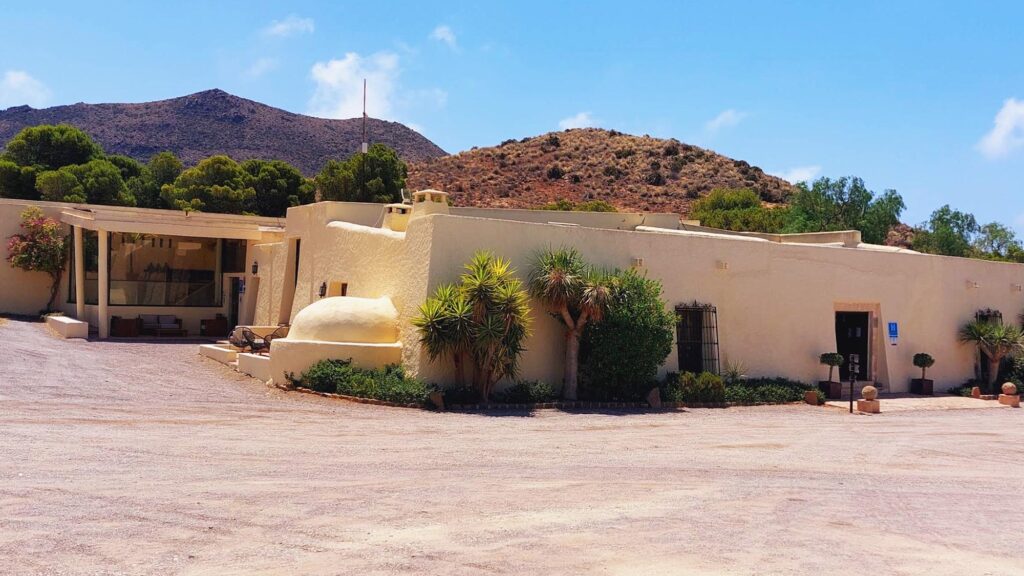
Cortijo El Sotillo
Cortijo El Sotillo has been used in A Fistful of Dollars (1964), Desafío en Río Bravo (1964), Johnny Yuma (1966) and "Day of Anger" (1967).