
Lawrence of Arabia (1962) is a British-American historical epic directed by David Lean and produced by Sam Spiegel. Peter O’Toole stars as T. E. Lawrence, the British officer who becomes involved in the Arab Revolt against the Ottoman Empire during the First World War. The film follows Lawrence’s military campaigns, his relationships with Arab leaders and his increasingly troubled position between British political interests and the people he has helped to unite. The cast includes Alec Guinness as Prince Faisal, Omar Sharif as Sherif Ali, Anthony Quinn as Auda Abu Tayi, Jack Hawkins as General Allenby and Claude Rains as Mr Dryden. Filmed on an enormous scale, with cinematography by Freddie Young and music by Maurice Jarre, Lawrence of Arabia won seven Academy Awards, including Best Picture and Best Director.
Lawrence of Arabia was filmed in Jordan, Spain, Morocco, England and the United States between 1961 and 1962. Filming began in Jordan, where David Lean used the country’s deserts for some of the film’s best-known sequences. The production received considerable assistance from King Hussein of Jordan, including support from the Jordanian Desert Patrol and local Bedouin tribesmen who appeared as extras. Wadi Rum, with its towering sandstone cliffs and red desert landscape, was used for Prince Faisal’s camp and the scenes in which Lawrence begins to adopt Arab clothing. Jebel Tubayq, near the Saudi Arabian border, provided the rocky and isolated desert terrain seen during Lawrence’s early journeys and the crossing of the Nefud Desert. One of the film’s most famous scenes, Sherif Ali’s gradual appearance from a distant mirage as he approaches a desert well, was filmed on the mudflats at Jafr. The same area was used for the sequence in which Lawrence returns across the desert to rescue the missing Gasim.
A large part of the production subsequently moved to Spain, where Seville was used to represent Cairo, Jerusalem and Damascus. Several of the city’s historic buildings became recognisable settings in the film. Plaza de España served as the exterior of the British officers’ club in Cairo, while the courtyard of Hotel Alfonso XIII was used for additional club scenes. Casa de Pilatos provided the setting for Lawrence’s meeting with General Allenby, and the Casino de la Exposición, near Parque de María Luisa, became the council chamber in Damascus, where Lawrence and the Arab leaders struggle to establish a government after taking the city. The buildings around Plaza de América were used to represent parts of Jerusalem. Although the film is set in the Middle East, many of its urban scenes were therefore filmed within a relatively small area of Seville.
The Spanish province of Almería provided several of the film’s major desert and battle locations. At Playa del Algarrobico, near Carboneras, the production constructed an extensive replica of Aqaba, the Red Sea port captured by Lawrence and his Arab allies. The set included around 300 building fronts, a long sea wall and a Turkish military camp overlooking the town. Hundreds of horses and camels were used during the large-scale assault sequence. The railway attacks were also filmed in Almería, particularly around Cabo de Gata and Playa de los Genoveses near San José. For these scenes, the production used real railway equipment, including locomotives brought in from elsewhere in Europe. The destruction of one of the trains required careful preparation, since the explosion and derailment could only be filmed once. The Sierra Nevada mountains were also used for scenes representing the colder mountain terrain around Azraq.
Morocco was another important filming country, with locations around Ouarzazate used for desert and battle sequences. The production moved there during the summer of 1962 to film the violent confrontation with Turkish forces following the massacre at Tafas. The sequence required large numbers of mounted extras, horses, camels and military equipment. The area around Aït Benhaddou was also used for desert material, adding to the locations photographed in Jordan and Spain.
The film’s opening and closing scenes were partly shot in England. The motorcycle accident that killed Lawrence was recreated at Chobham Common in Surrey, although the real accident took place near his home in Dorset. The exterior of St Paul’s Cathedral in London appears during the memorial service held after his death, while the cathedral interior was recreated in Spain. Additional desert footage was filmed at the Imperial Sand Dunes near Glamis in southern California. The finished film combines locations from several countries to represent the Arabian Peninsula and the wider Middle East during the First World War.
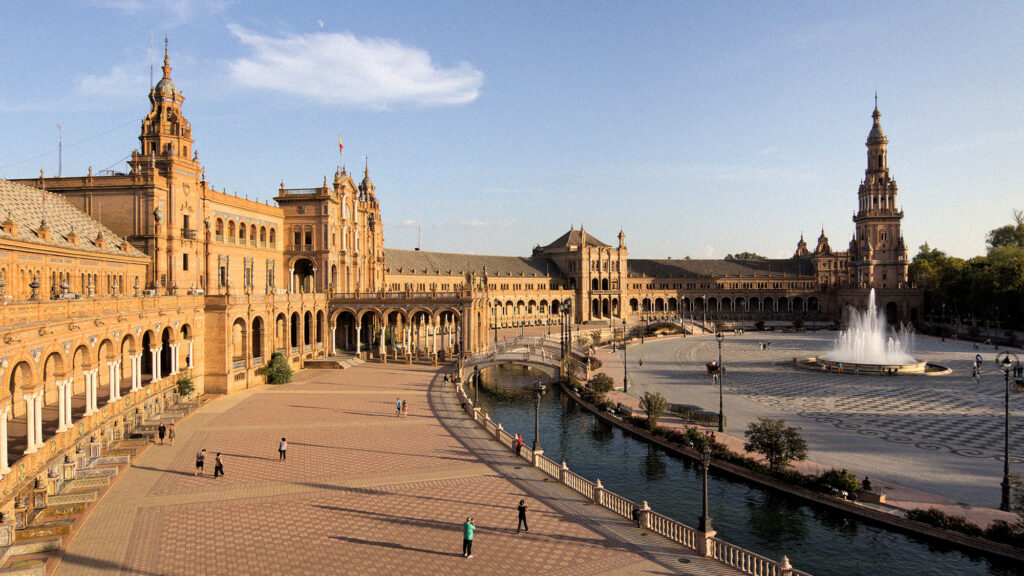
Plaza de España
The Plaza de España has been used as a filming location, including scenes for Lawrence of Arabia and Star Wars: Episode II – Attack of the Clones.