
The Tombs is a historic restaurant and bar at 1226 36th Street NW in the Georgetown neighbourhood of Washington, D.C., directly opposite the Georgetown University campus. Established on 23 July 1962 by Georgetown graduate Richard J. McCooey, it occupies the basement of a nineteenth-century Federal-style townhouse at the corner of 36th and Prospect Streets. McCooey had wanted to open a traditional student tavern near the university since his own undergraduate years in the late 1940s. After acquiring the property, he established two restaurants in the building: the more formal 1789 Restaurant upstairs and The Tombs in the basement. The name was inspired by T. S. Eliot’s poem «Bustopher Jones: The Cat About Town», in which the title character is described as having lunch at an establishment called The Tomb. McCooey, who had himself been nicknamed Bustopher Cat during his military service, thought the literary reference particularly suitable for an underground restaurant. The interior was designed in the style of an old-fashioned college tavern, with exposed brick walls, wooden booths, a long bar, leaded-glass partitions and a fireplace decorated with rowing oars. Historic photographs of Georgetown, university memorabilia and First World War recruitment posters cover much of the wall space. The restaurant quickly became a gathering place for Georgetown students, professors and alumni, developing several longstanding traditions. The Georgetown Chimes, the university’s male a cappella group, began performing at the restaurant during the 1960s, while generations of students have celebrated their twenty-first birthdays there. Another tradition, the 99 Days Club, encourages graduating seniors to visit the establishment on each of the final 99 days before graduation. McCooey sold The Tombs, 1789 Restaurant and the neighbouring F. Scott’s to Clyde’s Restaurant Group in 1985, although much of the original decoration was retained. The restaurant temporarily closed during the COVID-19 pandemic in March 2020 before reopening in March 2022. Despite its relatively modest appearance from the street, The Tombs has become one of Georgetown’s most familiar establishments. It also occupies an important place in American film history through its connections to The Exorcist and St. Elmo’s Fire.
The Tombs appears in The Exorcist III (1990), the supernatural horror film written and directed by William Peter Blatty. The restaurant provides the setting for an extended conversation between police lieutenant William Kinderman and Father Joseph Dyer after the two friends attend a screening of It’s a Wonderful Life (1946). Although The Tombs is also closely associated with The Exorcist (1973), its role in the original production has frequently been misidentified. The restaurant appears in Blatty’s original novel, and the filmmakers initially wanted to use it for the scene in which Father Damien Karras admits that he is losing his religious faith. Permission was refused, however, and the scene was instead filmed at Martin’s Tavern on Wisconsin Avenue. The Tombs also inspired the fictional St. Elmo’s Bar in St. Elmo’s Fire (1985), directed by Joel Schumacher. The filmmakers studied the restaurant’s appearance and atmosphere before recreating its interior on a Hollywood studio set, while the bar’s exterior was filmed at Universal Studios. Neither production therefore used the actual Tombs interior, making The Exorcist III its most clearly documented appearance as a filming location.
In The Exorcist III (1990), The Tombs appears during an early sequence involving Lieutenant William Kinderman, played by George C. Scott, and his longtime friend Father Joseph Dyer, played by Ed Flanders. Set approximately fifteen years after the events of the original film, the story follows Kinderman as he investigates a series of particularly disturbing murders in Georgetown that appear connected to the long-dead serial killer James Venamun, known as the Gemini Killer. Kinderman and Dyer are also united by their friendship with Father Damien Karras, who died during the exorcism of Regan MacNeil. The two men have maintained a tradition of going to the cinema together, and on this occasion they attend a screening of Frank Capra’s It’s a Wonderful Life, starring James Stewart. Afterwards, they visit The Tombs, where they sit together in one of the restaurant’s wooden booths. Their conversation initially concerns the film they have just watched, with Kinderman expressing his admiration for Stewart and Dyer responding with his usual dry humour. However, the detective’s increasingly troubled state of mind soon becomes apparent. He has recently investigated the horrific murder of a young boy named Thomas Kintry, whose body was discovered near the Potomac River. The brutality of the crime has deeply affected him, and he begins questioning how a supposedly benevolent God could allow such suffering to exist. Kinderman describes a world filled with disease, violence, murder and cruelty, arguing that death itself is an appalling invention for which God should be held responsible. Dyer attempts to challenge his pessimism, suggesting that human life continues beyond death and that everything will eventually make sense. Kinderman is unconvinced, insisting that he would much rather remain alive than place his faith in an uncertain afterlife. The disagreement is punctuated by moments of humour, with Dyer responding to the detective’s increasingly elaborate complaints with sarcastic remarks and assurances that they will both live forever as spirits.
The restaurant scene also establishes the close personal relationship between Kinderman and Dyer, whose friendship provides some of the film’s few moments of ordinary companionship before the murders become increasingly personal. Their conversation eventually returns to Father Karras, whose death continues to trouble both men despite the passage of fifteen years. The sequence was filmed inside the actual Tombs restaurant during the production’s Washington, D.C., location work in 1989. The establishment’s exposed brickwork, wooden booths and collegiate decorations are visible around the characters, with other customers occupying the surrounding tables. Two unexpected participants in the scene are television broadcaster Larry King and former United States Surgeon General C. Everett Koop, who make cameo appearances as themselves among the restaurant’s customers. Blatty also filmed additional dialogue for the scene that was shortened in the theatrical release. An extended version survives in the director’s cut, released as part of the film’s later home-video editions, in which the friends discuss James Stewart’s acting, other films and their memories of Karras before moving into the more serious discussion about death and religious faith. The location has a direct connection to the original Exorcist story, since the restaurant stands opposite the house used for exterior filming of the MacNeil residence in the 1973 film. By filming inside The Tombs, Blatty finally brought one of the Georgetown establishments associated with his original novel into the series, nearly two decades after the first film was made.

The Exorcist House
The Exorcist House refers to the private residence in Georgetown, Washington, D.C., which was used for exterior filming of the 1973 horror movie The Exorcist.

The Exorcist Steps
The Exorcist Steps the famous 75-step stairway in Washington, D.C., have appeared in The Exorcist (1973), The Exorcist III (1990) and Ghosted (2023).
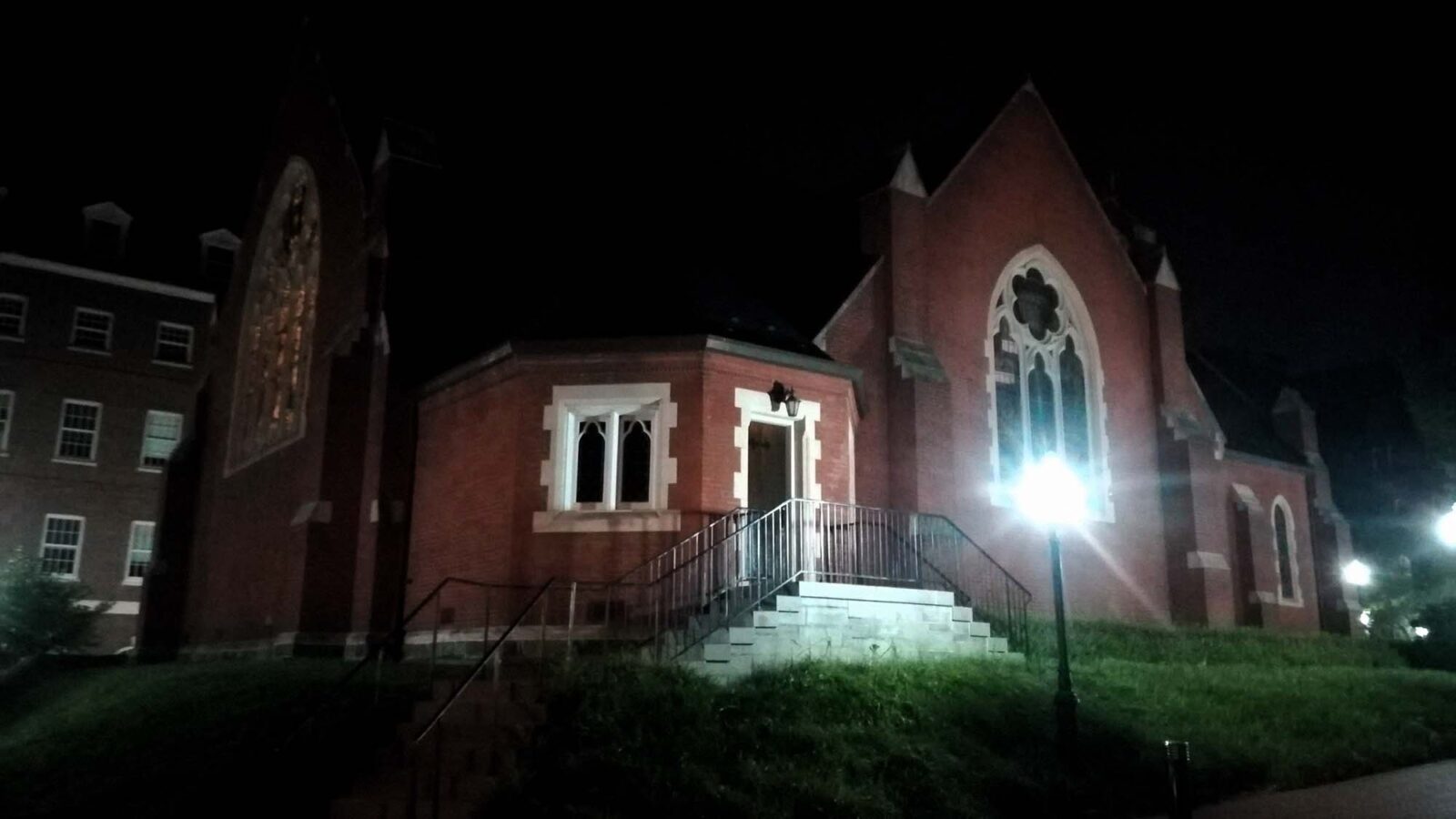
Dahlgren Chapel of the Sacred Heart
Dahlgren Chapel of the Sacred Heart appears in The Exorcist (1973) and The Exorcist III (1990), two horror films associated with Georgetown University.

Martin’s Tavern
Martin's Tavern appears in The Exorcist (1973), the supernatural horror film directed by William Friedkin and based on the novel by William Peter Blatty.

Garrett Jacobs Mansion
The Garrett Jacobs Mansion has been used in productions as Bedroom Window, Clara’s Heart, Her Alibi, The Accidental Tourist, He Said, She Said, Major League II, 12 Monkeys, Diner, Species II, and My One and Only.

Miller School of Albemarle
Miller School of Albemarle has appeared in Morgan Stewart's Coming Home (1987), Toy Soldiers (1991) and Major Payne (1995).

Philadelphia Museum of Art Steps
Philadelphia Museum of Art Steps appear most famously in Rocky (1976), and later returned in several other Rocky and Creed films. They also appear in Shazam.

Rocky Statue
The Rocky Statue appears in Rocky III (1982), Rocky V (1990), Philadelphia (1993), Creed II (2018), and several later Rocky-related screen works.

Eastern State Penitentiary
As a filming location, Eastern State Penitentiary is used in three feature films: 12 Monkeys, Return to Paradise, and Transformers: Revenge of the Fallen.