
Wayne Knight (born 7 August 1955) is an American actor and voice performer best known for portraying Newman in Seinfeld (1989–1998), Dennis Nedry in Jurassic Park (1993) and Officer Don Orville in 3rd Rock from the Sun (1996–2001). His other notable films include Dirty Dancing (1987), JFK (1991), Basic Instinct (1992), Space Jam (1996), Rat Race (2001), Punisher: War Zone (2008) and 12 Mighty Orphans (2021). Born in New York City and raised in Cartersville, Georgia, he studied theatre at the University of Georgia before working at the Barter Theatre in Virginia and establishing himself on Broadway. His career subsequently took him to filming locations across the United States, Canada and Hawaii, although much of his television work was concentrated at CBS Studio Center in Los Angeles. He has also developed an extensive career in animation, providing voices for characters in Tarzan (1999), Toy Story 2 (1999), Xiaolin Showdown (2003–2006) and numerous other productions.
Wayne Elliot Knight was born in New York City to William Edward Knight and Grace Monti Knight. His father worked in the textile industry, eventually becoming a factory supervisor, while his mother was employed in women’s clothing manufacturing. The family moved south during Wayne’s childhood, settling in Cartersville, a small industrial town approximately 65 kilometres northwest of Atlanta, Georgia. Situated near the Etowah River in Bartow County, Cartersville had developed during the nineteenth century around agriculture, mining and manufacturing, with textile mills providing employment for many local families. Knight grew up within a working-class Catholic household and attended local schools, developing an interest in performing despite having few direct connections with the professional entertainment industry. His early life was shaped by the culture of northwest Georgia, particularly its distinctive accents and the social environment of smaller Southern communities. He later drew on people he had encountered during his childhood when developing characters for film and television.
His earliest experience of performing came during kindergarten in Cartersville, when he was asked to recite a poem at a school celebration. The performance was originally scheduled for the beginning of the programme, but the teacher repeatedly forgot to introduce him. He eventually appeared as the final performer and received considerable applause, which he interpreted as evidence of his natural ability to entertain an audience. Knight later recalled the incident as the beginning of his interest in acting, although his professional ambitions remained relatively undeveloped throughout much of his childhood. At high school, he played American football as a lineman, taking advantage of his substantial build, while also developing an interest in theatre through speech classes. A teacher encouraged him to audition for a local production of the comedy Send Me No Flowers, in which he obtained a small role as a delivery boy. The experience introduced him to amateur theatrical companies and the social relationships among performers, encouraging him to pursue acting more seriously.
After completing high school, Knight enrolled at the University of Georgia in Athens in 1972. The university, established in 1785, is one of the oldest public universities in the United States, with its historic North Campus centred around the Arch and the buildings surrounding Broad Street. Knight studied theatre and became involved in student productions, gradually developing the technical skills required for professional stage performance. He was an academically successful student but increasingly interested in working within a repertory company rather than completing his degree immediately. During his university years, he became acquainted with Terry Turner, who would later co-create 3rd Rock from the Sun and contribute to another important phase of Knight’s television career. Knight eventually left the university one credit short of graduation to pursue an acting opportunity, although he returned many years later and completed his degree in 2008.
His first substantial professional experience came at the Barter Theatre in Abingdon, Virginia. Established in 1933 during the Great Depression, the theatre became known for allowing audiences to exchange agricultural produce for admission when cash was scarce. Its principal building stands on West Main Street in the historic centre of Abingdon, a small town in the Appalachian Mountains of southwestern Virginia. Knight initially joined the company as an intern in 1976, undertaking practical theatrical work while appearing in repertory productions. He subsequently became a member of the company and obtained his Actors’ Equity Association card, an important qualification for professional stage employment in the United States. The theatre offered an environment in which younger performers could work alongside experienced actors and participate in several productions during the same season. For Knight, the experience provided a direct transition from academic theatre to the demands of a professional company.
Following his work in Abingdon, Knight moved to New York City, hoping to establish himself within the Broadway and Off-Broadway communities. His first important stage engagement came in Albert Innaurato’s Gemini, a comedy about an Italian-American family in South Philadelphia. The production opened at the Little Theatre, now the Helen Hayes Theater, at 240 West 44th Street in Manhattan in May 1977. Knight joined the long-running production as a replacement performer, playing Herschel Weinberger, a young man whose relationship with the central character creates part of the comedy’s conflict. He had obtained an audition after writing directly to the producers and arguing that they should consider him if the part became available. The unusual approach succeeded, and Gemini provided him with his Broadway debut. The production ran for more than four years, establishing Knight within New York’s professional theatre community.
Although Broadway offered occasional employment, Knight struggled financially during the early stages of his career. He supported himself through temporary jobs, including several years working as a private investigator in New York. The work involved observing people and gathering information, frequently placing him in everyday environments far removed from theatres and rehearsal rooms. He also continued auditioning for smaller productions and television commercials, developing a reputation for performing distinctive supporting characters rather than conventional leading roles. His early experience in the city contributed to an ability to portray people with strongly defined personalities and unusual habits, a quality that would later become central to his performances as Newman and Dennis Nedry. New York also provided his first substantial film opportunities, particularly through productions using the city’s actual streets and neighbourhoods.
His screen debut came with an uncredited appearance in The Wanderers (1979), directed by Philip Kaufman and based on Richard Price’s novel about teenage gangs in the Bronx during the early 1960s. The production was filmed extensively in New York City, incorporating actual streets, apartment buildings and commercial establishments associated with the period. Knight initially worked as an extra before being given a small speaking part as a waiter at Puglia’s, an Italian restaurant in Manhattan. The assignment represented his first professional employment under a Screen Actors Guild contract. He later recalled the excitement of working alongside established character actors and observing the practical methods used during feature-film production. Although his appearance was brief, The Wanderers began a screen career that would eventually include more than a hundred film and television credits.
During the early 1980s, Knight continued appearing in smaller films and television programmes while maintaining his theatre work. His films included For Lovers Only (1982), Porky’s II: The Next Day (1983) and Forever, Lulu (1986), none of which initially brought substantial recognition. He also appeared in the British-American sketch comedy Assaulted Nuts (1985), produced for Channel 4. The programme featured performers from Britain and the United States, including Emma Thompson, and required Knight to spend time working in London. Its sketches were filmed within British television facilities rather than around the American locations associated with most of his earlier screen work. The experience introduced him to another national comedy industry and gave him opportunities to perform a variety of characters within the same programme.
His breakthrough in a widely successful feature film came with Dirty Dancing (1987), directed by Emile Ardolino and starring Patrick Swayze and Jennifer Grey. Knight played Stan, a member of the entertainment staff at Kellerman’s, the fictional Catskills resort where the story takes place during the summer of 1963. The production was filmed primarily in two locations considerably farther south than the Catskill Mountains: Lake Lure in North Carolina and Mountain Lake in Virginia. Filming began in September 1986 and lasted approximately six weeks, with the filmmakers combining the different properties to create the appearance of a single holiday resort.
The Mountain Lake Lodge near Pembroke, Virginia, provided much of the exterior environment for Kellerman’s, including the main hotel building, lawns and several guest accommodation areas. The property, situated in the Allegheny Mountains, had operated as a holiday resort for decades before becoming internationally associated with the film. Other scenes were photographed at the former Camp Occoneechee near Lake Lure, North Carolina, where the filmmakers constructed and adapted cabins, staff accommodation and dance facilities. The camp’s former gymnasium was used for interior dance sequences and the elaborate concluding performance. Knight recalled travelling between the two locations and spending extended periods staying in local accommodation alongside the cast, including Jack Weston, Jerry Orbach and the younger dancers. His role involved introducing resort activities and interacting with guests, allowing him to draw on his experience as a stage performer accustomed to addressing audiences. Dirty Dancing became an unexpected international success, transforming a relatively modest production into one of the most recognisable American films of the decade.
Knight continued accepting supporting roles in larger productions, including Everybody’s All-American (1988), directed by Taylor Hackford and starring Dennis Quaid and Jessica Lange. The sports drama was filmed in Louisiana, particularly around Baton Rouge, where historic buildings and university facilities represented the central characters’ environment. Knight appeared briefly as a man who approaches Quaid’s character in a public lavatory, a scene filmed on a temporary interior set after he had spent several weeks waiting for his assignment. He subsequently worked with director Oliver Stone on Born on the Fourth of July (1989), portraying an official encountered by Vietnam War veteran Ron Kovic, played by Tom Cruise. Knight’s scene was photographed at the Astrodome in Houston, Texas, which represented a political convention. The production used the enormous indoor stadium to recreate the scale of the event, with Knight appearing in a brief exchange involving Cruise’s character. Although his role was small, it introduced him to Stone’s demanding approach to film production.
The two subsequently worked together on JFK (1991), Stone’s historical thriller about the assassination of President John F. Kennedy. Knight portrayed Numa Bertel, an assistant district attorney involved in Jim Garrison’s investigation in New Orleans. The film was shot extensively in Louisiana, particularly around New Orleans, where the filmmakers incorporated actual streets, offices and historic buildings associated with the investigation. The production also travelled to Dallas, Texas, using locations connected with the assassination, including Dealey Plaza and surrounding streets. Knight initially prepared for the role using an accent inspired by people from Bartow County, Georgia, but later met the real Bertel and discovered that his New Orleans speech patterns were considerably different. He discussed the matter with Stone and adjusted the performance accordingly. The role required Knight to portray an actual historical figure rather than the fictional supporting characters he had played in previous films, giving him another opportunity to develop his work outside comedy.
A further important film role came in Basic Instinct (1992), directed by Paul Verhoeven and starring Michael Douglas and Sharon Stone. Knight played Assistant District Attorney John Correli, one of the investigators questioning novelist Catherine Tramell about a murder. His appearance included the film’s famous interrogation sequence, in which the investigators become increasingly unsettled by Tramell’s provocative behaviour. The production was filmed in San Francisco and the surrounding region during the spring of 1991, using actual streets, residential properties and public buildings associated with the city’s police and legal institutions. Other scenes were photographed in the Monterey area and at studio facilities. Knight’s role was concentrated within the law-enforcement environment, particularly the interrogation room where he appeared alongside Douglas and other members of the cast.
Basic Instinct became a major international commercial success, and Knight’s appearance proved unexpectedly important to his subsequent career. Steven Spielberg saw the interrogation scene and decided that Knight would be suitable for the role of Dennis Nedry in Jurassic Park (1993), without requiring him to audition. Knight later recalled that his agent telephoned unexpectedly with the news, explaining that Spielberg had specifically requested him after seeing Basic Instinct. The decision brought him into one of the most ambitious special-effects productions of the period, at a time when he was already beginning to receive recognition through television comedy.
Jurassic Park was based on Michael Crichton’s novel about an isolated island where genetically recreated dinosaurs become the central attraction of a theme park. Knight played Dennis Nedry, the computer programmer responsible for the park’s security systems, who attempts to steal dinosaur embryos for a rival company. The fictional Isla Nublar is situated near Costa Rica, but the production was filmed principally in Hawaii and California. Principal photography began in August 1992, with much of the outdoor work concentrated on Kauai, one of the Hawaiian Islands. Its tropical valleys, steep mountains and dense vegetation provided the setting for the fictional island, while elaborate interiors were constructed at Universal Studios in California.
Knight travelled to Kauai for his principal outdoor scenes, including those involving Nedry’s attempt to escape with the stolen embryos during a tropical storm. One of his first filming locations was the Blue Hole area in the upper Wailua River valley, where the production had constructed the enormous entrance gates to Jurassic Park. The location lies within a remote and exceptionally wet part of the island, accessible by rough roads and surrounded by dense rainforest. Knight recalled arriving by vehicle through muddy terrain and meeting Spielberg for the first time beside the constructed gates. Despite the area’s frequent natural rainfall, the filmmakers used artificial rain equipment to control the appearance of the storm. The combination of heavy rain, mud and difficult terrain made the production physically demanding, particularly because his character repeatedly slips and struggles while attempting to find his way through the jungle.
Nedry’s most memorable sequence involves an encounter with a Dilophosaurus, a dinosaur that initially appears relatively harmless before attacking him. The scene combined Knight’s physical performance with an animatronic creature developed by Stan Winston’s special-effects team. The filmmakers used practical effects, artificial rain and carefully controlled photography to make the encounter appear to take place during a violent tropical storm. Knight recalled that some of the liquid used during the sequence stained his skin, creating an unexpected problem when he returned to work on Seinfeld. His character was supposed to appear relatively normal in the sitcom, but traces of the effects material remained visible on his face. Jurassic Park also used locations around the former Valley House estate near Kealia, where the visitor centre exterior was constructed, and Kualoa Ranch on Oahu for scenes involving other characters. Knight’s own Hawaiian work was particularly associated with the forest roads and the heavily wooded area around the park entrance, rather than every location featured in the film.
Filming on Kauai was interrupted by Hurricane Iniki in September 1992, one of the strongest hurricanes to strike the Hawaiian Islands during the twentieth century. Knight was leaving the island as the storm approached, while several other members of the cast and crew remained there and experienced the hurricane’s destructive effects. The production subsequently continued in California, where the visitor centre interiors, control room and other environments had been constructed at Universal Studios. The finished film combined those sets with Hawaiian landscapes, animatronic dinosaurs and computer-generated effects developed by Industrial Light & Magic. Jurassic Park was released in June 1993 and became the highest-grossing film in history at the time. Knight received a Saturn Award nomination for Best Supporting Actor, while Nedry’s behaviour and distinctive appearance made him one of the franchise’s most recognisable supporting characters.
His role in Jurassic Park coincided with the development of his most famous television character. Newman had originally been introduced in Seinfeld during the second season as an unseen neighbour who communicates with Cosmo Kramer. The character’s voice was initially supplied by Larry David in the 1991 episode The Revenge, before Knight was cast for his first on-screen appearance in The Suicide, broadcast in January 1992. Newman was conceived as a neighbour who enjoyed gathering information about the other residents of the building, but gradually developed into a scheming postal worker whose friendship with Kramer contrasted with his mutual hostility towards Jerry Seinfeld. Knight auditioned for what was originally expected to be a single appearance, but the producers recognised the comic potential created by his physical contrast with Michael Richards and his interactions with the other principal characters.
Seinfeld was set in New York City, with Newman living in the same Upper West Side apartment building as Jerry and Kramer. The fictional property was given the address 129 West 81st Street, although its exterior was represented by an actual building at 757 South New Hampshire Avenue in Los Angeles. The principal interiors were constructed at CBS Studio Center, 4024 Radford Avenue in Studio City, where the production had relocated after its first season. Knight’s scenes as Newman were filmed primarily on the standing sets representing the apartment building, including Jerry’s flat, Kramer’s residence and the adjoining corridors. The studio environment allowed the programme to be recorded before an audience while maintaining the appearance of an ordinary Manhattan apartment house.
The series incorporated actual New York buildings through exterior photography, including Tom’s Restaurant at 2880 Broadway, near West 112th Street, which represented Monk’s Café. Newman frequently appeared within the fictional café, but Knight’s scenes were generally recorded on the restaurant set in Los Angeles rather than inside the actual Manhattan establishment. His character also worked for the United States Postal Service, creating opportunities for storylines involving mail delivery, sorting facilities and the ordinary frustrations of government employment. These settings were usually represented by studio interiors or adapted commercial properties around Los Angeles. Although Newman became closely associated with the geography of Manhattan, Knight’s working life during the series was concentrated largely in the San Fernando Valley.
Newman appeared throughout Seinfeld’s later seasons, becoming one of its most recognisable recurring characters despite never joining the four principal performers as a regular cast member. His storylines included elaborate schemes with Kramer, disputes with Jerry and increasingly absurd attempts to exploit his position as a postal worker. Episodes such as The Calzone, The Bottle Deposit and The Millennium gave Knight substantial opportunities for physical comedy and exaggerated emotional reactions. His performance drew on the combination of theatrical experience and character acting that he had developed in Virginia and New York. Knight later identified The Ticket, in which Newman becomes involved in a courtroom hearing following a speeding incident, as one of his favourite appearances because it allowed him to develop an unusually extravagant comic performance. The character remained part of the programme until its conclusion in May 1998, establishing Knight internationally through a supporting role that occupied only a relatively small proportion of the series’ overall screen time.
During the Seinfeld years, Knight also appeared in The Edge (1992–1993), an experimental television sketch comedy series featuring Jennifer Aniston, Tom Kenny, Jill Talley and other performers. The programme was produced at CBS Studio Center, where Knight subsequently worked repeatedly on different television projects. He later recalled recording episodes during the 1992 Los Angeles riots, when curfews affected the movement of cast and crew members around the city. The series provided further opportunities for unusual character performances, drawing on his earlier experience of British sketch comedy and stage improvisation. He also appeared in The Second Half (1993–1994), an NBC sitcom about a divorced sportswriter and his family, although the programme was short-lived.
One of his most substantial film roles during the middle of the 1990s came in Space Jam (1996), directed by Joe Pytka and starring basketball player Michael Jordan alongside animated characters from the Looney Tunes franchise. Knight played Stan Podolak, Jordan’s assistant, who becomes involved in the athlete’s extraordinary journey into an animated world. The production was filmed primarily at Warner Bros. Studios in Burbank, California, using elaborate green-screen environments to combine live-action performances with characters created through traditional animation and digital effects. Stage 22 was converted into a large green-screen basketball court, where Jordan performed much of the film’s central game without the animated players being physically present.
Knight spent extensive periods performing alongside Jordan and other live-action actors within these artificial environments. Technicians dressed in green clothing and positioned at different heights represented the approximate locations of animated characters, requiring him to direct his dialogue and physical movements towards performers who would later disappear from the finished film. The production also required him to perform elaborate falls and exaggerated reactions without the benefit of actual scenery or props. Knight later described the experience as technically demanding and considerably less natural than working on conventional film sets. Space Jam was released in November 1996 and became a major international commercial success, introducing Knight to another generation of younger audiences.
His second major long-running television role began with 3rd Rock from the Sun (1996–2001), created by Bonnie Turner and Terry Turner and starring John Lithgow, Kristen Johnston, French Stewart and Joseph Gordon-Levitt. Knight played Officer Don Leslie Orville, a local police officer in the fictional Ohio town of Rutherford who becomes romantically involved with Sally Solomon, an extraterrestrial living on Earth in human form. Although the series was set in Ohio, its production was based at CBS Studio Center in Studio City, allowing Knight to continue working in the same studio complex associated with Seinfeld. The programme’s university buildings, police facilities and residential interiors were constructed within the studio environment, while occasional outdoor locations around Southern California represented the fictional Midwestern community.
Knight had known Terry Turner during his years at the University of Georgia, and their shared background helped establish the character’s unusual identity. Turner had grown up watching an Atlanta children’s television programme called The Popeye Club, presented by a local personality known as Officer Don. The name and aspects of the television host’s appearance provided inspiration for Knight’s fictional police officer. Don Orville was initially intended as a minor character, but the producers recognised the comic potential of his relationship with Sally, particularly the physical and behavioural contrast between Knight and Kristen Johnston. Their characters gradually developed into a recurring romantic couple, allowing Knight to appear throughout the series’ six seasons. He later described 3rd Rock from the Sun as one of his most enjoyable television experiences because of the ensemble’s working relationships and the opportunities for unusual comedy.
His continuing involvement in feature films included To Die For (1995), directed by Gus Van Sant and starring Nicole Kidman as an ambitious television personality. Knight played Ed Grant, the manager of a local cable television station where Kidman’s character attempts to establish herself professionally. The film was set in a fictional New Hampshire community but photographed primarily in Ontario, Canada, particularly around Toronto and the surrounding suburbs. The production used actual residential neighbourhoods and commercial properties to recreate the environment of a small American town. Knight’s scenes were principally associated with the fictional television station, allowing him to portray another figure occupying a relatively modest position of authority. The film received strong reviews and became an important dramatic production of the decade.
His other significant comedy role during this period came in Rat Race (2001), directed by Jerry Zucker and featuring an ensemble cast including John Cleese, Rowan Atkinson, Whoopi Goldberg, Cuba Gooding Jr., Jon Lovitz and Seth Green. Knight played Zack Mallozzi, one of two brothers who become involved in a competition to reach a large sum of money hidden in New Mexico. Although the story involves a journey from Las Vegas across the American Southwest, much of the production was filmed in Alberta, Canada. Principal photography began in August 2000, with locations around Calgary and Drumheller representing highways and desert landscapes in Nevada, Arizona and New Mexico. The production also used former military facilities at Currie Barracks in Calgary, where large aircraft hangars were converted into soundstages for hotel interiors and driving scenes.
Additional Rat Race photography took place in Las Vegas, particularly around the Venetian hotel at 3355 Las Vegas Boulevard South, where the fictional competition begins. Other scenes used McCarran International Airport, now Harry Reid International Airport, and the historic railway facilities at Ely, Nevada, which represented the destination of Silver City, New Mexico. Knight’s character appeared frequently in sequences involving his brother, played by Seth Green, as the two attempt increasingly reckless methods of reaching the money. The film’s elaborate physical comedy required work with vehicles, special effects and locations across several different regions. Knight later recalled the amount of time spent in Alberta, particularly the unusual experience of filming an American desert road comedy within Canadian landscapes.
He also developed an extensive career in voice acting, particularly during the late 1990s and early 2000s. In Tarzan (1999), produced by Walt Disney Feature Animation, he voiced Tantor, a nervous elephant who becomes one of Tarzan’s childhood companions. The animated story depicts tropical African forests, but the production was created by artists and animators working in the United States and France rather than by photographing the fictional characters in actual jungle locations. Knight’s vocal performance drew on his familiar comic style, allowing Tantor to express anxiety and uncertainty through dialogue and exaggerated reactions.
The same year, he provided the voice of Al McWhiggin in Pixar’s Toy Story 2 (1999). Al is the owner of Al’s Toy Barn, a large toy shop whose attempt to obtain Woody becomes central to the story. The film was produced at Pixar Animation Studios in the San Francisco Bay Area, where artists created the fictional environments through computer animation. Knight recorded parts of his performance remotely from New York because he was appearing in the Broadway production of Art during the same period. The arrangement required a video connection between the recording studio and director John Lasseter, who could observe and direct his performance from Pixar’s facilities in California. Knight later recalled being impressed by the technology, which allowed him to collaborate with the animation team despite being thousands of kilometres away.
His Broadway appearance in Art (1999), a comedy by French playwright Yasmina Reza, marked an important return to the professional theatre where he had established his career. Knight played Yvan, one of three friends whose relationship becomes increasingly strained when another member of the group purchases an expensive abstract painting. The production was staged at the Royale Theatre, now the Bernard B. Jacobs Theatre, at 242 West 45th Street in Manhattan. His involvement gave him an opportunity to perform before live audiences again after several years working primarily within television studios. He subsequently returned to Broadway in the revival of Sweet Charity (2005), playing Herman alongside Christina Applegate, and in Elf (2012), portraying Santa Claus. These productions maintained his connection with musical theatre and the New York stage, although he continued living principally in California.
Knight’s animation work also included the character Dojo Kanojo Cho in Xiaolin Showdown (2003–2006), a magical dragon whose distinctive voice became an important part of the series. He subsequently voiced Mr Blik in Catscratch (2005–2007), a Nickelodeon comedy about three cats who inherit a mansion, and worked on other animated television productions including Toonsylvania, Buzz Lightyear of Star Command and The Grim Adventures of Billy & Mandy. These roles allowed him to work regularly within animation without undertaking extensive location filming. His experience as a voice actor also became an important part of his professional identity, giving him opportunities to portray animals, supernatural beings and characters whose appearance differed considerably from his own.
He returned to live-action comic-book material with Punisher: War Zone (2008), directed by Lexi Alexander and starring Ray Stevenson as the vigilante Frank Castle. Knight played Linus Lieberman, known as Microchip, a computer and weapons specialist who assists the central character. Although the story takes place in New York City, principal photography was conducted in Montreal, Quebec, beginning in October 2007. The production used the city’s urban infrastructure, including streets around the Old Port, Chinatown and several former industrial properties, to represent the darker environments of the fictional New York. Other locations included the Five Roses Flour Mill, the Palais des congrès de Montréal and Lionel-Groulx métro station. Knight’s scenes were associated with Microchip’s technical and criminal contacts rather than every location used for the action sequences. The production required him to learn about firearms and weapons handling, while the cold Montreal autumn created a working environment very different from the Hawaiian locations of Jurassic Park.
His most substantial later sitcom role came in The Exes (2011–2015), created by Mark Reisman for TV Land. Knight played Haskell Lutz, one of three divorced men sharing a New York City apartment owned by their divorce lawyer. The series also starred Donald Faison, David Alan Basche, Kristen Johnston and Kelly Stables. Although the fictional setting was Manhattan, the programme was filmed at CBS Studio Center in Los Angeles, returning Knight to the facility where he had worked on Seinfeld, 3rd Rock from the Sun and The Edge. The production followed a traditional multi-camera sitcom format, using permanent apartment sets and studio recordings before an audience. Knight’s character developed over the series’ four seasons, with the writers gradually expanding his personal history and relationships.
The Exes also reunited Knight with Kristen Johnston, his former co-star from 3rd Rock from the Sun. Their familiarity with one another allowed the performers to work comfortably within the programme’s ensemble, while their characters’ circumstances differed considerably from the relationship they had portrayed during the 1990s. Knight remained with the series throughout its sixty-four episodes, concluding in September 2015. He also appeared in the American television comedy Hot in Cleveland (2010–2015), portraying Rick, a neighbour who becomes involved with the principal characters. These programmes extended his career within the sitcom genre while providing opportunities to perform characters different from Newman and Officer Don.
His later film work included Blindspotting (2018), directed by Carlos López Estrada and starring Daveed Diggs and Rafael Casal. The film was set and filmed in Oakland, California, where the city’s neighbourhoods, streets and social divisions were central to the story. Knight played Patrick, a character connected with the film’s wider community, in a supporting role that differed considerably from the exaggerated comedies through which he was best known. The production incorporated actual Oakland locations, including residential streets and commercial districts, rather than representing the city through a generic studio environment. The film premiered at the Sundance Film Festival in January 2018 and received strong critical reviews, becoming one of Knight’s more notable independent film appearances of the decade.
Another substantial dramatic role came in 12 Mighty Orphans (2021), directed by Ty Roberts and starring Luke Wilson, Martin Sheen and Robert Duvall. Based on the true story of a Texas orphanage football team during the Great Depression, the film follows a group of boys whose sporting achievements attract national attention. Knight played Frank Wynn, an abusive administrator who exploits the children under his care. The production was filmed extensively in North Texas, particularly around Fort Worth, Weatherford and Cleburne, during October and November 2019. Rather than construct an entirely fictional Depression-era town, the filmmakers selected surviving historic institutions and public buildings associated with the region.
One of the most important 12 Mighty Orphans locations was the Texas Pythian Home at 1825 East Bankhead Drive in Weatherford. Established in 1909 by the Knights of Pythias, the institution contains substantial historic buildings surrounded by extensive grounds. Its imposing architecture provided the setting for several interiors of the fictional Masonic Home, including dormitories, offices, dining facilities and a printing press associated with Knight’s character. Other filming took place at the Fort Worth Masonic Temple and Farrington Field, the historic sports stadium where the real orphanage football team had played during the 1930s. The use of actual Texas locations helped the production recreate the period while maintaining a direct connection with the historical events on which the film was based. Knight appeared alongside established performers whose careers extended back to the 1960s and 1970s, allowing him to work within a more serious historical drama after decades of television comedy.
He continued appearing in television and independent films during the early 2020s, including guest roles in 9-1-1: Lone Star, Bookie and St Denis Medical. He also returned to horror with Five Nights at Freddy’s 2 (2025), directed by Emma Tammi and based on the successful video-game franchise. Knight played Mr Berg, a school employee associated with the young protagonist Abby Schmidt, portrayed by Piper Rubio. Principal photography took place in Louisiana between late 2024 and early 2025, with filming concentrated around New Orleans and its neighbouring communities. The production used facilities at The Ranch Film Studios in Chalmette, together with actual streets and commercial properties adapted for the fictional setting. Knight’s role was relatively small, but the project brought him back into a major horror franchise more than thirty years after Jurassic Park. The film was released in December 2025 and became a substantial commercial success.
His more recent animation work included The Day the Earth Blew Up: A Looney Tunes Movie (2024), which received a wider American theatrical release in March 2025. Knight voiced the mayor in the animated science-fiction comedy, which featured Porky Pig and Daffy Duck confronting an alien invasion. He also provided the voice of Frank, a gerbil landlord, in GOAT (2026), a computer-animated sports comedy produced by Sony Pictures Animation and associated with basketball player Stephen Curry. The film featured an ensemble voice cast including Caleb McLaughlin, Gabrielle Union, Nicola Coughlan, David Harbour and Patton Oswalt. Knight’s son Liam also contributed voices to the production, giving the project a personal family connection. These assignments continued a long association with animation extending back to the Disney and Pixar productions of the 1990s.
In 2026, Knight also voiced Lime in Among Us, an animated science-fiction comedy series adapted from the multiplayer video game. The programme was developed by Owen Dennis and produced through CBS Studios and Titmouse, combining an established entertainment franchise with a cast of experienced voice actors. His involvement represented another example of his work moving between established animation franchises and smaller independent productions, rather than concentrating exclusively on conventional live-action television roles. Although his performances as Newman and Nedry remained central to his public recognition, voice acting continued providing opportunities to work within different genres and production formats.
Knight’s personal life has remained relatively private throughout his career. He married makeup artist Paula Sutor in May 1996 at the home of his Seinfeld colleague Michael Richards, but the marriage ended in divorce in 2003. In October 2006, he married Clare de Chenu, and the couple subsequently had a son, Liam. The family established their home in Toluca Lake, a residential neighbourhood in the southeastern San Fernando Valley, close to Warner Bros. Studios in Burbank and the television production facilities of Studio City. The area has long been associated with performers and entertainment-industry professionals who prefer residential surroundings within a relatively short distance of the major studios. Knight has lived there for many years, maintaining professional connections with both film and television while spending much of his time with his family.
His physical appearance has also been an important aspect of his career, particularly during the years when he portrayed Newman and Dennis Nedry. Knight began losing weight during the 2000s and subsequently underwent a substantial physical transformation. In 2024, he discussed having lost approximately 110 pounds from his heaviest weight, explaining that the changes had altered the kinds of characters casting directors expected him to play. Although he had become widely recognised for portraying physically distinctive comic personalities, he expressed a desire to continue developing different roles rather than remain associated exclusively with characters resembling those he had played during the 1990s. The experience reflected the difficulties encountered by established character actors whose public image becomes closely connected with a particular appearance or performance.
Wayne Knight’s career has been shaped by several different parts of the United States, beginning with his childhood in Cartersville and theatrical education at the University of Georgia. The Barter Theatre in Abingdon provided his first substantial professional experience, while Broadway and the streets of Manhattan established his early stage and screen career. The resort properties of Lake Lure and Mountain Lake were associated with his breakthrough in Dirty Dancing, while the forests of Kauai and the Universal Studios soundstages provided the setting for his best-known feature-film role in Jurassic Park. CBS Studio Center in Los Angeles became particularly important through Seinfeld, 3rd Rock from the Sun and The Exes, establishing a long professional connection with a studio complex that represented fictional cities across the United States.
His later work took him to the studios of Burbank for Space Jam, the Canadian landscapes of Alberta for Rat Race, Montreal for Punisher: War Zone and the historic buildings of Weatherford and Fort Worth for 12 Mighty Orphans. Although his most recognisable character, Newman, was closely identified with Manhattan’s Upper West Side, Knight’s own adult life has been centred primarily in Southern California, where he has continued working in television, cinema and animation. More than five decades after beginning his professional career, he remains active as an actor and voice performer, with a body of work extending from regional theatre and Broadway to some of the most successful American films and television comedies of the late twentieth century.
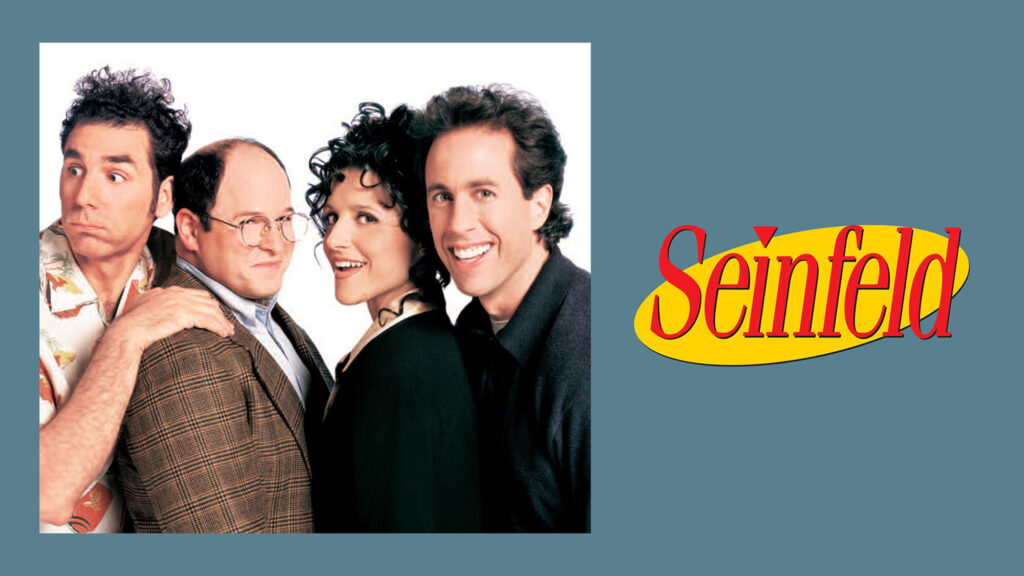
Seinfeld
Seinfeld is inseparable from New York in tone, most of the series was filmed in Los Angeles. The series used real New York locations for key establishing shots.