
Jason Alexander (born 23 September 1959) is an American actor, comedian, singer, theatre director and producer best known for portraying George Costanza in Seinfeld (1989–1998). His other work includes Pretty Woman (1990), Duckman (1994–1997), Dunston Checks In (1996), The Hunchback of Notre Dame (1996), Shallow Hal (2001), Hachi: A Dog’s Tale (2009) and the television series Young Sheldon (2018–2020). Born in Newark, New Jersey, and raised in the suburban communities of Maplewood and Livingston, he studied theatre at Boston University before establishing himself on Broadway during the 1980s. He won a Tony Award for Jerome Robbins’ Broadway (1989) shortly before becoming internationally recognised through Seinfeld. Although his television career has been based primarily in Los Angeles, Alexander has maintained a substantial involvement in New York theatre, returning to Broadway both as a performer and director. His work has also taken him to filming locations in California, North Carolina, Rhode Island, Britain and other parts of the United States.
Jay Scott Greenspan was born in Newark, the largest city in New Jersey, to Alexander B. Greenspan and Ruth Minnie Simon. His father worked as an accounting manager, while his mother was a nurse and healthcare administrator. The family was Jewish, and Alexander grew up within the established Jewish communities of suburban Essex County, west of New York City. His childhood was spent principally in Maplewood and Livingston, two neighbouring residential communities connected to Manhattan by commuter roads and railway services. During the 1960s and 1970s, both towns attracted families working in the professional and commercial sectors of the New York metropolitan area. Alexander was exposed to theatre and entertainment from an early age, although neither parent worked professionally in the performing arts. His interest initially centred on magic rather than acting, and he spent considerable time learning tricks and developing routines that he could perform for friends and family.
As a child, Alexander hoped to become a professional magician. He attended a magic camp and studied sleight-of-hand techniques, but eventually became frustrated by the physical demands of close-up card manipulation. He later recalled being advised that his relatively small hands would make certain techniques particularly difficult. His growing interest in theatre offered an alternative way of creating illusions for an audience, using characters, costumes and dramatic situations instead of playing cards and concealed objects. He began participating in school productions and gradually developed a particular enthusiasm for musical theatre. Alexander attended Livingston High School, where he performed in theatrical productions and completed his education in 1977. The school, situated in the township where his family lived, provided opportunities for singing, acting and stage performance, allowing him to develop interests that would subsequently become central to his professional career. Although he was already interested in comedy, his principal ambition at this stage was to become a serious stage actor.
Following graduation, Alexander enrolled at Boston University in Massachusetts, studying theatre at its College of Fine Arts. The university’s principal campus extends along Commonwealth Avenue beside the Charles River, and its theatre programme offered training in acting, voice, movement and stage production. Alexander initially concentrated on classical drama, particularly Shakespeare, but encountered teachers who encouraged him to explore comedy and character acting. His relatively short stature and appearance did not fit the conventional expectations associated with some classical leading roles, although his vocal and physical abilities made him particularly suitable for musical theatre. He remained at Boston University for approximately three years before leaving to accept professional employment in New York City. The decision marked an important transition from academic training to an industry in which Broadway, Off-Broadway and commercial television offered different opportunities for young performers. Boston University subsequently awarded him an honorary degree in 1995, recognising his achievements in theatre and television.
Alexander’s first feature film appearance came in The Burning (1981), a low-budget horror film directed by Tony Maylam. He played Dave, one of a group of young people staying at a summer camp where a former caretaker begins attacking the campers. The production was filmed during August and September 1980 in western New York State, particularly around Buffalo and North Tonawanda. Rather than construct a fictional campsite in a studio, the filmmakers used existing recreational camps and surrounding woodland. Locations included Camp Stonehaven near Ransomville in Niagara County and Camp Scouthaven near Freedom in Cattaraugus County. The buildings, cabins and lakeside areas provided the principal environments for the story, with actors frequently wearing their own clothes during filming. Alexander appeared alongside several other young performers who subsequently established careers in film and television, including Holly Hunter and Fisher Stevens. The Burning received a limited theatrical release but later developed a following among horror enthusiasts, becoming an unusual early entry in the career of an actor subsequently associated primarily with television comedy.
His professional breakthrough in theatre came with Stephen Sondheim’s Merrily We Roll Along (1981), directed by Harold Prince. Alexander originated the role of Joe Josephson in the musical, which follows a group of friends whose professional and personal relationships are presented in reverse chronological order. The production opened at the Alvin Theatre on West 52nd Street in Manhattan, subsequently renamed the Neil Simon Theatre. Despite considerable anticipation surrounding a new collaboration between Sondheim and Prince, the musical received largely negative reviews and closed after only sixteen regular performances. Alexander nevertheless gained valuable experience working with established Broadway professionals and became involved with the city’s musical-theatre community. The production subsequently acquired a much stronger reputation through revised versions and later revivals, with the original cast recording remaining an important document of its early history.
He continued working on Broadway and Off-Broadway throughout the 1980s, appearing in Forbidden Broadway (1982), The Rink (1984) and Personals (1985–1986). The Rink, written by John Kander and Fred Ebb, starred Chita Rivera and Liza Minnelli and opened at the Martin Beck Theatre on West 45th Street, now known as the Al Hirschfeld Theatre. Alexander played several supporting characters, drawing on his abilities as a singer, dancer and comic performer. Personals was staged at the Minetta Lane Theatre in Greenwich Village, a smaller venue that offered opportunities for original musical comedy outside Broadway’s larger commercial productions. His most substantial dramatic role of the period came in Neil Simon’s Broadway Bound (1986), in which he played Stanley Jerome, the older brother of an aspiring comedy writer. The production opened at the Broadhurst Theatre at 235 West 44th Street in December 1986 and ran for nearly two years. Alexander appeared alongside Jonathan Silverman and Linda Lavin, portraying a character loosely inspired by Simon’s own experiences growing up in a Jewish family in Brooklyn during the 1940s. The role established him as a performer capable of combining comedy with more serious family drama.
His greatest theatrical success of the decade arrived with Jerome Robbins’ Broadway (1989), an elaborate musical revue celebrating the work of the influential American director and choreographer. The production brought together material from earlier Broadway shows including West Side Story, On the Town, The King and I and A Funny Thing Happened on the Way to the Forum. Alexander served as a central narrator and appeared in several different musical sequences, helping connect the material into a unified theatrical production. He also contributed to the revue’s narrative continuity. The show opened at the Imperial Theatre at 249 West 45th Street in February 1989, featuring a large cast and extensive choreography developed under Robbins’s supervision. Its demanding schedule required performers who could move comfortably between acting, singing and dancing, allowing Alexander to use the full range of his musical-theatre training.
Jerome Robbins’ Broadway became a major critical success and received six Tony Awards, including Best Musical. Alexander won Best Actor in a Musical, earning one of Broadway’s highest individual honours just before his television career transformed his public image. He also received the Drama Desk Award for Outstanding Actor in a Musical. The achievement was particularly significant because he had spent years developing a professional identity within theatre, long before audiences became familiar with George Costanza. Although television would eventually occupy much of his working life, Alexander continued regarding himself as a stage performer, returning to Broadway and regional theatres throughout the following decades.
During the same period, Alexander accepted occasional film and television assignments. He appeared in the television comedy E/R (1984–1985), which was set in a fictional hospital environment, and Everything’s Relative (1987), a short-lived sitcom in which he played Julian Beeby. He also became a familiar face in American advertising, appearing in commercials for companies including McDonald’s, Hershey’s and Levi’s. One of his most recognisable advertisements was a musical commercial for the McDonald’s McDLT hamburger, which involved an elaborate dance sequence and drew directly on his Broadway experience. These assignments provided regular employment while he continued appearing in theatrical productions, but they did not establish him as a television star. That changed when Jerry Seinfeld and Larry David began developing a sitcom about a fictional version of Seinfeld’s own life as a New York stand-up comedian.
Alexander was cast as George Costanza in Seinfeld, which premiered on NBC in July 1989 under the title The Seinfeld Chronicles. George was presented as Jerry’s childhood friend, a frequently unemployed and socially insecure man whose dishonesty, selfishness and elaborate attempts to avoid embarrassment became central to the series. The character drew heavily on the personality and experiences of Larry David, who co-created the programme and served as one of its principal writers. Alexander initially approached George through a relatively conventional comic performance, but gradually recognised that David’s own behaviour provided an unusually direct model for the character. His portrayal became increasingly distinctive, incorporating rapid changes of emotion, elaborate gestures and a willingness to make George thoroughly unpleasant without attempting to turn him into a sympathetic television hero. The ensemble also included Julia Louis-Dreyfus as Elaine Benes and Michael Richards as Cosmo Kramer, with the four characters occupying a recognisable but exaggerated version of everyday New York life.
Although Seinfeld was set almost entirely in New York City, the production was based in Los Angeles. The pilot was filmed at Ren-Mar Studios, 846 North Cahuenga Boulevard in Hollywood, before regular production moved to CBS Studio Center at 4024 Radford Avenue in Studio City. The studio provided permanent sets for Jerry’s apartment, Monk’s Café and numerous other interiors, allowing the programme to be recorded before a live audience. As the series became more successful, its production occupied larger soundstages, with additional sets constructed for offices, restaurants and the homes of recurring characters. Alexander spent much of the 1990s working within these Los Angeles studio environments, despite portraying a character whose personal and professional life was closely associated with Manhattan.
The fictional New York setting was established partly through exterior photography of actual buildings and streets. Tom’s Restaurant at 2880 Broadway, near West 112th Street in Morningside Heights, provided the familiar exterior of Monk’s Café, where George regularly met Jerry, Elaine and Kramer. The restaurant interiors, however, were constructed at CBS Studio Center, and Alexander’s scenes at the fictional café were generally filmed there. Jerry’s apartment building was represented externally by a property at 757 South New Hampshire Avenue in the Koreatown district of Los Angeles, rather than by an actual Upper West Side residence. The building shown as George’s parents’ home was at 22-37 37th Street in Astoria, Queens. Its exterior became familiar during storylines involving Frank and Estelle Costanza, played by Jerry Stiller and Estelle Harris, but the domestic interiors were again photographed on studio sets.
George’s employment with the New York Yankees introduced another important geographical connection. During several seasons, he worked within the baseball organisation, bringing him into fictional contact with team owner George Steinbrenner. The real Yankee Stadium at East 161st Street and River Avenue in the Bronx appeared in exterior footage, while the offices and corridors where Alexander performed were constructed in Los Angeles. Larry David supplied the voice of Steinbrenner, who was generally shown from behind. The arrangement created one of the series’ most recognisable recurring jokes without requiring the actors to film regularly inside the actual stadium. Other New York exteriors included commercial buildings, hotels and streets around Manhattan, but the distinction between establishing photography and principal studio filming remained consistent throughout the programme.
Seinfeld gradually developed into one of the most successful American television comedies of the 1990s. Episodes including The Contest (1992), The Opposite (1994), The Marine Biologist (1994), The Soup Nazi (1995) and The Summer of George (1997) gave Alexander opportunities to explore different aspects of George’s character. The Marine Biologist became particularly associated with his acting ability because its concluding monologue was rewritten shortly before filming, requiring him to learn a lengthy and complicated passage with relatively little preparation. The Opposite presented George’s decision to abandon his usual instincts and deliberately act against his own judgement, temporarily transforming his fortunes. These episodes contributed to George becoming one of the defining characters of American situation comedy, influencing later television portrayals of flawed, self-defeating protagonists.
The series ran for nine seasons and 180 episodes before concluding in May 1998. Alexander received seven consecutive Primetime Emmy Award nominations for Outstanding Supporting Actor in a Comedy Series but never won in that category. He did receive the Screen Actors Guild Award for Outstanding Performance by a Male Actor in a Comedy Series in 1995, along with ensemble awards shared with the other principal performers. The success also transformed his professional and financial circumstances, enabling him to accept acting roles more selectively and pursue directing and theatrical projects. Although he had been an established Broadway performer before joining the programme, international audiences increasingly identified him with George Costanza, a character whose unsuccessful ambitions and social anxieties contrasted sharply with Alexander’s own professional achievements.
While Seinfeld was developing its audience, Alexander appeared in Pretty Woman (1990), directed by Garry Marshall and starring Richard Gere and Julia Roberts. He played Philip Stuckey, a lawyer and business associate of wealthy entrepreneur Edward Lewis, whose behaviour towards Vivian Ward becomes increasingly threatening. The film was shot primarily in Los Angeles County during the second half of 1989, making extensive use of Beverly Hills, Hollywood and downtown Los Angeles. One of the principal locations was the Beverly Wilshire hotel at 9500 Wilshire Boulevard, where Edward and Vivian stay during their relationship. The hotel’s exterior and lobby were used for filming, while additional interiors were constructed in studio facilities. Alexander’s character was associated with the professional and social environments surrounding Gere’s businessman, including office buildings and exclusive events in Beverly Hills.
An important Pretty Woman scene involving Alexander was filmed at the Los Angeles Equestrian Center at 480 Riverside Drive in Burbank. The property represented the polo grounds where Philip Stuckey encounters Vivian and begins questioning her relationship with Edward. The actual equestrian centre provided the outdoor playing field, spectator areas and surrounding facilities, rather than the filmmakers constructing a fictional polo venue. Stuckey’s business environment was also established through photography of the Bank of America Plaza at 333 South Hope Street in downtown Los Angeles, whose modern office architecture represented the corporate world in which Edward and his associates operate. Pretty Woman was released in March 1990 and became one of the most commercially successful romantic comedies of the decade. Alexander’s performance introduced him to cinema audiences who might not yet have discovered Seinfeld, although Stuckey’s unpleasant behaviour made him a considerably different character from the roles he had played in Broadway musicals.
His other early film appearances included Jacob’s Ladder (1990), directed by Adrian Lyne and starring Tim Robbins, and Coneheads (1993), based on the recurring Saturday Night Live sketches created by Dan Aykroyd and other performers. He also appeared in The Paper (1994), directed by Ron Howard and set within a fictional New York newspaper. The film was shot primarily in New York City, using actual commercial buildings, printing facilities and city streets alongside constructed newsroom interiors. These projects offered supporting roles within ensemble productions, allowing Alexander to continue film acting between the demanding recording schedules of Seinfeld. He also accepted smaller independent films and television guest appearances, including an episode of Dream On for which he received a Primetime Emmy nomination in 1994.
Alexander made his feature directorial debut with For Better or Worse (1995), a romantic comedy written by Jeff Nathanson and starring Alexander alongside James Woods and Lolita Davidovich. The story follows a man whose romantic and professional difficulties become entangled with a complicated scheme involving his brother. Principal filming was conducted in Los Angeles County, where the production used residential and commercial locations associated with contemporary American urban life. Alexander directed while also portraying the leading character, giving him practical experience coordinating performances, camera movements and the overall production schedule. The film received only a limited theatrical release and did not achieve substantial commercial success, but the experience encouraged him to continue developing work behind the camera. His second feature as director, Just Looking (1999), was considerably different in tone, presenting a coming-of-age story set in New York during the 1950s.
Just Looking followed a teenage boy from the Bronx who spends the summer with relatives in Queens while becoming increasingly curious about adult relationships. The production was filmed in New York City, particularly around Dongan Hills on Staten Island, where older residential streets and houses could represent the mid-twentieth-century setting. Rather than photograph a contemporary urban comedy, Alexander worked with historic vehicles, costumes and properties designed to recreate an earlier period of New York life. The cast included Patti LuPone, Gretchen Mol and Ryan Merriman, with the screenplay written by Marshall Karp. The film premiered at the Hamptons International Film Festival in October 1999 and subsequently received a limited theatrical release. Its New York production was particularly significant for Alexander because it returned him professionally to the metropolitan region where he had grown up and established his theatrical career.
During the middle of the 1990s, Alexander also became known for voice acting. He played Eric Tiberius Duckman in Duckman (1994–1997), an adult animated television comedy based on characters created by Everett Peck. Duckman was a private detective whose vulgar behaviour and disastrous family relationships provided the basis for the series’ satire. Produced by Klasky Csupo in Los Angeles, the programme used conventional animation rather than live-action filming, requiring Alexander to develop the character principally through vocal performance. He appeared in all seventy episodes, often recording material alongside performers including Gregg Berger and Nancy Travis. The series developed a cult following for its unusual combination of crude humour, social commentary and surreal situations, establishing another distinctive role outside George Costanza.
A major animated feature followed with Disney’s The Hunchback of Notre Dame (1996), in which Alexander provided the voice of Hugo, one of the three gargoyles living in the bell tower of Notre-Dame Cathedral in Paris. The film was produced by Walt Disney Feature Animation, with principal animation work carried out in the United States and France. Alexander recorded his dialogue and musical performances in studio facilities, including the song A Guy Like You, performed with other members of the voice cast. Although the story is set in medieval Paris and depicts recognisable elements of the cathedral, Alexander was not physically filmed at Notre-Dame, and the animated environments were created by artists rather than photographed on location. The role drew on his musical-theatre background, particularly his ability to combine singing with rapid comic dialogue. He subsequently continued providing voices for animated television and film productions, including Aladdin-related Disney projects and numerous children’s programmes.
His leading role in Dunston Checks In (1996), directed by Ken Kwapis, brought him into a larger family comedy alongside Faye Dunaway, Rupert Everett and a trained orangutan named Dunston. Alexander played Robert Grant, the manager of a luxurious New York hotel whose carefully organised workplace is disrupted by the arrival of an animal trained to assist a jewel thief. Although the film is set in Manhattan, principal photography was divided between Los Angeles and London. The former Bullocks Wilshire department store at 3050 Wilshire Boulevard in Los Angeles provided important exterior and interior settings for the fictional Majestic Hotel. Designed in the Art Deco style and opened in 1929, the building had previously been one of Southern California’s most prestigious department stores before closing in the early 1990s. Its elaborate public interiors, staircases and decorative features were suitable for representing a large luxury hotel.
Additional Dunston Checks In interiors were filmed at The Dorchester on Park Lane in London, where the production incorporated actual facilities of the historic luxury hotel. Opened in 1931, The Dorchester provided a different architectural environment from Bullocks Wilshire, but careful editing and set dressing allowed the two buildings to represent a single fictional property. The production schedule was arranged around Alexander’s Seinfeld commitments, with substantial Los Angeles work completed while he was still involved in the television series and further filming conducted during his summer hiatus. His role required frequent interaction with child actors and a trained animal, adding technical demands that differed considerably from the studio sitcom environment where he spent most of the year. The film was released in January 1996 and became another recognisable family-oriented role during the height of his television popularity.
Following the conclusion of Seinfeld, Alexander returned more frequently to theatre. One of his important performances came in the touring production of Mel Brooks’s musical The Producers, in which he played Max Bialystock opposite Martin Short as Leo Bloom. The two performers joined the American national tour in April 2003, appearing first in San Francisco before undertaking an extended engagement at the Pantages Theatre on Hollywood Boulevard in Los Angeles. The production allowed Alexander to return to large-scale musical comedy, performing alongside another actor with substantial experience in physical humour and character comedy. The Pantages, a historic theatre opened in 1930 and long associated with Hollywood entertainment, became an important professional venue during this period. He continued touring with the production until January 2004, adding another substantial musical-theatre role to a career increasingly defined by television.
His other film work during the early 2000s included Shallow Hal (2001), directed by Peter and Bobby Farrelly and starring Jack Black and Gwyneth Paltrow. Alexander played Mauricio Wilson, the best friend of Black’s character Hal Larson, whose obsession with women’s physical appearance becomes central to the comedy. Principal photography took place during the spring of 2001, particularly around Charlotte, North Carolina, where numerous actual buildings and businesses provided locations for the fictional contemporary city. The Bank of America Corporate Center at 100 North Tryon Street represented the headquarters of the investment company where the principal characters work, while other scenes were filmed around the neighbouring financial district and Latta Arcade.
Shallow Hal also used the former Hotel Concord at 14 North Union Street in Concord, approximately thirty kilometres northeast of Charlotte, as the exterior of Hal’s apartment building. Other Charlotte locations included Freedom Park, commercial properties around Tryon Street and several local restaurants. A particularly identifiable scene involving Alexander’s character was filmed on Hempstead Place, where Mauricio reveals a personal physical condition to Hal during an encounter on a residential street. Additional outdoor photography took place at Wachusett Mountain in Princeton, Massachusetts, representing the mountain resort visited by the characters. The production made extensive use of actual North Carolina locations rather than constructing the entire story within Hollywood studios, providing Alexander with another substantial period of location filming away from Los Angeles.
His later film appearances included Hachi: A Dog’s Tale (2009), directed by Lasse Hallström and starring Richard Gere. Inspired by the true story of the Japanese Akita dog Hachikō, the American adaptation follows a dog that continues waiting at a railway station after the death of its owner. Alexander played Carl, a railway employee who becomes familiar with the animal’s repeated visits. Although the original events took place at Shibuya Station in Tokyo, the American production was filmed primarily in Rhode Island. The historic railway station at 1 Depot Square in Woonsocket provided the principal setting, with surrounding streets and buildings incorporated into the fictional community. The station, constructed in 1882 by the Providence and Worcester Railroad, had ceased regular passenger service decades before filming but retained much of its historic appearance.
Additional Hachi locations included Bristol, Rhode Island, the University of Rhode Island campus in Kingston and the Columbus Theatre in Providence. The filmmakers used existing streets and railway infrastructure to create a setting that could accommodate scenes taking place over several years. Alexander’s character appeared principally within the railway environment, where the dog’s repeated presence becomes familiar to station employees and passengers. Following the film’s release, the connection with the location was commemorated through a statue of Hachikō installed outside the former Woonsocket station in 2012. The production therefore created a direct relationship between an American historic building and a story originally associated with Japan, with Alexander among the performers appearing at the actual Rhode Island location.
His involvement in theatre extended beyond acting. In 2007, Alexander became artistic director of Reprise Theatre Company, a Los Angeles organisation devoted to presenting revivals of American musicals. The company was associated particularly with the Freud Playhouse at the University of California, Los Angeles, where it had staged productions since the late 1990s. Alexander sought to expand the organisation’s repertoire and encourage greater diversity in casting and programming, moving beyond relatively conventional concert-style revivals. Under his leadership, Reprise produced works including Once on This Island, I Love My Wife, The Fantasticks and Sunday in the Park with George. He also directed and revised productions, drawing on his earlier experience with Stephen Sondheim and Jerome Robbins. The company eventually suspended operations because of financial difficulties in 2012 and formally closed the following year, but Alexander’s involvement established him as an important figure within the Los Angeles theatre community beyond his work as a performer.
He continued directing stage productions elsewhere in Southern California, including work at the Geffen Playhouse in Westwood, the Pasadena Playhouse and the Odyssey Theatre in Los Angeles. At the Geffen, he directed Stephen Belber’s The God of Hell, while later productions included Native Gardens and revivals of familiar American plays and musicals. These assignments allowed him to work regularly in the theatres of metropolitan Los Angeles, where he had established his family home during the Seinfeld years. His work also included television directing, with credits on programmes including Seinfeld and other American comedy series. Although Alexander remained principally recognised as an actor, directing gradually became another substantial part of his professional identity, allowing him to influence productions through staging, casting and interpretation rather than appearing exclusively in front of an audience.
His television acting continued through guest appearances and shorter series. He played himself in several episodes of Larry David’s Curb Your Enthusiasm, particularly during the programme’s early seasons and the 2009 storyline involving a fictional Seinfeld reunion. The series was produced primarily in Los Angeles, combining actual residential and commercial locations with studio interiors. Alexander’s appearances allowed him to parody aspects of his public reputation and his relationship with David, often presenting an exaggerated version of himself. He also appeared in programmes including Criminal Minds, Community, Two and a Half Men and The Marvelous Mrs. Maisel. These roles varied considerably in scale, reflecting his preference for projects that offered unusual characters or opportunities to work with performers and directors he admired.
One of his longer-running later television roles came in Young Sheldon (2018–2020), the CBS comedy-drama about the childhood of Sheldon Cooper from The Big Bang Theory. Alexander played Gene Lundy, an enthusiastic school drama teacher whose ambitions frequently conflict with the interests and personalities of his students. The story takes place in East Texas during the late 1980s and early 1990s, but the programme was produced principally in Southern California. Studio facilities and suburban streets around Los Angeles represented the fictional community of Medford, Texas, allowing Alexander to work in an environment familiar from his earlier television career. The character drew on his extensive knowledge of school theatre, musicals and enthusiastic amateur performers, giving him an opportunity to combine personal experience with comedy. The role also introduced him to a younger television audience whose familiarity with Seinfeld came primarily through streaming rather than its original broadcasts.
His later work included the sitcom Hit the Road (2017), which he co-created and starred in as Ken Swallow, the father of a family attempting to establish a musical career while travelling across the United States. The series was produced for the Audience Network and drew partly on Alexander’s experiences of family life, music and the entertainment industry. Although the story involved an extended American road trip, the production relied on a combination of studio facilities and selected outdoor locations rather than filming continuously across the country. The programme ran for one season and provided Alexander with another opportunity to develop a project as a writer, producer and leading performer. He continued appearing in other comedy series while taking on more voice-acting assignments, including the role of Sy Borgman in the animated series Harley Quinn and characters in Star Trek: Prodigy.
His return to Broadway as a performer came in Fish in the Dark (2015), a comedy written by Larry David about a family struggling with the death of an elderly relative. The production opened at the Cort Theatre, now the James Earl Jones Theatre, at 138 West 48th Street in Manhattan in March 2015. David initially played Norman Drexel, the central character, before Alexander replaced him in June. The change reunited two performers whose professional relationship had begun nearly thirty years earlier, but in a very different theatrical environment from the television studios where Seinfeld had been produced. Alexander appeared alongside Glenne Headly and other members of the ensemble until the production closed in August. His return to Broadway allowed him to work with David’s distinctive dialogue before a live audience, rather than through the carefully rehearsed and edited performances associated with television.
In 2023, Alexander made his Broadway debut as a director with The Cottage, a new comedy written by Sandy Rustin. The play, set in the English countryside during the 1920s, follows a group of characters whose romantic relationships become increasingly complicated by revelations and misunderstandings. The production opened at the Hayes Theater at 240 West 44th Street in Manhattan on 24 July 2023, following previews that began earlier in the month. Its cast included Eric McCormack, Laura Bell Bundy, Lilli Cooper, Alex Moffat and Nehal Joshi. Although the fictional story takes place in England, the production was staged entirely within the Broadway theatre, where an elaborate drawing-room set represented the principal location. The production required Alexander to coordinate physical comedy, entrances, exits and rapidly changing relationships among the cast, drawing directly on the stagecraft he had developed during his musical-theatre career.
The Cottage ran until October 2023, marking an important professional milestone more than forty years after his Broadway debut in Merrily We Roll Along. Unlike his earlier work as an actor, the production placed Alexander in responsibility for the interpretation and staging of the entire play. He had previously directed stage productions in Los Angeles, but this was his first Broadway assignment in that capacity. Its success strengthened his continuing connection with New York theatre, where he had established his professional career before moving to Hollywood. Around the same period, he launched Really? No, Really?, a podcast co-hosted with broadcaster Peter Tilden, exploring unusual questions, beliefs and aspects of contemporary life through interviews and discussions. The project allowed Alexander to continue developing material based on curiosity and conversation rather than conventional scripted comedy.
His later film work included The Electric State (2025), directed by Anthony and Joe Russo and starring Millie Bobby Brown and Chris Pratt. Adapted from Simon Stålenhag’s illustrated novel, the science-fiction adventure takes place in an alternative version of the 1990s in which robots have become part of everyday society. Alexander played Ted Finnster, the foster father of the principal character, and also performed the movements of his robot avatar, Wingman. Much of the production was filmed in and around Atlanta, Georgia, between October 2022 and February 2023, using extensive constructed sets and studio facilities. Additional photography took place in California and other locations, but the principal dramatic work was concentrated in Georgia.
For The Electric State, Alexander trained in movement and performance-capture techniques to portray Wingman physically rather than provide only a recorded voice. Working with the production’s movement specialists, he learned to develop the mechanical gestures and controlled physical behaviour required for the robot character. His experience in musical theatre and dance proved particularly useful, allowing him to perform scenes opposite Brown rather than leave the character entirely to animators. The film was released internationally on Netflix in March 2025, becoming one of his most substantial recent appearances in a large-scale production. He also continued working in animation, contributing voices to projects including Leo (2023), The Bad Guys: Breaking In (2025–2026) and Mating Season (2026).
Alexander’s personal life has remained closely associated with his wife, Daena Title, whom he met during the early stages of his career in New York. Their first date took place at Café Central, a Manhattan restaurant and entertainment-industry meeting place where Bruce Willis was working as a waiter and John Goodman as a bartender before either had established a major screen career. Alexander and Title began living together soon afterwards, and he eventually proposed through a billboard displayed in Times Square. They married on 31 May 1982, while Alexander was developing his Broadway career. Title initially worked as an actress and writer before becoming an expressionist painter, creating work concerned with representations of women, identity and contemporary social expectations. Her paintings have been exhibited in galleries across the United States, and her career has developed largely independently of Alexander’s television success.
The couple have two sons, Gabriel and Noah, both of whom subsequently became involved in the entertainment industry. Gabriel studied theatre at Yale University and developed a career as an actor and comedian, while Noah pursued voice acting and other creative work. Alexander and Title raised their family principally in the Los Angeles area, where his television and film commitments were concentrated throughout the 1990s and 2000s. Although he maintained regular professional connections with New York and occasionally spent extended periods there for stage productions, Southern California became the family’s principal residential base. He has generally avoided publicising detailed information about their private residence, distinguishing his family life from the characters and professional activities for which he is internationally recognised.
Outside entertainment, Alexander has participated in charitable organisations and fundraising events, particularly those supporting children, education and medical research. He has been involved with the Scleroderma Research Foundation and other organisations, occasionally participating in celebrity poker tournaments to raise money for charitable causes. He is also a keen poker player and has appeared in televised poker competitions, using the activity both recreationally and as a means of supporting fundraising campaigns. His public work has included support for cultural and humanitarian projects, while his professional activities have continued to involve teaching and mentoring younger performers interested in musical theatre and comedy.
Alexander’s achievements have been recognised through several major awards. In addition to his Tony Award for Jerome Robbins’ Broadway, he has received a Drama Desk Award, a Screen Actors Guild Award and a Daytime Emmy Award for his contribution to an original song in Brainwashed by Toons. He was inducted into the New Jersey Hall of Fame in 2018, recognising his connection with the state where he was born and raised. The honour brought his career back to Maplewood, Livingston and Newark, the communities associated with his early life before he moved to Boston and New York. Although George Costanza remains his most widely recognised role, his honours reflect a career extending across acting, singing, directing, writing and musical theatre.
Jason Alexander’s professional history has remained particularly closely connected with the New York metropolitan area and Los Angeles. Newark, Maplewood and Livingston were central to his childhood, while Boston University and the Broadway theatres of Manhattan provided his professional education and first major successes. The Alvin, Broadhurst and Imperial theatres established his stage career before the studios of Hollywood and Studio City became associated with Seinfeld. The series’ fictional New York locations, including Tom’s Restaurant and the Costanza family house in Astoria, provided an important geographical identity for his most famous character, even though the principal performances were recorded in California. His film work subsequently took him to the polo grounds of Burbank, the former Bullocks Wilshire department store in Los Angeles, The Dorchester in London, the commercial districts of Charlotte and the historic railway station in Woonsocket. His later return to the Hayes Theater as director of The Cottage continued a theatrical career that had begun more than four decades earlier, demonstrating that his work has extended considerably beyond the television character that made him internationally famous.
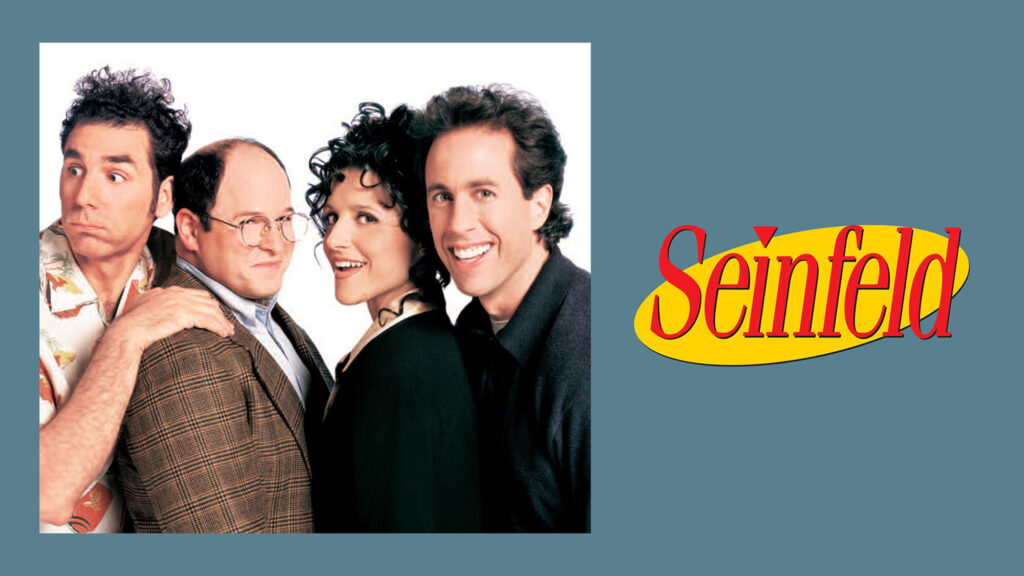
Seinfeld
Seinfeld is inseparable from New York in tone, most of the series was filmed in Los Angeles. The series used real New York locations for key establishing shots.