
Ivan Reitman was born on 27 October 1946 in Komárno, Czechoslovakia, now part of Slovakia, to Jewish parents Ladislav and Klara Reitman. His father, also known as Leslie, had owned a vinegar factory and participated in the resistance against the Nazi occupation, while his mother survived imprisonment at Auschwitz. Following the establishment of communist rule in Czechoslovakia, the family fled the country in 1950, travelling secretly aboard a barge to Austria before eventually reaching Canada. They settled in Toronto, Ontario, where relatives were already living. His father initially established a dry-cleaning business and subsequently operated a car wash, providing the family with a more stable life after the upheavals of the war and their departure from Europe. Reitman grew up in Toronto with his two sisters, Agi and Susan, and attended Oakwood Collegiate Institute. He developed an early interest in entertainment, organising puppet shows, performing at summer camps and playing music with a folk group called the Twintone Four. Although he had been born in Europe, Canada became his permanent home and the country in which he began his filmmaking career.
Reitman studied music at McMaster University in Hamilton, Ontario, graduating in 1969. His involvement in student theatre and filmmaking became more important than his formal musical education, and he took an active role in the university’s film club, organising screenings to raise money for student productions. Among his early projects was Orientation (1968), a short comedy about a student’s experiences on a university campus, filmed with fellow students at McMaster. The university brought him into contact with several young Canadian performers, including Eugene Levy, Andrea Martin and Martin Short. Reitman was particularly interested in bringing together writers, actors and technicians who could work independently of the established Canadian film industry. His early involvement with filmmaking also brought controversy when he helped produce the sexually explicit film Columbus of Sex (1969), which was banned by the Ontario Board of Censors. He was convicted under obscenity legislation, fined $300 and given a year’s probation. Nevertheless, he continued producing low-budget films and television projects, including the comedy programme Greed, which featured a young Dan Aykroyd.
After graduating, Reitman remained active in Toronto’s developing independent film community. His first feature as director, Foxy Lady (1971), featured Eugene Levy and Andrea Martin in early screen appearances, while Cannibal Girls (1973), a low-budget horror comedy, brought him his first significant success in international film distribution. The latter was filmed in Ontario and starred Levy and Martin as a couple whose holiday takes an unpleasant turn. Reitman sold the film to American International Pictures at the Cannes Film Festival, demonstrating an ability to develop commercially viable productions with limited resources. He also became associated with fellow Canadian filmmaker David Cronenberg and helped produce two of Cronenberg’s early horror films, Shivers (1975) and Rabid (1977). These productions were part of a period in which Toronto and Montreal were becoming increasingly important centres for independent filmmaking, with Canadian producers finding opportunities to finance and distribute genre films internationally.
Reitman’s activities were not confined to cinema. He became involved with magician Doug Henning, whom he had known at McMaster University, and helped produce The Magic Show, a Broadway musical that opened at the Cort Theatre on West 48th Street in Manhattan in May 1974. Featuring music and lyrics by Stephen Schwartz, the production ran until December 1978 and established Reitman as a successful theatrical producer. His work in New York also brought him into contact with the National Lampoon organisation, whose comedy magazine and stage productions were attracting a young audience. He produced The National Lampoon Show, an Off-Broadway revue featuring performers including John Belushi, Gilda Radner, Bill Murray and Harold Ramis. The relationships formed during this period would become central to his film career, particularly his collaborations with Murray and Ramis. In 1976, Reitman married French-Canadian actress Geneviève Robert, with whom he later had three children: Jason, Catherine and Caroline.
The success of the National Lampoon stage production led to Reitman’s involvement in National Lampoon’s Animal House (1978), a college comedy directed by John Landis and starring John Belushi. Reitman had hoped to direct the film himself, but Universal Pictures preferred to employ a director with more feature-film experience. Instead, he served as one of its producers. The film was shot largely in Eugene, Oregon, where the University of Oregon represented the fictional Faber College. The production also used fraternity houses on East 11th Avenue, the nearby Dexter Lake Club and the town of Cottage Grove, where the climactic parade was filmed along Main Street. The film became a major commercial success, giving Reitman greater influence within the American film industry and establishing several performers associated with National Lampoon as bankable cinema stars.
Following Animal House, Reitman directed Meatballs (1979), his first substantial commercial success as a filmmaker. The summer-camp comedy starred Bill Murray in his first leading film role and was made principally at Camp White Pine near Haliburton, Ontario. The production used the existing camp facilities, including cabins, dining areas and recreational grounds, while many campers and staff members appeared as extras. Its Canadian setting and relatively modest budget made it a continuation of Reitman’s earlier production methods, despite his growing involvement with Hollywood. He reunited with Murray for Stripes (1981), a military comedy also featuring Harold Ramis and John Candy. Filming took place at Fort Knox and in Louisville, Kentucky, with additional work in California. The production made extensive use of American military facilities, while some of the scenes depicting communist-controlled Eastern Europe were recreated at locations in Kentucky. Reitman also served as a producer of the animated anthology Heavy Metal (1981), contributing to another production with strong Canadian connections.
Reitman’s greatest commercial success came with Ghostbusters (1984), a supernatural comedy developed from an idea by Dan Aykroyd and written by Aykroyd and Harold Ramis. The film brought together Bill Murray, Aykroyd, Ramis and Ernie Hudson as a group of paranormal investigators operating from a disused New York fire station. Reitman worked closely with the writers to transform Aykroyd’s original, more elaborate concept into a story set in contemporary Manhattan. Principal photography began in New York in October 1983, with filming at the New York Public Library, Columbia University, the apartment building at 55 Central Park West and Hook & Ladder Company No. 8 on North Moore Street in Tribeca, which became the exterior of the Ghostbusters headquarters. Much of the interior filming was subsequently undertaken in Los Angeles and Burbank. The former Fire Station No. 23 at 225 East 5th Street in Los Angeles supplied the headquarters interiors, while the Millennium Biltmore Hotel doubled for the fictional Sedgewick Hotel. A large rooftop set was constructed at The Burbank Studios for the film’s climax, allowing Reitman to combine recognisable New York landmarks with elaborate studio effects. Ghostbusters became one of the highest-grossing films of 1984 and established Reitman as a major Hollywood director.
During the remainder of the 1980s, Reitman expanded his range while continuing to work with actors from his earlier comedies. He directed the romantic mystery Legal Eagles (1986), starring Robert Redford, Debra Winger and Daryl Hannah, before beginning a successful collaboration with Arnold Schwarzenegger. Twins (1988), in which Schwarzenegger appeared opposite Danny DeVito, marked a departure from the actor’s established action-film roles and became another substantial box-office success. Reitman subsequently returned to New York for Ghostbusters II (1989), reuniting much of the original cast for a sequel that again combined Manhattan locations with studio filming in California. His next project with Schwarzenegger, Kindergarten Cop (1990), took the production to Astoria, Oregon, where the historic John Jacob Astor Elementary School on Franklin Avenue was used for exterior scenes. The production spent approximately a month filming in the Oregon coastal town before continuing at Universal Studios in California, where the school interiors were recreated. Reitman followed this with Dave (1993), a political comedy starring Kevin Kline and Sigourney Weaver. Although the story takes place largely in Washington, D.C., much of the filming occurred in California, where detailed reproductions of the White House’s Oval Office, Cabinet Room and other interiors were constructed at Warner Bros. Studios in Burbank. The Los Angeles County Arboretum in Arcadia also provided exterior settings for the fictional presidential residence.
Reitman reunited Schwarzenegger and DeVito for Junior (1994), but his later productions increasingly involved different actors and genres. He directed Fathers’ Day (1997), starring Robin Williams and Billy Crystal, and Six Days, Seven Nights (1998), a romantic adventure featuring Harrison Ford and Anne Heche. The latter was filmed extensively on the Hawaiian island of Kauai, where the production spent approximately two months, with additional filming in Burbank and New York City. By this time, Reitman and his family had established a home in Montecito, near Santa Barbara, California. They moved to the area during the mid-1990s and acquired part of the historic El Mirador estate, a substantial property associated with the region’s earlier development as a residential retreat for wealthy American families. Reitman became involved in local charitable activities, particularly those supporting Cottage Hospital and the Santa Barbara International Film Festival. In 1998, he also established The Montecito Picture Company with former Universal Pictures chairman Tom Pollock, creating a production business that allowed him to develop films independently of his own directing commitments.
The Montecito Picture Company became the principal vehicle for much of Reitman’s subsequent producing work. Its projects included Road Trip (2000), Old School (2003) and EuroTrip (2004), while Reitman also produced films such as Space Jam (1996), Private Parts (1997) and the thriller Disturbia (2007). His own directing career continued with Evolution (2001), My Super Ex-Girlfriend (2006) and No Strings Attached (2011), the latter starring Natalie Portman and Ashton Kutcher. Although these films did not match the commercial success of his earlier comedies, Reitman remained an influential producer and maintained working relationships with several major American studios. His family also became increasingly involved in filmmaking. His son Jason Reitman established himself as a director with Thank You for Smoking (2005) and Juno (2007), while Ivan served as a producer on Jason’s Up in the Air (2009), starring George Clooney. The film received six Academy Award nominations, including Best Picture and Best Director. His daughter Catherine Reitman also pursued an acting and writing career, later creating and starring in the Canadian television comedy Workin’ Moms (2017–2023).
Despite having lived in California for much of his adult life, Reitman retained close ties to Toronto and the Canadian film industry. One of his most significant contributions outside filmmaking was his involvement in establishing a permanent home for the Toronto International Film Festival. His father had purchased Farb’s Car Wash at the corner of King and John Streets in downtown Toronto during the mid-1960s. Decades later, the family property became central to the development of TIFF Bell Lightbox, the festival’s purpose-built cinema and cultural complex. Reitman and his sisters, Agi Mandel and Susan Michaels, worked with The Daniels Corporation to donate the land for the project. The surrounding site was named Reitman Square in honour of their parents, Leslie and Clara Reitman, at a ceremony in September 2010 attended by Ivan and his son Jason. Located in Toronto’s Entertainment District, the complex became a permanent home for the festival, with cinemas, exhibition spaces and educational facilities. The project had particular significance for the Reitman family, transforming a property acquired through their parents’ business into an institution devoted to the industry in which Ivan had built his career. His contributions to Canadian film and culture were also recognised when he was appointed an Officer of the Order of Canada in 2009, receiving his investiture in September 2010. He had previously received a star on the Hollywood Walk of Fame in 1997, located at 7024 Hollywood Boulevard, and was inducted into Canada’s Walk of Fame in 2001.
Reitman’s final feature film as director was Draft Day (2014), a sports drama starring Kevin Costner as the general manager of the Cleveland Browns. Unlike many Hollywood films that recreate sporting events on studio sets, the production received extensive cooperation from the National Football League. Filming began during the actual 2013 NFL Draft at Radio City Music Hall in New York City before moving to Cleveland, Ohio. The production used the Browns’ facilities in Berea, FirstEnergy Stadium and several locations around Greater Cleveland. Case Western Reserve University’s Case Field was used to represent the University of Wisconsin’s football stadium, while other local buildings and businesses appeared throughout the film. Reitman subsequently continued producing rather than directing, remaining involved in projects including the 2016 Ghostbusters reboot and Ghostbusters: Afterlife (2021). The latter was directed by Jason Reitman and brought back several actors from the original films. Although set primarily in Oklahoma, the sequel was filmed largely in Alberta, Canada, returning the franchise to the country where Ivan had begun his career more than fifty years earlier.
Ivan Reitman died in his sleep at his home in Montecito, California, on 12 February 2022, aged 75. He was buried at Santa Barbara Cemetery in California. His final years had been spent working closely with Jason on Ghostbusters: Afterlife, which was released in November 2021, only three months before his death. Following his passing, the subsequent film Ghostbusters: Frozen Empire (2024) was dedicated to his memory. Reitman’s life had taken him from postwar Czechoslovakia to Toronto, Hamilton, New York and Hollywood, with his family’s former car wash in Toronto eventually becoming part of one of Canada’s most prominent film institutions.
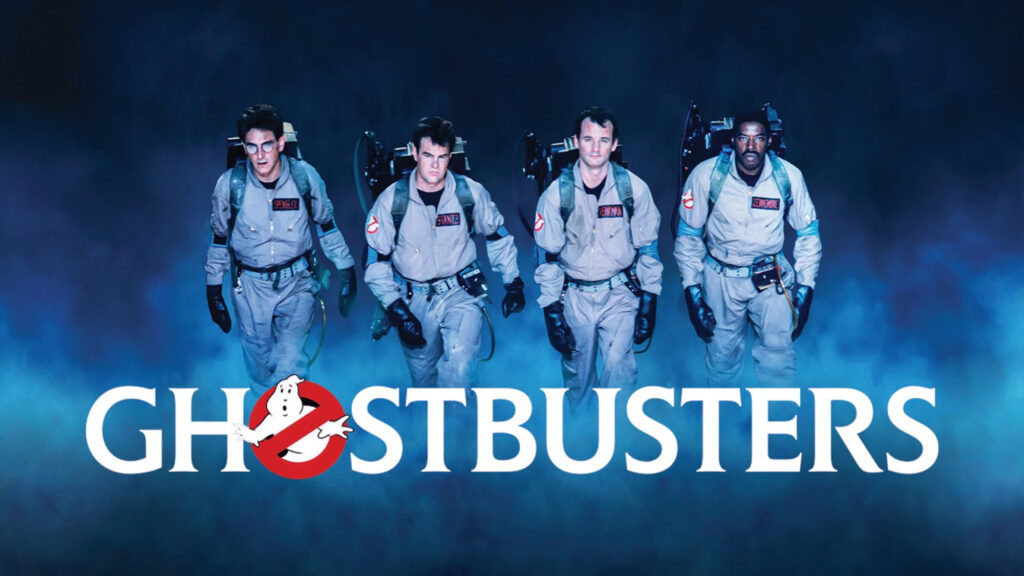
Ghostbusters
Ghostbusters is completely identified with New York, its locations were actually split between New York and Los Angeles in a very effective way.