
Don Siegel (26 October 1912 – 20 April 1991) was an American film director, producer and editor best known for Riot in Cell Block 11 (1954), Invasion of the Body Snatchers (1956), The Lineup (1958), The Killers (1964), Coogan’s Bluff (1968), Dirty Harry (1971), Charley Varrick (1973), The Shootist (1976) and Escape from Alcatraz (1979). Born in Chicago, he spent parts of his childhood in New York and New Jersey before studying in England and France. He began his Hollywood career at Warner Bros. in the 1930s, eventually becoming one of the most respected directors of American crime thrillers, Westerns and action films. His work frequently used actual streets, prisons, industrial buildings and historic properties rather than elaborate studio recreations, with particularly strong connections to Los Angeles, San Francisco, Nevada and the American Southwest. He is also remembered for his friendship and five-film collaboration with Clint Eastwood, whom he helped establish as a major Hollywood star and director.
Donald Siegel was born in Chicago, Illinois, into a Jewish family. His father, Samuel Siegel, was a businessman and accomplished mandolin player who had performed professionally, while his mother was involved in raising the family during a period of frequent relocations. In 1914, the Siegels moved to New York City, followed by a move to Lakewood, New Jersey, the following year. They returned to Chicago in 1919, where Donald attended the Theodor Herzl School, a Jewish educational institution. The family subsequently moved several times between Chicago and New York during the 1920s. His father’s business activities eventually took them to Europe, and in 1929 the family relocated to London, where Samuel had been employed to help introduce American business methods to a British company. Donald took advantage of the move to pursue higher education, enrolling at Jesus College, Cambridge, while also attending classes at the Royal Academy of Dramatic Art in London. He initially hoped to become an actor, but his interest gradually shifted towards the technical and creative aspects of theatrical production.
When the family moved to Paris, Siegel briefly studied painting at the École des Beaux-Arts. His European years exposed him to several different artistic traditions, although he did not establish a lasting career in either painting or acting. He also worked for a period as a drummer aboard passenger ships before returning to the United States. By 1934, he had arrived in Los Angeles, where he secured employment in the film library at Warner Bros. Studios in Burbank. The studio, situated at 4000 Warner Boulevard, had developed into one of Hollywood’s major production centres following the success of early sound films. Siegel initially handled photographic material and film reels, but gradually moved into editing and production work. He became an assistant editor and subsequently joined the studio’s montage department, which specialised in short sequences designed to communicate the passage of time, geographical movement or complicated events through rapidly assembled images.
During the late 1930s and early 1940s, Siegel became one of the principal figures in Warner Bros.’ montage department. His work appeared in productions including The Roaring Twenties (1939), Yankee Doodle Dandy (1942), Now, Voyager (1942), Gentleman Jim (1942) and Casablanca (1942). In the latter, he helped construct the opening sequence explaining the movement of refugees across Europe and North Africa during the Second World War. Rather than travelling to the countries represented, the filmmakers combined maps, archival images and specially photographed material within the Burbank studio complex. Siegel also worked as a second-unit director on major Warner productions, including Sergeant York (1941) and Passage to Marseille (1944). These assignments required him to organise action sequences and supplementary scenes while working within the schedules of larger productions. His experience in the editing rooms influenced the economical approach that became characteristic of his later films: he preferred to plan scenes carefully, minimise unnecessary coverage and leave relatively little material that could be radically rearranged during post-production.
In 1945, Siegel directed two short films, Star in the Night and Hitler Lives, both of which won Academy Awards. Star in the Night was a modern Christmas story set at an isolated roadside establishment, while Hitler Lives examined the continuing dangers of Nazi ideology following Germany’s defeat. Their success helped him move into feature directing, beginning with The Verdict (1946), a Victorian crime thriller starring Sydney Greenstreet and Peter Lorre. Although set in nineteenth-century London, the film was made within Warner Bros.’ California production facilities, using studio streets and interiors to represent the British capital. Siegel remained at Warner for several more years before becoming an independent director, working for several Hollywood companies rather than maintaining a permanent studio contract.
One of his final Warner assignments was Night Unto Night (1949), a drama starring Ronald Reagan and Swedish actress Viveca Lindfors. Siegel and Lindfors began a relationship during the production and married in 1949. Their son, Kristoffer, born in 1952, later became an actor and director under the professional name Kristoffer Tabori. The marriage ended in divorce in 1954. During the same period, Siegel directed The Big Steal (1949), a crime thriller starring Robert Mitchum and Jane Greer. The film was set in Mexico and included genuine Mexican locations, notably Tehuacán in the state of Puebla, Veracruz and Mexico City. The production also used California locations such as Corriganville in Simi Valley and Iverson Ranch in Chatsworth. The combination of Mexican streets, countryside and Californian studio facilities was typical of Hollywood’s attempts to create international settings during the period, although Siegel increasingly preferred actual locations whenever production circumstances allowed.
Throughout the early 1950s, he moved between Westerns, crime films, war dramas and television assignments. His productions included The Duel at Silver Creek (1952), China Venture (1953) and Private Hell 36 (1954), the latter involving actress and filmmaker Ida Lupino. He also travelled to Spain for Spanish Affair, an American-Spanish production starring Richard Kiley and Carmen Sevilla that was filmed at CEA Studios in Madrid. Although the film was not among his better-known works, it represented one of his relatively few European feature assignments after establishing himself in Hollywood. More significant was Riot in Cell Block 11 (1954), which brought him to Folsom State Prison in Represa, California, approximately 30 kilometres northeast of Sacramento. The film was produced by Walter Wanger, who had recently served a prison sentence and wanted to examine conditions within American correctional institutions.
Siegel filmed Riot in Cell Block 11 inside the functioning maximum-security prison rather than constructing a conventional Hollywood prison set. The production was permitted to use an empty two-storey cell block, with actual prisoners and correctional officers appearing as background performers. The prison’s original stone walls, barred cells, exercise areas and corridors provided the setting for the fictional uprising. Working inside an operating correctional facility required strict supervision and coordination with prison officials, particularly because several cast members had previously served prison sentences themselves. Actor Leo Gordon, who played one of the principal inmates, had spent five years in San Quentin State Prison for armed robbery, initially causing concern among the Folsom authorities. Siegel persuaded the prison administration to allow him to participate. The film also introduced a young Sam Peckinpah to professional filmmaking. Peckinpah worked as an assistant and dialogue coach, beginning a long association with Siegel and later developing his own career as a director. The production earned Siegel a Directors Guild of America nomination and attracted attention for its unusual degree of realism.
His next major success, Invasion of the Body Snatchers (1956), established him as an important director of science-fiction cinema. Adapted from Jack Finney’s novel, the film starred Kevin McCarthy and Dana Wynter as residents of a small California town whose neighbours are gradually replaced by emotionless duplicates. Siegel and producer Walter Wanger initially considered filming in Mill Valley, north of San Francisco, where Finney had drawn inspiration for the fictional community. In January 1955, they visited the town with screenwriter Daniel Mainwaring, but the costs of working there proved too high. Instead, Siegel constructed the fictional Santa Mira from several communities and neighbourhoods across Los Angeles County. Sierra Madre, east of Pasadena, provided the principal town centre, with Kersting Court and the surrounding streets appearing prominently. Additional scenes were filmed around Chatsworth, Glendale, Los Feliz and the Hollywood Hills, while interiors were constructed at the Allied Artists studio on Sunset Boulevard in East Hollywood.
The production made particularly effective use of the residential streets and hillside terrain of Los Angeles. The old Chatsworth railway station represented Santa Mira’s station, while the home of Wilma Lentz was filmed at 1635 Rancho Avenue in Glendale. A pursuit sequence involving McCarthy and Wynter used the steep public staircases around Westshire Drive in Beachwood Canyon, followed by scenes at the Bronson Caves in Griffith Park. The film’s famous final warning was photographed at the Mulholland Drive Viaduct in the Hollywood Hills, where McCarthy’s character desperately attempts to stop passing motorists. Principal photography took place during March and April 1955, with additional material filmed later after the studio requested a framing sequence. Although the production was comparatively inexpensive, its use of recognisable Californian streets and houses became central to its disturbing portrayal of ordinary suburban life. The film subsequently developed a reputation as one of the defining American science-fiction thrillers of the 1950s.
Siegel returned to location filmmaking in California with several further productions. The Lineup (1958), adapted from the San Francisco police television series, was filmed extensively in the city, using its waterfront, hotels, museums and steep streets. The production took advantage of actual locations including the U.S. Custom House at 555 Battery Street, the War Memorial Opera House on Van Ness Avenue, the Mark Hopkins Hotel on Nob Hill and the former Steinhart Aquarium in Golden Gate Park. One of its most historically important locations was Sutro Baths at Lands End, the enormous former public bathing complex built during the nineteenth century. By the time Siegel filmed there in 1957, parts of the building had been converted into an ice-skating rink. The production used its entrance, staircases, promenade and interior spaces for the film’s climactic confrontation. Sutro Baths was largely destroyed by fire in 1966, making The Lineup a valuable visual record of the complex before its disappearance. Siegel also staged a car chase on sections of the unfinished Embarcadero Freeway, preserving images of San Francisco during a period of major road construction.
The city would later become particularly important to his career through Dirty Harry, but The Lineup was already notable for its detailed use of San Francisco’s geography. Siegel’s subsequent Edge of Eternity (1959) took him to Arizona, where he filmed around Grand Canyon National Park, Kingman and the former mining community of Oatman. Its action sequences made use of the canyon’s steep terrain, isolated mining settlements and the Mojave County Courthouse in Kingman. He then directed Elvis Presley in Flaming Star (1960), a Western filmed partly at the former Janss Conejo Ranch in Thousand Oaks, California, with additional locations around Delle, Lonerock and Skull Valley in Utah. The ranchlands near Thousand Oaks had been used for numerous Westerns, but were gradually incorporated into residential development during the following decades. A road near Wildwood Regional Park was later named Flaming Star Avenue in recognition of the production’s local association. Siegel also directed Steve McQueen in the Second World War drama Hell Is for Heroes (1962), before moving increasingly towards contemporary crime stories.
One of his most important productions of the 1960s was The Killers (1964), adapted from Ernest Hemingway’s short story and starring Lee Marvin, Angie Dickinson, John Cassavetes and Ronald Reagan. The film was originally produced for NBC television, but was considered too violent for broadcast and released theatrically instead. Much of the production took place at Universal Studios in Universal City, with additional filming around Los Angeles County. Racing sequences were photographed at Riverside International Raceway, near Moreno Valley, while other locations included Mulholland Highway in Calabasas and residential streets in Toluca Lake. The film marked Reagan’s final theatrical acting role before entering politics and was also unusual for presenting him as a criminal antagonist. Siegel continued working in television during the period, directing episodes of The Twilight Zone and other series, while his feature career increasingly attracted attention from European critics associated with the French New Wave. François Truffaut and other writers recognised qualities in his economical approach that had frequently been overlooked by American reviewers.
His most important professional partnership began in 1967 when Universal executive Jennings Lang introduced him to Clint Eastwood, who had recently returned from making Sergio Leone’s Westerns in Spain and Italy. Their first film together was Coogan’s Bluff (1968), in which Eastwood played an Arizona deputy sheriff sent to New York City to collect a prisoner. Siegel and Eastwood initially met at the actor’s home in Carmel-by-the-Sea, on California’s Monterey Peninsula, and began discussing the project. The production subsequently used actual New York locations, most notably Fort Tryon Park in northern Manhattan, where the medieval architecture of The Cloisters provided the setting for an extended motorcycle chase. The museum, part of the Metropolitan Museum of Art, occupies a hilltop site overlooking the Hudson River and incorporates architectural elements from several European monasteries. Other Manhattan scenes used streets around Greenwich Village, the Lower East Side and Midtown, while the opening Arizona sequences were actually filmed in California’s Mojave Desert. Some interiors and supplementary streets were recreated on the Universal backlot. Coogan’s Bluff was the first of five films Siegel directed with Eastwood, establishing a collaboration that would continue for more than a decade.
Their second production, Two Mules for Sister Sara (1970), took them to Mexico. The Western, starring Eastwood and Shirley MacLaine, was set during the French intervention in Mexico in the nineteenth century. Principal photography began in February 1969 in the state of Morelos, particularly around Cocoyoc, Cuautla and Tlayacapan, with additional work at Estudios Churubusco in Mexico City. The production lasted approximately ten weeks and involved extensive outdoor filming in rural communities, mountainous countryside and locations adapted to resemble military installations. Several members of the cast and crew became ill during the shoot, and MacLaine temporarily returned to Los Angeles for medical treatment. The production brought Siegel into contact with Mexican cinematographer Gabriel Figueroa, whose extensive experience included collaborations with Luis Buñuel and Emilio Fernández. The film also employed music by Italian composer Ennio Morricone, who had previously worked with Eastwood on Leone’s Westerns.
Siegel and Eastwood returned to the American South for The Beguiled (1971), a psychological drama set during the Civil War. The production filmed in Louisiana, particularly at Ashland-Belle Helene Plantation near Geismar, between Baton Rouge and New Orleans. The large Greek Revival mansion, constructed during the nineteenth century, represented the isolated girls’ school where a wounded Union soldier is taken into care. The film used the property’s rooms, verandas and surrounding grounds, with additional interiors completed at Universal Studios in California. The Ashland-Belle Helene property had previously appeared in other Hollywood productions and later fell into serious disrepair. Siegel’s film is consequently an important record of the house during a period when it remained substantially intact. The Beguiled was a departure from his conventional action films, but its limited setting allowed him to concentrate on the relationships between the characters and the physical environment in which they were confined.
The same year, Siegel directed Dirty Harry (1971), the film most closely associated with his name. Eastwood played Inspector Harry Callahan, a San Francisco police detective pursuing a serial killer known as Scorpio. The project had initially been developed with other actors and directors, and early versions of the screenplay were set in New York. By the time Siegel and Eastwood became involved, San Francisco had been selected as the principal setting. Filming began in April 1971 and continued until June, using numerous actual locations throughout the city. The opening assassination was photographed from the Bank of America Building at 555 California Street, with the victim swimming in the rooftop pool of the Holiday Inn at 750 Kearny Street, now the Hilton San Francisco Financial District. Callahan’s police headquarters was represented by the Hall of Justice at 850 Bryant Street, while surrounding scenes incorporated City Hall, the streets of North Beach and the waterfront.
Several of Dirty Harry’s most recognisable sequences were filmed at locations that have since changed substantially. Scorpio’s rooftop surveillance scenes used buildings overlooking Washington Square and Saints Peter and Paul Church at 666 Filbert Street, while the pursuit through the narrow passages of Krausgrill Place and Medau Place incorporated the residential streets north of the square. The ransom-delivery sequence took Eastwood’s character through Forest Hill Muni station, Dolores Park and the disused Fort Mason railway tunnel before arriving at the enormous concrete cross on Mount Davidson. The confrontation at Kezar Stadium was filmed shortly after the San Francisco 49ers had played their final season there before moving to Candlestick Park. Siegel and Eastwood had attended a football game at the stadium and recognised that its largely empty stands would provide an appropriate setting. The original stadium was substantially demolished and rebuilt in 1989. The film’s concluding confrontation was photographed at Hutchinson’s Rock Quarry in Larkspur, across the Golden Gate in Marin County. The former industrial site was subsequently redeveloped, leaving little of the original quarry environment visible today.
Dirty Harry became a major commercial success, although its portrayal of police violence and the legal system generated considerable controversy. It also strengthened Siegel’s relationship with Eastwood, who was beginning his own directing career. Siegel appeared as a bartender named Murphy in Eastwood’s directorial debut, Play Misty for Me (1971), filmed around Carmel-by-the-Sea and Monterey. His scenes were photographed at The Sardine Factory restaurant on Wave Street in Monterey, where Eastwood’s character meets a woman who subsequently becomes dangerously obsessed with him. The cameo reversed their established working relationship, placing Siegel in front of the camera while Eastwood directed. Eastwood later credited Siegel with teaching him the importance of preparation, economy and decisive filmmaking, principles that became characteristic of his own work as a director.
Siegel’s next major crime film was Charley Varrick (1973), starring Walter Matthau as a small-time bank robber who accidentally steals money belonging to organised crime. Although the fictional setting includes New Mexico, the production was filmed principally in Nevada during the autumn of 1972. The historic town of Genoa, situated near the eastern slopes of the Sierra Nevada, represented the fictional Tres Cruces, with the former Douglas County courthouse used as the bank. The surrounding roads, including Genoa Lane and Kingsbury Grade, provided locations for the getaway scenes. Other filming took place in Minden, Gardnerville, Dayton and Reno. Arlington Towers at 100 North Arlington Avenue in Reno represented a high-rise apartment building, while a trailer park near the Carson River in Dayton supplied another important location. The film also made use of the Mustang area east of Reno, including an automobile wrecking yard that became the setting for the final aircraft sequence. Siegel employed local residents and people associated with the area’s businesses as extras, continuing the practice he had developed during his earlier location productions.
His career briefly returned him to Britain with The Black Windmill (1974), a spy thriller starring Michael Caine and Donald Pleasence. Set largely in London, the film was photographed at numerous actual locations across the capital, including Covent Garden, Hampstead and Shepherd’s Bush. Caine’s character was filmed travelling along Cleve Road in West Hampstead and visiting a property at 80 South Hill Park Gardens. Other scenes used Garrick Street and Rose Street in Covent Garden, including the exterior of the historic Lamb & Flag pub. Underground railway sequences were filmed at Shepherd’s Bush and Aldwych stations, while further work took place at Twickenham Studios in west London. The film’s title referred to an actual windmill location in the South Downs: the Jack and Jill Windmills at Clayton, near Burgess Hill in West Sussex. The production also used Ramsgate Hoverport at Pegwell Bay in Kent, which had become an important terminal for cross-Channel hovercraft services during the 1960s and 1970s. For Siegel, the film represented a professional return to the country where he had studied theatre more than forty years earlier.
In 1976, he directed John Wayne in The Shootist, the actor’s final feature film. The story follows an ageing gunfighter suffering from terminal cancer who spends his final days in Carson City, Nevada, at the beginning of the twentieth century. Wayne, whose own medical history included treatment for lung cancer, was particularly interested in the role. Siegel filmed significant exterior material in Carson City, where the Krebs-Peterson House at 500 Mountain Street represented the boarding house operated by Lauren Bacall’s character. The historic residence was built in 1914 and stands within Carson City’s older residential district. Additional scenes were filmed at Washoe Lake State Park and Jack’s Valley, where the open countryside supplied the setting for horse-drawn journeys. However, many of the town’s commercial streets and interiors were recreated at Warner Bros. Studios in Burbank, particularly on the studio’s former Laramie Street Western set. The production combined actual Nevada architecture with carefully constructed period environments, allowing the filmmakers to recreate Carson City in 1901 without extensively altering the modern town. Wayne died in 1979, three years after the film’s release.
Siegel returned to international production with Telefon (1977), a Cold War thriller starring Charles Bronson and Lee Remick. The film concerns Soviet agents operating within the United States, but several sequences representing the Soviet Union were filmed in Helsinki, Finland. The city’s Senate Square, the harbour district of Katajanokka and surrounding streets stood in for Moscow and Leningrad, while other scenes were filmed in Great Falls, Montana, and San Francisco. The Hyatt Regency hotel at 5 Embarcadero Center appeared among the American locations. Helsinki was frequently used by Western productions requiring a Soviet setting because its nineteenth-century architecture included buildings influenced by Russian imperial design, while Finland remained accessible to American film crews. The production was one of Siegel’s few later films to involve substantial work outside North America.
His final collaboration with Eastwood was Escape from Alcatraz (1979), based on the attempted escape of Frank Morris and brothers John and Clarence Anglin from the notorious federal prison in San Francisco Bay in June 1962. Unlike many Hollywood prison dramas, which rely primarily on studio sets, Siegel obtained permission to film inside the actual Alcatraz prison, which had closed in 1963 and become part of the Golden Gate National Recreation Area. He had previously visited the island while researching Riot in Cell Block 11 and was familiar with its history. Principal photography began on 16 October 1978, with filming continuing on Alcatraz for approximately seven weeks before the production moved to Paramount Studios in Hollywood for additional interiors and technical work.
Preparing Alcatraz for filming required extensive restoration. The abandoned prison had deteriorated considerably since its closure, and the production spent approximately $500,000 repairing electrical systems, repainting certain areas and recreating the institution’s appearance during the early 1960s. The work was undertaken under the supervision of the National Park Service, which required the filmmakers to protect historic features and avoid permanently altering evidence of the island’s subsequent Native American occupation. Because Alcatraz was already open to visitors, the crew frequently worked at night to avoid disrupting public tours. Much of the filming took place inside the cellhouse, including the corridors, cells, dining hall and recreation areas associated with the actual escape. The production constructed replicas of the prisoners’ improvised equipment and altered certain areas temporarily to accommodate cameras and lighting. Escape from Alcatraz was a substantial commercial success and became the last film that Siegel and Eastwood made together.
During his later career, Siegel continued working with established actors while dealing with increasingly difficult production circumstances. Rough Cut (1980), a romantic crime comedy starring Burt Reynolds, Lesley-Anne Down and David Niven, was filmed at locations in Europe and the United States. The production experienced disagreements over its screenplay and editing, with several directors becoming involved at different stages before the film was completed. His final feature as director was Jinxed! (1982), starring Bette Midler, Ken Wahl and Rip Torn. The comedy was filmed primarily in Nevada and California, beginning in May 1981. Locations included the casino districts of Reno and Lake Tahoe, the Heavenly Valley ski resort area, Sand Harbor and the former mining settlement of Bodie in Mono County, California. The production also used studio facilities in Culver City.
Jinxed! reunited Siegel with Sam Peckinpah, whose career had suffered from repeated conflicts with producers and difficulties completing films. Siegel offered his former assistant approximately twelve days of second-unit directing work, giving Peckinpah an opportunity to return to a professional film production. The arrangement attracted attention within the industry and contributed to Peckinpah’s subsequent employment on his final feature, The Osterman Weekend (1983). Jinxed! itself was a troubled production, marked by disagreements between Siegel and members of the cast. He also clashed with the studio over the rejection of a musical score composed by Lalo Schifrin, who had worked with him on several earlier films. Siegel did not direct another theatrical feature after its release, although he continued taking an interest in filmmaking and occasionally appeared in small screen roles, including a cameo in John Landis’s Into the Night (1985).
Siegel’s personal life had undergone several changes during his long Hollywood career. Following his marriage to Viveca Lindfors, he married actress and model Doe Avedon in 1957. Avedon had previously been married to photographer Richard Avedon and had worked professionally as an actress. The couple adopted four children before divorcing in 1975. Siegel subsequently married Carol Rydall, who had worked as a secretary and assistant to Clint Eastwood. Their marriage took place in April 1981, and they remained together until Siegel’s death. His five children included Kristoffer Tabori, who continued working in American film and television as an actor, director and voice performer. Although Siegel spent most of his professional life in the Los Angeles area, he developed a connection with California’s Central Coast during his later years, eventually establishing a home in Nipomo, a rural community in San Luis Obispo County between Santa Maria and Arroyo Grande.
Siegel received increasing recognition during the final decades of his life, particularly through retrospectives organised by film institutions in the United States and Europe. In 1980, the University of Southern California in Los Angeles presented a retrospective of his work, bringing renewed attention to films that had initially been produced with modest budgets and limited publicity. His autobiography, A Siegel Film, was completed with the assistance of collaborators and published posthumously in 1993. The book examined his experiences in the Warner Bros. editing rooms, the practical difficulties of location filmmaking and his relationships with actors and producers. It also documented his frequently contentious working relationships with major studios, whose attempts to alter his films had occasionally led to serious disputes.
Don Siegel died of cancer at his home in Nipomo, California, on 20 April 1991, aged 78. He was buried at Cayucos-Morro Bay District Cemetery, a small cemetery near Highway 1 on the Central California coast, north of Morro Bay. The burial place lies within the same coastal region where he had spent his later years, away from the major Hollywood studios where most of his career had developed.
His influence on Clint Eastwood remained particularly significant after his death. Eastwood dedicated his Western Unforgiven (1992) to Siegel and Sergio Leone, the two directors who had been most closely associated with his development as a film star and filmmaker. The dedication appears in the film’s closing credits as “For Sergio and Don”. Siegel’s work has continued to be recognised through restorations and screenings of his films, including the original Invasion of the Body Snatchers and Escape from Alcatraz. Several of his most distinctive locations have disappeared or changed substantially, among them Sutro Baths in San Francisco, the original Kezar Stadium and the industrial quarry at Larkspur. Others remain recognisable, including Kersting Court in Sierra Madre, Folsom State Prison, Ashland-Belle Helene Plantation in Louisiana, the Krebs-Peterson House in Carson City and the Alcatraz cellhouse. These surviving buildings and locations preserve an important part of Siegel’s practical approach to filmmaking, in which real places frequently became central to the stories he directed.
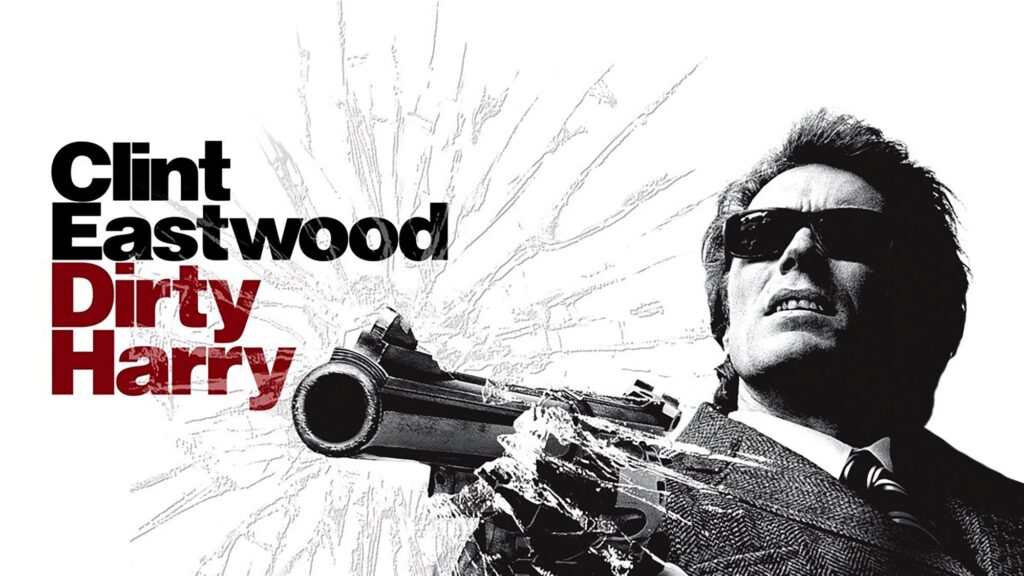
Dirty Harry
Dirty Harry was shot largely on location in San Francisco, and the city is essential to its cold, tense atmosphere.