
Opera (1987), also released internationally as Terror at the Opera, is an Italian giallo horror film directed by Dario Argento and co-written with Franco Ferrini. Cristina Marsillach stars as Betty, a young soprano who unexpectedly receives the leading role in a production of Giuseppe Verdi’s Macbeth after the original star suffers an accident. Her successful debut quickly turns into a nightmare when a masked killer begins murdering people connected to the production, repeatedly forcing Betty to witness the violence by attaching needles beneath her eyes to prevent her from closing them. Ian Charleson plays Marco, the opera’s ambitious director, while Daria Nicolodi appears as Betty’s agent Mira, Urbano Barberini as Inspector Santini and Coralina Cataldi-Tassoni as the costume designer Giulia. The film marked Argento’s first major exploration of the operatic world, several years before his adaptation of The Phantom of the Opera (1998). It is particularly remembered for its elaborate camerawork, the use of live ravens inside the theatre and a series of violent murder sequences accompanied by an unusual mixture of classical opera, electronic music and heavy metal.
Opera was filmed in Italy and Switzerland during 1987, with principal locations in Parma and Rome, additional studio work at Incir De Paolis Studios and exterior filming in the Swiss Alps. Although the story’s operatic production is associated with La Scala in Milan, the theatre seen on screen is actually the Teatro Regio in Parma, approximately 120 kilometres southeast of Milan. The filmmakers used both its interior and exterior, making it the most important filming location in the production. Several scenes outside the theatre were shot elsewhere in Italy, particularly in Rome, while the final sequence was filmed in the mountains of southern Switzerland. The production was one of Argento’s most expensive at the time, with a budget of several billion Italian lire and particularly demanding technical preparations for the sequences involving the ravens.
Teatro Regio di Parma stands at Strada Giuseppe Garibaldi 16 and is one of Italy’s most historic opera houses. Commissioned by Duchess Marie Louise of Austria, the former wife of Napoleon Bonaparte, it was designed by architect Nicola Bettoli and opened in 1829 with Vincenzo Bellini’s Zaira. The Neoclassical building has a colonnaded façade and an elaborate auditorium decorated in white and gold, with four tiers of boxes surrounding the stalls. Its large chandelier, painted ceiling and red velvet furnishings are prominently featured throughout Opera. The theatre was already closely associated with the music of Giuseppe Verdi, who was born near Parma, making it a particularly appropriate setting for a film centred on a performance of Macbeth.
The opening scenes establish the theatre as a place where artistic ambition and superstition are already creating problems. The celebrated soprano Mara Cecova complains about the production, particularly the ravens that director Marco has introduced into his unconventional staging of Macbeth. She storms out of the building and subsequently suffers the accident that allows Betty to take her place. Her departure was filmed at the actual Teatro Regio, with the exterior on Strada Garibaldi clearly visible. Argento uses an extended moving camera shot to follow the departing singer through the building, establishing the elaborate visual style that continues throughout the film. The production also makes extensive use of the theatre’s auditorium, boxes, corridors and backstage spaces, where the murderer moves between performers, technicians and members of the audience.
Once Betty takes over the leading role, the Teatro Regio becomes the setting for several of the film’s most disturbing sequences. During the opening performance, the killer enters the building, murders an attendant and damages Betty’s costumes while she is singing on stage. Later, the costume department becomes the scene of another murder when Giulia discovers evidence connected to the killer. The film repeatedly moves between the public areas of the theatre and the less glamorous spaces behind the stage, showing costume rooms, storage areas, staircases and narrow passages normally hidden from an opera audience. This allows Argento to turn the building into a complicated network of rooms where the characters can become separated from one another, even while a performance is taking place nearby.
One of the most technically ambitious sequences takes place during a later performance of Macbeth, when Marco releases the ravens into the auditorium in an attempt to expose the murderer. The birds have previously encountered the killer, and Marco hopes they will recognise and attack him. Argento wanted the camera to reproduce the experience of a raven flying above the audience, looking down into the crowded theatre while circling the auditorium. Achieving the effect required an elaborate camera system installed inside the Teatro Regio, allowing the camera to travel and rotate high above the seats. The resulting sequence sweeps repeatedly over the spectators before descending towards the killer. It was among the most expensive shots in the production, reportedly costing around one billion lire.
Filming with the ravens created additional complications. Large numbers of trained birds were released inside the historic auditorium, and controlling their movements proved difficult. Actor Urbano Barberini later recalled that recovering the birds after filming could take hours, with some escaping altogether. The sequence culminates in the ravens attacking the murderer in front of the audience, causing panic throughout the theatre. The combination of live animals, large crowds, elaborate camera equipment and special effects made the scene one of the most demanding parts of the production. It also provided an unusual way to use the actual architecture of the Teatro Regio, with the auditorium and its tiers of boxes photographed from angles rarely seen during an ordinary performance.
While Parma provides the film’s main setting, several important scenes were photographed in central Rome. One of the earliest identified locations is Via Nazionale, where Betty narrowly avoids being struck by a taxi while crossing the busy street. The scene introduces the character outside the opera house and uses the actual traffic and commercial surroundings of the Italian capital. Betty’s apartment building was filmed at Piazza Cavour, the large square in the Prati district of Rome, close to the Palace of Justice. The building appears when Betty returns home and is confronted by the police during the investigation into the murders. These locations were identified through comparisons of the film with the surviving buildings and streets.
Another particularly interesting Roman location is Palazzo Sacchetti at Via Giulia 66, a sixteenth-century palace in the historic centre of the city. The building was used for the scenes involving Betty and her young companion Stefano, played by William McNamara. Stefano takes Betty to a luxurious apartment belonging to his wealthy uncle, where the two spend time together before the murderer arrives. Betty is restrained, with needles taped beneath her eyes, and forced to witness Stefano’s brutal death. The interiors were filmed in the palace’s Salone dei Mappamondi, an elaborately decorated Renaissance room containing frescoes by Francesco Salviati. The historic room provided a striking setting for the murder, although Argento altered its appearance by adding artificial columns that were not part of the original architecture. The columns were incorporated into the scene and helped create the arrangement required for the killing.
Palazzo Sacchetti was also used for exterior scenes immediately following Stefano’s murder. Betty emerges from the building into the rain, visibly shaken by what she has witnessed. The entrance on Via Giulia is recognisable, but the scene then moves to nearby Via Monserrato, where the production filmed her walking away from the palace. She stops at a telephone booth near the intersection of Via della Barchetta and Via Monserrato to contact the police. Continuing along Via Monserrato, she encounters Marco, who arrives in his car and offers to take her home. Although the action appears to follow one continuous route, the production uses editing to connect the palace entrance with different streets in the surrounding neighbourhood. These locations have been identified by Italian film-location researchers through comparisons with the original scenes.
Further interior filming took place at Incir De Paolis Studios in Rome, a facility that Argento had previously used during his career. The studio work allowed the filmmakers to construct and control environments needed for the elaborate murders and visual effects. One of the film’s most memorable effects occurs when Betty’s agent Mira looks through the peephole of an apartment door, believing that a police officer has arrived to protect them. The killer fires a gun directly through the opening, and the camera follows the bullet in extreme slow motion as it passes through the peephole and strikes her eye before continuing into the room. The complicated sequence required carefully planned camera angles and special effects to create the illusion of the bullet travelling through the confined space. It remains one of the most recognisable examples of Argento’s fascination with unusual camera perspectives.
The production also brought together several people who had worked with Argento on earlier films. Cinematographer Ronnie Taylor, who had shared an Academy Award for his work on Gandhi (1982), was responsible for the film’s elaborate photography. Michele Soavi, who had directed the horror film Stage Fright (1987), worked as Argento’s assistant director and also appeared briefly as a police officer. The musical soundtrack was equally unconventional, combining excerpts from Verdi’s Macbeth with compositions by Claudio Simonetti, Brian and Roger Eno, Bill Wyman and heavy metal performers including Steel Grave. The abrupt changes between classical opera and distorted guitars were particularly noticeable during the murder sequences. Argento’s decision to combine these contrasting styles followed his earlier use of rock and metal music in Phenomena (1985).
The concept behind Betty’s ordeal also had an unusual origin. Argento later explained that he had become irritated by cinema audiences who closed their eyes during the violent scenes in his films, particularly the sequences that required the most preparation and technical work. He imagined a device that would force spectators to keep watching, eventually developing the idea of attaching needles beneath Betty’s eyes. The resulting images became central to the film’s advertising. Opera also emerged after Argento had been involved in an unsuccessful attempt to direct a stage production of Verdi’s Rigoletto in Macerata. His proposed staging was considered too unconventional, and the project was abandoned. The experience helped inspire a film in which a controversial director attempts to introduce horror imagery into the traditionally conservative world of opera.
The casting also changed during pre-production. Vanessa Redgrave had originally been attached to play the demanding soprano Mara Cecova, but withdrew before filming began. Her character was subsequently reduced considerably and appears mainly through subjective camera shots and dialogue delivered off screen. This required changes to the opening scenes, which concentrate on Mara’s troubled departure from the theatre rather than establishing her as a major character. The production was further complicated by tensions between Argento and some of the performers, as well as accidents and other difficulties during filming. Argento later connected these experiences to the supposed curse surrounding Macbeth, although the theatrical superstition is traditionally associated with Shakespeare’s play rather than Verdi’s operatic adaptation.
For the final part of the story, filming moved to Switzerland. After the apparent resolution of the murders, Betty travels to a mountain retreat with Marco, hoping to recover from her experiences in the theatre. The location is a dramatic departure from the enclosed interiors and urban streets that dominate the earlier scenes. Instead of corridors, staircases and dark rooms, the final sequence takes place around a secluded stone house, mountain meadows and wooded slopes. The production used locations in the Swiss canton of Ticino, with Lugano commonly listed among the filming areas.
The stone house seen during the Swiss ending has been identified near the village of Nante, above Airolo in the Leventina Valley. Italian location enthusiasts traced the property through its distinctive windows, stone exterior and the mountain skyline visible in the film. The house appears when Betty and Marco spend time together in the mountains before the killer unexpectedly returns. Betty eventually flees into the surrounding countryside, where the pursuit continues across the grass and through the nearby trees. Unlike the heavily controlled theatre interiors, these scenes rely on the natural terrain and vegetation of the Swiss Alps. The location was documented by visiting researchers in 2010, who compared the surviving building and surrounding landscape with the original footage.
The Swiss ending became a point of disagreement during the film’s international distribution. Orion Pictures, which had acquired the American distribution rights, reportedly wanted Argento to remove the final mountain sequence, believing that the story should end with the confrontation inside the opera house. Argento refused, insisting on retaining the conclusion. The film consequently experienced difficulties securing a conventional American theatrical release and eventually appeared in the United States under the title Terror at the Opera.
Opera remains one of Argento’s most technically elaborate films, with its distinctive visual style closely connected to the places where it was made. Teatro Regio di Parma provides the historic opera-house architecture and the setting for the raven sequence, while Rome contributes Renaissance interiors, residential buildings and recognisable city streets. The final scenes in the Swiss Alps introduce an entirely different landscape. Together, these locations demonstrate how Argento combined real historic buildings, modified interiors, elaborate camera equipment and studio effects to create one of the most visually ambitious Italian horror films of the 1980s.
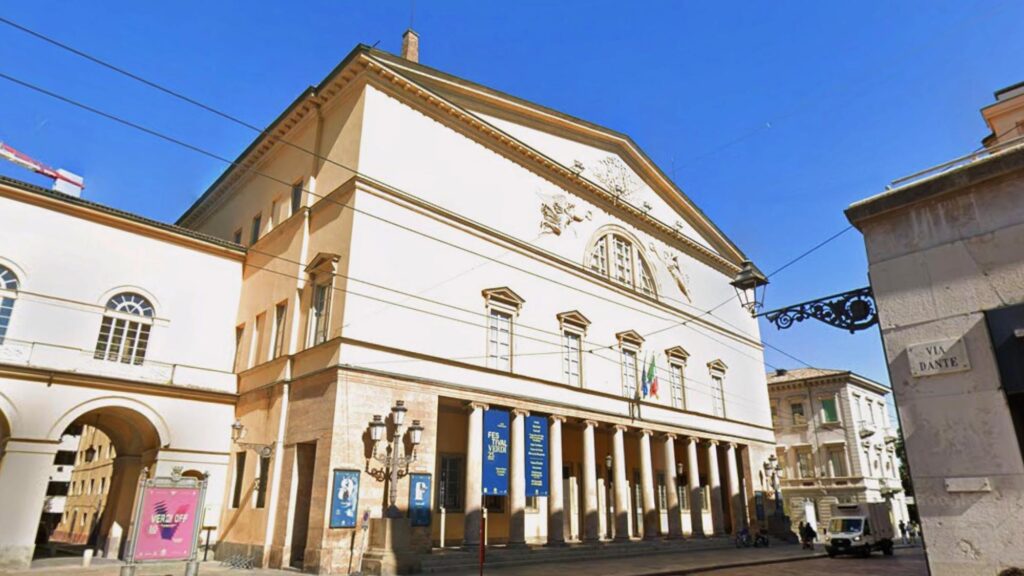
Teatro Regio di Parma
Teatro Regio di Parma has been used in several films, most notably Dario Argento’s Opera from 1987 and Bernardo Bertolucci’s Before the Revolution from 1964.