
Nosferatu in Venice (1988), also released as Vampire in Venice and Prince of the Night, is an Italian supernatural horror film directed by Augusto Caminito and starring Klaus Kinski, Christopher Plummer, Donald Pleasence and Barbara De Rossi. Conceived as a loose follow-up to Werner Herzog’s Nosferatu the Vampyre (1979), the film follows Professor Paris Catalano, who travels to Venice to investigate the mysterious disappearance of Nosferatu during the Carnival of 1786. The production became notorious for its troubled filming, which involved several changes of director and conflicts with Kinski.
Nosferatu in Venice was filmed primarily in Venice, using historic palaces, churches, canals and islands around the Venetian Lagoon. Additional filming took place at Villa Grazioli in Grottaferrata, near Rome, which was used for the vampire’s abandoned residence. Several buildings were combined to represent individual locations, particularly the home of the Canins family and Nosferatu’s hideout.
The Canins family residence was created using two historic Venetian palaces. The exterior was filmed at Palazzo Pisani in Campiello Pisani, close to Campo Santo Stefano. The enormous building, now home to the Benedetto Marcello Conservatory of Music, represents the residence of Helietta Canins, played by Barbara De Rossi, who invites Professor Catalano to Venice. The interior scenes were filmed at nearby Palazzo Barbaro on the Grand Canal, close to the Accademia Bridge. Its historic rooms and waterside entrance appear during the scenes inside the family residence, including Nosferatu’s arrival through the doorway facing the Grand Canal. The filmmakers combined the two buildings to create the appearance of a single Venetian palace.
Another historic residence, Palazzo Zenobio degli Armeni at Fondamenta del Soccorso, was used for the carnival gathering where Helietta first encounters Nosferatu. The sequence takes place in the palace’s grand rooms and courtyard, with Helietta becoming disturbed after exchanging glances with the vampire. The adjoining church is visible through the windows during the festivities. Palazzo Zenobio was built during the seventeenth century and later became associated with the Armenian community in Venice.
St Mark’s Campanile provides one of the film’s most memorable locations. Maria Canins, played by Anne Knecht, climbs the bell tower overlooking Piazza San Marco. After reaching the top, she looks out across Venice, removes her shoes and climbs onto the railing before falling from the tower, apparently under Nosferatu’s influence. The sequence uses the actual tower and the elevated views across the city. The Campanile stands almost 99 metres tall and was rebuilt in 1912 after the original structure collapsed ten years earlier.
St. Mark’s Square, or Piazza San Marco, also appears during the film’s closing sequence. Nosferatu carries the naked Maria through the square and the adjoining Piazzetta at dawn, with the Doge’s Palace clearly visible beside them. The scene was filmed in misty conditions, although some ordinary activity in the square is noticeable in the background. Bystanders can be seen watching the filming, while restaurant employees are preparing outdoor seating in another shot. These details remain visible despite the production’s attempt to portray an almost deserted Venice.
The cemetery island of San Michele, situated between Venice and Murano, was used for the funeral of Helietta’s grandmother, the elderly Princess Canins. Her coffin is transported through the lagoon before the burial ceremony on the island. San Michele has served as Venice’s principal cemetery since the nineteenth century and contains historic cloisters, chapels and burial grounds. The island’s enclosed cemetery and surrounding lagoon are visible during the funeral sequence.
Nosferatu’s abandoned villa on the fictional Isola dei Cani was created using locations in two different parts of Italy. The island itself was represented by Lazzaretto Vecchio, south of the Lido in the Venetian Lagoon. Established as a plague hospital in 1423, Lazzaretto Vecchio contains historic buildings associated with Venice’s long history of quarantine and disease. Its waterfront and terraces appear during the scenes around the vampire’s refuge, including a shot in which Maria looks from a window and sees Nosferatu standing outside overlooking the water.
The villa itself was filmed at Villa Grazioli, now Park Hotel Villa Grazioli, at Via Umberto Pavoni 19 in Grottaferrata, approximately 20 kilometres southeast of Rome. The historic residence was in a neglected condition during filming, with its weathered exterior and deteriorating interiors providing the setting for Nosferatu’s hideout. The building appears when Dr. Barneval approaches the villa to confront the vampire, while its frescoed rooms were used for scenes involving Nosferatu and Maria. The property was subsequently restored and converted into a luxury hotel, making its present appearance considerably different from the abandoned building seen in the film.
Several of Venice’s narrower streets were used for the vampire’s nighttime attacks. Calle Frutarol, close to Campo Santo Stefano, appears when Nosferatu waits for Gloria Barnabò, played by Elvire Audray. He pursues her into nearby Calle Giustinian, where she briefly escapes before seeking refuge in a church. The church interior was filmed at the former Church of the Abbazia della Misericordia in Campo de l’Abazia, where Nosferatu eventually catches and kills her. The historic church stands in the Cannaregio district and dates from the medieval period, although its present appearance reflects later alterations.
Another recognisable location is Ponte del Diavolo on Fondamenta dell’Osmarin, in the Castello district. Professor Catalano jumps from the small stone bridge into the canal below after his attempt to defeat Nosferatu fails. This is not the much better-known Devil’s Bridge on the island of Torcello, but a separate bridge within Venice itself.
The Rialto Bridge appears in an atmospheric canal sequence featuring Nosferatu travelling through Venice by gondola. The bridge is photographed from the water, with its distinctive stone arch visible in the dim light. The present bridge was completed in 1591 and remains one of the city’s most recognisable landmarks.
Additional filming took place along Rio di Noale, where Helietta travels by boat during the funeral procession and learns more about her grandmother’s death. The film also uses the area outside the Basilica of San Giorgio Maggiore for a historical sequence depicting victims of the plague. The church and surrounding waterfront provide the setting for the bodies lying outside during the epidemic, connecting the film’s eighteenth-century background with one of Venice’s actual historic landmarks.

Palazzo Barbaro
Palazzo Barbaro has appeared in Brideshead Revisited, Nosferatu in Venice, Indiana Jones and the Last Crusade, In Love and War, The Wings of the Dove and more.
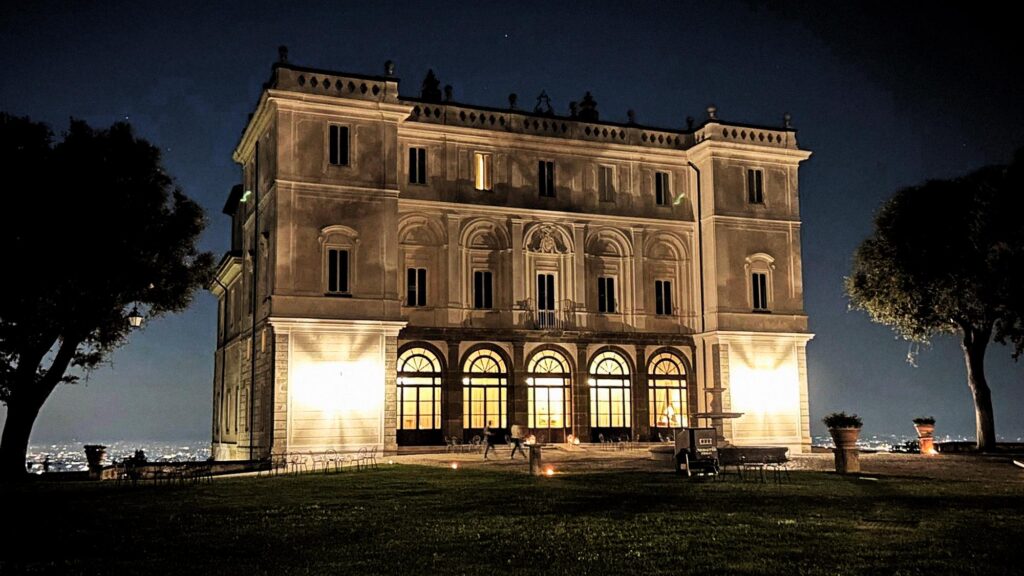
Park Hotel Villa Grazioli
Park Hotel Villa Grazioli has appeared in Kill, Baby, Kill, The Marquis of Grillo, Nosferatu in Venice, The Dew Point and The Long Night.

St Mark’s Campanile
St Mark’s Campanile often appears in films as part of the wider San Marco skyline, its most direct use as a filming location is in "Nosferatu in Venice" (1988).

St. Mark’s Square
Films associated with St. Mark’s Square are Summertime, Death in Venice, A Little Romance, Moonraker, The Tourist, Inferno and Spider-Man: Far From Home.