
Argo (2012) is an American historical thriller directed by Ben Affleck and written by Chris Terrio, based on the real-life rescue of six American diplomats during the Iran hostage crisis. Affleck stars as Tony Mendez, a CIA specialist tasked with extracting six Americans who escaped when Iranian militants stormed the United States Embassy in Tehran on 4 November 1979. With the fugitives hiding under the protection of Canadian ambassador Ken Taylor, Mendez devises an elaborate scheme to smuggle them out of Iran disguised as members of a Canadian film crew scouting locations for a fictional science-fiction movie called Argo. Bryan Cranston plays CIA officer Jack O’Donnell, while Alan Arkin and John Goodman portray Hollywood producer Lester Siegel and make-up artist John Chambers, who help establish the fake production company. Victor Garber appears as Ken Taylor, alongside Tate Donovan, Clea DuVall, Scoot McNairy, Rory Cochrane, Kerry Bishé and Christopher Denham as the six Americans. Based on Tony Mendez’s memoir The Master of Disguise and a 2007 Wired article by Joshuah Bearman, the film received seven Academy Award nominations and won three, including Best Picture, Best Adapted Screenplay and Best Film Editing.
Argo was filmed primarily in Los Angeles and the surrounding areas of California, with additional production in Istanbul, Turkey, Washington, D.C., and McLean, Virginia. Filming took place in 2011, with approximately ten weeks of the fourteen-week production spent in the Los Angeles area. Although much of the story unfolds in Tehran between November 1979 and January 1980, none of the film was shot in Iran. Instead, the filmmakers used Turkish streets and historic buildings alongside carefully selected American locations to recreate the city during the Iranian Revolution. Production designer Sharon Seymour and cinematographer Rodrigo Prieto studied photographs, news reports and archival footage from the period, paying particular attention to Iranian shop signs, military vehicles, clothing and government buildings. Several scenes also incorporate genuine news footage from the hostage crisis, helping connect the reconstructed environments to the historical events.
The opening sequence depicting the storming of the American Embassy was assembled from filming in Istanbul and Los Angeles. The large demonstration outside the embassy gates was staged on a football pitch in Bakırköy, a district on the European side of Istanbul. The production constructed a replica of the embassy entrance and gathered more than 1,300 extras to portray the Iranian crowds. Many of the performers wore period clothing, including military jackets, traditional robes and black chadors made specifically for the scene. The protesters were directed to chant in Farsi as they approached the gates, and Affleck placed camera operators among the crowd with 16mm and Super 8 cameras to capture footage resembling contemporary television news. Some of the shots were deliberately grainy, reproducing the appearance of documentary images from 1979.
The moment the protesters climb over the embassy gates provides one of the film’s most interesting examples of combining locations. The outside of the wall was filmed in Istanbul, but when the protesters descend into the embassy compound, the location changes to the Sepulveda VA Medical Center in North Hills, Los Angeles. The former Veterans Affairs hospital complex, located on Plummer Street in the San Fernando Valley, contained a red-brick institutional building with a remarkably similar appearance to the real American Embassy in Tehran. Location manager Chris Baugh was particularly pleased to discover that it even had the same number of floors. The crew transformed parts of the medical centre into embassy offices and corridors, where American personnel desperately destroy classified documents as the protesters force their way inside. Additional structures and temporary façades were constructed around the compound to complete the setting. Through editing, the Turkish entrance and California interiors appear to belong to the same building, despite being filmed thousands of miles apart.
Following their escape from the embassy, the six Americans find refuge in the home of Canadian ambassador Ken Taylor. The residence seen in the film was actually a private house in Hancock Park, an affluent residential neighbourhood of Los Angeles known for its large historic properties. Finding a suitable building was one of the production’s more difficult tasks, as the filmmakers needed a house that could convincingly represent a diplomatic residence in Tehran while accommodating an extensive filming schedule. Baugh eventually secured permission from the homeowners and the neighbourhood association to work at the property for nearly a month. Before filming began, the six actors portraying the Americans spent an entire week living together inside the house, wearing period clothing and avoiding modern technology such as mobile phones and computers. Affleck wanted them to become accustomed to one another and develop the same familiarity as people forced to share a confined space for several months. Much of the filming inside the house was conducted with handheld cameras, allowing the actors to improvise parts of their conversations while the camera operators followed their movements.
While the Americans remain hidden in Tehran, the story moves to Washington, D.C., where CIA officials search for a way to bring them home. The production was granted access to the actual CIA headquarters in Langley, in the McLean area of Virginia. Affleck was permitted to film in the lobby of the Original Headquarters Building, completed in 1961, using the real entrance to establish Mendez’s workplace. The building’s recognisable CIA seal and institutional architecture required no artificial recreation. Most of the agency’s office and conference-room scenes, however, were filmed thousands of miles away in the former Los Angeles Times Building at First and Spring Streets in downtown Los Angeles. Opened in 1935 and designed by Gordon B. Kaufmann, the newspaper headquarters contained offices, corridors and meeting rooms that could be adapted to resemble those of the CIA during the late 1970s. The film’s government scenes were generally photographed using steady camera movements, contrasting with the more restless style used for the Iranian sequences.
The production also filmed in Washington itself, including exterior views of the United States Department of State at the Harry S. Truman Building on C Street Northwest. The building appears as the government attempts to coordinate its response to the hostage crisis and consider possible rescue plans. Additional Washington footage included the Arlington Memorial Bridge over the Potomac River, connecting the Lincoln Memorial area with Arlington National Cemetery in Virginia. These actual government locations help establish the political side of the story before Mendez turns to the film industry for an unconventional solution.
The Hollywood portion of Argo introduces several additional Los Angeles locations. After deciding that a fake film production might provide a convincing reason for Westerners to travel through Iran, Mendez visits make-up artist John Chambers, played by John Goodman. Their meeting takes place at the Smoke House Restaurant at 4420 West Lakeside Drive in Burbank, directly across from Warner Bros. Studios. Established in 1946, the restaurant has long been associated with Hollywood actors, filmmakers and studio employees. Chambers, who had worked on films including Planet of the Apes (1968), had also secretly assisted the CIA with disguise techniques. During their conversation, he explains that a convincing Hollywood production needs more than a script and a few costumes. It must have a recognised producer, offices, publicity and a believable commercial identity. The Smoke House has an additional connection to the film, as producers George Clooney and Grant Heslov named their production company Smokehouse Pictures after the restaurant.
Mendez and Chambers subsequently approach the fictional Hollywood producer Lester Siegel, played by Alan Arkin. The extravagant mansion where Siegel lives was filmed at 1001 Bel Air Road, a private estate in Los Angeles formerly owned by actress Zsa Zsa Gabor and her husband, Frédéric Prinz von Anhalt. The production used several parts of the property, including its entrance, foyer, living room and swimming pool. It is here that the characters discuss the possibility of creating an entirely fictional film and discover the science-fiction screenplay that becomes the basis of their operation. The estate’s lavish surroundings provide a deliberate contrast to the modest CIA offices and the increasingly desperate conditions in Tehran. Siegel himself was a fictional character, although the film’s Hollywood deception was based on an actual operation involving Chambers and other film-industry contacts.
Another recognisable Hollywood location is Crossroads of the World, the unusual office and shopping complex at Sunset Boulevard and Las Palmas Avenue. Opened in 1936, the property consists of several buildings in different architectural styles, centred around a Streamline Moderne structure designed to resemble an ocean liner. Its distinctive tower, topped by a revolving globe, appears when Mendez and Siegel visit a producer to secure the rights to the Argo screenplay. The location was particularly suitable for a film set in Hollywood around 1980, as much of its architecture had survived from the industry’s earlier decades. The unusual collection of buildings also reflects the slightly eccentric world of independent film producers and agents that Mendez must enter to establish his cover story.
The fictional Studio Six Productions was recreated on the Warner Bros. Studios lot in Burbank. In the film, Mendez, Chambers and Siegel establish a production office, commission artwork and begin publicising their supposedly forthcoming science-fiction adventure. The Warner Bros. backlot appears in scenes involving the company’s preparations, while the famous studio water tower was temporarily altered to display the name The Burbank Studios, matching the studio’s identity during the period in which the story takes place. The real Studio Six Productions had operated from offices on the old Columbia Pictures lot, now associated with Sunset Gower Studios, rather than Warner Bros. The deception was considerably more elaborate than simply inventing a film title. The actual CIA operation used artwork created by comic-book artist Jack Kirby for an unproduced adaptation of Roger Zelazny’s Lord of Light, along with advertisements, business cards and a functioning telephone number. The fake company was convincing enough to attract genuine interest from people in the film industry.
The film also features the Beverly Hilton Hotel at 9876 Wilshire Boulevard in Beverly Hills, where Studio Six organises a publicity event for Argo. The characters stage a screenplay reading and invite journalists to help establish the film as a legitimate production. The hotel, which opened in 1955, plays itself in the sequence. The event introduces the fictional science-fiction characters and costumes, providing an opportunity for the filmmakers to recreate the slightly extravagant promotional style of late-1970s Hollywood. It also demonstrates how the CIA’s deception depended on creating a public record that could withstand scrutiny if Iranian officials contacted the production company.
When Mendez travels towards Iran, the action shifts to Istanbul, which served both as an actual setting in the story and a substitute for Tehran. The exterior of the Blue Mosque, officially the Sultan Ahmed Mosque, appears as Mendez prepares for a clandestine meeting with an intelligence contact. The meeting itself takes place inside Hagia Sophia, the sixth-century Byzantine building that had served as a church, mosque and museum at different periods of its history. Mendez meets a British intelligence officer there to discuss the difficulties of entering and leaving Iran. Filming inside Hagia Sophia presented an unusual technical challenge. The building’s enormous chandeliers had been fitted with modern fluorescent bulbs, which produced lighting inappropriate for a scene set in 1980. The production crew worked overnight replacing more than 4,000 bulbs to obtain the warmer appearance required by cinematographer Rodrigo Prieto. The historic interior, including its great dome and monumental columns, is clearly visible during the conversation.
Other Istanbul locations were used to recreate the streets and neighbourhoods of Tehran. Filming took place in areas including Balat, Eminönü, Bakırköy and Etiler, with streets temporarily altered using Persian signs, period cars and political posters. The production also used views of the Golden Horn and the Yeni Camii, or New Mosque, near the waterfront at Eminönü. These recognisable Istanbul landmarks were combined with carefully selected street scenes to suggest a much larger city. Because the filmmakers could not work in Iran, they relied on buildings that had retained enough historic character to be convincing after relatively modest alterations. Production designer Sharon Seymour’s team was particularly concerned with removing modern signs and Turkish lettering that would reveal the actual filming location.
One of the most demanding sequences in Istanbul was filmed in the Grand Bazaar, the enormous covered market established during the fifteenth century. In the film, Mendez takes the six Americans through a crowded Tehran bazaar, supposedly scouting locations for their science-fiction production. Their nervous behaviour attracts suspicion, and the situation becomes increasingly dangerous when merchants and bystanders begin confronting them. The actual Grand Bazaar provided the narrow passages, vaulted ceilings and densely packed shops needed for the sequence. Filming coincided with a major holiday, when many of the businesses were closed, allowing the crew to work without disrupting normal trading to the same extent. Seymour’s team replaced Turkish shop signs with Farsi lettering and altered selected stalls to resemble a Tehran market. Although the architecture required comparatively little modification, the sequence involved large numbers of performers and considerable coordination between local crews, camera operators and the actors.
The journey to the bazaar also involved a particularly tense scene in which the Americans’ vehicle becomes surrounded by angry demonstrators. Protesters bang on the windows and rock the vehicle as the frightened passengers attempt to remain calm. According to the actors, the sequence was unsettling even though everyone knew it was staged. Clea DuVall and Christopher Denham later recalled that the movement of the vehicle and the intensity of the shouting made the situation feel genuinely threatening. Scoot McNairy described a moment when an extra struck the windscreen with a rock, startling even Affleck. The filmmakers used these reactions to strengthen the tension of the sequence, rather than relying entirely on performances created under controlled studio conditions.
The final escape from Iran was filmed at Ontario International Airport in California, east of Los Angeles. The production used an inactive passenger terminal and transformed it into Tehran’s Mehrabad International Airport, where Mendez and the six Americans attempt to leave the country using their forged Canadian passports. The terminal was filled with Farsi signs, portraits of Ayatollah Khomeini, period airline material and hundreds of extras. Approximately 800 people participated in the airport scenes, including many Iranian Americans who had lived through the revolution. Some recognised small inaccuracies in the recreated environment and offered suggestions about clothing, signs and other details. The airport scenes required considerable preparation, particularly the sequence in which officials inspect the travellers’ documents and question them about their supposed film project.
The climactic airport sequence also involved extensive stunt and vehicle work. As the Americans finally board their aircraft, Iranian security officials discover the deception and attempt to stop their departure. Police cars race across the airport grounds in pursuit of the accelerating passenger jet, with the final moments combining practical vehicle footage and visual effects. Among the period vehicles obtained for the production were AMC Matador police cars resembling those used by Iranian authorities at the time. Although this dramatic pursuit provides the film with its final burst of action, it did not occur during the real Canadian Caper. The six Americans departed Tehran on 27 January 1980 without the last-minute discovery and runway chase depicted in the film. The airport confrontation was invented to create a more suspenseful ending.
Argo’s production was unusual because the same film crew had to recreate three very different environments: the tense streets of revolutionary Iran, the restrained government offices of Washington and the colourful film industry of late-1970s Hollywood. Affleck and Prieto developed different photographic styles for each setting, using handheld cameras and grainier images for Iran, smoother camera movements for Washington and more saturated colours and zoom shots for Los Angeles. The film’s many locations were brought together through editing, archival material and detailed production design. Its opening embassy sequence is perhaps the clearest example, combining footage from a football pitch in Istanbul with a Veterans Affairs medical complex in Los Angeles to recreate a single historical event. The completed film demonstrates how location shooting can reconstruct places that are politically or practically inaccessible, while also showing how the real Hollywood film industry became part of an extraordinary intelligence operation.
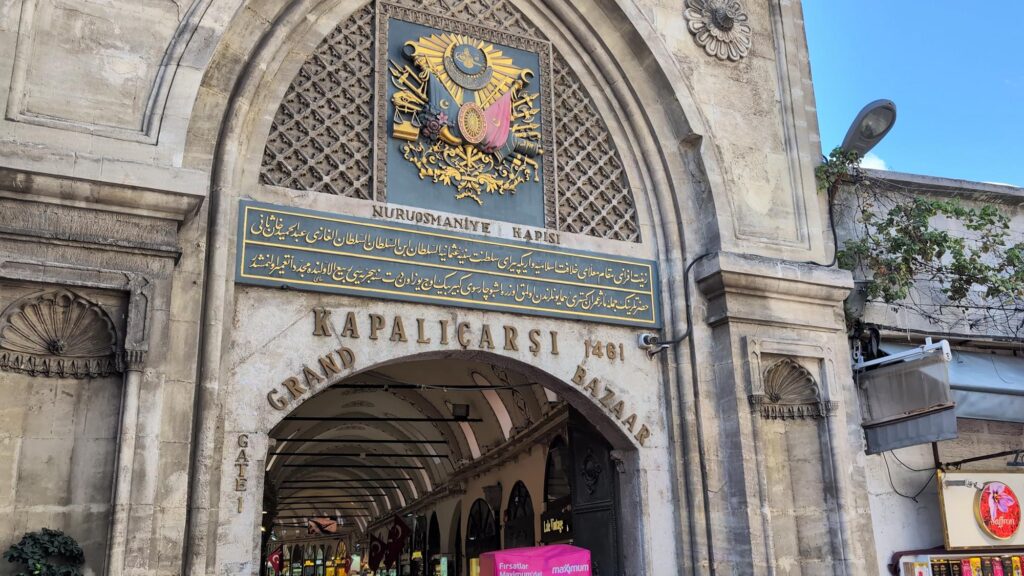
Grand Bazaar
Grand Bazaar has appeared in From Russia with Love (1963), The International (2009), Argo (2012), Taken 2 (2012), Skyfall (2012), Inferno and Charlie’s Angels.
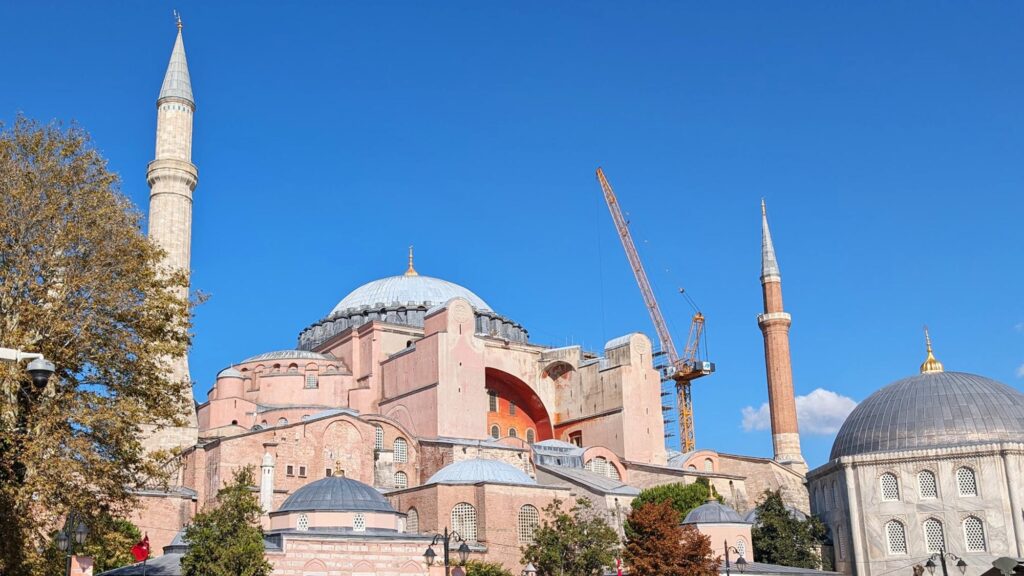
Hagia Sophia
Hagia Sophia has appeared in several international films, including "From Russia with Love" (1963), "Argo" (2012) and "Inferno" (2016).