
George Walton Lucas Jr. was born on 14 May 1944 in Modesto, California, United States, to George Walton Lucas Sr., a businessman who owned an office equipment and stationery store, and Dorothy Ellinore Bomberger. He grew up in Modesto, an agricultural city in California’s Central Valley, where his father operated the L. M. Morris Company at the corner of 11th and I Streets. Lucas attended John Muir Elementary School, Roosevelt Junior High School and Thomas Downey High School. He developed an early interest in comic books, illustrated adventure stories and the science-fiction serials that had been popular in American cinemas during the 1930s and 1940s. His father expected him to eventually take over the family business, but Lucas was more interested in drawing, photography and motor racing. During his teenage years, he became involved in the local car culture, spending considerable time modifying engines and driving around the streets of Modesto. He initially hoped to become a professional racing driver and participated in amateur competitions. Shortly before graduating from high school in June 1962, however, he was involved in a serious road accident when another vehicle struck his small Fiat, causing it to overturn. Lucas was thrown from the car and spent several days in hospital. The accident ended his ambitions of a racing career and contributed to his decision to pursue further education.
Lucas enrolled at Modesto Junior College, where he studied anthropology, sociology and literature while beginning to experiment with filmmaking. He purchased an 8mm camera and started recording motor races, gradually developing an interest in the technical and artistic possibilities of moving images. A friend encouraged him to apply to the University of Southern California in Los Angeles, which had established one of the country’s most important film programmes. Lucas transferred to USC in 1964 and moved to southern California, studying cinematography and film production at the university’s School of Cinema. Among his fellow students were John Milius, Walter Murch, Randal Kleiser and several other young filmmakers who would become influential figures in the American film industry. Unlike students primarily interested in conventional Hollywood storytelling, Lucas concentrated on experimental editing, visual composition and the relationship between sound and images. He produced several short films, including Look at Life (1965), Freiheit (1966) and 1:42.08 (1966), the latter reflecting his continuing fascination with racing cars. His most ambitious student project was Electronic Labyrinth: THX 1138 4EB (1967), a science-fiction film about a man attempting to escape a technologically controlled society. The short won first prize in the dramatic category at the National Student Film Festival and attracted attention from professional filmmakers.
After graduating from USC in 1966, Lucas continued studying filmmaking and received a Warner Bros. scholarship that allowed him to observe a professional film production. He chose to visit the set of Finian’s Rainbow (1968), directed by Francis Ford Coppola, at Warner Bros. Studios in Burbank. Although Coppola was several years older, the two men discovered a shared interest in experimental filmmaking and independence from the established Hollywood studio system. Lucas subsequently worked on Coppola’s The Rain People (1969), travelling with the production during its location filming across the United States. He documented the experience in Filmmaker (1968), a short documentary examining Coppola’s working methods. Their professional friendship led to the establishment of American Zoetrope in San Francisco in 1969, with Coppola seeking to create an alternative filmmaking organisation away from Hollywood. Lucas moved to the Bay Area, where the company established offices and production facilities. During this period, he married film editor Marcia Lou Griffin, whom he had met while working in the Los Angeles film industry. They married in February 1969, and she became an important collaborator on his early films.
Lucas developed his student film into the feature-length THX 1138 (1971), starring Robert Duvall and Donald Pleasence, with Coppola serving as executive producer. The production was filmed during 1969 at numerous locations around San Francisco and the East Bay. Instead of constructing a futuristic city entirely inside a studio, Lucas used existing modern buildings and infrastructure, including the Marin County Civic Center in San Rafael, designed by Frank Lloyd Wright, and the Lawrence Hall of Science in Berkeley. Other sequences were filmed inside the unfinished tunnels of the Bay Area Rapid Transit system, at the Oakland Coliseum and in the Caldecott Tunnel, which connects Oakland and Orinda. Industrial facilities and modern office interiors around the region provided additional settings. The film’s unusual approach to science fiction attracted critical interest and was selected for screening at the Cannes Film Festival in 1971, but Warner Bros. was dissatisfied with the finished production and imposed alterations before its release. Its disappointing commercial performance contributed to tensions between American Zoetrope and the studio. Lucas subsequently established Lucasfilm Ltd. in 1971, creating an independent company through which he could develop and retain greater control over his future projects.
His next feature, American Graffiti (1973), drew directly on his teenage experiences in Modesto during the early 1960s. The film follows a group of young people over one summer night, incorporating the cruising culture, rock and roll music and social relationships that Lucas had known before leaving his hometown. Although the story is set in a fictionalised version of Modesto, the production was filmed mainly in Marin and Sonoma Counties north of San Francisco. Filming began in San Rafael in June 1972, but complaints from local businesses and difficulties with traffic restrictions forced the crew to relocate much of the work to Petaluma. Petaluma Boulevard North became the principal setting for the driving sequences, while other scenes were filmed in Berkeley, Mill Valley and San Francisco. Mel’s Drive-in on South Van Ness Avenue in San Francisco supplied the restaurant exterior, while the KRE radio station in Berkeley was used for scenes involving the mysterious disc jockey Wolfman Jack. The film featured Richard Dreyfuss, Ron Howard, Harrison Ford, Cindy Williams and Charles Martin Smith, many of whom were still establishing their careers. Produced on a comparatively small budget, American Graffiti became a major commercial success after its release in August 1973 and received five Academy Award nominations, including Best Picture and Best Director. The film also maintained Lucas’s connection to Modesto, where its success eventually led to an annual celebration of the city’s historic car culture.
The success of American Graffiti gave Lucas the opportunity to pursue a more ambitious project inspired by the science-fiction serials and adventure stories of his childhood. He had initially attempted to acquire the rights to Flash Gordon but eventually developed his own fictional universe, drawing on mythology, Japanese cinema, Westerns and historical conflicts. The resulting screenplay became Star Wars (1977), a space adventure starring Mark Hamill, Harrison Ford, Carrie Fisher and Alec Guinness. Lucas secured financing from 20th Century Fox but retained considerable creative control through his independent production company. Principal photography began on 22 March 1976 in Tunisia, where Lucas personally directed scenes in the desert around Nefta, Tozeur and Chott el Djerid. The underground Hotel Sidi Driss in Matmata provided the interiors of the Lars family homestead, while locations on the island of Djerba were used for the settlement of Mos Eisley. Difficult weather and logistical problems disrupted the Tunisian filming, after which Lucas returned to England to continue production at EMI Elstree Studios in Borehamwood, Hertfordshire. Extensive sets were constructed at the studios for the spacecraft interiors and other scenes, while additional location photography included material filmed at Tikal in Guatemala for the Rebel base on Yavin 4. The visual effects were created by Industrial Light & Magic, a company Lucas had established in 1975 in Van Nuys, Los Angeles, specifically to develop the techniques required for the film.
Star Wars was released on 25 May 1977 and became an unprecedented commercial success, transforming Lucas from an independent filmmaker into one of the most influential figures in Hollywood. The film received ten Academy Award nominations, winning six competitive Oscars and a special achievement award for sound effects. Lucas himself was nominated for Best Director and Best Original Screenplay. Its success also demonstrated the commercial possibilities of film-related merchandise, an area in which Lucasfilm had retained unusually valuable rights. Rather than immediately pursuing another directing assignment, Lucas concentrated on developing the Star Wars universe and expanding the businesses responsible for its production. He financed the sequel The Empire Strikes Back (1980) largely through his own resources, appointing Irvin Kershner as director while retaining responsibility for the story and overall production. The film was shot at Elstree Studios and in the mountains around Finse, Norway, where the Hardangerjøkulen glacier and surrounding snowfields represented the frozen planet of Hoth. Lucas remained primarily responsible for the production from California rather than personally directing the Norwegian location sequences. He also oversaw Return of the Jedi (1983), directed by Richard Marquand, which completed the original trilogy with studio filming in England and additional photography in California and Arizona.
The financial success of Star Wars enabled Lucas to establish a permanent filmmaking organisation in Northern California. Industrial Light & Magic relocated from the Los Angeles area to San Rafael in 1979, and the company’s activities expanded into editing, sound design, computer graphics and other areas of post-production. Lucas began acquiring land in Marin County in 1978, eventually assembling the extensive property that became Skywalker Ranch near Nicasio, northwest of San Rafael. Construction of the principal facilities took place during the early 1980s, with the first phase completed in 1985. Unlike a conventional Hollywood studio, the ranch was designed as a working environment combining offices, recording facilities, research areas and accommodation within a rural landscape. Its buildings included a substantial Victorian-style main house, an extensive research library and the Technical Building, which housed advanced sound-mixing and recording facilities. The complex eventually became the headquarters of Skywalker Sound, while Lucasfilm’s visual-effects and administrative departments continued operating at other locations. Although the property contains facilities used by numerous productions, Skywalker Ranch was never intended as a tourist attraction or a conventional public film studio.
During the same period, Lucas developed another major film franchise with Steven Spielberg. Their collaboration began with Raiders of the Lost Ark (1981), based on a story conceived by Lucas and Philip Kaufman and developed into a screenplay by Lawrence Kasdan. Spielberg directed the film, with Harrison Ford portraying the archaeologist Indiana Jones. Production took place in England, Tunisia, France and Hawaii, with Elstree Studios providing extensive interior sets. Lucas served as executive producer and remained involved in the development of the subsequent films, including Indiana Jones and the Temple of Doom (1984), Indiana Jones and the Last Crusade (1989) and Indiana Jones and the Kingdom of the Crystal Skull (2008). His producing activities also extended beyond the two franchises most closely associated with his name. He helped finance Akira Kurosawa’s Kagemusha (1980), supported the production of Paul Schrader’s Mishima: A Life in Four Chapters (1985) and collaborated with Jim Henson on Labyrinth (1986). Other projects included the science-fiction comedy Howard the Duck (1986) and the fantasy adventure Willow (1988), directed by Ron Howard. These productions involved filmmakers working in different countries and genres, allowing Lucas to support projects without assuming responsibility for directing them himself.
His growing business interests coincided with substantial changes in his personal life. Lucas and Marcia adopted a daughter, Amanda, in 1981, but their marriage ended in divorce in 1983. Marcia had been closely involved in the editing of his early films and shared the Academy Award for Best Film Editing for Star Wars with Richard Chew and Paul Hirsch. Following the divorce, Lucas continued raising Amanda and later adopted two more children as a single father: Katie, born in 1988, and Jett, born in 1993. His family life remained centred in Marin County, where Skywalker Ranch and the surrounding communities provided an alternative to living in Los Angeles. During the 1980s, he also had a relationship with singer Linda Ronstadt, although they did not marry. As his children grew older, they occasionally appeared in his productions, with Katie and Jett taking small roles in the Star Wars prequel films. Katie subsequently became involved in screenwriting, including work on the animated series Star Wars: The Clone Wars.
Lucasfilm developed into an increasingly diverse technology and entertainment company during the 1980s and 1990s. In 1979, Lucas recruited computer scientist Ed Catmull to establish a computer research group within Lucasfilm, beginning work on digital editing, sound and computer-generated imagery. The division employed artists and engineers including Alvy Ray Smith and John Lasseter, and its research contributed to the development of several important digital filmmaking techniques. In 1986, Lucas sold the computer graphics division to Steve Jobs, who established it as the independent company Pixar. Lucasfilm continued developing its own computer-generated visual effects through Industrial Light & Magic, which subsequently worked on productions including Terminator 2: Judgment Day (1991), Jurassic Park (1993) and numerous other Hollywood films. Another division, Lucasfilm Games, established in 1982 and later known as LucasArts, became a major developer and publisher of computer games, including the adventure titles Maniac Mansion (1987), The Secret of Monkey Island (1990) and numerous Star Wars adaptations. Lucas also helped develop the THX cinema sound certification system, originally introduced in connection with Return of the Jedi, and continued investing in technologies intended to improve film exhibition and production.
Although his business interests increasingly occupied his time, Lucas eventually returned to directing with a new trilogy exploring events preceding the original Star Wars films. After several years of development, principal photography on Star Wars: Episode I – The Phantom Menace (1999) began at Leavesden Studios in Hertfordshire, England, in June 1997. Lucas returned to Tunisia, where the desert around Nefta and the traditional fortified granaries at Ksar Ouled Soltane and Ksar Medenine provided locations associated with the fictional planet Tatooine. In Italy, the Royal Palace of Caserta, north of Naples, was used for interior scenes at the royal palace on Naboo. Additional filming took place in England, including Whippendell Wood near Watford. The production involved extensive computer-generated imagery and digital characters, reflecting the technological developments that Lucasfilm had pursued during the preceding two decades. The Phantom Menace became a major commercial success after its release in May 1999, although critical responses were more divided than those received by the original trilogy.
Lucas subsequently moved much of the production of the remaining prequel films to Australia, where Fox Studios Australia in Sydney provided the facilities needed for increasingly digital filmmaking. Star Wars: Episode II – Attack of the Clones (2002) began principal photography in June 2000 and became one of the first major feature films to be photographed entirely using digital cameras rather than traditional motion-picture film. Lucas worked with Sony and Panavision to develop the camera technology, while Industrial Light & Magic handled the extensive visual effects. In addition to studio filming in Sydney, the production returned to the Royal Palace of Caserta and used Villa del Balbianello on Lake Como for scenes involving Anakin Skywalker and Padmé Amidala. Plaza de España in Seville, Spain, provided another location representing Naboo. Lucas continued working in Sydney for Star Wars: Episode III – Revenge of the Sith (2005), which was filmed primarily at Fox Studios Australia, with additional photography at studios in England. Background footage was also obtained in Switzerland, Thailand and Italy, including volcanic imagery recorded at Mount Etna in Sicily. Revenge of the Sith became Lucas’s final feature film as director, completing a career in which he had personally directed six feature-length films despite his involvement in numerous other productions as writer and producer.
During the prequel era, Lucasfilm’s facilities and organisational structure continued evolving. The company expanded operations around San Rafael and Skywalker Ranch before establishing a substantial new headquarters in San Francisco. In 2005, Industrial Light & Magic, LucasArts and Lucasfilm’s corporate departments relocated to the Letterman Digital Arts Center in the Presidio, a former United States military installation beside the Golden Gate Bridge. The development occupied the site of the former Letterman Army Medical Center and incorporated several modern office buildings, production facilities and landscaped grounds. A bronze fountain featuring Yoda was installed outside Building B, becoming one of the site’s most recognisable features. Skywalker Sound remained at Skywalker Ranch, preserving the separation between the company’s sound operations and its visual-effects facilities. The relocation strengthened Lucasfilm’s ties to San Francisco, a city where Lucas had first attempted to establish an independent filmmaking organisation with Francis Ford Coppola more than three decades earlier.
Lucas also became increasingly involved in educational and philanthropic activities. In 1991, he established the George Lucas Educational Foundation, an organisation dedicated to improving teaching methods and encouraging the use of technology and project-based learning in schools. Its work eventually developed into Edutopia, a publication and educational resource for teachers and school administrators. He maintained a particularly strong relationship with the University of Southern California, where his experiences during the 1960s had fundamentally changed his career. In 2006, his Lucasfilm Foundation donated $175 million to the university, funding new facilities and an endowment for what became the USC School of Cinematic Arts. The substantial building complex was constructed on the Los Angeles campus and incorporated classrooms, screening rooms, sound stages and production facilities. Lucas participated in the groundbreaking ceremony in October 2006 alongside university officials and filmmakers including Steven Spielberg and Robert Zemeckis. His contribution was among the largest donations to a film school and reflected his longstanding interest in encouraging independent filmmaking and technological experimentation.
His final years as head of Lucasfilm included the development of new Star Wars television productions and several projects outside the franchise. He played an important role in establishing Star Wars: The Clone Wars (2008–2020), an animated series that expanded the fictional universe through computer-generated animation. He also spent years developing Red Tails (2012), a historical drama about the Tuskegee Airmen, the African-American military pilots who served during the Second World War. Directed by Anthony Hemingway, the film was shot largely in the Czech Republic, with production work at Prague Studios and locations including Milovice, Karlovy Vary and Krupá. Lucas was closely involved in the film’s development and production, particularly its extensive aerial sequences, which combined practical photography with computer-generated aircraft. Red Tails was released in January 2012, shortly before Lucas made one of the most significant business decisions of his career.
In October 2012, Lucas announced the sale of Lucasfilm to The Walt Disney Company for approximately $4.05 billion in cash and shares. He had already appointed producer Kathleen Kennedy as co-chairwoman of Lucasfilm, and she subsequently became president of the company following the acquisition. The sale transferred control of the Star Wars and Indiana Jones franchises, along with Lucasfilm’s various production and technology divisions, to Disney. Lucas retained ownership of Skywalker Ranch and continued pursuing interests outside mainstream film production. Although he remained associated with the franchises he had created, he was no longer directly responsible for developing their subsequent films and television series. He had previously expressed an interest in returning to the experimental filmmaking that had occupied him during his university years, but his priorities increasingly shifted towards his family, educational activities and the development of an art museum.
The change coincided with a new chapter in his personal life. Lucas had begun a relationship with Mellody Hobson, a financial executive associated with the Chicago-based investment firm Ariel Investments, in 2006. The couple married on 22 June 2013 at Skywalker Ranch, with guests including Steven Spielberg, Francis Ford Coppola and Ron Howard. A second celebration took place the following week at Promontory Point in Chicago, overlooking Lake Michigan. In August 2013, their daughter Everest Hobson Lucas was born via surrogate. The marriage strengthened Lucas’s connections to Chicago, where Hobson had established much of her professional and personal life. The family divided their time between northern California and Chicago, while Lucas continued maintaining Skywalker Ranch as a private property and professional facility. His business and philanthropic interests increasingly involved projects in both cities.
One of the most ambitious of these projects was the Lucas Museum of Narrative Art, conceived as a permanent institution devoted to visual storytelling. Lucas had spent decades collecting American illustration, paintings, comic art, film-related material and other works that explored storytelling through images. His collection included works by artists such as Norman Rockwell, N. C. Wyeth, Maxfield Parrish and numerous comic-book illustrators. He initially hoped to establish a museum in San Francisco’s Presidio, where Lucasfilm already maintained its headquarters, but negotiations with the Presidio Trust failed. In 2014, Lucas and Hobson selected a site beside Soldier Field on the Chicago lakefront, close to the city’s Museum Campus. The proposal encountered legal opposition over the use of public parkland, and the project was abandoned in June 2016 after prolonged litigation. Lucas subsequently considered alternative locations in California, including Treasure Island in San Francisco Bay, before selecting Exposition Park in Los Angeles in January 2017. The decision brought him back to the city where he had studied filmmaking and first entered the industry more than half a century earlier.
The museum was designed by Chinese architect Ma Yansong and his firm MAD Architects, working with Stantec and landscape architect Mia Lehrer. Construction began in March 2018 on a site near the Los Angeles Memorial Coliseum and the California Science Center. The project occupied approximately thirteen acres, incorporating a large new museum building, landscaped public gardens, exhibition spaces, theatres, educational facilities and a research library. Its collection encompassed traditional painting, illustration, comics, photography, animation and cinema, including material from Lucas’s own productions. After years of planning and construction, the Lucas Museum of Narrative Art opened to the public on 22 September 2026 at One Lucas Plaza in Exposition Park. Lucas and Hobson attended the opening ceremony alongside the museum’s architect and staff, welcoming visitors to an institution devoted to the history and development of visual storytelling. The museum also incorporated the Lucas Archives, preserving production material from his filmmaking career between 1971 and 2012.
Lucas received numerous professional honours during the later stages of his career. The American Film Institute presented him with its Life Achievement Award in 2005, recognising his contributions to filmmaking and the development of cinematic technology. In 2009, he was inducted into the California Hall of Fame, while President Barack Obama awarded him the National Medal of Arts in 2013. He subsequently received the Kennedy Center Honors in Washington, D.C., in December 2015, alongside other figures from American performing arts. One of his most significant international recognitions came at the Cannes Film Festival on 25 May 2024, when he received an Honorary Palme d’Or. Francis Ford Coppola presented the award at the Grand Théâtre Lumière, bringing together the two filmmakers whose collaboration had begun on the Warner Bros. lot in Burbank during the late 1960s. The ceremony also returned Lucas to the festival where his first feature, THX 1138, had screened more than fifty years earlier.
Although Lucas largely withdrew from directing and producing major feature films after the sale of Lucasfilm, he has remained involved in educational initiatives, art collecting and the development of new technologies. Skywalker Ranch continues operating as a sound production and recording facility, while the Letterman Digital Arts Center in San Francisco remains a major centre of Lucasfilm’s activities under Disney ownership. His connections to Modesto have also endured, with the city commemorating American Graffiti through the annual Graffiti Summer celebrations and a public sculpture at the Five Points intersection. By the time the Lucas Museum opened in Los Angeles in September 2026, Lucas was 82 years old and had devoted much of the preceding decade to establishing an institution intended to preserve and exhibit forms of visual storytelling extending far beyond the films with which his name had become synonymous.
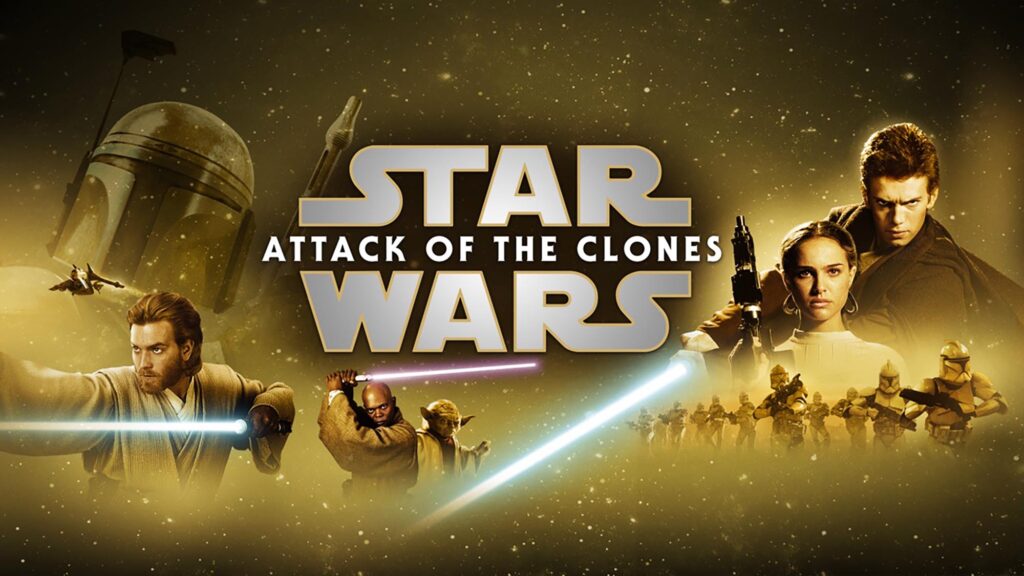
Star Wars: Episode II – Attack of the Clones
Star Wars: Episode II – Attack of the Clones was shot through a mix of studio production in Australia and location work in Tunisia, Italy and Spain.