
Roy Scheider was an American actor born Roy Richard Scheider on 10 November 1932 in Orange, New Jersey. His father, Roy Bernhard Scheider, was an automobile mechanic of German descent, while his mother, Anna Crosson, came from an Irish Catholic family. He grew up in northern New Jersey and developed a strong interest in sports during childhood, particularly baseball and boxing. Although he suffered from recurring health problems when he was young, he became an accomplished athlete during his teenage years. He attended Columbia High School in Maplewood, graduating in 1950, and competed in amateur boxing tournaments around New Jersey. During one fight, his nose was broken, leaving the distinctive facial appearance that would later become familiar to cinema audiences. He participated in the Diamond Gloves boxing tournament in Elizabeth and competed as a welterweight, although he eventually abandoned boxing in favour of education and acting.
After leaving high school, Scheider studied at Rutgers University in New Jersey and Franklin & Marshall College in Lancaster, Pennsylvania. He graduated from Franklin & Marshall in 1955 with a degree in history, initially intending to pursue a career in law. Instead, he entered the United States Air Force, serving from 1955 to 1958 and reaching the rank of first lieutenant. He subsequently remained in the Air Force Reserve while reconsidering his professional future. After completing his active military service, he returned to theatre and appeared in a college production of Richard III, which helped persuade him to pursue acting seriously. In 1961, Scheider made his professional theatrical debut as Mercutio in William Shakespeare’s Romeo and Juliet at Joseph Papp’s New York Shakespeare Festival. He continued working with classical and contemporary material throughout the decade, establishing himself in New York’s theatre community before achieving recognition in cinema.
Scheider’s early stage work included Ben Jonson’s The Alchemist, performed at the Gate Theatre in New York in 1964, and John Arden’s Sergeant Musgrave’s Dance in 1966. He also appeared on Broadway in The Chinese Prime Minister (1964) and Tartuffe (1965), gaining experience in productions that brought him into contact with established American actors and directors. A particularly important role came in Stephen D., Hugh Leonard’s theatrical adaptation of material drawn from James Joyce’s writings. The production was staged at the East 74th Street Theatre in Manhattan, and Scheider’s performance earned him an Obie Award in 1968. By this stage, he had spent several years developing a reputation as a serious stage actor, although his screen career remained limited. His first feature-film appearance had been in the low-budget horror production The Curse of the Living Corpse (1964), directed by Del Tenney, in which he played Philip Sinclair. During the same period, Scheider married Cynthia Bebout in November 1962. The couple welcomed their daughter, Maximillia, in July 1963, while Scheider continued balancing family responsibilities with the uncertainty of theatrical employment.
His screen career developed more substantially towards the end of the 1960s. He appeared in the crime thriller Stiletto (1969), followed by Loving (1970) and Jerry Schatzberg’s psychological drama Puzzle of a Downfall Child (1970), starring Faye Dunaway as a former fashion model recalling her experiences in the industry. Scheider played Mark, a businessman involved in her personal history. The following year, he appeared opposite Jane Fonda and Donald Sutherland in Alan J. Pakula’s Klute (1971), playing Frank Ligourin, a former lover of Fonda’s character who becomes connected to a missing-person investigation. The film was shot extensively in New York City, where its urban locations and interiors contributed to the atmosphere of the story. Scheider’s supporting performance attracted wider attention and helped establish him in American cinema after nearly a decade of professional theatre work.
His breakthrough came with William Friedkin’s crime thriller The French Connection (1971), in which he played Detective Buddy Russo, the comparatively restrained partner of Gene Hackman’s aggressive narcotics investigator Jimmy “Popeye” Doyle. Based on a real New York drug investigation, the film was shot extensively on location in Manhattan, Brooklyn and the Bronx, using actual streets, businesses and public transport facilities rather than relying entirely on studio sets. Among the locations were Little Italy, the Lower East Side and the elevated railway along New Utrecht Avenue in Brooklyn, where the production staged its celebrated car chase beneath a moving subway train. Additional filming took place in Marseille, France, reflecting the international heroin-smuggling operation at the centre of the investigation. Scheider’s performance earned him an Academy Award nomination for Best Supporting Actor, while the film won five Oscars, including Best Picture, Best Director and Best Actor for Hackman. The success established Scheider as a leading character actor, particularly suited to the realistic crime dramas that became prominent in American cinema during the 1970s.
Following The French Connection, Scheider starred in The Seven-Ups (1973), a police thriller directed by Philip D’Antoni, who had previously produced both The French Connection and Bullitt (1968). Scheider played Buddy Manucci, the leader of an unconventional New York police unit investigating a series of kidnappings involving organised crime figures. Production took place entirely around New York City and neighbouring New Jersey, including locations in Manhattan, the Bronx, Brooklyn and the Hudson River waterfront. The film’s elaborate car chase was staged through the streets of Upper Manhattan, including sections of Broadway and other roads around Washington Heights, before continuing north towards the George Washington Bridge. Additional scenes were filmed around Mosholu Parkway in the Bronx and the waterfront at Weehawken, New Jersey. The production again relied heavily on actual urban environments, giving Scheider another opportunity to portray a detective operating within the streets and institutions of New York. The Seven-Ups became an important continuation of his work in police thrillers and led to further leading roles in major studio productions.
The defining role of Scheider’s film career came when Steven Spielberg cast him as Police Chief Martin Brody in Jaws (1975), adapted from Peter Benchley’s bestselling novel. Brody is a former New York police officer who has moved with his family to the fictional island community of Amity, only to discover that a great white shark is attacking swimmers along its beaches. Scheider starred alongside Robert Shaw as the shark hunter Quint and Richard Dreyfuss as marine biologist Matt Hooper, with Lorraine Gary playing Brody’s wife, Ellen. Principal photography began in May 1974 on Martha’s Vineyard, an island off the coast of Massachusetts that Spielberg selected for its traditional New England coastal communities and relatively shallow surrounding waters. The town of Edgartown represented Amity, with filming around Main Street, North Water Street, the harbour and the local ferry terminal. The production used an actual waterfront building as the exterior of the police station, while other businesses were temporarily altered to represent establishments in the fictional town.
Several of the most recognisable scenes in Jaws were filmed at Joseph Sylvia State Beach, between Edgartown and Oak Bluffs, where Brody witnesses a shark attack on a young boy while attempting to protect the crowded beach. The production also used the American Legion Memorial Bridge, crossing the tidal channel into Sengekontacket Pond, for the sequence in which Brody’s son narrowly escapes another shark attack. Menemsha, a fishing village on the western side of Martha’s Vineyard, supplied the harbour where Quint keeps his boat, the Orca, and prepares for the expedition to kill the shark. Much of the final section of the film was shot aboard the vessel in the Atlantic Ocean, where Scheider, Shaw and Dreyfuss worked under difficult conditions involving unpredictable weather, mechanical failures and repeated delays. Spielberg insisted on filming extensively at sea, a decision that substantially increased the production’s complexity. Scheider’s famous line, “You’re gonna need a bigger boat”, was developed during filming and became one of the most recognisable quotations in American cinema.
The production of Jaws lasted considerably longer than originally planned, with filming extending from May until October 1974. Technical problems with the mechanical sharks repeatedly interrupted work, while the combination of open water and changing weather made maintaining continuity particularly difficult. Scheider later recalled the physical demands of working on the production, although he also recognised that the technical difficulties had encouraged Spielberg to develop alternative ways of creating suspense. Jaws was released on 20 June 1975 and became the highest-grossing film in cinema history at that time, establishing the modern model of the summer blockbuster. The success transformed Scheider into an internationally recognised leading actor and established a lasting connection between his image and the fictional police chief. The coastal communities of Martha’s Vineyard subsequently became among the most recognisable filming locations in American cinema, while Scheider’s association with the character continued through the remainder of his career.
Scheider followed Jaws with John Schlesinger’s political thriller Marathon Man (1976), starring Dustin Hoffman and Laurence Olivier. He played Henry “Doc” Levy, the older brother of Hoffman’s character, a graduate student who becomes involved in a conspiracy concerning stolen diamonds and a former Nazi war criminal. The film was shot in New York City, Paris and Los Angeles, with Scheider appearing in sequences that connect the American intelligence operation to the international conspiracy. One of his most important scenes, involving a confrontation with Olivier’s character, was filmed at Arco Plaza on South Flower Street in Downtown Los Angeles, although the story itself takes place primarily in New York. Other locations included Central Park, Columbia University and the historic streets around Manhattan’s Diamond District, while French sequences were filmed around the Palais-Royal and other Parisian landmarks. Marathon Man became another successful thriller and continued Scheider’s association with filmmakers interested in political corruption, intelligence operations and characters operating within morally compromised institutions.
His next collaboration with William Friedkin was considerably more demanding. Sorcerer (1977), a new adaptation of Georges Arnaud’s novel The Wages of Fear, follows four men hiding in a remote Latin American community who are hired to transport unstable explosives through dangerous mountain terrain. Scheider played Jackie Scanlon, an American criminal living under an assumed identity after fleeing the United States. Principal photography took place in the Dominican Republic during 1976, particularly around Villa Altagracia, where the production transformed an existing settlement into the fictional village of Porvenir. The remote location, tropical heat and difficult roads created serious problems for the cast and crew, while the elaborate action sequences required months of preparation. The production also filmed in Mexico, including a dangerous sequence involving trucks crossing a damaged suspension bridge above a river near Tuxtepec. The bridge had originally been constructed in the Dominican Republic but was rebuilt in Mexico after the river beneath it unexpectedly receded. Other scenes used locations in New Jersey, Paris, Jerusalem and the Bisti Badlands of New Mexico. Sorcerer was released shortly after Star Wars (1977) and performed poorly at the box office, although it subsequently developed a substantial reputation among critics and film enthusiasts.
Scheider returned to the role of Martin Brody in Jaws 2 (1978), directed by Jeannot Szwarc. The sequel follows another series of shark attacks around Amity, with Brody increasingly convinced that the community faces a new danger. Production began on Martha’s Vineyard in June 1977, returning to Edgartown and other locations associated with the original film. Much of the subsequent filming, however, took place around Navarre Beach and Okaloosa Island on the Florida Panhandle, where the warmer Gulf of Mexico waters provided more manageable conditions for the mechanical shark equipment and underwater scenes. The production established its headquarters at a beachfront Holiday Inn in Navarre, where Scheider and other members of the cast and crew stayed during filming. Although Jaws 2 was commercially successful, Scheider did not return for the later sequels. He continued seeking roles that would allow him to move beyond the image of a police officer confronting extraordinary circumstances.
One of the most important opportunities of his career came when director and choreographer Bob Fosse cast him as Joe Gideon in All That Jazz (1979), a semi-autobiographical musical drama inspired by Fosse’s experiences of working in theatre and cinema. The character is a successful Broadway director and choreographer whose exhausting professional commitments, relationships and deteriorating health become increasingly intertwined. Scheider had limited professional dance experience and underwent extensive physical preparation to perform alongside experienced dancers and musical theatre performers. Fosse insisted on long rehearsals and precise choreography, and Scheider later described the production as one of the most demanding experiences of his acting career. Filming took place in New York City between October 1978 and February 1979, using actual theatres, rehearsal spaces, hospitals and studios. The opening audition sequence was filmed at the Palace Theatre on Broadway, while other scenes used Pace University in Lower Manhattan and hospital facilities in Brooklyn. Major studio sequences were completed at Kaufman Astoria Studios in Queens, where the production could accommodate elaborate musical numbers and complicated camera movements.
All That Jazz premiered in December 1979 and earned widespread critical recognition for its unconventional combination of musical performance, psychological drama and autobiographical material. Scheider received his second Academy Award nomination, this time for Best Actor, and also earned Golden Globe and BAFTA nominations. The film won four Oscars and shared the Palme d’Or at the 1980 Cannes Film Festival with Akira Kurosawa’s Kagemusha. Scheider later described Joe Gideon as his favourite screen role, partly because it had required him to develop skills and approaches to performance that differed considerably from his earlier crime thrillers. The success also brought renewed attention to his theatrical background and demonstrated that he could convincingly portray an obsessive and self-destructive artist rather than the police officers and government agents with whom he had become associated.
During this period, Scheider returned to Broadway, appearing opposite Blythe Danner and Raul Julia in Peter Hall’s 1980 production of Harold Pinter’s Betrayal. His performance earned recognition from the Drama League, continuing his long association with New York theatre. His film work included Jonathan Demme’s psychological thriller Last Embrace (1979), in which he played a government agent recovering from a nervous breakdown, and Robert Benton’s Still of the Night (1982), opposite Meryl Streep. The latter was filmed in New York City and the surrounding region, with its story involving a psychiatrist investigating the circumstances surrounding a patient’s murder. Scheider continued alternating between leading roles and supporting performances, although the changing commercial priorities of Hollywood increasingly favoured large-scale action and science-fiction productions rather than the character-driven thrillers that had established his reputation.
He returned to action cinema with Blue Thunder (1983), directed by John Badham and co-starring Malcolm McDowell, Warren Oates and Candy Clark. Scheider played Frank Murphy, a Los Angeles police helicopter pilot who discovers that an experimental aircraft has been developed for domestic surveillance and military operations. The production was filmed extensively around Los Angeles between October 1981 and January 1982, using actual city streets, rooftops and public buildings for its aerial sequences. Locations included the Los Angeles Police Department’s Hooper Heliport, represented by the newly constructed air-support facility near Downtown, and the Bunker Hill district, where helicopters flew between high-rise buildings. Other scenes were filmed around Elysian Park, Little Tokyo and the former Pickwick Drive-In Theatre in Burbank. The production combined real helicopter photography with elaborate miniature work and studio effects, allowing Scheider to portray a pilot involved in increasingly dangerous aerial confrontations. Blue Thunder became a commercial success and introduced him to another generation of action-film audiences.
Scheider subsequently starred as Dr Heywood Floyd in Peter Hyams’s science-fiction film 2010: The Year We Make Contact (1984), a sequel to Stanley Kubrick’s 2001: A Space Odyssey (1968). The production also featured John Lithgow, Helen Mirren and Bob Balaban, with Scheider portraying the scientist responsible for returning to Jupiter to investigate the fate of the earlier expedition. Principal photography took place at MGM Studios in Culver City, California, where elaborate spacecraft interiors and control rooms were constructed. The production also used the Very Large Array radio telescope facility near Socorro, New Mexico, for the film’s opening sequence, with further location work in Washington, D.C., and Rancho Palos Verdes, California. Scheider’s character provided a human perspective within a story involving technological advancement, international political tensions and unexplained extraterrestrial phenomena. Although 2010 did not achieve the historical reputation of Kubrick’s original film, it extended Scheider’s experience of working with elaborate visual effects and large-scale science-fiction production.
His other films during the middle and late 1980s included 52 Pick-Up (1986), a crime thriller directed by John Frankenheimer and based on an Elmore Leonard novel, and Cohen and Tate (1988), in which he portrayed an experienced contract killer working alongside a younger, unstable criminal played by Adam Baldwin. During this period, Scheider’s marriage to Cynthia Bebout came to an end, with the couple divorcing in 1986. He subsequently developed a relationship with actress and documentary filmmaker Brenda Siemer, whom he married on 11 February 1989. They had a son, Christian, born in 1990, and adopted a daughter, Molly. The family increasingly divided its time between professional commitments in Los Angeles and New York, with Scheider eventually establishing a long-term residence on eastern Long Island. His involvement in community organisations became an important part of his personal life, particularly as his children grew older.
Scheider continued working internationally with The Fourth War (1990), another collaboration with John Frankenheimer. He played Colonel Jack Knowles, an American military officer stationed near the border between West Germany and Czechoslovakia during the final years of the Cold War. The film also starred Jürgen Prochnow as a Soviet officer whose personal rivalry with Knowles threatens to develop into a larger military confrontation. Although the story takes place in Central Europe, the production was shot primarily in Alberta, Canada, including locations around Calgary, Canmore and Bragg Creek. The Rocky Mountains and surrounding forests represented the border landscape, while several institutional buildings in Calgary were used to recreate American military facilities. Filming took place during the winter of 1989, when unusually low temperatures made outdoor action sequences difficult. Scheider suffered a cracked rib during a fight sequence, while Prochnow sustained a knee injury. The film was released shortly after the fall of the Berlin Wall, when the political circumstances depicted in its screenplay were rapidly changing.
That same year, Scheider appeared in Fred Schepisi’s espionage drama The Russia House (1990), adapted from John le Carré’s novel and starring Sean Connery and Michelle Pfeiffer. He played Russell, an American intelligence officer involved in an investigation concerning Soviet military information. The production was historically significant because it was among the first major American films permitted to shoot extensively in the Soviet Union. Principal photography took place in Moscow and Leningrad, now St Petersburg, during the autumn of 1989, with locations including Red Square, the Hermitage Museum, the Moscow Metro and the city’s historic hotels. Additional sequences were filmed in Lisbon, London and on Bowen Island near Vancouver, British Columbia. The international production took place shortly before the collapse of the Soviet Union, giving the finished film a direct connection to the final years of the Cold War. Scheider subsequently appeared as Dr Benway in David Cronenberg’s Naked Lunch (1991), an adaptation of William S. Burroughs’s experimental novel. Although the story includes a fictionalised North African city inspired by Tangier, most of the production was filmed in Toronto, Canada, using studio sets constructed inside a former industrial building. His character was a sinister physician involved in the protagonist’s increasing dependence on drugs and the bizarre world surrounding him.
During the early 1990s, Scheider increasingly returned to television. His most significant role was Captain Nathan Bridger in SeaQuest DSV (1993–1996), a science-fiction adventure series created by Rockne S. O’Bannon and executive produced by Steven Spielberg. Set in a future where underwater exploration and international politics have become increasingly important, the series follows the crew of an advanced submarine designed for scientific research and military operations. Scheider played Bridger, a former naval officer and engineer who reluctantly agrees to command the vessel. The first season was filmed primarily in Los Angeles, with elaborate submarine interiors constructed at Universal Studios. In 1994, production relocated to Universal Studios Florida in Orlando, where additional sets were built and location filming took place around central Florida. Some episodes used Florida Southern College in Lakeland, the University of Central Florida and facilities around SeaWorld Orlando. The series also starred Jonathan Brandis, Stephanie Beacham, Ted Raimi and Don Franklin.
SeaQuest DSV initially attracted considerable attention for its combination of marine science, futuristic technology and family-oriented adventure, but the programme underwent significant changes during its second season. Scheider became increasingly dissatisfied with the emphasis on more elaborate fantasy storylines and the abandonment of the comparatively realistic scientific premise that had originally interested him. He publicly criticised the direction of the series and eventually requested to leave. The third season, retitled SeaQuest 2032, introduced Michael Ironside as Captain Oliver Hudson, while Scheider made a smaller number of appearances to complete his contractual obligations. The series ended in 1996 after three seasons. Although his relationship with the production had become difficult, SeaQuest remained his most substantial regular television role and introduced him to an audience that had not necessarily seen his earlier cinema work.
Scheider continued accepting film roles during the 1990s, including the crime thriller Romeo Is Bleeding (1993), starring Gary Oldman, and the independent family drama The Myth of Fingerprints (1997), directed by Bart Freundlich. In the latter, he played Hal, the emotionally distant father of a family gathering for Thanksgiving at their home in New England. The film starred Julianne Moore, Noah Wyle and Blythe Danner, with much of the production shot around New York State and Connecticut. Scheider received an Independent Spirit Award nomination for Best Supporting Male for his performance. He also appeared in Francis Ford Coppola’s The Rainmaker (1997), an adaptation of John Grisham’s novel starring Matt Damon, Danny DeVito and Claire Danes. Scheider portrayed Wilfred Keeley, the chief executive of an insurance company accused of denying legitimate medical claims. The film was shot primarily around Memphis, Tennessee, where the city’s courthouses, offices and residential neighbourhoods supplied the setting for the legal drama. These productions allowed Scheider to return to relatively restrained character roles after several years working in large-scale science fiction and television.
His personal life became increasingly centred on eastern Long Island during this period. In 1994, Scheider had a family home constructed in Sagaponack, a community in the Hamptons, where he lived with Brenda Siemer and their children. The property stood on several acres of land and provided a base away from the major film studios. Scheider became involved in local educational and environmental organisations, and he and his wife were among the founders of the Hayground School in Bridgehampton. Established as an alternative educational institution, the school emphasised creative learning, community participation and a more individual approach to education. Scheider served on its governing board and remained involved in discussions concerning education and development on Long Island. His political interests had developed much earlier, particularly during the Vietnam War, when he participated in anti-war activities. He continued opposing American military interventions and became involved in environmental campaigns concerning development and land conservation in the Hamptons.
His activism attracted renewed attention during the preparations for the American invasion of Iraq in 2003. Scheider participated in demonstrations against the war, including protests in New York City and on Long Island. During one demonstration, he joined activists lying across a public road to symbolise civilian casualties, an action that reflected his willingness to engage directly in political protest rather than limit his involvement to public statements. He also supported local environmental campaigns and community organisations, particularly those concerned with preserving the character of eastern Long Island. Although he continued working professionally, these activities became an increasingly visible part of his life away from Hollywood. His relationship with the Hamptons extended beyond its association with wealthy holiday homeowners and the entertainment industry, involving participation in local schools, public meetings and community debates.
Scheider’s later film appearances included the science-fiction thriller The Doorway (2000), the television drama King of Texas (2002) and the horror sequel Dracula II: Ascension (2003). He also appeared in Jonathan Hensleigh’s The Punisher (2004), an adaptation of the Marvel Comics character starring Thomas Jane as Frank Castle and John Travolta as crime boss Howard Saint. Scheider played Frank Castle Sr., the protagonist’s father, whose death forms part of the violent attack that drives Castle’s subsequent campaign of revenge. The production was filmed in and around Tampa, Florida, during 2003, with the city’s industrial waterfront, residential streets and surrounding coastline providing much of the setting. The scenes involving the Castle family were filmed around the Tampa Bay area rather than in Puerto Rico, where the attack occurs in the story. Scheider also continued appearing on television, including a recurring role in the emergency-services drama Third Watch in 2002 and a guest appearance in Law & Order: Criminal Intent in 2007.
During the middle of the 2000s, Scheider developed serious health problems. He was diagnosed with multiple myeloma, a cancer affecting plasma cells in the bone marrow, in late 2004. He began receiving specialist treatment at the University of Arkansas for Medical Sciences in Little Rock, Arkansas, where the Myeloma Institute for Research and Therapy had established an international reputation. In June 2005, he underwent a bone marrow transplant and subsequently continued receiving treatment while attempting to maintain his professional commitments. The illness was accompanied by a devastating personal loss when his eldest daughter, Maximillia Connelly Lord, died of leukaemia on 2 August 2006, aged forty-three. Despite his own diagnosis, Scheider continued accepting acting roles and participating in community activities whenever his condition permitted. In 2007, he announced plans to sell the family’s Sagaponack property and relocate to nearby Sag Harbor, where he had maintained longstanding personal and professional connections.
One of his final completed productions was If I Didn’t Care (2007), an independent crime thriller directed by Ben and Orson Cummings and set in the Hamptons. Scheider played Linus, a local investigator drawn into a complicated relationship involving adultery, deception and murder. The film’s Long Island setting gave him an opportunity to work in a region where he had lived for many years. He also travelled to Poland during 2007 to participate in Joshua Newton’s thriller Iron Cross, later released under the title Beautiful Blue Eyes. Scheider portrayed Joseph, a retired New York police detective and Holocaust survivor who becomes convinced that an elderly man living in Germany is responsible for the murder of his family during the Second World War. The production filmed in Kraków and other Polish locations, with Scheider photographed near Wawel Castle in April 2007. Although the story involves Germany, much of the historical material and contemporary action was recreated in Poland. The film became particularly significant because it was Scheider’s final screen role, and he died before all planned production work had been completed.
Following Scheider’s death, director Joshua Newton continued working on Iron Cross, using a combination of existing footage, doubles and visual effects to complete scenes that had not been filmed. The production underwent an extended period of editing and distribution difficulties before receiving limited screenings under its original title. It was subsequently reworked and released as Beautiful Blue Eyes in 2022, bringing Scheider’s final performance to audiences more than fourteen years after his death. The film’s subject matter, involving the consequences of wartime persecution and the search for justice, also reflected his interest in historical and political issues. Although he had spent much of his earlier career playing detectives, police officers and other authority figures, the role of Joseph centred on the experiences of an ageing man confronting personal trauma rather than a conventional crime investigation.
Roy Scheider died on 10 February 2008 at the University of Arkansas for Medical Sciences Medical Center in Little Rock, Arkansas, aged seventy-five. He had been receiving treatment for multiple myeloma for more than three years and developed a fatal staphylococcal infection following complications associated with the disease. His death was announced by the hospital and confirmed by his family. He was survived by his wife, Brenda Siemer, their son Christian and their adopted daughter Molly. His death attracted tributes from filmmakers and actors including Richard Dreyfuss, who had worked alongside him on Jaws and remembered his professionalism and dedication to acting.
Scheider’s career had begun in the theatres of New York before extending into some of the most significant American films of the 1970s. His work with directors including William Friedkin, Steven Spielberg, Bob Fosse, John Schlesinger, David Cronenberg and Francis Ford Coppola took him from the streets of Manhattan and the beaches of Martha’s Vineyard to remote tropical locations, European cities and major film studios across North America. New Jersey remained the place of his birth and education, while New York City became the centre of his theatrical development and many of his early film roles. In later life, Sagaponack and Sag Harbor provided a family home and a community in which he became increasingly involved. His performances in The French Connection, Jaws and All That Jazz remained his most widely recognised achievements, representing three very different approaches to acting within the American cinema of the 1970s.
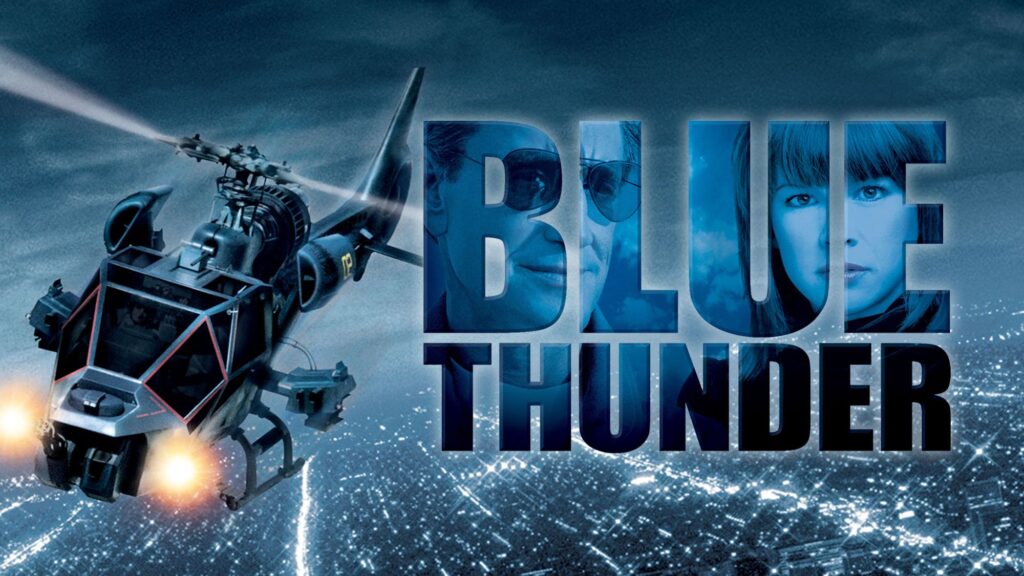
Blue Thunder
Blue Thunder was filmed around Los Angeles, using the city’s rooftops, streets, freeways, river channels and skyline as part of the action.

Jaws
Jaws was shot mainly on Martha’s Vineyard in Massachusetts, and the island is absolutely central to its identity.