
Jackie Chan (born 7 April 1954) is a Hong Kong actor, martial artist, film director, producer and stunt performer known for Drunken Master (1978), Project A (1983), Police Story (1985), Armour of God (1986), Rumble in the Bronx (1995), Who Am I? (1998), Rush Hour (1998), Shanghai Noon (2000), The Karate Kid (2010) and The Foreigner (2017). Born in British Hong Kong, he spent most of his childhood training at a traditional Chinese opera school before working as a stuntman in the territory’s rapidly expanding film industry. His career eventually took him from Hong Kong to Australia, Europe, Africa and North America, where he became one of the most internationally recognised Asian film stars. Known for combining martial arts with physical comedy and elaborate stunt sequences, Chan has frequently used actual streets, buildings and natural landscapes as the settings for his action scenes. His work has taken him to locations ranging from the shopping centres of Hong Kong and historic European castles to the deserts of Namibia and the skyscrapers of Rotterdam. He received an Honorary Academy Award in 2016 in recognition of his contributions to international cinema.
Chan was born Chan Kong-sang on Victoria Peak, Hong Kong Island, to Charles and Lee-Lee Chan, who had fled mainland China during the political upheavals surrounding the Chinese Civil War. His father, originally named Fang Daolong, had worked in intelligence and other occupations before moving to Hong Kong, where he adopted the surname Chan. His mother had also experienced considerable hardship before establishing a new life in the British colony. The couple found employment at the residence of the French consul on Victoria Peak, with Charles working as a cook and Lee-Lee as a housekeeper. Their son spent his earliest years within the grounds of the residence, situated in one of Hong Kong’s most prestigious residential districts overlooking Victoria Harbour. Despite their surroundings, the family had limited financial resources, and Chan later recalled that his parents had difficulty paying the hospital expenses associated with his birth. He was nicknamed Pao-pao, meaning Cannonball, because of his energetic behaviour as a young child.
His first experience of formal education was at Nah-Hwa Primary School on Hong Kong Island, but he struggled academically and failed his first year. In 1960, his parents accepted employment at the United States Embassy in Canberra, Australia, where Charles would eventually become head cook at the American ambassador’s residence. Rather than take their son to Australia, they enrolled him at the China Drama Academy in Kowloon, a traditional Peking opera school operated by Yu Jim-yuen. Chan was approximately seven when he began studying there, entering a demanding training programme that would occupy the next decade of his life. The academy operated in modest facilities associated with the Lai Chi Kok Amusement Park, where its students learned acrobatics, martial arts, singing, acting and stage combat. Lessons began early in the morning and often continued late into the evening. Physical discipline was severe, and students were expected to perform exercises repeatedly until they achieved the required precision. Chan became one of the school’s most accomplished pupils, eventually joining the Seven Little Fortunes, a performing troupe whose members included Sammo Hung and Yuen Biao. The three developed a friendship and working relationship that would continue throughout their adult careers.
The academy provided accommodation as well as education, and Chan spent much of his childhood separated from his parents, who remained in Canberra. Its training emphasised traditional Chinese theatrical performance rather than the realistic fighting styles later associated with Hong Kong action cinema. Students learned to combine movement, rhythm and carefully choreographed physical contact, often performing acrobatics and staged fights for audiences. They also began appearing as extras in films, taking advantage of the close relationship between opera schools and Hong Kong’s expanding entertainment industry. Chan made an early screen appearance in Big and Little Wong Tin Bar (1962), followed by minor roles in other Cantonese productions. By the time he left the academy in 1971, he had spent approximately ten years developing the physical skills that would define his career. He initially worked in Hong Kong as a stuntman, appearing in several martial arts films produced during the early 1970s. Among the most important were Bruce Lee’s Fist of Fury (1972) and Enter the Dragon (1973), in which Chan performed supporting action work. During Fist of Fury, he doubled an actor in a sequence requiring him to be kicked through the air by Lee, while Enter the Dragon included a brief appearance in which his character is defeated by the film’s star.
Following the completion of his opera training, Chan spent time in Australia with his parents. They were living in Canberra at the official residence of the American ambassador, where Charles and Lee-Lee had become longstanding members of the household staff. Chan stayed in the servants’ quarters and worked in construction, taking jobs at building sites around the Australian capital while the Hong Kong film industry experienced a temporary decline. According to his autobiography, a fellow construction worker named Jack helped him during this period, leading to the nickname Little Jack, subsequently shortened to Jackie. He also spent time improving his English and has been associated with Dickson College, although documentary evidence of formal enrolment there is inconclusive. The experience established a connection with Australia that continued throughout his life. His parents remained in Canberra for decades, and Chan regularly returned to visit them even after becoming internationally famous. The ambassador’s residence later preserved a punching bag that he had used during his visits, along with other reminders of the family’s years in the building.
Chan returned to Hong Kong as employment opportunities in martial arts cinema improved. Producer and director Lo Wei attempted to establish him as a successor to Bruce Lee, casting him in films including New Fist of Fury (1976) and Shaolin Wooden Men (1976). These productions were made largely within Hong Kong’s established film industry, combining studio work with traditional Chinese architectural locations and rural scenery. However, Chan gradually became dissatisfied with the attempts to imitate Lee’s serious screen persona. His breakthrough came through a collaboration with director and martial arts choreographer Yuen Woo-ping on Snake in the Eagle’s Shadow (1978). The film allowed Chan to develop a more humorous fighting style, incorporating improvised movements, clumsiness and comic reactions into traditional kung fu sequences. The partnership continued with Drunken Master (1978), in which he played a fictionalised version of martial artist Wong Fei-hung. Both productions were filmed in Hong Kong and relied heavily on the practical experience of performers trained in traditional opera and martial arts. Their commercial success established Chan as a leading figure in Hong Kong cinema, while demonstrating that he could develop an identity distinct from Bruce Lee.
During the following years, Chan began directing and choreographing his own films. His first major directorial effort was The Fearless Hyena (1979), followed by The Young Master (1980), which brought him into a closer relationship with Golden Harvest, one of Hong Kong’s principal film production companies. The Young Master was filmed using studio facilities and rural locations in the New Territories, with Chan supervising increasingly elaborate martial arts sequences. He simultaneously attempted to establish a career in the United States, appearing in The Big Brawl (1980), a period action film set in Chicago, and subsequently in The Cannonball Run (1981), alongside Burt Reynolds and Roger Moore. Although these films introduced him to American audiences, they did not immediately achieve the success he had enjoyed in Asia. Chan found that Hollywood directors and producers generally expected him to perform conventional martial arts rather than the elaborate physical comedy he had developed in Hong Kong. He therefore continued concentrating on productions in which he could exercise greater control over choreography, editing and the practical design of action sequences.
One of the defining films of this period was Project A (1983), a period adventure set in colonial Hong Kong during the early twentieth century. Chan directed and starred alongside Sammo Hung and Yuen Biao, reuniting three performers who had trained together at the China Drama Academy. The film incorporated elaborate sets recreating Hong Kong’s waterfront districts, narrow streets and colonial institutions, alongside carefully choreographed sequences involving bicycles, ladders and other everyday objects. Its most famous stunt involved Chan falling approximately fifteen metres from a clock tower, striking a series of awnings before reaching the ground. The sequence was inspired partly by the silent-film comedian Harold Lloyd, whose elaborate physical stunts Chan had admired. Rather than relying on a mechanical stunt double or miniature, Chan performed the fall himself, requiring several attempts to achieve the intended result. Project A became one of Hong Kong’s major commercial successes and was followed by Project A Part II (1987), again directed by Chan and filmed in the territory.
He continued developing his approach to location-based action with Police Story (1985), in which he played Hong Kong police inspector Chan Ka-kui. The film made particularly extensive use of the territory’s urban environment, including residential districts, roads and commercial buildings that had undergone rapid development during the preceding decades. The opening action sequence was filmed around a hillside settlement constructed for the production, while the subsequent bus chase used Sui Wo Road in Fo Tan, within the Sha Tin district of the New Territories. Other scenes were filmed at the High Court Building at 38 Queensway in Admiralty and at Goodview Garden in Tuen Mun. The concluding confrontation took place at Wing On Plaza, 62 Mody Road in Tsim Sha Tsui East, Kowloon. The shopping centre’s escalators, balconies and glass display areas were incorporated directly into the fight choreography, culminating in Chan sliding down a tall pole decorated with electric lights. He sustained burns to his hands and other injuries while performing the stunt. Police Story won Best Film at the Hong Kong Film Awards and established a model for the action sequences that would become central to his subsequent productions.
The physical demands of his filmmaking reached a particularly dangerous point during Armour of God (1986), an international adventure in which Chan played a treasure hunter known as Asian Hawk. Filming took place across Europe and North Africa, with important locations in what was then Yugoslavia. Zagreb, now the capital of Croatia, provided several urban settings, including the historic Dolac Market, the Upper Town and streets around the unfinished headquarters of Croatian Radio Television. Other Croatian locations included Motovun in Istria, while Predjama Castle near Postojna, in present-day Slovenia, provided one of the production’s most recognisable historic buildings. The castle, constructed against the entrance of an enormous cave in a limestone cliff, dates largely from the sixteenth century and was particularly suitable for the film’s combination of adventure and medieval architecture. Additional filming took place in Austria, France, Spain and Morocco.
During production in Yugoslavia, Chan suffered one of the most serious accidents of his career. A sequence required him to jump from a wall onto a tree branch, but during a second attempt the branch broke and he fell onto rocks below. He fractured his skull and required emergency surgery, leaving him with a permanent injury and partial hearing loss in his right ear. Filming was interrupted while he recovered, but the production was eventually completed and released in early 1987. The accident reinforced the reputation he had developed for performing dangerous stunts personally, although he increasingly relied on carefully trained teams and more extensive safety preparations. He returned to European locations for Armour of God II: Operation Condor (1991), which incorporated Spanish and Moroccan environments into another international treasure-hunting adventure. By this stage, his productions regularly moved between several countries rather than remaining within Hong Kong’s established studio system.
Chan also continued expanding the Police Story series. Police Story 2 (1988) returned him to Hong Kong’s commercial and industrial districts, while Police Story 3: Supercop (1992), directed by Stanley Tong and co-starring Michelle Yeoh, took the series into mainland China and Malaysia. The production filmed in Hong Kong, Guangzhou, Shanghai and Kuala Lumpur, where the final action sequences incorporated actual urban roads and railway infrastructure. Yeoh performed a particularly dangerous motorcycle stunt involving a moving train, while Chan’s sequences included a helicopter pursuit through the Malaysian capital. The use of genuine buildings and transport facilities was central to the series’ identity, with the actors and stunt performers adapting their movements to locations rather than constructing every environment around predetermined action sequences. Another notable production was Crime Story (1993), directed by Kirk Wong. The film was shot in Hong Kong and Taiwan, including footage inside the abandoned Kowloon Walled City shortly before its demolition. Once an extraordinarily dense urban settlement containing thousands of apartments and businesses within a relatively small area, the Walled City had been cleared of residents by the early 1990s. Its empty buildings provided the filmmakers with an opportunity to stage explosions and action sequences in an environment that would soon disappear completely. The site was subsequently redeveloped as Kowloon Walled City Park, preserving fragments of its earlier history.
Chan’s longstanding connection with Australia became especially important during the middle of the decade. Police Story 4: First Strike (1996) began with scenes set in Eastern Europe before moving to Australia, where much of the action was filmed. The production worked around Brisbane, the Gold Coast and the Sunshine Coast in Queensland, including Chinatown Mall in Fortitude Valley and Underwater World at Mooloolaba. The snowy Eastern European sequences were partly filmed at Falls Creek in the Victorian Alps, where the resort’s slopes and surrounding mountains represented terrain much farther north. Chan participated in extensive skiing and action sequences during the production, while local winter sports professionals assisted with the difficult outdoor work. In 1996, the Australian city of Melbourne also became the principal setting for Mr. Nice Guy (1997), directed by Sammo Hung. The film used actual locations around Melbourne’s central business district, including Swanston Street and Melbourne Central shopping centre. The latter incorporates Coop’s Shot Tower, a nineteenth-century industrial building preserved beneath a modern glass roof. Other scenes used locations in Queensland and the Hunter Valley in New South Wales. The Australian productions were personally significant because the country had been his parents’ home for decades and had provided him with employment before his breakthrough in cinema.
His international reputation had grown considerably during the 1980s, but Rumble in the Bronx (1995) finally established him as a major commercial star in North America. Directed by Stanley Tong, the film follows a Hong Kong visitor who becomes involved in a conflict with street criminals in New York. Despite its title and fictional Bronx setting, the production was filmed primarily in Vancouver, British Columbia. The filmmakers selected streets in Gastown and other parts of downtown Vancouver that could resemble older New York neighbourhoods, temporarily altering shopfronts, signs and other details. Scenes were photographed along West Hastings Street, including the blocks around numbers 47–55 and 78–84, while the surrounding commercial and industrial districts provided locations for the film’s elaborate street fights and vehicle pursuits. One of the most unusual geographical features is the presence of mountains in the background of several scenes, an unmistakable indication that the film was made in Vancouver rather than New York. During production, Chan seriously injured his ankle while performing a stunt but continued filming with a specially adapted cast. The film was released in Hong Kong in 1995 and received its American release the following year, becoming a major success and introducing his work to a considerably wider audience.
His next major international production, Who Am I? (1998), took him to southern Africa and the Netherlands. Chan co-directed the film with Benny Chan and played a special forces operative suffering from amnesia after a mission goes wrong. Principal photography took place in 1997, using locations in Namibia, South Africa and the Netherlands. The African sections incorporated desert landscapes and locations around Johannesburg and Sun City, while the European sequences were filmed extensively in Rotterdam. The city was particularly suitable for the production because of its modern architecture, large commercial buildings and extensive road network. The filmmakers used the Erasmus Bridge, Coolsingel, the Cube Houses near Blaak and the Beurstraverse shopping passage, commonly known as the Koopgoot.
The film’s most famous stunt was performed at the Willemswerf office building on Boompjes, beside the River Nieuwe Maas. Constructed during the 1980s, the building has a distinctive sloping glass façade overlooking the waterfront. Chan climbed onto the exterior and slid down its steep surface during an escape sequence, performing the stunt at considerable height above the street. Additional Rotterdam locations included the Alexandrium shopping centre and surrounding car parks, while the nearby city of Dordrecht supplied streets and public spaces for other scenes. The building stunt became one of his most celebrated practical achievements and remains closely associated with Rotterdam’s film history. Unlike many of the fictional locations in his earlier productions, the Willemswerf is a real building whose architectural design directly determined the nature of the action sequence.
Chan’s breakthrough in mainstream Hollywood came with Rush Hour (1998), directed by Brett Ratner and co-starring Chris Tucker. He played Hong Kong police inspector Lee, who travels to Los Angeles to assist with a kidnapping investigation. The film was shot primarily in Los Angeles County between December 1997 and March 1998, using numerous recognisable buildings and neighbourhoods. Its opening sequence was photographed in the industrial waterfront area of San Pedro, while Long Beach Airport represented the terminal where Lee arrives in the United States. The Foo Chow Restaurant at 949 North Hill Street in Chinatown provided the exterior of a criminal meeting place, and the historic Ennis House at 2607 Glendower Avenue in Los Feliz represented the luxurious residence of one of the principal antagonists. Designed by Frank Lloyd Wright and completed in 1924, the house was already well known through appearances in other films. The Chinese Consulate was represented by a mansion at 380 South San Rafael Avenue in Pasadena, while Greystone Mansion in Beverly Hills provided additional interiors. The final action sequences took place at the Los Angeles Convention Center, with the large exhibition halls transformed for the fictional presentation of Chinese cultural treasures.
Rush Hour was a substantial international success and established Chan and Tucker as a popular screen partnership. The sequel, Rush Hour 2 (2001), brought both actors to Hong Kong, where the production used actual streets in Wan Chai, Tsim Sha Tsui and the Central district. A sequence involving traditional bamboo scaffolding was filmed near the junction of Tai Wo Street and Wan Chai Road, while the former Tsim Sha Tsui Police Station at 213 Nathan Road represented a fictional American diplomatic building. Other scenes incorporated the Island Eastern Corridor and the Causeway Bay Typhoon Shelter. The production subsequently moved to Las Vegas, where the former Desert Inn hotel and casino at 3145 Las Vegas Boulevard South represented the fictional Red Dragon casino. The original resort closed in 2000 and was demolished during redevelopment, with the Wynn Las Vegas resort eventually occupying much of the site. Rush Hour 3 (2007) moved the story to Paris, with filming around the Trocadéro, the Eiffel Tower and several historic streets, while additional production took place in Southern California. The three films became among the most commercially successful productions of Chan’s career.
His Hollywood success also opened opportunities in genres outside contemporary crime films. In Shanghai Noon (2000), he starred opposite Owen Wilson in a Western comedy set in the American frontier during the nineteenth century. Rather than filming primarily in Nevada, where much of the story takes place, the production used the Canadian province of Alberta. Locations included the badlands near Drumheller, the countryside around Cochrane and Exshaw, and the CL Ranch southwest of Calgary. The region’s steep eroded hills and open grasslands provided the setting for numerous horseback sequences, while the production also photographed material at the Forbidden City in Beijing. The sequel, Shanghai Knights (2003), moved the fictional story to Victorian London but was filmed largely in the Czech Republic. Principal production took place between February and June 2002, with Barrandov Studios in Prague providing substantial sets and interiors. Other locations included Prague Castle, Hradčany Square, Kampa, the banks of the River Vltava, Kutná Hora and Karlovy Vary. The filmmakers used historic Czech streets and buildings to represent nineteenth-century London, constructing sections of British architecture where necessary. The production also worked at Hluboká Castle in southern Bohemia and other locations outside Prague, bringing Chan into contact with some of Central Europe’s most distinctive historic buildings.
During the same period, Chan appeared in other international productions, including The Tuxedo (2002), filmed mainly in Toronto, and The Medallion (2003), which used locations in Ireland and Thailand. The latter was partly filmed around Dublin, where the production incorporated city streets and harbour areas. Chan returned to Asian historical and fantasy material with The Myth (2005), directed by Stanley Tong. One of its most significant filming locations was Hampi in Karnataka, India, whose extensive ruined temples and monuments were used for sequences involving an archaeological expedition. The production photographed scenes around the Virupaksha Temple, Vittala Temple, Hazara Rama Temple, Matanga Hill and Anjanadri Hill. Hampi, formerly the capital of the Vijayanagara Empire, is a UNESCO World Heritage Site containing numerous surviving structures from the fourteenth to sixteenth centuries. Additional filming took place in China, including Xi’an in Shaanxi province. The use of actual Indian monuments gave the production a geographical range quite different from the studio-created environments of his earlier historical adventures.
As his international career expanded, Chan continued maintaining business interests in Hong Kong and mainland China. He had established his own production operations and had long been involved in the practical training and employment of stunt performers through the Jackie Chan Stunt Team, a group he developed during the 1970s. The team worked across numerous productions, helping design action sequences, train performers and establish safety procedures. Chan also invested in restaurants, cafés, fitness businesses and other commercial ventures. Among them was Jackie’s Kitchen, a restaurant chain that operated outlets in Hong Kong and other Asian cities, and Jackie Chan’s Cafe, which expanded to locations in China and Southeast Asia. Some of these ventures subsequently closed or changed ownership. His business activities increasingly extended into cinema exhibition, and in 2011 he partnered with Sparkle Roll Investment to establish Jackie Chan Cinema in Beijing. The business expanded into a chain of multiplex cinemas in cities across mainland China, reflecting his growing involvement in the distribution and exhibition of films as well as their production.
His personal connection to Australia remained important. His mother, Lee-Lee Chan, died in Canberra in 2002, followed by his father Charles in 2008. Charles had become a familiar figure in the Canberra community after decades working at the American ambassador’s residence and had been visited regularly by his son. His funeral took place in the Australian capital, attended by approximately one hundred people, including diplomatic representatives and former political leaders from the Australian Capital Territory. Both parents were buried at Gungahlin Cemetery in Mitchell, in the northern part of Canberra. The cemetery preserves one of the most personal geographical connections in Chan’s life, linking his family history to the city where his parents had established a permanent home after leaving Hong Kong. Chan has spoken about the importance of Canberra during different stages of his life and has continued returning to Australia for professional and personal visits.
Another major Hollywood production brought him back to China in 2009. In The Karate Kid (2010), directed by Harald Zwart, Chan played Mr Han, a maintenance worker who becomes the martial arts teacher of a young American boy portrayed by Jaden Smith. The film was produced primarily in Beijing, using both actual Chinese locations and studio facilities. Much of the principal work took place at the former Beijing Film Studio, where the filmmakers constructed residential apartments, courtyard houses and narrow hutong streets to represent the neighbourhood where the characters live. The production also used Beijing Luxun Middle School in the Xicheng district, while scenes involving large groups of martial arts students were filmed at the Beijing Shaolin Wushu School in the city’s northern suburbs. Other sequences incorporated the Forbidden City and the Great Wall of China.
The film’s mountain training scenes were photographed at Wudang Shan in Hubei province, an important centre of Chinese Taoist culture and martial arts history. The area’s historic temples, stone staircases and wooded mountain slopes provided locations for the scenes in which Mr Han teaches his pupil more advanced techniques. The production also made use of other Chinese landscapes, including mountainous areas beyond Beijing. Although the film’s title refers to karate, much of the training depicted is based on Chinese kung fu. Chan’s performance was notably restrained compared with his earlier action comedies, and he received critical recognition for portraying an older mentor rather than a conventional action hero. The film became a major international success and introduced him to a younger generation of audiences.
Chan continued directing and starring in Chinese productions during the following decade. Chinese Zodiac (2012), also released as CZ12, returned him to the treasure-hunting character associated with the Armour of God films. The production required filming in France, China, Taiwan, Latvia and Vanuatu, with principal photography beginning in 2011. One particularly unusual location was the Aerodium vertical wind tunnel in Jelgava, Latvia, where Chan filmed sequences requiring him to appear suspended in the air. The facility uses powerful fans to create a controlled column of air suitable for flight training and entertainment. Filming there took place during April and May 2012. The production also used European estates, Chinese urban locations and tropical environments. Chan directed, produced, wrote and performed in the film, taking on numerous responsibilities beyond acting. His work earned recognition from Guinness World Records for the unusually large number of credits held by one person on a single production.
He also expanded his work in mainland China’s film industry, appearing in historical dramas and action films such as 1911 (2011), Police Story 2013 (2013) and Dragon Blade (2015). The latter, a historical adventure involving Roman soldiers in ancient China, used locations and constructed sets in the desert regions of western China. Other films during this period included Skiptrace (2016), which followed an international journey involving Hong Kong, Macau, mainland China and Mongolia. The production used actual Chinese cities and landscapes, incorporating locations in Guangxi and other regions. Kung Fu Yoga (2017) brought Chan back to India, with filming around Jaipur in Rajasthan, including the historic Amer Fort, and at locations in Dubai and China. He continued alternating between major international productions and films produced principally for audiences in China.
One of his most substantial later dramatic performances came in The Foreigner (2017), directed by Martin Campbell and co-starring Pierce Brosnan. Chan played Ngoc Minh Quan, a London restaurant owner seeking justice after his daughter is killed in a terrorist attack. The production was filmed in Britain and Northern Ireland, making extensive use of actual London streets and buildings. An explosion sequence was staged on Lambeth Bridge, crossing the River Thames between Lambeth Palace and the Palace of Westminster, while other scenes were photographed on Churton Street in Pimlico and around the Isle of Dogs. Additional filming took place near Larne in County Antrim, Northern Ireland, where rural properties and countryside roads supplied locations for the sections involving political figures and former militants. The film gave Chan a considerably more serious role than the action comedies that had established his international reputation. It also marked a return to British locations after earlier productions such as The Medallion and Shanghai Knights.
His contribution to cinema was formally recognised in November 2016 when he received an Honorary Academy Award at the Governors Awards in Los Angeles. The ceremony took place in the Ray Dolby Ballroom at the Hollywood & Highland Center, near the Dolby Theatre on Hollywood Boulevard. Chan was honoured for his international career as an actor, director, producer and stunt performer, having worked in hundreds of films since childhood. Tom Hanks, Michelle Yeoh and Chris Tucker were among those who participated in the presentation. The award was particularly significant because martial arts and action comedy had rarely been recognised through the Academy’s major acting categories. Chan had previously received a star on the Hollywood Walk of Fame at 6801 Hollywood Boulevard in October 2002 and had also been honoured on the Avenue of Stars in Tsim Sha Tsui, Hong Kong. The latter waterfront promenade, overlooking Victoria Harbour, commemorates important figures in Hong Kong cinema and includes handprints and statues associated with the local film industry.
Chan’s interests outside cinema have included philanthropy, education and motor racing. In 1988, he established the Jackie Chan Charitable Foundation to support disadvantaged young people and other humanitarian causes. He subsequently created the Dragon’s Heart Foundation, which has helped fund educational facilities in rural China. Through these organisations, he has travelled to remote communities in mainland China to support school construction and other projects. He has also worked with UNICEF and other international organisations on initiatives involving children, health and disaster relief. In 2016, he became involved in endurance motor racing through Jackie Chan DC Racing, established with racing driver David Cheng. The team competed internationally, including at the Circuit de la Sarthe in Le Mans, France, where its two cars finished second and third overall in the 2017 24 Hours of Le Mans. His involvement reflected a longstanding interest in cars and mechanical technology, subjects frequently incorporated into the stunts and vehicle sequences of his films.
Chan has also invested in preserving material associated with his filmmaking career. In 2014, he opened the JC Film Gallery at 88 Yunling East Road in Shanghai’s Putuo district. The exhibition occupied a converted industrial building and displayed costumes, props, photographs and equipment used during his career, together with material documenting his childhood training and numerous stunt injuries. The museum was developed over several years and officially opened shortly after his sixtieth birthday. Its exhibitions included objects from his Hong Kong productions as well as later international films, providing a permanent record of a career whose original filming locations were spread across several continents. The choice of Shanghai also reflected the increasing importance of mainland China to his business and production interests. Unlike the temporary exhibitions frequently organised around major film releases, the gallery was conceived as a dedicated space documenting his life and work.
His family life has largely remained separate from his public career. Chan married Taiwanese actress Joan Lin in Los Angeles in December 1982, shortly before the birth of their son, Jaycee, who was born in the city on 3 December. Lin subsequently reduced her acting commitments, while Chan continued spending much of each year travelling for productions. Jaycee later pursued a career in music and acting, working primarily in Hong Kong and mainland China. Chan also has a daughter, Etta Ng, born in Hong Kong in 1999 from a relationship with actress and former beauty queen Elaine Ng Yi-Lei. His relationship with Etta has been estranged, a subject that has periodically attracted media attention. Although Chan has maintained residential and business interests in Hong Kong, Beijing and other cities, he has generally kept the precise details of his private homes out of public discussion. His career has required lengthy stays in hotels and rented accommodation near filming locations, particularly during international productions, but Hong Kong has remained central to his professional identity.
His later films increasingly reflected his age and the physical consequences of decades spent performing dangerous stunts. In Ride On (2023), directed by Larry Yang, he played Lao Luo, an ageing stunt performer struggling to maintain his relationship with his daughter and his beloved horse. The film was shot at Hengdian World Studios in Dongyang, Zhejiang province, and at Pegasus Watertown in Jiangyin, Jiangsu province. Hengdian is one of China’s largest film production complexes, containing extensive replicas of historic Chinese streets, palaces and other environments. The story incorporated archival footage and references to Chan’s earlier action sequences, giving the production an unusually direct connection with his own career. He subsequently appeared in Hidden Strike (2023), an action film co-starring John Cena, and provided the voice of Master Splinter in the animated film Teenage Mutant Ninja Turtles: Mutant Mayhem (2023).
Chan returned to the role of Mr Han in Karate Kid: Legends (2025), which reunited him with the martial arts franchise fifteen years after The Karate Kid. The film also featured Ralph Macchio, who reprised his role as Daniel LaRusso from the original series. Although much of the story takes place in New York City, principal filming was concentrated in Montreal, Quebec, during the spring and early summer of 2024. The production used streets around Old Montreal and the Old Port, adapting the city’s architecture to represent contemporary Manhattan. Additional filming took place in the United States and other locations, but Montreal provided the principal working environment for Chan and the leading cast. Director Jonathan Entwistle subsequently praised the city’s film crews and the accessibility of its historic districts. The production represented another return to Canada, where Chan had worked on Rumble in the Bronx and Shanghai Noon during the 1990s.
One of his most notable recent action roles came in The Shadow’s Edge (2025), directed by Larry Yang. The crime thriller reunited Chan with Chinese actor Tony Leung Ka-fai and was filmed extensively in Macau, the former Portuguese territory on the southern coast of China. Principal photography began in October 2024, using the city’s combination of historic neighbourhoods, modern casinos and high-rise commercial buildings. Locations included Macau Tower, Wynn Macau and streets around Coloane. The filmmakers selected actual buildings and surrounding roads to accommodate the action sequences, including scenes involving the tower and hotel complex. Macau’s mixture of Chinese and Portuguese architectural influences provided a distinctive setting quite different from the modern urban environment of Hong Kong, where much of Chan’s earlier police work had been filmed. The Shadow’s Edge was released in China in August 2025 and became one of his more commercially successful recent films.
He continued working in Chinese cinema during 2026, appearing in the family comedy Unexpected Family, released in January. The film was shot in Wuhan, Hubei province, where locations included the historic Gude Temple in Hankou and the surrounding East Lake area. The temple, constructed in the late nineteenth century, combines Chinese Buddhist traditions with architectural influences from South and Southeast Asia. Chan also returned to the Panda Plan franchise with Panda Plan: The Magical Tribe, released in February 2026. Filming took place in Yunnan province, particularly around Lincang and Xishuangbanna, using tropical and subtropical environments in southwestern China. The production included scenes at Wengding, a traditional Wa village near the border with Myanmar. These later projects continued his long practice of working in actual communities and landscapes rather than relying entirely on studio interiors.
Jackie Chan’s career remains closely connected to the places where his films were made. The China Drama Academy in Kowloon provided the foundation for his physical abilities, while the former French consul’s residence on Victoria Peak and the American ambassador’s residence in Canberra were important locations during his childhood and early adulthood. Hong Kong’s roads, markets and shopping centres became central to his action filmmaking during the 1980s, while later productions brought him to the castles of Slovenia, the former Kowloon Walled City, the mountains of Victoria, the streets of Vancouver and the glass façade of the Willemswerf in Rotterdam. His Hollywood success added Los Angeles, Las Vegas, the Canadian prairies and numerous European cities to his professional history, while his later work in China returned him to the country where his parents had been born. At 72, he continued working in films, maintaining business and charitable interests across Asia and remaining one of the most internationally recognisable figures in martial arts cinema.
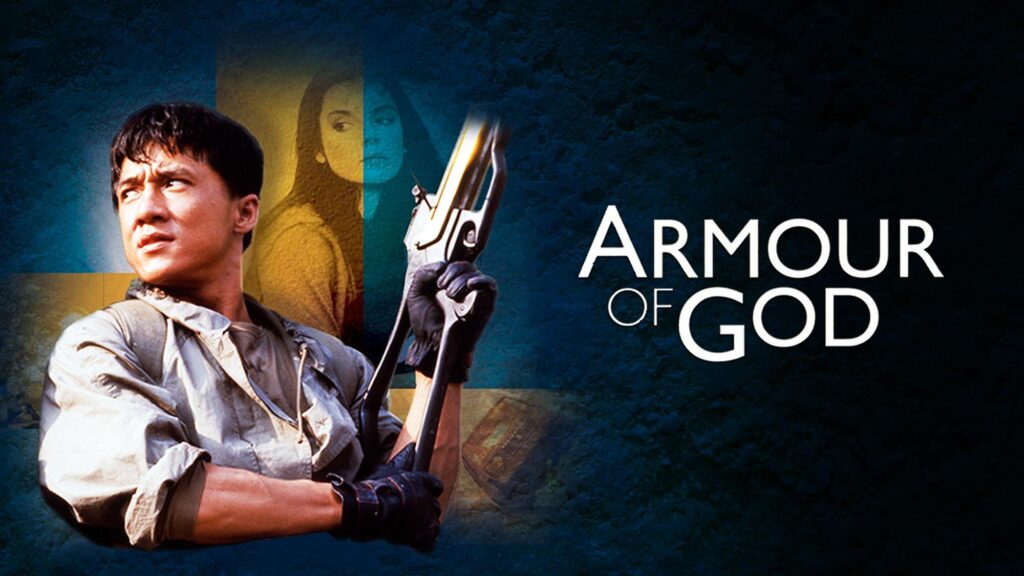
Armour of God
Armour of God was filmed primarily in Yugoslavia (now Slovenia and Croatia) and Austria, with notable scenes shot at the Predjama Castle in Postojna, Slovenia.